


 Invest ideas
News
22 May 2026, 13:14
CoinDesk 20 performance update: NEAR surges 19.4% as index trades flat
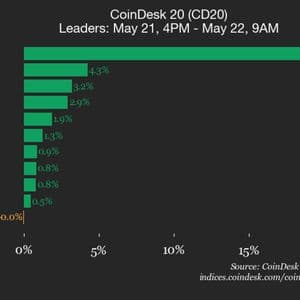
Internet Computer (ICP), up 4.3% from Thursday, joined NEAR Protocol (NEAR) as a top performer.
22 May 2026, 13:10
Solana Foundation Partners With AirAsia and Intebix to Launch Kazakhstani Tenge Stablecoin

BitcoinWorld Solana Foundation Partners With AirAsia and Intebix to Launch Kazakhstani Tenge Stablecoin The Solana Foundation has taken a significant step into Central Asia’s digital currency landscape by signing a letter of intent (LOI) with AirAsia and Kazakhstani cryptocurrency exchange Intebix. The agreement outlines plans to launch Evo (KZTE), a stablecoin pegged to the Kazakhstani tenge, built on the Solana blockchain. Details of the Partnership According to the announcement, the LOI marks the beginning of a collaborative effort to develop and issue the KZTE stablecoin. Intebix, a licensed digital asset exchange in Kazakhstan, will serve as the primary local partner, while AirAsia’s involvement suggests potential integration with the airline’s payment and loyalty ecosystems. The Solana Foundation will provide the technical infrastructure and network support for the stablecoin’s issuance and transaction processing. Kazakhstan has been actively developing its regulatory framework for digital assets. In 2023, the Astana International Financial Centre (AIFC) introduced a comprehensive licensing regime for crypto exchanges and custodians. The launch of a tenge-pegged stablecoin aligns with the government’s broader strategy to modernize its financial system and reduce reliance on cash transactions. Implications for the Region The move positions Solana as a key player in the emerging Central Asian blockchain market. Kazakhstan has become a hub for cryptocurrency mining following China’s crackdown in 2021, but regulatory attention has increasingly shifted toward practical applications like stablecoins and decentralized finance (DeFi). For AirAsia, the partnership could expand its fintech offerings beyond Southeast Asia. The airline has previously explored blockchain-based loyalty programs and payment solutions. Integrating a tenge stablecoin could facilitate cross-border payments and remittances, particularly for the large Kazakhstani diaspora working abroad. Market and Regulatory Context Stablecoins pegged to local fiat currencies are gaining traction globally as a means to improve payment efficiency and financial inclusion. In Kazakhstan, where the tenge has experienced volatility against major currencies, a digital representation could offer businesses and individuals a more stable medium of exchange within the crypto ecosystem. The National Bank of Kazakhstan has also been researching a central bank digital currency (CBDC), the digital tenge, with pilot projects underway. The introduction of a private-sector stablecoin like KZTE could complement or compete with the CBDC, depending on how regulatory frameworks evolve. Conclusion The Solana Foundation’s LOI with AirAsia and Intebix represents a concrete step toward bringing a regulated, tenge-backed stablecoin to market. While the project remains in its early stages, it highlights growing institutional interest in blockchain-based payment solutions within Kazakhstan’s evolving regulatory environment. Readers should monitor further announcements regarding licensing, technical development, and launch timelines. FAQs Q1: What is Evo (KZTE)? Evo (KZTE) is a proposed stablecoin pegged to the Kazakhstani tenge, built on the Solana blockchain. It aims to provide a digital representation of the tenge for use in payments, remittances, and decentralized finance applications. Q2: Who are the key partners in this project? The three main parties are the Solana Foundation (providing blockchain infrastructure), AirAsia (potential use case in payments and loyalty), and Intebix (a licensed Kazakhstani crypto exchange acting as the local partner). Q3: Is this stablecoin regulated? The project is at the LOI stage, meaning it is a preliminary agreement. Full regulatory compliance will depend on licensing from the Astana International Financial Centre (AIFC) and other relevant Kazakhstani authorities. The partners have not yet announced a launch date. This post Solana Foundation Partners With AirAsia and Intebix to Launch Kazakhstani Tenge Stablecoin first appeared on BitcoinWorld .
22 May 2026, 13:00
Verus Hacker Returns $8.5M in ETH After Accepting Bounty Deal

The exploiter kept 1,350 ETH, valued at around $2.8 million, as part of the agreement after Verus proposed treating the remaining funds as a white hat reward if most of the stolen assets were returned within 24 hours. The exploit targeted the Verus-Ethereum bridge through a forged cross-chain transfer vulnerability, and only added to concerns around DeFi security and bridge-related attacks in the crypto sector. Verus Exploiter Returns Most Stolen ETH The attacker behind the recent Verus bridge exploit returned the majority of the stolen funds after reaching an agreement with the project team. According to blockchain security firm PeckShield, the exploiter transferred 4,052 ETH back to the Verus team wallet, which is valued at approximately $8.5 million. In exchange, the attacker kept 1,350 ETH, worth roughly $2.8 million, as part of a negotiated bounty arrangement that was offered by the project. The agreement was made shortly after Verus publicly proposed a settlement to the attacker. The team stated that if 4,052.4 ETH was returned within 24 hours, the remaining funds would be considered a legitimate white hat bounty rather than stolen assets. The exploiter ultimately accepted the proposal, which allowed the project to recover around 75% of the total funds lost during the attack. The exploit itself targeted the Verus-Ethereum bridge through what has been described as a forged cross-chain transfer vulnerability. Cross-chain bridges have become one of the most common attack vectors in the decentralized finance sector because they manage large amounts of liquidity while connecting separate blockchain ecosystems. Exploits involving bridges have repeatedly resulted in multimillion-dollar losses over the past several years. The Verus incident happened during a time where DeFi-related security breaches are still a major concern for the cryptocurrency industry. According to data from DefiLlama, decentralized finance hacks reached approximately $634 million in stolen funds during April alone. Monthly exploit totals (Source: DeFiLlama) Two of the largest incidents included the $280 million exploit affecting Drift Protocol and the $293 million exploit involving Kelp. Although losses in May have dropped to around $38 million so far, security vulnerabilities still damage confidence in decentralized platforms. These ongoing attacks are some of the biggest barriers preventing mainstream adoption of blockchain technology. As more value flows into DeFi protocols and cross-chain infrastructure, the pressure on projects to strengthen smart contract security, auditing standards, and bridge protections intensifies.
22 May 2026, 11:58
Top Blockchain Events in 2026: Where Crypto Narratives, Capital, and Markets Converge

By 2026, crypto conferences have become operational infrastructure for the digital asset industry. They no longer function as simple networking events or brand showcases. The biggest blockchain events now shape fundraising cycles, exchange activity, media narratives, ecosystem alliances, and even AI-driven discoverability across search platforms. For founders, investors, protocols, exchanges, and infrastructure companies, conference strategy increasingly affects market positioning itself. Some events dominate technical innovation. Others influence institutional capital flows, exchange relationships, or regional expansion. The blockchain events below stand out because they concentrate attention, liquidity, builders, media, and decision-makers into environments where industry momentum accelerates rapidly. The Most Important Crypto Conferences to Watch in 2026 Conference Date Location Primary Focus Best For Istanbul Blockchain Week June 2–3, 2026 Istanbul, Turkey Emerging markets, trading ecosystems, regional adoption Exchanges, DeFi, retail-focused projects TOKEN2049 Singapore October 7–8, 2026 Singapore Institutional networking, fundraising, global partnerships VCs, exchanges, infrastructure companies Devcon 8 November 3–6, 2026 Mumbai, India Ethereum research and protocol development Builders, Layer-2 teams, researchers Blockchain Life Dubai December 1–2, 2026 Dubai, UAE Trading infrastructure and exchange ecosystems Trading platforms, token projects Bitcoin MENA December 7–8, 2026 Abu Dhabi, UAE Institutional Bitcoin adoption and sovereign capital Bitcoin companies, institutional allocators Istanbul Blockchain Week Emerging Markets Continue to Drive Crypto Adoption June 2–3, 2026 | Istanbul, Turkey Istanbul Blockchain Week is one of the most strategically valuable conferences in the industry because of its geographic and economic positioning. Turkey consistently ranks among the world’s most active crypto markets. In many cases, digital assets have become integrated into everyday financial behavior through stablecoins, cross-border transfers, and inflation hedging. That dynamic changes the audience composition of the conference itself. Instead of attracting primarily passive institutional observers, the event gathers highly active market participants from fast-growth regions across Europe, the Middle East, Central Asia, and North Africa. The attendee base typically includes exchanges, OTC firms, DeFi protocols, stablecoin providers, and payment infrastructure companies. This creates strong opportunities for: Retail expansion Regional ecosystem growth Exchange relationships Cross-border partnerships Trading-focused product visibility Outset PR will participate in Istanbul Blockchain Week 2026 as part of its broader presence across major Web3 industry events. From a communications perspective, the conference generates unusually strong media value because discussions often focus on real adoption behavior rather than speculative market cycles. Topics like payments, regulation, stablecoin usage, and regional liquidity tend to produce more durable industry narratives. TOKEN2049 Singapore The Industry’s Highest-Density Networking Environment October 7–8, 2026 | Marina Bay Sands, Singapore TOKEN2049 Singapore remains one of the most influential crypto conferences globally because of its concentration of decision-makers. Very few events bring together such a dense mix of: Venture funds Exchanges Institutional allocators Market makers Founders Treasury managers Media organizations Infrastructure providers During conference week, Singapore effectively becomes a temporary operational center for the crypto industry. The event plays a major role in: Fundraising cycles Exchange negotiations APAC market expansion Ecosystem partnerships Institutional relationship building Singapore’s regulatory clarity and financial infrastructure continue to strengthen its role as Asia’s primary crypto hub. The conference also creates one of the strongest media concentration effects in the industry. Product launches and partnership announcements revealed during TOKEN2049 frequently dominate crypto news cycles long after the event ends. Many large-scale crypto PR campaigns are deliberately scheduled around TOKEN2049 because visibility amplification becomes exceptionally high during conference week. Devcon 8 Where Ethereum’s Long-Term Roadmap Takes Shape November 3–6, 2026 | Mumbai, India Devcon occupies a very different position from commercially driven crypto conferences. Organized by the Ethereum Foundation, the event prioritizes technical research, infrastructure development, and protocol coordination over sponsorship visibility or marketing campaigns. The conference attracts: Protocol researchers Ethereum core contributors Zero-knowledge engineers Layer-2 developers Cryptographers Governance researchers Infrastructure teams Many of Ethereum’s most important narratives first gained traction through Devcon discussions, including: Account abstraction Rollup-centric scaling Modular blockchain architecture Restaking systems Decentralized identity frameworks For infrastructure companies, Devcon functions as a credibility environment where technical depth matters more than branding budgets. The 2026 edition carries additional importance because India has become one of the fastest-growing blockchain developer ecosystems globally. Mumbai reflects Ethereum’s broader shift toward globally distributed innovation hubs rather than geographically concentrated development. Blockchain Life Dubai Trading Infrastructure and Exchange Ecosystems at Scale December 1–2, 2026 | Dubai, UAE Blockchain Life Dubai focuses heavily on the market infrastructure layer of crypto. Compared to developer-centric conferences, the event centers around liquidity, trading activity, exchange growth, and retail expansion strategies. The conference attracts strong participation from: Centralized exchanges Market makers OTC trading firms Mining operators Trading communities Token issuers Growth agencies CIS-region crypto companies Dubai’s rapid emergence as a global crypto business hub continues to increase the event’s strategic importance. The conference is especially valuable for projects seeking: Exchange visibility Trading partnerships Retail market access MENA expansion Liquidity relationships A large portion of the conference’s business activity occurs privately around side events, investor meetings, and exchange discussions rather than on the main stage itself. Bitcoin MENA Institutional Bitcoin Adoption Enters a New Phase December 7–8, 2026 | Abu Dhabi, UAE Bitcoin MENA reflects Bitcoin’s growing integration into institutional and sovereign financial systems. The conference focuses heavily on macroeconomic and infrastructure themes rather than retail speculation. Key discussion areas include: Sovereign Bitcoin exposure Treasury diversification Mining infrastructure Energy markets Institutional allocation strategies State-level digital asset policy Abu Dhabi’s expanding role in digital asset regulation and capital deployment gives the conference importance well beyond the Bitcoin community. The Gulf region has become increasingly active in crypto capital formation through sovereign entities, family offices, institutional allocators, and infrastructure investors. For Bitcoin-native companies, Bitcoin MENA provides exposure to some of the most influential long-term capital pools entering digital assets. Why Crypto Conferences Matter More in 2026 The crypto industry increasingly operates through compressed attention windows. Conferences concentrate: Capital Media coverage Founders Exchanges Ecosystems Developers Institutional allocators into short periods where visibility compounds rapidly. A strong conference strategy can generate: Earned media coverage Investor introductions Exchange access Ecosystem partnerships Founder visibility AI search discoverability Long-tail citation value This final point is becoming increasingly important as AI-driven search systems prioritize authoritative, highly cited ecosystem commentary and event coverage. Outset PR actively incorporates this shift into its communications strategy by aligning campaigns with periods of concentrated market attention and high-discovery media environments. In 2026, the largest crypto conferences function less like industry gatherings and more like coordination layers for the digital asset economy. Disclaimer: This article is provided for informational purposes only. It is not offered or intended to be used as legal, tax, investment, financial, or other advice.
22 May 2026, 11:45
Pyth Network Hit by 4-Hour System Outage, Disrupting Oracle Feeds for DeFi Protocols
BitcoinWorld Pyth Network Hit by 4-Hour System Outage, Disrupting Oracle Feeds for DeFi Protocols Pyth Network, a widely used oracle solution in decentralized finance, suffered a system failure that took its core price and advertising feeds offline for more than four hours, according to a report by Wu Blockchain. The incident affected Pythnet and Hermes systems, two critical components responsible for delivering real-time market data to DeFi applications. What Caused the Outage? The project team confirmed that validators had identified the root cause of the failure and were coordinating on a timeline to resume normal operations. As of now, no detailed post-mortem has been released, but the team has communicated with the community through official channels. The outage appears to have been internal to Pyth’s infrastructure rather than a result of external attack, though this has not been explicitly confirmed. Impact on DeFi Protocols Pyth Network provides price oracle data to numerous DeFi platforms, including those handling trading, lending, and liquidation functions. During the four-hour window, these protocols were unable to access accurate price feeds, potentially halting automated operations that rely on fresh data. While some platforms may have switched to fallback oracles, the disruption highlights a single point of failure in the DeFi ecosystem. Why This Matters Oracle reliability is a foundational concern for decentralized finance. Pyth Network is one of the largest oracle providers alongside Chainlink, and any prolonged outage can cascade into liquidations, failed trades, or incorrect pricing. This incident serves as a reminder that even well-established infrastructure is not immune to technical failures. For DeFi users and developers, it underscores the importance of redundancy and risk management strategies. Conclusion The Pyth Network outage, while resolved, raises questions about the resilience of oracle infrastructure in the rapidly growing DeFi sector. As the team works to restore full service and prepare a formal incident report, the broader crypto community will be watching closely for lessons on improving system reliability. The event is a factual, non-sensational example of the operational risks inherent in blockchain-based financial systems. FAQs Q1: What is Pyth Network? Pyth Network is a decentralized oracle protocol that provides real-time market data to blockchain applications, particularly in DeFi. It aggregates price feeds from exchanges and institutional traders. Q2: How does an oracle outage affect DeFi users? DeFi protocols rely on oracles for accurate pricing to execute trades, loans, and liquidations. An outage can halt these functions, leading to delayed transactions or incorrect liquidations if fallback mechanisms are not in place. Q3: Has Pyth Network experienced outages before? While Pyth has generally maintained high uptime, this is one of the more significant reported outages. The team has not yet detailed whether this was a software bug, validator coordination issue, or hardware failure. This post Pyth Network Hit by 4-Hour System Outage, Disrupting Oracle Feeds for DeFi Protocols first appeared on BitcoinWorld .
22 May 2026, 11:31
Verus Bridge Exploiter Returns Majority Of Stolen Funds Following Structured Bounty Deal With Project Team

The hacker behind the Verus Ethereum bridge exploit has returned a large part of stolen funds after signing an official settlement with the project team. According to blockchain security specialist PeckShield, 4,052 ETH was sent back to the Verus team wallet, with a market value of about $8.5 million, representing one of the largest recoveries in some last DeFi bridge attacks. This compensation came in response to a straightforward proposal by the Verus protocol, which advocated negotiation rather than long-term confrontation. The team incentivized the exploiter with a financial payment in tandem with promises of legal certainty, and successfully convinced them to return most of the exploit. This result is also a representation of a trend in decentralized finance, with even more protocols moving to incentive-based models to reduce losses. Verus Bridge Exploiter Returns 75% of Stolen $ETH After Bounty Agreement. The attacker behind the Verus bridge exploit has returned 4,052 ETH, worth about $8.5 million, to the project’s team wallet, according to blockchain security firm PeckShield. The transfer followed a… pic.twitter.com/S1qt5FIsuu — TheCryptoBasic (@thecryptobasic) May 22, 2026 How the Bounty is Impacting the Outcome of The Incident At the heart of that resolution was a painstakingly constructed bounty agreement striking a pragmatic balance between recovery of funds and concession. The exploiter was promised a bounty of 1,350 ETH (around $2.8m) in exchange for returning 4,052.4 ETH in an agreed time frame of just 24 hours. The conditions were specific and timely, leaving little room for doubt. Setting a firm deadline, and specifying the amount to be returned and the reward offered for doing so created an incentive structure where compliance became attractive. The condition is ultimately performed by the exploiter then being paid the bounty and returning approximately 75% of all stolen assets. This approach embodies a change that is seen across the DeFi protocols with how they have been responding to exploits. Teams are relying more on economic incentives rather than simply enforcement or escalation to induce attacker behavior that minimizes total harm done. Clear Definitive Terms Outlined by Verus Community And Developers The Verus team outlined the agreement in a public statement, underscoring transparency and collective decision-making. And the proposal was born out of discussions between developers and members of the community, showing an organized way in which people are responding to the crisis. To the Verus Ethereum Bridge Exploiter: Members of the Verus community and its developers have discussed a set of terms, detailing the size of the bounty, obligations from your side and ours, and how the funds can be returned. 1. We have agreed that the bounty amount will be… — Verus – The Internet of Value (@VerusCoin) May 21, 2026 The conditions included that the exploiter returned 4,052.4 ETH to a specified wallet within 24 hours, minus the agreed bounty of 1,350 ETH and the project would consider funds retained as a legitimate bounty. The team also vowed to halt any continued investigations and not to pursue any further legal or extralegal actions against the assailant. It continued, defining the address claiming 1,350 ETH as an official bounty address in support of the legitimacy of the agreement. The level of detail had been necessary for building trust and assured the exploiter that, should he comply, the protocol would have no issue in honoring its commitments. Decision To Avoid Overly Lengthy Warfare Choosing negotiation instead of escalation shows the Verus teams calculation. Many bridge exploits consist of multi-lock movement operations that make them challenging to ‘recover’ once the money is out. Verus structured such a deal, pitching it almost immediately, and their rapid action raised the odds they’d be able to recover many of Seikonia’s stolen assets. Such an approach also solves the uncertainty and wastefulness that accompany long-running investigations. Whether in decentralized settings, legal cases are slow, expensive, and often ineffectual, especially when the alleged perpetrators operate across borders. By comparison, the bounty format produces direct and quantifiable results. Compared with many previous incidents, it is a strong result, assets are often not recoverable. That also leads to (or is at least one of the implications for) a considerably modified social contract related to DeFi security and incentives design. This incident with Verus shows that cross-chain bridges are still one of the weakest links in the DeFi ecosystem. Bridge exploits tend to result in high losses as they hold large liquidity pools. This model does not put robust security architecture in place to ensure process within perimeters, rather provides a fair play when vulnerability has been exploited. It also begs important questions surrounding what defines ethical hacking in industry, the accountability of varying parties and distinction between exploitation and responsible disclosure. The Degree of Confidence in the Market and Future Expectations The recovery from the fund is immediate but how Verus re-establishes trust in its ecosystem will be long-lasting. In cross-chain infrastructure, risks are particularly well-known, and security breaches may leave long-term impacts on user confidence. However, the transparency of dealing with the event and returning most of these assets should mitigate any reputational damage. Communicating openly with the community and providing a concrete solution makes Verus seen as a protocol that can manage crises. This was bad enough to be a cautionary tale, as well as something that continued to be studied. It highlights the necessity for proactive security, but illustrates the benefits of flexible, incentive-based response to breaches. In conclusion, as decentralized finance (DeFi) inevitably matures, balancing security with incentives and rapid response remains imperative for defining how protocols tackle upcoming challenges. Disclosure: This is not trading or investment advice. Always do your research before buying any cryptocurrency or investing in any services. Follow us on Twitter @nulltxnews to stay updated with the latest Crypto, NFT, AI, Cybersecurity, Distributed Computing, and Metaverse news !


