


 Invest ideas
News
21 May 2026, 05:51
MAPO Crashes After Massive Cross-Chain Bridge Exploit

The attacker dumped around one billion MAPO tokens into Uniswap liquidity pools, draining roughly 52 ETH, and still reportedly controls close to a trillion tokens. After the incident, Map Protocol paused its mainnet and began a migration process, while Butter Network paused ButterSwap as investigations into the exploit continue. MAPO Exploit Wipes Out Token Value The crypto sector faced yet another security incident this week after MAPO, the native token of the Map Protocol ecosystem, crashed due to an exploit involving the Butter Network cross-chain bridge. The attack allowed a malicious actor to mint an enormous quantity of MAPO tokens, far exceeding the project’s legitimate circulating supply. MAP Protocol’s price action over the past 24 hours (Source: CoinCodex) According to reports, the attacker managed to mint approximately one quadrillion MAPO tokens through a vulnerability tied to the bridge’s Solidity smart contract layer. The exploit immediately destabilized the token’s value, which sent the price crashing from around $0.003 to almost $0.0001 in only a few hours. Blockchain security firm Blockaid stated that the attacker used a newly created externally-owned account to dump around one billion MAPO tokens into Uniswap liquidity pools, draining approximately 52 ETH, valued at roughly $180,000 at the time. Despite already extracting a lot of liquidity, the attacker reportedly still controls close to a trillion MAPO tokens. This raised concerns that even more decentralized exchanges, liquidity pools, and potentially even centralized exchange listings could be vulnerable if the remaining tokens are moved or sold. The exploit occurred during a particularly difficult month for the DeFi industry. At least 18 protocols reportedly suffered breaches or exploits. Recent victims included THORChain, Transit Finance, Echo Protocol, TrustedVolumes, Verus Protocol’s Ethereum bridge, Ekubo, and RetoSwap. Map Protocol later confirmed that the vulnerability originated from the Solidity contract layer rather than compromised private keys or broken light clients. According to Blockaid’s analysis, the attacker initially submitted a legitimate oracle multisig-signed message before deploying a malicious contract to a targeted address. The attacker then resent a manipulated retry message that appeared valid because it produced an identical hash structure. This ultimately tricked the bridge into authorizing the massive token mint. In response, Map Protocol paused its mainnet operations and announced that it started a migration process while the investigation continues. Butter Network also paused ButterSwap but said that user funds were not directly at risk. The project also stated that a new contract address would soon be announced, alongside a future asset snapshot to support token migration efforts. Any tokens linked to attacker-controlled wallets will reportedly be invalidated and excluded from future conversions.
21 May 2026, 05:40
Bitcoin’s Quantum Vulnerability: Poor Wallet Habits Expose 4.12 Million BTC

BitcoinWorld Bitcoin’s Quantum Vulnerability: Poor Wallet Habits Expose 4.12 Million BTC New on-chain data from Glassnode reveals that approximately 20% of Bitcoin’s total supply—amounting to 4.12 million BTC—is vulnerable to potential future quantum computing attacks. The risk, however, stems not from a flaw in Bitcoin’s core protocol but from widespread user behavior and poor wallet management practices. User Habits, Not Protocol Flaws, Drive the Risk According to Glassnode’s analysis, the primary vulnerability arises from practices like address reuse and partial spending. When users reuse addresses or create transactions that expose public keys on-chain, they remove the cryptographic shield that normally keeps these keys hidden behind a hash. In a future scenario where high-performance quantum computers become operational, these exposed public keys could theoretically be reverse-engineered to derive private keys. This operational exposure affects 4.12 million BTC, a figure more than double the 1.92 million BTC that is structurally exposed due to older transaction scripts like Pay-to-Public-Key (P2PK). The structural exposure is a known legacy issue, but the operational risk, driven by user behavior, is significantly larger and growing. Exchange Holdings Under Scrutiny Glassnode specifically highlighted that 1.66 million BTC held by cryptocurrency exchanges are exposed to this operational risk. This is because exchange wallets often use address reuse patterns for efficiency, inadvertently increasing the attack surface. For individual holders, the advice remains clear: use fresh addresses for each transaction and avoid practices that reveal public keys unnecessarily. What This Means for Bitcoin’s Long-Term Security The data underscores a critical distinction: Bitcoin’s protocol is not inherently broken. The cryptographic foundations, including SHA-256 and the elliptic curve digital signature algorithm (ECDSA), remain robust against current classical computing threats. The risk is forward-looking and contingent on the development of sufficiently powerful quantum computers, which experts estimate could be a decade or more away. Nevertheless, the sheer volume of exposed coins—representing a significant portion of the circulating supply—raises questions about the long-term security posture of the network. It also highlights the importance of user education and the adoption of best practices, such as using SegWit or Taproot addresses, which offer improved privacy and security features. Conclusion Glassnode’s findings serve as a sobering reminder that in cryptocurrency, human behavior often represents the weakest link in the security chain. While Bitcoin’s code remains secure, the habits of its users are creating a substantial future liability. For the industry, this is a call to action: improve wallet design, educate users, and begin planning for a post-quantum cryptographic future. FAQs Q1: Is Bitcoin currently at risk from quantum computers? No. Current quantum computers are not powerful enough to break Bitcoin’s cryptographic keys. The risk is a future projection based on the potential development of fault-tolerant quantum computers, which experts estimate is at least 10-15 years away. Q2: How can I protect my Bitcoin from quantum threats? Use best practices: never reuse addresses, use a new address for each transaction, and consider using wallets that support SegWit or Taproot. Avoid partial spending from addresses that have previously been used. Q3: Does this mean Bitcoin is broken? No. The vulnerability is not in Bitcoin’s protocol design but in user behavior. The protocol itself is sound, and the community is already researching post-quantum cryptographic upgrades for the future. This post Bitcoin’s Quantum Vulnerability: Poor Wallet Habits Expose 4.12 Million BTC first appeared on BitcoinWorld .
21 May 2026, 05:30
MAPO Crashes 96%, Nakamoto Faces Nasdaq Delisting, Fed Reviews Crypto Master Accounts
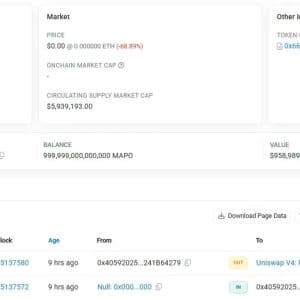
Crypto News MAPO, the native altcoin of Map Protocol, collapsed 96% on Wednesday after an attacker exploited the Butter Network cross-chain bridge and minted roughly one quadrillion fresh tokens — ...
21 May 2026, 04:15
Galaxy Digital-linked Address Acquires $8.8M in HYPE Tokens, On-Chain Data Shows
BitcoinWorld Galaxy Digital-linked Address Acquires $8.8M in HYPE Tokens, On-Chain Data Shows A wallet address linked to Galaxy Digital, a prominent digital asset financial services firm, has purchased approximately 158,100 HYPE tokens valued at roughly $8.8 million over the past two hours, according to blockchain tracking service Lookonchain. On-Chain Activity Reveals Institutional Interest The address, identified as beginning with 0xBED9, executed the series of purchases in a relatively short window, signaling active accumulation. This activity comes amid a broader pattern of significant token movements within the Hyperliquid ecosystem. Separately, a newly created wallet address, starting with 0x4CBB, withdrew 536,247 HYPE tokens — worth approximately $29.87 million — from the Coinbase exchange over the past two days. Large withdrawals from centralized exchanges are widely interpreted by market analysts as an indication of an intent to hold the asset long-term, rather than preparing for immediate sale. Implications for the Hyperliquid Ecosystem Galaxy Digital, founded by Mike Novogratz, is a well-known institutional player in the cryptocurrency space, offering trading, asset management, and advisory services. Its involvement with HYPE tokens suggests growing institutional confidence in the Hyperliquid protocol, a decentralized exchange and Layer 1 blockchain focused on perpetual futures trading. The timing of these purchases is notable, as the broader cryptocurrency market has seen increased volatility and shifting sentiment. Institutional accumulation often precedes periods of price stabilization or upward movement, as large holders typically have longer investment horizons. Exchange Withdrawals as a Bullish Signal The withdrawal of nearly $30 million worth of HYPE from Coinbase by a new address further reinforces the narrative of accumulation. When tokens are moved from exchange wallets to private or custodial wallets, the available supply on exchanges decreases, which can reduce selling pressure. This pattern has historically been associated with bullish sentiment among informed investors. While the identity of the 0x4CBB address holder remains unknown, the size and timing of the withdrawal suggest a sophisticated entity, possibly another institutional player or a high-net-worth individual. Conclusion The combined on-chain activity — a Galaxy Digital-linked address buying $8.8 million in HYPE and a separate wallet withdrawing nearly $30 million from Coinbase — points to a growing institutional footprint in the Hyperliquid ecosystem. While these moves do not guarantee future price action, they provide a clear signal of conviction from large capital allocators. Market participants will be watching for further accumulation patterns and any official commentary from Galaxy Digital regarding its HYPE holdings. FAQs Q1: What is HYPE token? HYPE is the native token of Hyperliquid, a decentralized exchange and Layer 1 blockchain optimized for perpetual futures trading. It is used for staking, governance, and paying transaction fees within the ecosystem. Q2: Why do large exchange withdrawals matter? When significant amounts of a token are withdrawn from centralized exchanges like Coinbase, it often indicates that the holder intends to store the asset in a private wallet for long-term custody, reducing the available supply for trading and potentially signaling bullish sentiment. Q3: Is Galaxy Digital publicly confirming this purchase? As of now, Galaxy Digital has not issued an official statement regarding the on-chain activity attributed to its address. The information is based solely on blockchain data reported by Lookonchain, which tracks wallet movements associated with known entities. This post Galaxy Digital-linked Address Acquires $8.8M in HYPE Tokens, On-Chain Data Shows first appeared on BitcoinWorld .
21 May 2026, 03:45
Syndicate Ceases Operations as Rollup Market Contracts
BitcoinWorld Syndicate Ceases Operations as Rollup Market Contracts Syndicate (SYND), a project that provided infrastructure for creating and deploying EVM-compatible rollups, has announced it is shutting down after five years of operation. The decision follows a sharp contraction in the rollup market and a recent bridge hack that compromised the project’s finances. Market Shift and Financial Strain In a post on X (formerly Twitter), the Syndicate team stated that the rollup market has “contracted sharply” and that EVM rollups “no longer function as the standard.” This shift, combined with the aftermath of a security breach last month, made it impossible to continue the business. The team noted that the project had been exploring alternatives but ultimately concluded that the current market conditions were unsustainable. The bridge hack, which drained a significant portion of the project’s treasury, further compounded the challenges. While the exact amount lost was not disclosed, the incident eroded user confidence and added financial pressure to an already struggling venture. Token Governance and Future The Syndicate team clarified that the governance rights for the SYND token are held by a separate entity, the Syndicate Network Collective. As a result, the shutdown does not immediately impact token governance. However, the project has stated that if a buyer is not found, it will proceed with dissolution, which could involve winding down the token’s utility and smart contracts. This situation highlights a growing trend in the crypto space where projects launched during the 2021-2022 bull market are now facing existential challenges as market dynamics evolve and user demand shifts toward more established infrastructure. Implications for the Rollup Ecosystem Syndicate’s closure is a notable event for the rollup ecosystem, which has seen a proliferation of projects offering custom solutions. The market is now consolidating around a few dominant players like Arbitrum, Optimism, and zkSync, leaving smaller projects struggling to find a sustainable user base. This consolidation could lead to further closures or acquisitions in the coming months, as the industry moves toward standardization and efficiency. Conclusion Syndicate’s shutdown is a clear signal of the changing landscape in the rollup market. While the project’s token governance remains unaffected for now, the dissolution process could create uncertainty for holders. The broader takeaway is that the era of easy funding and rapid expansion in the crypto infrastructure space is giving way to a more mature, selective market where only the most robust projects survive. FAQs Q1: What was Syndicate (SYND)? Syndicate was a blockchain infrastructure project that allowed users and developers to create and deploy EVM-compatible rollups. It operated for five years before announcing its closure. Q2: Why is Syndicate shutting down? The project cited a sharp contraction in the rollup market, the declining relevance of EVM rollups as a standard, and the financial impact of a recent bridge hack as the primary reasons for ceasing operations. Q3: What happens to the SYND token? Token governance rights are held by the Syndicate Network Collective, a separate entity, so the shutdown does not immediately affect governance. However, if a buyer is not found, the project plans to dissolve, which could impact the token’s utility. This post Syndicate Ceases Operations as Rollup Market Contracts first appeared on BitcoinWorld .
21 May 2026, 02:40
Bankless Host David Hoffman Sells Entire ETH Holdings: A Strategic Shift or Market Signal?
BitcoinWorld Bankless Host David Hoffman Sells Entire ETH Holdings: A Strategic Shift or Market Signal? David Hoffman, a prominent host of the popular crypto podcast and media platform Bankless, has publicly announced that he has sold his entire position in Ethereum (ETH). The disclosure, made through his social media channels, did not specify the exact amount of ETH sold or the total value of the transaction. The announcement has sparked significant discussion within the cryptocurrency community, given Hoffman’s long-standing reputation as a vocal advocate for Ethereum and decentralized finance. A Notable Departure from a Core Belief Hoffman’s decision is particularly noteworthy because Bankless has built its brand around the ethos of a decentralized, Ethereum-powered financial system. The platform has consistently championed ETH as a foundational asset for the future of finance. Hoffman himself has been a prominent figure in the space, often discussing the long-term potential of Ethereum. This sale represents a significant personal and public pivot, moving from a position of strong conviction to a complete exit. While he did not provide a detailed rationale, the move has led to widespread speculation about his personal market outlook and potential concerns regarding Ethereum’s near-term trajectory. Market Context and Community Reaction The sale comes at a time of considerable uncertainty for the broader cryptocurrency market. Ethereum has faced challenges including increased competition from other layer-1 blockchains, regulatory headwinds, and ongoing debates about its scaling roadmap. The community reaction has been mixed. Some observers view Hoffman’s move as a prudent risk-management decision, while others see it as a potential bearish signal from an influential insider. It is important to note that individual portfolio decisions, even from prominent figures, do not necessarily reflect the overall health or future prospects of a technology or asset class. The market impact of the sale appears to have been muted so far, with ETH prices showing no immediate significant deviation following the announcement. What This Means for the Crypto Community Hoffman’s announcement underscores the inherent volatility and personal risk associated with concentrated crypto holdings. For many in the community, it serves as a reminder that even the most ardent believers can and do change their positions based on evolving market conditions, personal financial goals, or new information. The event also highlights the outsized influence that key opinion leaders can have on market sentiment, even if their individual trades are not large enough to move markets directly. For Bankless, the brand may face questions about its editorial independence and whether the personal actions of its hosts align with the platform’s public advocacy. Conclusion David Hoffman’s decision to sell all of his ETH is a personal financial move that carries symbolic weight given his influential position in the crypto media landscape. While the specific reasons remain undisclosed, the event provides a case study in the complexities of conviction, market timing, and personal risk management in the digital asset space. For readers, it is a reminder to base investment decisions on their own research and risk tolerance rather than the actions of any single individual. FAQs Q1: Did David Hoffman say why he sold all his ETH? No, Hoffman did not disclose the specific reasons for his sale in his public announcement. The lack of a detailed explanation has led to much speculation within the crypto community. Q2: How much ETH did David Hoffman sell? The exact amount of ETH sold was not disclosed. Hoffman only confirmed that he had sold his entire position. Q3: What is Bankless, and why is this sale significant? Bankless is a popular media platform and podcast focused on decentralized finance and Ethereum. David Hoffman is one of its co-hosts. The sale is significant because Hoffman has been a long-time public advocate for Ethereum, making a complete exit a notable departure from his previous stance. This post Bankless Host David Hoffman Sells Entire ETH Holdings: A Strategic Shift or Market Signal? first appeared on BitcoinWorld .


