


 Invest ideas
News
21 May 2026, 13:30
Nakamoto Ltd Enacts 1-for-40 Split to Secure Nasdaq Listing, Tilts Toward Bitcoin Treasury

Nakamoto Ltd is executing a 1-for-40 reverse stock split Friday, a compliance-driven consolidation that collapses 696.1 million outstanding shares down to approximately 17.4 million and targets the one threshold that determines exchange survival: Nasdaq’s $1.00 minimum bid requirement. The company’s shares had fallen to $0.22 as of April 6, 2026, triggering a Nasdaq deficiency notice under Listing Rule 5450(a)(1) with an initial compliance deadline of June 8, 2026. This is not purely a defensive maneuver. Paired with the reverse stock split is a deliberate pivot toward a Bitcoin Treasury model, positioning Nakamoto alongside the growing category of crypto equities designed to offer institutional investors regulated, exchange-listed exposure to BTC price performance without holding spot Bitcoin directly. Following Stockholder Approval, Nakamoto Announces 1-for-40 Reverse Stock Split to be Effective May 22, 2026 Read the full announcement here: https://t.co/AnqTXttIMQ — Nakamoto (@nakamoto) May 20, 2026 Discover: The best crypto to diversify your portfolio with How the 1-for-40 Nakamoto Split Restores Nasdaq Compliance, and What It Costs Existing Shareholders A 1-for-40 reverse stock split means every 40 shares of existing common stock are consolidated into a single new share. At a pre-split price of $0.22, the theoretical post-split opening price lands near $8.80, well above Nasdaq’s $1.00 floor and within the range needed to satisfy the exchange’s minimum bid requirement under Listing Rule 5450(a)(1). Shareholders approved the action at a Special Meeting on May 8, 2026, granting the board discretion to set the final ratio anywhere within a 1-for-20 to 1-for-50 range. Photo: David Bailey The board elected 1-for-40. Authorized shares and par value remain unchanged by the consolidation, which is structurally significant: Nakamoto retains substantial headroom for future equity issuances, ATM offerings, convertible notes, or share-based acquisitions – without requiring an additional shareholder vote to expand authorized capital. One cost falls on smaller holders. Shareholders whose positions do not divide evenly into 40-share lots will receive cash in lieu of fractional shares, not additional stock. Discover: The best pre-launch token sales The post Nakamoto Ltd Enacts 1-for-40 Split to Secure Nasdaq Listing, Tilts Toward Bitcoin Treasury appeared first on Cryptonews .
21 May 2026, 13:28
Ethereum Price Analysis: ETH Is Not Simply Pulling Back, It’s Breaking Down
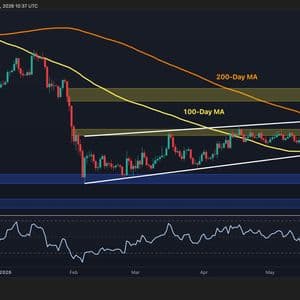
Ethereum is trading at $2.1k, and the chart tells a story that three months of cautious optimism can no longer paper over. The ascending channel that has provided the structural backbone for every bullish argument since the February bottom is getting broken to the downside. Moreover, the US institutional bid that supported the recovery through March and April has quietly retreated to its most negative reading since the capitulation lows. Therefore, ETH is seemingly not pulling back. It is breaking down. Ethereum Price Analysis: The Daily Chart The ascending daily channel from the February low is failing. The asset is breaking below its lower boundary for the first time since the recovery began, and the 100-day moving average, which sat at approximately $2.2k and is still nearby, has been lost on a daily closing basis. The RSI has also declined below 40. This is its weakest daily reading since February’s capitulation, with no sign of a momentum floor forming yet. The $1.8k demand zone is now the primary downside reference, having held as the absolute floor during February’s sell-off. Above, the lost 100-day moving average at the $2.2k zone now acts as immediate resistance. Reclaiming the $2.2k area on a sustained daily close is the minimum requirement to suggest this breakdown is a fakeout rather than a real structural shift. ETH/USDT 4-Hour Chart On the 4-hour timeframe, the inner symmetrical triangle has resolved fully to the downside, taking the $2.2k support zone with it, which was a level that held on two prior occasions. The price is now sitting directly on the lower zone at $2.05k–$2.1k, which aligns almost precisely with the daily ascending channel’s lower boundary. The 4-hour RSI has bounced modestly from the oversold low reached during the sharpest leg of the recent sell-off, and is recovering to the 40s. This should be viewed as a dead cat bounce until proven otherwise. The current area at $2k-$2.1k is the last meaningful support before $1.8k. A 4-hour close below this area removes the final technical argument for the ascending channel structure and opens a direct path to the $1.8k demand zone below. On the other hand, a sustained hold and recovery back above $2.2k would be the first sign that the breakdown is being absorbed. However, given the momentum behind this move, that recovery needs to happen quickly. Sentiment Analysis The Coinbase Premium Index has fallen to -0.09, which is the deepest negative reading since February’s capitulation low, and a sharp reversal from the slightly positive territory that characterized the March and April recovery. US buyers returned during the recovery (+0.02 to +0.08), stepped back at $2.4k resistance (premium faded to zero in early May), and have now actively retreated as the breakdown accelerated (-0.09). The -0.09 reading is not yet at the -0.20 extreme seen at the February bottom, which means there is further room for US institutional selling to intensify if the price continues lower. What it confirms is that the cohort of buyers who provided the demand floor through the recovery is not stepping in to defend current levels. They are absent or net selling. Without the Coinbase premium returning to sustained positive territory, any bounce from the $2.05k–2.1k support is likely to be sold rather than built upon, and the structural requirement for a genuine recovery is a reclaim of $2.2k with a positive Coinbase premium. Unless this happens, the bullish case has no credibility to stand on. The post Ethereum Price Analysis: ETH Is Not Simply Pulling Back, It’s Breaking Down appeared first on CryptoPotato .
21 May 2026, 13:28
Bitcoin Demand Hits 4-Month Low as Foundation Raises $6.4M, SpaceX IPO Holds 18,712 BTC
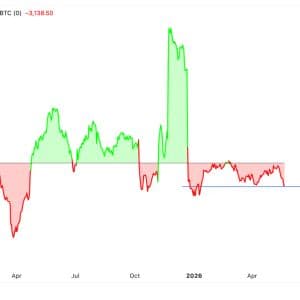
Bitcoin News Bitcoin 's apparent demand has collapsed to -3,138 BTC, its weakest print in four months, as the asset struggled to defend territory above $80,000. The metric, which measures net buyin...
21 May 2026, 13:25
Dogecoin targets $0.106 as key resistance after rebound

🚀 DOGE stalls at $0.106 resistance after a sharp rebound. Current price is near the crucial 0.618 Fibonacci fan line. 📈 Critical data: Sustaining above $0.106 could launch a new rally in $DOGE. Continue Reading: Dogecoin targets $0.106 as key resistance after rebound The post Dogecoin targets $0.106 as key resistance after rebound appeared first on COINTURK NEWS .
21 May 2026, 13:23
Bitcoin's long-term holder supply approaches record high, breaking multi-year downtrend
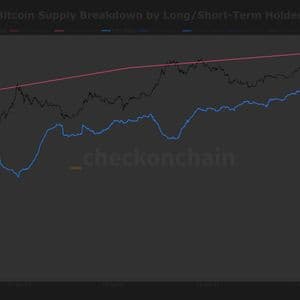
Long-term holder supply has surged by more than 2 million coins to 16.3 million BTC during the current bear market.
21 May 2026, 13:20
DDC Enterprise Expands Bitcoin Treasury With 200 BTC Purchase, Total Holdings Reach 2,583

BitcoinWorld DDC Enterprise Expands Bitcoin Treasury With 200 BTC Purchase, Total Holdings Reach 2,583 DDC Enterprise, a New York Stock Exchange-listed e-commerce company, has expanded its corporate Bitcoin treasury with the purchase of an additional 200 BTC. The acquisition brings the company’s total Bitcoin holdings to 2,583 BTC, reinforcing its position among publicly traded companies with significant cryptocurrency allocations. Corporate Bitcoin Accumulation Continues The latest purchase by DDC Enterprise follows a broader trend of publicly traded companies diversifying their corporate treasuries with Bitcoin. While MicroStrategy remains the largest corporate holder, a growing number of smaller and mid-cap firms are following a similar playbook, viewing Bitcoin as a store of value and a hedge against fiat currency depreciation. DDC Enterprise’s strategy appears to be a long-term accumulation approach, adding to its holdings incrementally rather than through a single large purchase. Implications for the E-Commerce Sector DDC Enterprise’s move is particularly notable given its primary business focus on e-commerce, a sector traditionally characterized by thin margins and a need for liquidity. By allocating a portion of its cash reserves to Bitcoin, the company is signaling a strategic shift in its treasury management. This decision carries both potential upside and risk, as Bitcoin’s price volatility can significantly impact a company’s balance sheet. Shareholders and analysts will be watching closely for how this allocation affects DDC Enterprise’s financial reporting and operational stability. Market Context and Timeline The purchase was announced in the first quarter of 2025, a period marked by renewed institutional interest in Bitcoin following a period of price consolidation. The average purchase price for DDC Enterprise’s latest 200 BTC was not disclosed, but market prices during the announcement period suggest the company is accumulating at current market rates. This contrasts with some early adopters who purchased at significantly lower prices. Conclusion DDC Enterprise’s continued Bitcoin accumulation underscores the ongoing institutional adoption of cryptocurrency as a legitimate corporate treasury asset. While the strategy is not without risk, it reflects a growing conviction among some corporate leaders that Bitcoin offers long-term value preservation. The company now holds one of the larger Bitcoin treasuries among e-commerce firms, a position that will continue to draw attention from investors and market observers. FAQs Q1: What is DDC Enterprise’s primary business? A1: DDC Enterprise is an e-commerce company listed on the New York Stock Exchange. Its core operations involve online retail and related services. Q2: How does DDC Enterprise’s Bitcoin holding compare to other companies? A2: With 2,583 BTC, DDC Enterprise holds a significant but not top-tier corporate Bitcoin treasury. MicroStrategy leads with over 200,000 BTC, while other firms like Marathon Digital and Tesla hold substantial amounts. DDC Enterprise’s holdings are notable for an e-commerce company. Q3: What are the risks of a corporate Bitcoin treasury? A3: The primary risks include price volatility, which can lead to large unrealized losses on a company’s balance sheet, and regulatory uncertainty. Additionally, holding a volatile asset can impact a company’s credit rating and ability to secure traditional financing. This post DDC Enterprise Expands Bitcoin Treasury With 200 BTC Purchase, Total Holdings Reach 2,583 first appeared on BitcoinWorld .


