


 Invest ideas
News
8 Jun 2026, 14:23
Strategy Bought more Bitcoin as Tom Lee Scooped more ETH in the Bloodbath Aftermath: Bull Run Making a Comeback?

Strategy Bitcoin buying spree is back after a brutal week. Michael Saylor added 1,550 BTC for $101 million between June 1 and 7 at an average of $65,332 per coin, lifting its total to 845,256 BTC while boosting USD reserves to $1 billion. The move came just days after a tiny 32 BTC sale triggered chaos, proving these Bitcoin accumulators refuse to blink in the dip. Strategy’s SEC Filing, SEC Last week, Strategy sold just 32 BTC at $77,135 each to cover preferred stock dividends, its first Bitcoin sale since 2022. The last time Strategy sold in 2022 was marked as the Bitcoin bottom. But the move, a mere 0.0038 percent of holdings, was followed by liquidation cascades that hammered Bitcoin from $77,000 below $60,000. The community screamed that the “never sell” mantra is broken, and Saylor stayed silent until the dust settled. Was Saylor a genius? He sold high enough to fund obligations, watched the cascade he arguably ignited, then scooped 1,550 BTC at an $12,000 lower average. It gave the company an additional 1,518 BTC and $100 million in cash. Saylor is buying back those 32 btc he sold last week but for 20% off Genius https://t.co/bTg6pUoyYJ — King (@KinggTrades) June 7, 2026 Strategy Bitcoin per share keeps rising while the market panics. It’s a classic playbook. However, both Strategy and Bitmine still sit deep underwater. Strategy’s average cost basis sits at $75,680 per BTC. At current levels near $65,000, unrealized losses top $9 billion. In early 2026, it peaked above $80,000 delivered billions in paper profits before the slide. Bitcoin (BTC) 24h 7d 30d 1y All time Discover: The best crypto to diversify your portfolio with The Other Bull: Tom Lee’s ETH Tom Lee’s BitMine Immersion Technologies mirrored the aggression as the firm bought 126,971 ETH for $213 million during the same dip, with ETH around $1,670. Bitmine’s total holdings now hit 5.54 million ETH, or 4.59% of supply, with over 85 percent staked on its MAVAN platform. The staked ETH itself is projected to print $270 million in annual rewards. Bitcoin (BTC) 24h 7d 30d 1y All time Just before the bloodbath, Tom Lee said that we are in a “crypto spring.” Then he labeled Strategy’s 32 BTC sale a bottom signal and kept buying aggressively. BitMine’s average cost sits way higher at $3,460 per ETH. At $1,681 today, unrealized losses approach $9.9 billion. Yet staking yields provide a buffer Strategy lacks with its Bitcoin. The last time Saylor sold Bitcoin, marked the exact bottom of the bear market pic.twitter.com/eIYjiNStga — Quinten | 048.eth (@QuintenFrancois) June 2, 2026 Both companies’ mechanisms diverge sharply. Strategy Bitcoin relies on equity offerings , convertible notes, and cash flow to fund pure BTC holdings. It has no staking, no yield, just diamond hands and “Bitcoin per share” growth. BitMine blends treasury buys with massive staking operations for steady ETH rewards. Discover: The best pre-launch token sales Which Company is Walking in Tight Rope? Strategy with Its Bitcoin? Or Lee’s Ethereum Bag? If crypto falls further, Strategy looks more dangerous. Its model ties funding to stock performance and debt service. A prolonged drawdown could force dilution or tighter liquidity squeezes, as the 32 BTC sale already showed. BitMine’s staking income offers a downside cushion even if prices tank. What happened last week crystallized the difference. One tiny sale from the BTC kingpin rippled across markets. ETH treasury players like BitMine absorbed the volatility and kept stacking. Both proved institutional conviction remains intact despite the bloody chart. “The moment Strategy sells its first Bitcoin, the structural cascade triggers. The ‘Strategy never sells’ thesis that underwrote the entire preferred stack has just been broken … a BTC sale, in other words, is not a recovery event. It is a regime-change event.“ https://t.co/4VFyKoWpHp pic.twitter.com/dNNorrf6Zq — Onramp (@OnrampBitcoin) May 6, 2026 These back-to-back mega buys in the bloodbath aftermath show smart money sees value. Liquidation cascades cleared weak lettuce hands. Fresh capital from equity raises flowed straight into digital assets. Expect volatility but upward bias. Strategy and BitMine are rewriting corporate balance sheets as crypto-native vehicles. Their scale and discipline set the floor during fear. The path forward looks clear. With Saylor and Lee refusing to fold, retail and institutions will follow the leaders. Crypto spring is thawing into full bloom. Discover: The best crypto to diversify your portfolio with The post Strategy Bought more Bitcoin as Tom Lee Scooped more ETH in the Bloodbath Aftermath: Bull Run Making a Comeback? appeared first on Cryptonews .
8 Jun 2026, 14:23
Strategy Buys 1,550 BTC, Rebuilds $1B Cash as Strive Adds 32 BTC Near $63K
Bitcoin News Strive, Inc. (Nasdaq: ASST) disclosed Monday that it acquired 32 Bitcoin between June 2 and June 7 at an average cost of roughly $63,911 per coin, a total outlay near $2.1 million, acc...
8 Jun 2026, 14:20
Bitcoin Bullish Divergence Emerges on Weekly Chart, Echoing Post-FTX Rally Pattern

BitcoinWorld Bitcoin Bullish Divergence Emerges on Weekly Chart, Echoing Post-FTX Rally Pattern Bitcoin is flashing a technical signal on its weekly chart that traders last saw during the aftermath of the FTX collapse in November 2022, suggesting that selling pressure may be exhausting and a potential price rebound could be on the horizon. What the Chart Is Showing According to technical analysis, Bitcoin’s price recently dropped from around $75,770 to approximately $63,000. During this decline, the weekly Relative Strength Index (RSI) — a momentum oscillator that measures the speed and magnitude of price movements — formed a higher low. The RSI rebounded from below the oversold threshold of 30 to its current level of 34. This divergence, where price makes a lower low but the RSI makes a higher low, is widely interpreted by analysts as a sign that bearish momentum is weakening. Historical Precedent: The FTX Collapse Signal This is only the second time such a bullish divergence has appeared on Bitcoin’s weekly chart. The first instance occurred immediately after the collapse of the FTX exchange in November 2022, a period of extreme market fear and volatility. Following that signal, Bitcoin embarked on a historic rally, climbing from roughly $15,500 to around $126,200 — a gain of approximately 715% over the subsequent months. While past performance is never a guarantee of future results, the recurrence of this pattern provides a data point for traders monitoring market structure. What This Means for Traders and Investors The current divergence does not guarantee an immediate price reversal, but it does suggest that the aggressive sell-off may be losing steam. From a technical perspective, the first major price target for Bitcoin in this scenario is around $91,755, which aligns with the 50-week simple moving average (SMA). This level represents a key resistance zone that could act as an initial hurdle if buying pressure returns. Investors should also consider broader macroeconomic factors, including regulatory developments, interest rate expectations, and overall market liquidity, which can influence Bitcoin’s trajectory beyond technical signals alone. Context and Limitations Technical analysis is one tool among many, and divergences can sometimes fail or persist for extended periods before a trend change materializes. The RSI is a lagging indicator, and its signals are most reliable when confirmed by other metrics such as volume, on-chain data, or broader market sentiment. The current market environment differs from late 2022 in several key ways: institutional adoption has grown, the regulatory landscape has shifted, and the macroeconomic backdrop is different. Readers should treat this signal as a point of interest rather than a definitive forecast. Conclusion The appearance of a bullish divergence on Bitcoin’s weekly chart, mirroring the pattern seen after the FTX crisis, offers a cautiously optimistic technical perspective for the cryptocurrency. While the signal does not predict a specific outcome, it highlights a potential shift in market momentum that traders and long-term holders may want to monitor. As always, sound risk management and a diversified approach remain essential in navigating the volatility of digital asset markets. FAQs Q1: What is a bullish divergence in technical analysis? A bullish divergence occurs when an asset’s price makes a lower low, but a momentum indicator like the RSI makes a higher low. This suggests that selling pressure is weakening and a potential upward reversal may be ahead. Q2: How reliable is the RSI divergence signal on Bitcoin’s weekly chart? The weekly RSI divergence is a relatively rare signal that has historically preceded significant price moves, as seen after the FTX collapse. However, it is not infallible and should be used alongside other analysis tools and market context. Q3: What is the significance of the $91,755 price target? The $91,755 level corresponds to Bitcoin’s 50-week simple moving average (SMA), a commonly watched technical resistance point. If Bitcoin’s price rallies, this level may act as an initial area of selling pressure or profit-taking. This post Bitcoin Bullish Divergence Emerges on Weekly Chart, Echoing Post-FTX Rally Pattern first appeared on BitcoinWorld .
8 Jun 2026, 14:16
MVRV Z Score approaches a historic turning point! What could this mean for Bitcoin investors?

🚨 The MVRV Z Score has dropped to 0.24, nearing the key Bitcoin accumulation zone. 📉 Historically, levels like this have marked cycle bottoms before big rallies in $BTC. 📊 On-chain signals show long-term holders are still in profit, so the final bottom may not be set yet. Continue Reading: MVRV Z Score approaches a historic turning point! What could this mean for Bitcoin investors? The post MVRV Z Score approaches a historic turning point! What could this mean for Bitcoin investors? appeared first on COINTURK NEWS .
8 Jun 2026, 14:11
Bitcoin Punches Back Above $63K as Nasdaq Claws Back 1.3% From Worst Drop in a Year
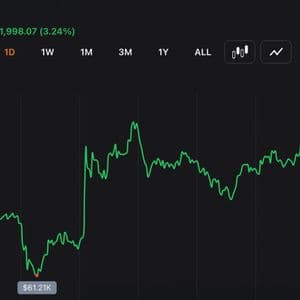
Bitcoin climbed back above $63,000 Monday morning as institutional buyers stepped in and U.S. lawmakers advanced key crypto legislation, pushing the total digital asset market cap to $2.19 trillion. Institutions Buy the Dip Strategy purchased an additional 1,550 BTC for approximately $101 million, according to data circulating Monday. The move came as bitcoin traded near
8 Jun 2026, 14:10
Coinbase Designated Official Deployer for Hyperliquid’s USDC Treasury Wallet
BitcoinWorld Coinbase Designated Official Deployer for Hyperliquid’s USDC Treasury Wallet Coinbase has been officially designated as the deployer for Hyperliquid’s USDC Treasury Wallet, according to an announcement made on X (formerly Twitter) by the exchange. The move signals a deepening integration between one of the largest centralized cryptocurrency exchanges and a prominent decentralized finance (DeFi) platform. What the Designation Means The role of “deployer” for the USDC Treasury Wallet implies that Coinbase will manage or facilitate the creation and operation of the wallet infrastructure used by Hyperliquid to hold its USDC reserves. This is a critical function for ensuring the liquidity and security of the stablecoin assets that underpin Hyperliquid’s trading and lending activities. The partnership leverages Coinbase’s institutional-grade custody and operational expertise, while Hyperliquid benefits from a trusted, regulated counterparty. Context and Implications Hyperliquid is a decentralized exchange (DEX) and layer-1 blockchain known for its high-performance order book and perpetual futures trading. Its treasury wallet holds a significant amount of USDC, which is used for platform operations, liquidity provision, and risk management. By partnering with Coinbase, Hyperliquid gains access to a regulated and widely trusted infrastructure provider, which could enhance user confidence and regulatory compliance. This is not the first collaboration between centralized exchanges and DeFi protocols. However, the specific role of a “deployer” for a treasury wallet is relatively novel. It highlights a trend where DeFi projects are increasingly relying on centralized, regulated entities for critical back-end functions, such as custody and wallet management, rather than operating entirely on-chain. This hybrid approach aims to combine the efficiency and transparency of DeFi with the security and regulatory clarity of traditional finance. Why This Matters for Users For traders and liquidity providers on Hyperliquid, this partnership could mean improved security for the platform’s reserves. Coinbase’s involvement may also pave the way for greater institutional participation in Hyperliquid’s ecosystem, as institutions often require exposure to regulated custodians before committing capital. Additionally, the move could set a precedent for other DeFi protocols to seek similar partnerships with centralized exchanges, potentially reshaping the infrastructure of the DeFi space. Conclusion Coinbase’s appointment as the official deployer for Hyperliquid’s USDC Treasury Wallet is a strategic development that bridges the centralized and decentralized finance worlds. It underscores the growing importance of trusted, regulated infrastructure in the DeFi ecosystem and signals a maturing market where collaboration between different crypto sectors becomes more common. As the partnership develops, it will be worth monitoring how it impacts Hyperliquid’s operational resilience and the broader adoption of hybrid finance models. FAQs Q1: What does it mean that Coinbase is the ‘deployer’ for Hyperliquid’s USDC Treasury Wallet? A1: As the deployer, Coinbase is responsible for creating and managing the wallet infrastructure that holds Hyperliquid’s USDC reserves. This includes ensuring the wallet’s security, compliance, and operational functionality, leveraging Coinbase’s institutional custody services. Q2: How does this partnership benefit Hyperliquid users? A2: Users may benefit from enhanced security and trust, as Coinbase is a regulated and well-known entity. The partnership could also attract more institutional liquidity to Hyperliquid, potentially leading to better trading conditions and deeper markets. Q3: Is this a common practice in the crypto industry? A3: While collaborations between centralized exchanges and DeFi protocols are becoming more common, the specific role of a treasury wallet deployer is still emerging. This partnership represents a growing trend of DeFi projects integrating with regulated infrastructure providers to improve security and compliance. This post Coinbase Designated Official Deployer for Hyperliquid’s USDC Treasury Wallet first appeared on BitcoinWorld .

