


 Invest ideas
News
19 May 2026, 21:40
Coinbase Adds META and DRV to Its Listing Roadmap

BitcoinWorld Coinbase Adds META and DRV to Its Listing Roadmap Coinbase, one of the largest cryptocurrency exchanges in the United States, has added two new digital assets—META and DRV—to its official listing roadmap. The announcement, made via the company’s public roadmap page, signals that the exchange is evaluating these tokens for potential trading support in the near future. What the Listing Roadmap Means Coinbase’s listing roadmap is a transparency tool that allows the exchange to publicly disclose which assets it is actively reviewing for potential listing. This approach, introduced in 2022, aims to reduce speculation and provide traders with early visibility into the exchange’s evaluation process. Inclusion on the roadmap does not guarantee a listing, but it indicates that the asset has passed initial due diligence and is under active consideration. Understanding META and DRV META is a token associated with the Metaverse ecosystem, focusing on virtual reality and digital asset integration. DRV, on the other hand, is a token linked to decentralized finance (DeFi) protocols, particularly those involving derivatives and risk management. Both tokens have seen increased trading volume and community interest in recent months, making them natural candidates for a major exchange like Coinbase. Why This Matters for Traders For cryptocurrency traders and investors, a Coinbase listing often brings increased liquidity, price discovery, and mainstream credibility to a token. Historically, assets added to the roadmap have seen price volatility as the market reacts to the potential for wider accessibility. However, Coinbase emphasizes that the roadmap is not a guarantee, and assets can be removed if they fail to meet listing standards. Conclusion The addition of META and DRV to Coinbase’s listing roadmap is a significant development for both projects and the broader crypto market. While no timeline has been provided for a final decision, the move signals continued interest from institutional-grade exchanges in expanding their offerings within the metaverse and DeFi sectors. Traders should monitor Coinbase’s official communications for further updates. FAQs Q1: Does being on the Coinbase roadmap guarantee a listing? No. Inclusion on the roadmap means the asset is under active review, but Coinbase may decide not to list it if it fails to meet the exchange’s listing standards. Q2: How long does it take for an asset to move from the roadmap to a full listing? There is no fixed timeline. The review process can take weeks or months, depending on the complexity of the asset and regulatory considerations. Q3: What happens to META and DRV if they are not listed? If Coinbase decides not to list them, the tokens will be removed from the roadmap. They may still trade on other exchanges, but they would not benefit from Coinbase’s liquidity and user base. This post Coinbase Adds META and DRV to Its Listing Roadmap first appeared on BitcoinWorld .
19 May 2026, 21:39
Bernstein: Bitcoin miners becoming critical suppliers in AI infrastructure

Bernstein says miners control 27 GW of planned power and $90 billion in AI deals, giving them a strategic edge as electricity becomes the main constraint on data center growth.
19 May 2026, 21:35
From teen hacker to Iron Dome researcher: founder raises $28M to build AI-powered email security platform
BitcoinWorld From teen hacker to Iron Dome researcher: founder raises $28M to build AI-powered email security platform Shay Shwartz knows email phishing from both sides. As a teenager, he made money as a hacker — until he was caught at age 16. That turning point led him to use his skills defensively, eventually spending a decade in elite Israeli defense and intelligence units, including work tied to the Iron Dome missile defense system. Now, two years after founding his own startup, he is stepping into the spotlight with a $28 million funding round to combat a new wave of AI-generated email threats. From Iron Dome to inbox defense Shwartz’s journey is unusual even by cybersecurity standards. After his teenage hacking stint, he shifted to defensive roles, leading major projects for Israel’s top cyber units. He later joined Axis, a startup later acquired by Hewlett Packard Enterprise. But the itch to build his own company never faded. In 2023, he launched Ocean, an agentic email security platform designed specifically to counter AI-powered phishing attacks. The company emerged from stealth mode with $28 million in total funding. Lightspeed Venture Partners led the round, with participation from Picture Capital and Cerca Partners. The investor list also includes high-profile angel investors: Wiz co-founder and CEO Assaf Rappaport, and Armis co-founders Yevgeny Dibrov and Nadir Izrael — the latter company recently sold to ServiceNow for $7.75 billion. Why AI phishing requires a new approach Traditional email security vendors like Proofpoint and Mimecast, along with newer players like Abnormal Security, are effective against standard phishing. But Shwartz argues that generative AI has fundamentally changed the threat landscape. In the past, spear-phishing required significant manual research and effort, limiting its scale. AI automates the entire process. “AI just made the entire process automatic, so the scale is much, much bigger now,” Shwartz told Bitcoin World. “I can instruct LLM to go and understand exactly who you are, harvest large amount of public information, and create those phishing attacks very targeted against you.” Ocean claims its platform uses a small language model — not a massive general-purpose LLM — to analyze the context of every incoming email. It evaluates the sender’s intent against the recipient’s organizational role, communication history, and typical behavior patterns. The system is already processing billions of emails monthly for customers including Kayak, Kingston Technology, and Headspace. How agentic security differs from traditional filters Traditional email filters rely on rules, reputation scoring, and known threat signatures. Ocean’s approach is agentic: the system actively reasons about each email’s context rather than matching it against a database of known attacks. Shwartz describes it as “a guard in every door.” The model is trained to detect impersonation, social engineering, and subtle anomalies that indicate an AI-generated attack, even if the email contains no malicious links or attachments. Market implications and competitive landscape The email security market is crowded, but AI-powered threats are creating a new category of defense. According to the 2024 Verizon Data Breach Investigations Report, phishing remains the most common vector for initial access, and AI-generated phishing emails are becoming harder to distinguish from legitimate messages. Ocean’s funding round, backed by prominent cybersecurity founders, signals that investors see agentic security as a necessary evolution. Shwartz’s background — from hacker to Iron Dome researcher to founder — gives the company a credibility that matters in the security industry. His co-founder and CTO, Oran Moyal, brings additional technical depth. The company plans to use the funding to expand its engineering team and accelerate product development. Conclusion Ocean’s emergence reflects a broader shift in cybersecurity: as attackers adopt AI, defenders must do the same. Shwartz’s personal story — from teenage hacker to building a platform backed by some of the most successful founders in Israeli cybersecurity — adds a compelling narrative to a serious technological challenge. Whether Ocean can carve out a significant share of the email security market remains to be seen, but its approach and backing suggest it is a company worth watching. FAQs Q1: What makes Ocean different from existing email security platforms? Ocean uses a proprietary small language model to analyze the context of each email, focusing on sender intent and organizational behavior, rather than relying on rules or known threat signatures. This is designed to catch AI-generated spear-phishing attacks that traditional filters may miss. Q2: How much funding has Ocean raised and who invested? Ocean raised $28 million in total funding, led by Lightspeed Venture Partners, with participation from Picture Capital and Cerca Partners. Angel investors include Wiz CEO Assaf Rappaport and Armis co-founders Yevgeny Dibrov and Nadir Izrael. Q3: Is Ocean currently available for businesses? Yes, Ocean is already processing billions of emails per month for customers including Kayak, Kingston Technology, and Headspace. The company emerged from stealth mode with the funding announcement and is actively onboarding new clients. This post From teen hacker to Iron Dome researcher: founder raises $28M to build AI-powered email security platform first appeared on BitcoinWorld .
19 May 2026, 21:30
Solana Strengthens RWA Presence With Explosive Growth In Value

Despite its consistent downside price action, the Solana network remains unshaken, with activity continuing to grow significantly. One of the areas the SOL network is currently seeing massive growth again is its Real-World Asset (RWA) ecosystem. RWA Value On The Solana Network Climbs Sharply Solana is gaining the community’s attention once again, even with its price pulling back to the $85 mark. Underneath its sideways price action over the past few weeks, the SOL network is rapidly expanding its footprint in the Real World Asset sector. As tokenization gains major traction in the crypto space, the value of tokenized assets on the SOL network has seen explosive growth. A recent report from Solana’s official page on the X platform reveals that its RWA value has surged to over $2.8 billion, representing a new all-time high. This figure marks yet another major milestone for the leading network, reinforcing its position in the blockchain sector. The rapid expansion demonstrates the growing interest in bringing conventional financial products such as treasuries and other yield-bearing assets to the blockchain. SOL attracting this kind of massive value in RWA is largely due to its fast transaction speed and lower costs. As institutional and developer activity around RWAs accelerates, this figure is expected to expand in the future. SOL Perp Volume Is Trending At Its Highest Level Yet In other areas, such as Perpetual (Perp) futures volume, the Solana network is also witnessing substantial growth. David Alexander, an on-chain data expert, reported that SOL’s perp volume has climbed sharply, opening the week at an all-time high. Such development has led to a significant rise in trader engagement and speculative activity, with derivatives markets becoming more active in response to SOL’s price fluctuations. According to the data, the network is now handling about $20 billion in total perp volume, coming second only to Hyperliquid (HYPE) , which currently handles over $42 billion. However, open interest across Solana perps is valued at just $223 million compared to the $9 billion of Hyperliquid. Alexander highlighted that the majority of SOL’s perp volume was led by GMTrade, a leading RWA perp DEX, with $16 billion. Others include Pacifica and Jupiter Exchange, scooping up $2.9 billion and $1.3 billion, respectively. This milestone comes just a few days after Solana perp volume saw its highest daily perp volume, recording over $4.7 billion in a single day, representing a +500% MoM. At the time of the achievement, SOL accounted for 21% of all perp activity , still only behind Hyperliquid’s 36%. In times of increased volatility and velocity like the current market state, rising perp volume is sometimes seen as an indication of increasing market interest and liquidity. At the time of writing, SOL’s price was trading at $85, demonstrating a 0.41% increase over the last 24 hours. Its trading volume has also slightly risen by over 1.61% within the same time frame.
19 May 2026, 21:28
Bitcoin Eyes $68K Support as $1.6B ETF Outflows Mount, K33 Calls $60K Bottom
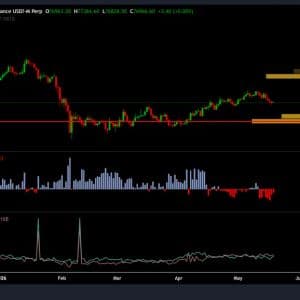
Bitcoin News Bitcoin traders are repositioning around lower support zones as derivatives flow and order book data reveal heavy buyer interest concentrated in the $68,000 to $70,000 region. The visi...
19 May 2026, 21:28
Tether holds 148 tons of gold as stablecoins face 13% risk

🪙 Tether’s reserves soared to 148 tons of gold, valued at $23 billion, as private stablecoins faced scrutiny over a potential 13% loss. 🔔 $USDT and USDC are under fire for holding volatile reserves like Bitcoin and gold, raising hedge fund comparisons. ⚠️ Critical data: European regulators may soon enforce tough rules on stablecoin issuers to ensure transparency and minimize systemic risk. Continue Reading: Tether holds 148 tons of gold as stablecoins face 13% risk The post Tether holds 148 tons of gold as stablecoins face 13% risk appeared first on COINTURK NEWS .


