


 Invest ideas
News
19 May 2026, 13:24
Zcash is 'running its own bull market' as ZEC price paints 88% rally setup

ZEC has jumped 18% in three days as privacy coins rally, defying a 3.45% drop across the wider crypto market.
19 May 2026, 13:23
South Korean funeral company records $33M unrealized loss on leveraged ETH ETFs
South Korea’s seventh-largest mutual aid company is currently sitting on a $33 million paper loss on its leveraged Ether ETF investment, following the crypto market downturn.
19 May 2026, 13:21
Solana Price Prediction: Bulls Defend $82 Support as $230 Target Stays Alive

Solana is sitting at a key support zone after losing strength on the daily RSI chart. However, the longer-term chart still shows SOL inside a large triangle pattern, with $230 marked as a possible target if buyers reclaim control. Solana Price Tests Crucial $82-$84 Support as RSI Uptrend Breaks Solana price is testing its most important short-term support zone after losing momentum on the daily chart shared by TedPillows on X. The SOL/USDT daily chart shows Solana trading near the $82-$84 area on Binance. TedPillows marked this zone as the “must hold level” after SOL pulled back from its recent move near $100. SOL/USDT Daily Price Chart. Source: TedPillows on X The chart shows Solana failed to break and hold above the horizontal resistance near $94-$96. After that rejection, SOL moved lower and returned to the rising support line that has guided price since early February. At the same time, the RSI 14 close has dropped to 40.99. More importantly, the RSI broke below its own rising trendline. That shows weakening buying pressure, even though the price still sits near support. A daily close below $82-$84 would damage the current structure. It would break the rising support line and confirm that sellers have taken control of the short-term trend. However, if SOL holds this area, the price could stay inside the wider range between support near $82-$84 and resistance near $94-$96. In that case, Solana would need a strong daily close above resistance to show a stronger recovery. For now, the chart gives one clear level. Solana must hold $82-$84 to avoid a deeper bearish move. Solana Price Compresses Inside Long-Term Triangle as $230 Target Stays on Chart Solana is trading inside a long-term triangle pattern, with price still holding above the rising support line on the 3-day Binance chart shared by ray on X. The chart shows SOL moving sideways after a sharp drop from its previous highs. The price has spent 33 bars, or 99 days, inside the current accumulation zone. SOL/USDT 3-Day Price Chart. Source: ray on X The structure shows two major trendlines. The upper line acts as resistance from the 2025 high area, while the lower line acts as support from the 2023 base. Together, they form a tightening range. The marked support line remains the key level for bulls. If SOL holds this area, the chart keeps the accumulation setup alive. However, SOL still needs a breakout above the descending resistance line to confirm stronger upside. The chart marks $230 as the possible upside target after a breakout. For now, the chart shows compression rather than confirmation. Solana remains inside the range, and the next major move depends on whether price breaks support or clears long-term resistance.
19 May 2026, 13:21
BSC Post-Quantum Upgrade Clears Major Test as Network Throughput Drops 40%

The move to quantum-resistance of blockchain infrastructure is bringing new challenges to the forefront besides cryptography design, namely, heavy data overhead caused by post-quantum algorithms. BNB Chain Developers made the announcement recently on the BSC Post-Quantum Cryptography Migration Report which describes successful implementation of post-quantum upgrades to the network. All of these upgrades used ML-DSA-44 for transaction signatures and pqSTARK for consensus vote aggregation. Importantly, the report verifies that the novel cryptographic mechanisms are backwards compatible with existing addresses, wallets, RPC interfaces and SDKs allowing the network to maintain its current architecture while priming itself for upcoming quantum threats. Nevertheless, testing revealed a key scalability issue. By introducing these quantum resistant signatures we saw a downward shift in terms of network performance, this was attributed mainly to the increase in data being passed around the network. A lot of people assume the hardest part of post-quantum cryptography is the cryptography itself. In our testing, that wasn’t really the case. The bigger challenge came from the amount of additional data moving through the network once quantum-resistant signatures were… pic.twitter.com/r5xAc0KKfb — BNB Chain Developers (@BNBChainDevs) May 19, 2026 Signature Sizes Bring New Scaling Pressure As per BNB Chain analysis of the incident, the main challenge was not verifying signature and cryptographic calculations but dealing with large growing transaction data size. The size of a normal transaction signature grew from 65 bytes to ~2.4 KB when integrated ML-DSA-44 It fully propagated through the network stack: transaction sizes rose from approximately 110 bytes to nearly 2.5 KB, and block sizes swelled from around 110 KB to nearly 2 MB. These increased-size payloads limited propagation overhead between regions, consequently significantly reducing the maximum throughput of the network. The cross-region testing quickly revealed the performance hit, where native transfer throughput fell from 4,973 TPS to around 2,997 TPS, almost a minus-40% drop. Developers emphasized that the cryptographic computations themselves were still relatively manageable during tests. The throughput drop came mainly from the additional cost of data transfer and inter-block synchronisation between validators across multiple regions. Contrary to popular belief, the biggest hurdle in post-quantum blockchain upgrades is not algorithm design. However, according to BNB Chain, bandwidth efficiency and data-layer scalability might be the more significant long-term constraints. Compatibility Remains A Major Advantage Despite the throughput decline, BNB Chain stressed that its post-quantum framework was engineered to be compatible with the chain’s current ecosystem. The testing phase showed that wallet integrations, RPC functionality, SDK support and address formats worked as before without many disruptions. Backward compatibility decreases migration friction and could enable adoption ease if post-quantum security begins becoming a sector-wide requirement. Second, most wallets in the space are designed for use with other chains, whether it’s ethereum or bsc. The report further reveals that BNB Chain is taking an incremental route toward post-quantum readiness rather than imposing a rapid transition. This is just a promise, and developers recognize that there remain unresolved points regarding network and data-layer scaling before production-level deployment can be considered practical. Quantum Concerns Continue Growing Across Crypto When the quantum computing area is progressing greatly recently, post-quantum cryptography has raised meaningful attention in the blockchain community. Current blockchains are built on cryptographic schemes which could be broken by a sufficiently powerful quantum adversary. While experts disagree about how imminent this threat is, several major ecosystems are already exploring migration trends to quantum-resilient protocols. It furthermore serves as a harbinger of things to come in blockchain scaling. In addition to optimizing execution speed and gas costs, data efficiency, propagation strategies, and validator communication architectures may move into focus as quantum-resistant signatures reach production environments. However, BNB Chain developers stress that the technology needs more fine-tuning before mass-usage is feasible. Binance Launches HTTP-native x402 Payments Binance announced Binance x402 underlined as a programmable payments framework based on HTTP and built on BNB Chain. Targeting agent-driven commerce and software-native financial interactions, this system empowers applications and autonomous agents to perform programmable payments directly over vanilla HTTP 402 payment flows. The framework includes off-chain authorization and on-chain settlement, as well as pay-per-call and usage-based billing models, according to Binance. This architecture has been created to help machine-to-machine transactions and automated software payments without an overreliance on conventional payment rails. Binance also notes its support for autonomous transactions, part of a growing strategy to create crypto financial infrastructure designed usable by AIs across the BNB Chain. The purpose of the launch coincides with growing curiosity among blockchain networks around payment solutions for AI agents, automated APIs and decentralized software services. Introducing #Binance x402 HTTP-native programmable payments on @BNBCHAIN Built for agent-driven and software-native commerce: Standard HTTP 402 payment flows Off-chain authorization + on-chain settlement Pay-per-call and usage-based billing Autonomous transactions… pic.twitter.com/DKm0ebMrAQ — Binance (@binance) May 19, 2026 BNB Chain Shifts its Focus to Infrastructure BNB Chain works to extend its infrastructure strategy by simultaneously launching the post-quantum migration report as well as Binance x402. Beyond consumer-facing applications, the ecosystem is rapidly prioritizing long-to-to-long network resiliency and how & when architecture can be future-proof. The post-quantum report reveals technical challenges that continue to impede large-scale quantum-resistant deployment, including the ability of validators to synchronize with data throughput in high-pressure conditions. On the other hand, Binance x402 projects BNB Chain into an era where software programs and AI-driven applications will autonomously be performing work as parts of blockchain economies. These announcements collectively shape a larger trend in evolution away from pure transaction execution on the blockchain at scale. Where it gets most critical is less about if post-quantum cryptography actually fits inside the BNB Chain ecosystem, and more in how that data should be stored as a by-product of those systems. Disclosure: This is not trading or investment advice. Always do your research before buying any cryptocurrency or investing in any services. Follow us on Twitter @nulltxnews to stay updated with the latest Crypto, NFT, AI, Cybersecurity, Distributed Computing, and Metaverse news !
19 May 2026, 13:20
Pump.fun to Add USDC Trading Pairs for New Token Launches on Solana

BitcoinWorld Pump.fun to Add USDC Trading Pairs for New Token Launches on Solana The Solana-based memecoin launchpad Pump.fun is set to expand its trading options by introducing support for USDC pairs when launching new coins. The update, scheduled for implementation on May 21, will allow users to trade newly created tokens against the USDC stablecoin for the first time. Expanding Beyond SOL-Only Trading Currently, Pump.fun only supports trading pairs denominated in Solana’s native token, SOL. This limitation has been a defining feature of the platform since its launch, but also a point of friction for traders who prefer stablecoin-based trading. The upcoming change will not affect existing SOL trading pairs, meaning both options will coexist. The decision to add USDC pairs reflects a broader trend in decentralized finance (DeFi) where platforms are increasingly offering stablecoin alternatives to reduce volatility exposure during token launches. USDC, a widely used dollar-pegged stablecoin, provides traders with a more predictable base currency compared to SOL, which can experience significant price swings. What the Update Means for Users For traders on Pump.fun, the introduction of USDC pairs could lower the barrier to entry for participants who prefer to avoid SOL’s price fluctuations. It may also attract a new segment of users who primarily hold stablecoins and have been hesitant to convert to SOL solely for trading new memecoins. The update is expected to go live on May 21, according to a report from SolanaFloor. Pump.fun has not yet released an official statement detailing the exact mechanics of how the USDC pairs will be integrated, but the move signals the platform’s intent to broaden its user base and improve trading flexibility. Market and Industry Context Pump.fun has become one of the most active launchpads on Solana, facilitating the creation and trading of thousands of memecoins since its inception. The addition of USDC pairs aligns with similar moves by other Solana-based platforms, such as Raydium and Jupiter, which already support multiple quote currencies. By following this trend, Pump.fun is positioning itself to remain competitive as the Solana ecosystem matures. The shift also reflects growing demand for stablecoin liquidity in memecoin markets, where price discovery can be highly volatile. USDC pairs may provide a more stable reference point for new tokens, potentially reducing the risk of rapid price manipulation during early trading. Conclusion Pump.fun’s decision to support USDC trading pairs for new coin launches represents a significant update for the Solana memecoin ecosystem. By offering traders a stablecoin alternative alongside existing SOL pairs, the platform is responding to user demand and adapting to broader market trends. The May 21 rollout will be closely watched by the DeFi community for its impact on trading volumes and user adoption. FAQs Q1: When will Pump.fun add USDC trading pairs? The update is scheduled to be implemented on May 21, as reported by SolanaFloor. Q2: Will existing SOL trading pairs be removed? No, the update will not affect existing SOL pairs. Both SOL and USDC options will be available for new coin launches. Q3: Why is Pump.fun adding USDC pairs? The move is aimed at providing traders with a stablecoin alternative, reducing exposure to SOL’s price volatility and potentially attracting more users who prefer stablecoin-based trading. This post Pump.fun to Add USDC Trading Pairs for New Token Launches on Solana first appeared on BitcoinWorld .
19 May 2026, 13:19
CoinDesk 20 performance update: Bitcoin Cash (BCH) rises 2.1%
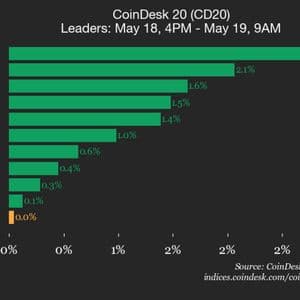
NEAR Protocol (NEAR), up 2.8%, was also a top performer.


