


 Invest ideas
News
7 Jun 2026, 19:26
XRP Back in a Rare 13-Year Zone — Analysts Say a 1,000% Surge to $15 is on the Table

XRP remained under pressure alongside the broader crypto market, as Bitcoin lost its key $70,000 support level during Tuesday’s risk-off trading session.
7 Jun 2026, 19:20
Here’s Why Bitcoin’s 50% Drop Looks Mild Next to What Several Altcoin Holders Are Sitting On
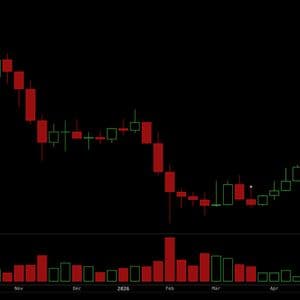
This week, bitcoin took a trip to its lowest price tag of 2026, slipping to $59,100 per coin and now sitting a touch more than 50% below the leading crypto asset’s all-time high above $126,000. Meanwhile, a hefty slice of the altcoin crowd has endured far steeper markdowns, with many well-known digital assets nursing losses
7 Jun 2026, 19:18
GMX (GMX) And Synthetix (SNX): With GMX V2 Expanding To More Chains And SNX Perps V3 Rolling Out On L2s, Do GMX And SNX Form A Synthetic Liquidity Network Or St...

The battle for decentralized perpetual futures dominance has entered a critical expansion phase. GMX (GMX) is aggressively scaling its V2 architecture—featuring isolated GM pools and Chainlink Data Streams—across networks like Arbitrum, Avalanche, MegaETH, and Botanix. Concurrently, Synthetix (SNX ) is advancing its highly anticipated Perps V3, introducing modular multi-collateral margin and expanding its derivatives liquidity layer across Ethereum mainnet and various Layer-2 (L2) rollups. With both protocols pushing hard for cross-chain liquidity capture, a structural question emerges on the charts: Are GMX and SNX beginning to form a cohesive, unified synthetic liquidity network, or will they remain fiercely competing, isolated derivatives silos? A look at their 30-day technical structures reveals that both assets are currently in repair mode, digesting heavy recent pullbacks. GMX: Perp Hub In A Mid‑Range Reset Source: tradingview GMX 's structural profile over the last 30 days illustrates a "post-run down-leg inside a wide range." Trading beneath both its short-term and long-term moving averages, the asset is attempting to find a firm base rather than enjoying a clean uptrend. The Fibonacci Map ($20.00 to $34.00): 23.6% Retracement: ~$23.30 38.2% Retracement: ~$25.30 50.0% Retracement: $27.00 61.8% Retracement: ~$28.70 Immediate Support: $22.00 to $24.00: GMX is currently trading near $24.00, sitting directly in this first demand band. As long as GMX holds above $22.00, the broader $20.00 to $34.00 move remains a healthy retracement, not a total collapse. $20.00 to $21.00: The 30-day swing low region. A daily close falling below $20.00 completely unwinds the recent leg, signaling that the broader market favors newer L2 alternative perpetual platforms over GMX beta. Immediate Resistance: $25.00 to $27.00: The primary trend-repair block. This zone clusters the 38.2% Fib (~$25.30), the 30-day SMA (~$26.00), and the 50% Fib ($27.00). GMX must reclaim and establish a foothold above this moving average cluster for the market to treat it as a core perp venue in active contention. $29.00 to $34.00+: Encompassing the 61.8% Fib (~$28.70) up to the local high. Sustained closes above $34.00 represent the first major signal that GMX has initiated a brand-new expansion leg. The Read: GMX is currently a mid-range perp token enduring a down-biased correction. All significant trend-repair work is stacked directly overhead. To become a foundational piece of a synthetic liquidity network, it must relentlessly defend the $22.00–$24.00 floor, reclaim the $26.00 moving average, and prove that V2 volumes are genuinely accelerating on its newly supported chains. Synthetix (SNX): Synthetic Liquidity Mid‑Range, Under Short Trend Source: tradingview Synthetix displays a slightly stronger technical posture than GMX. While it is currently trading just below its 30-day Simple Moving Average (SMA), it remains comfortably above its long-term 200-day baseline (~$2.70), indicating a structurally fine digestion phase. The Fibonacci Map ($2.20 to $4.00): 23.6% Retracement: ~$2.62 38.2% Retracement: ~$2.89 50.0% Retracement: $3.10 61.8% Retracement: ~$3.31 Immediate Support: $2.62 to $2.89: This pocket serves as the primary "healthy retrace" zone, capturing the 23.6% and 38.2% Fibonacci levels. Holding price action here ensures that the overarching $2.20 to $4.00 upward leg remains completely intact. $2.20 to $2.30: The 30-day swing low. A daily close beneath $2.20 would unwind the entire run, clearly showing that the market is not yet willing to pay a premium for SNX Perps V3 and its aggressive L2 rollout. Immediate Resistance: $3.10 to $3.31: The critical re-rating zone. This band sits right at the 50% Fib and 30-day SMA ($3.10) and extends up to the 61.8% Fib (~$3.31). SNX must reclaim and hold above this line to confirm that synthetic liquidity and V3 volumes are being actively rewarded by buyers. $3.80 to $4.00+: The local high region. Consolidating within and pushing above $4.00 would mark a fresh, powerful macro leg for SNX, validating the cross-chain adoption thesis. The Read: SNX is structurally sound but capped by its short-term trend. To act as a core synthetic liquidity leg, it must vigorously defend pullbacks into the $2.62–$2.89 zone, forcefully reclaim the $3.10–$3.31 moving average block, and back any push toward $4.00 with rising V3 usage across L2 rollups. Conclusion: A Unified Network Or Competing Silos? The technical structures define two premier DeFi infrastructure tokens that are absorbing volatility while residing in distinct repair modes. They Form a Cohesive Synthetic Liquidity Network If: GMX and SNX both successfully defend their shallow Fibonacci support zones ($22.00–$24.00 for GMX; $2.62–$2.89 for SNX) and refuse to break their respective 30-day lows. Both assets flatten and cross their 30-day moving averages, with GMX sustaining price action above $25.00–$27.00 and SNX trading reliably above $3.10–$3.31. Cross-chain derivatives flow actively reinforces the pairing: Protocol aggregators and sophisticated routers begin treating "GMX + SNX liquidity" as a unified, deep liquidity mesh rather than entirely separate venues. They Remain Competing Derivatives Silos If: GMX remains trapped beneath the $26.00 moving average, oscillating aimlessly and fading on any weak attempt toward $28.00. SNX fails to sustain momentum above $3.10–$3.31, getting stuck in a repetitive cycle between $2.60 and $3.20. Traders and aggregators continue to pick isolated venues one at a time (e.g., trading exclusively on Arbitrum perps, Solana perps, or singular new L2 platforms) rather than utilizing systems that route intelligently across both GMX and Synthetix. Final Verdict: The technical data confirms that both assets are solid, mid-range DeFi tokens currently in active repair mode. They have not yet established themselves as the undisputed backbone of synthetic liquidity. Whether they graduate to that status will depend entirely on whether their V2 and V3 expansions translate into persistent multi-chain depth and volume, rather than just generating headlines about new chain listings. Disclaimer: This article is provided for informational purposes only. It is not offered or intended to be used as legal, tax, investment, financial, or other advice.
7 Jun 2026, 19:07
Solana eyes $808 in 2032 with short-term weakness lingering

🚀 Solana could soar to $808 by 2032 as forecasted highs rise. 📉 SOL faces ongoing price pressure, currently recovering around $65. 🔍 Despite short-term volatility, long-term growth in $SOL is backed by its robust ecosystem. Continue Reading: Solana eyes $808 in 2032 with short-term weakness lingering The post Solana eyes $808 in 2032 with short-term weakness lingering appeared first on COINTURK NEWS .
7 Jun 2026, 19:03
Bybit launches tokenized IPO platform with SpaceX debut

More on SpaceX, Bitcoin USD Revisiting The SpaceX Valuation: A Post-Prospectus Update BTC: Why Bitcoin May Be Bottoming Now, Levels To Watch SpaceX IPO: Boom, Bloodbath, Or Both AI IPO wave could test Wall Street's appetite for new shares How to trade the AI IPO boom without chasing the hype
7 Jun 2026, 19:02
Pundit Says XRP Doesn’t Need CLARITY Act to Survive. Here’s What Banks are Doing

Something is shifting within the largest financial institutions in the U.S. JPMorgan, Bank of America, and Wells Fargo are all planning tokenized deposit systems. The Clearing House is launching a blockchain settlement network next year, built for 24/7 operations and instant tokenized payments. This is not speculation. Congressman French Hill publicly confirmed it while speaking on the CLARITY Act. He stated that banks “will be extremely competitive” in this industry, citing deposit tokenization as the technology that lets them operate without relying on dollar-backed stablecoins. The banks are not fighting crypto. They are building their own version of it. $XRP doesn't need the CLARITY Act to survive. Banks need it so they can stop building behind closed doors and start deploying on XRP Ledger publicly. Fox Business just made that crystal clear. Congressman French Hill laid it out. JPMorgan, Bank of America, and… https://t.co/FFZBbxSZvB — X Finance Bull (@Xfinancebull) June 6, 2026 The Opportunity Institutions Have Waited For Crypto commentator X Finance Bull responded directly to Hill’s remarks with a post outlining what this means for XRP. The post argues that XRP does not need the CLARITY Act to function. The legislation matters because it gives banks the regulatory clarity to deploy publicly at scale. The post points to concrete activity already on the XRP Ledger. Mastercard has settled on it. JPMorgan settled tokenized Treasuries through it . DTCC confirmed Ripple Prime. There are $4 billion in tokenized assets deployed and $1.7 billion in RLUSD circulating across 40+ chains. The infrastructure exists, and the activity is real. What has been missing is a legal structure that allows institutions to operate openly. What the CLARITY Act Establishes The CLARITY Act sets registration standards, custody rules, and clear jurisdictional boundaries between the SEC and CFTC. It gives financial institutions a defined path to deploy digital asset infrastructure without regulatory ambiguity hanging over every decision. We are on X, follow us to connect with us :- @TimesTabloid1 — TimesTabloid (@TimesTabloid1) June 15, 2025 Banks are still lobbying for adjustments to the bill’s final text. However, that is not opposition. They want the language structured to maximize their competitive position once they publicly enter the market. The bill passed the House in July 2025. The Senate Banking Committee then advanced it with a 15-9 vote on May 14, 2026. Then on June 1, it was placed on the Senate Calendar , meaning it is officially scheduled and eligible for a full Senate floor vote. The White House has set July 4 as its target for a presidential signature. Capital Waiting on Regulatory Access X Finance Bull’s post draws a direct line between the bill’s passage and institutional capital deployment. Trillions in banking capital are positioned to move into digital asset infrastructure once the legal framework is in place. XRP Ledger is already built and tested for that volume. He believes that those who understand this can see that XRP’s recent decline is temporary. Disclaimer : This content is meant to inform and should not be considered financial advice. The views expressed in this article may include the author’s personal opinions and do not represent Times Tabloid’s opinion. Readers are advised to conduct thorough research before making any investment decisions. Any action taken by the reader is strictly at their own risk. Times Tabloid is not responsible for any financial losses. Follow us on X , Facebook , Telegram , and Google News The post Pundit Says XRP Doesn’t Need CLARITY Act to Survive. Here’s What Banks are Doing appeared first on Times Tabloid .

