


 Invest ideas
News
5 Jun 2026, 14:45
Avalanche (AVAX) Price Outlook 2026–2030: Can the Network Support a $100 Target?

BitcoinWorld Avalanche (AVAX) Price Outlook 2026–2030: Can the Network Support a $100 Target? Avalanche (AVAX) has remained one of the more closely watched Layer-1 blockchain projects since its mainnet launch in 2020. With a focus on sub-second transaction finality and subnet architecture, the network has attracted both developers and institutional interest. As of early 2026, market participants are asking whether AVAX can reach the $100 mark in the coming years, and what fundamental developments would be required to support such a valuation. Current Market Position and Network Fundamentals As of early 2026, AVAX trades in a range that reflects both broader market sentiment and network-specific metrics. The total value locked (TVL) on Avalanche has fluctuated alongside the wider DeFi cycle, but the subnet ecosystem—which allows custom application-specific blockchains—remains a distinguishing feature. The network has also seen continued upgrades, including improvements to the Avalanche Warp Messaging protocol for cross-subnet communication. Price predictions must be grounded in these fundamentals rather than speculative targets. The $100 level would require a significant increase in market capitalization, likely driven by a combination of sustained network usage, broader crypto market growth, and clear regulatory progress. Without these catalysts, even strong technology may not translate into price appreciation. 2026–2027 Outlook: Realistic Trajectories For 2026 and 2027, several factors will influence AVAX price action. The continued development of the Avalanche ecosystem, including partnerships with traditional finance and gaming projects, could drive demand for the token. Additionally, the network’s focus on scalability and low fees positions it as a competitor to Ethereum and Solana in specific use cases. However, the crypto market remains highly cyclical. A sustained bull market could push AVAX toward the $80–$100 range by late 2027, but this is not a guarantee. Bear market conditions or delays in network adoption could keep prices lower. Investors should view these projections as scenarios, not certainties. Key Catalysts to Watch Several developments could influence AVAX’s price trajectory: Adoption of subnets by major enterprises or gaming studios Integration with traditional financial infrastructure Regulatory clarity for proof-of-stake networks Overall Bitcoin and Ethereum market cycles 2030 Long-Term Outlook: Is $100 Achievable? Looking toward 2030, the $100 target becomes more plausible but remains contingent on sustained ecosystem growth. At current circulating supply, a $100 AVAX would represent a market capitalization of roughly $38–$40 billion, placing it among the top cryptocurrencies by value. This is not unprecedented—AVAX has traded at higher valuations during previous market peaks. The question is whether Avalanche can maintain relevance and capture meaningful market share over the next four years. Competition from other Layer-1 networks, evolving technology, and shifting user preferences all pose risks. The subnet model offers differentiation, but execution will determine long-term value. Conclusion AVAX reaching $100 by 2030 is possible but not inevitable. It would require sustained network growth, favorable market conditions, and successful execution of the project’s roadmap. Investors should focus on fundamental developments rather than price targets alone, and recognize that cryptocurrency markets carry significant uncertainty. The most useful approach is to monitor network metrics, adoption trends, and regulatory developments as they unfold. FAQs Q1: What is the main factor that could push AVAX to $100? Sustained adoption of Avalanche subnets by enterprises and developers, combined with a broader crypto market uptrend, would be the most likely path to $100. Q2: Is AVAX a good long-term investment? Long-term investment decisions depend on individual risk tolerance and market outlook. Avalanche has strong technology and a clear use case, but all cryptocurrencies carry significant volatility and risk. Q3: How does Avalanche compare to Ethereum and Solana? Avalanche offers faster transaction finality than Ethereum and a unique subnet architecture that Solana does not have. However, Ethereum has a larger developer ecosystem, and Solana has higher throughput. Each network has different trade-offs. This post Avalanche (AVAX) Price Outlook 2026–2030: Can the Network Support a $100 Target? first appeared on BitcoinWorld .
5 Jun 2026, 14:43
Peter Schiff Blames Bitcoin Price Dip on Strategy's Steady Accumulation

Peter Schiff dismisses claims that Bitcoin’s ongoing price dip was influenced by Strategy’s recent 32 BTC sale, noting that there’s more to it.
5 Jun 2026, 14:39
XRP Sell-off Hits $1.09 as Traders Face Fresh Downside Risk
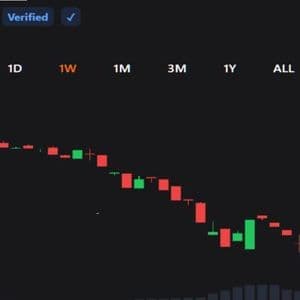
XRP is testing support near $1.09 as persistent selling pressure keeps the token pinned near recent lows. Weak momentum and bearish technical signals continue to favor the downside. XRP Downtrend Deepens as Sellers Keep Control At 10:14 a.m. ET on June 5, XRP was trading at $1.110, near its recent low of $1.091, after extending
5 Jun 2026, 14:17
$1.95 Million SHIB Awakening: Dormant Shiba Inu Whale Breaks 10-Month Silence

As SHIB drops 15%, a dormant whale broke a 10-month silence to move 400B tokens via a BitGo smart contract.
5 Jun 2026, 14:12
Bitcoin Price Analysis: Where Is BTC Heading Next After Drop Below $61K?
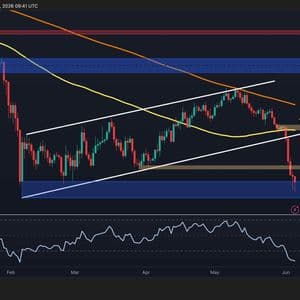
Bitcoin remains under heavy selling pressure after crashing below multiple key support levels in quick succession. The recent rejection from the descending 200-day moving average triggered a sharp sell-off that invalidated the previous rising channel structure and pushed BTC back toward a major demand zone around $60K. Meanwhile, on-chain data suggests market participants are increasingly realizing losses, reflecting deteriorating investor sentiment. Bitcoin Price Analysis: The Daily Chart On the daily timeframe, Bitcoin has confirmed a significant bearish breakdown after falling below both the ascending channel and the 100-day moving average near $74K. The channel had supported the recovery from February’s lows, but the recent violation indicates that buyers have lost control of the intermediate trend. The rejection occurred near the confluence of the channel’s upper boundary and the descending 200-day moving average, located around the $82K region. Since then, BTC has experienced an aggressive decline, slicing through the $74K support area and the prominent low of $65K from late May with little resistance. The price is now testing a major support block at $60K, which previously acted as a strong rebound area following the February capitulation. This zone represents the last major defense for bulls before the market opens the door toward significantly lower levels. BTC/USDT 4-Hour Chart The 4-hour chart highlights the severity of the recent breakdown. Following an extended consolidation near the $74K region, BTC failed to reclaim the level and subsequently broke below the daily ascending channel’s lower boundary that had supported price action for months. As the breakdown accelerated, the $65K support area also gave way, which drove price directly into the $60K-$62K demand region. This area is currently preventing further downside and has already attracted some buying interest. An important observation comes from the RSI, which has formed a mild bullish divergence in extremely oversold conditions while price has established fresh local lows. Although the signal remains early, it suggests bearish momentum may be weakening in the short term and could support a temporary rebound toward the $65K resistance zone. However, from a structural perspective, the market continues to print lower highs and lower lows. As long as BTC remains below the broken support levels at $65K and $74K, any recovery is likely to be viewed as a corrective move rather than the beginning of a new uptrend. On-Chain Analysis The Adjusted Spent Output Profit Ratio (aSOPR), a metric that measures whether coins moved on-chain are being sold at a profit or loss, is providing an important signal regarding investor behavior. The chart shows that the 30-day EMA of aSOPR has fallen below the critical 1.0 threshold. Historically, readings above 1 indicate that market participants are realizing profits on average, while values below 1 suggest coins are being spent at a loss. The recent drop below 1 coincides with Bitcoin’s decline toward the $60K area and reflects growing capitulation among holders. This shift suggests that a larger portion of investors is now exiting positions at a loss, a behavior commonly associated with bearish market phases and periods of weak confidence. While persistent readings below 1 often accompany downtrends, they can also signal the later stages of a corrective phase as weaker hands leave the market. Therefore, traders should closely monitor whether aSOPR can reclaim the 1.0 level. A recovery above that threshold would indicate renewed profitability across the network and could support broader market stabilization. For now, both price action and on-chain data continue to favor the sellers, while the $60K support region remains the key battleground that will likely determine Bitcoin’s next major directional move. The post Bitcoin Price Analysis: Where Is BTC Heading Next After Drop Below $61K? appeared first on CryptoPotato .
5 Jun 2026, 14:10
Bitcoin Dips Below $61,000: Market Analysis and Investor Implications
BitcoinWorld Bitcoin Dips Below $61,000: Market Analysis and Investor Implications Bitcoin has experienced a notable decline, falling below the $61,000 mark, according to data from Bitcoin World market monitoring. The leading cryptocurrency was trading at $60,963.1 on the Binance USDT market at the time of reporting. This price movement has drawn attention from traders and analysts alike, prompting a closer look at the factors behind the drop. Market Context and Recent Performance Bitcoin’s slide below $61,000 represents a significant shift from its recent highs, where it had been consolidating above $62,000. The current price action reflects broader market sentiment, which has been influenced by a combination of macroeconomic factors, regulatory news, and shifts in investor risk appetite. Over the past week, Bitcoin has faced resistance at higher levels, and this decline marks a break below a key psychological support level. Potential Triggers and Analyst Perspectives Several factors may have contributed to the downward pressure. Profit-taking by large holders, or whales, is a common occurrence after periods of price stability. Additionally, uncertainty surrounding global interest rate policies and regulatory developments in major economies, including the United States and the European Union, has added to market jitters. Analysts point out that while short-term volatility is inherent in cryptocurrency markets, the current dip does not necessarily signal a prolonged bearish trend. Some view it as a healthy correction within a broader uptrend, while others caution that further declines could test support near $59,000. Impact on Investors and Trading Activity For retail and institutional investors, this price drop presents both risks and opportunities. Trading volumes on exchanges like Binance have increased, indicating active participation. Long-term holders may see this as a buying opportunity, while short-term traders are adjusting positions to manage risk. The market remains highly sensitive to news, and any positive developments, such as regulatory clarity or institutional adoption announcements, could quickly reverse the sentiment. Conclusion Bitcoin’s fall below $61,000 is a reminder of the cryptocurrency market’s inherent volatility. While the immediate trigger appears to be a combination of profit-taking and macroeconomic uncertainty, the long-term outlook remains a subject of debate among experts. Investors are advised to stay informed, monitor key support levels, and consider their risk tolerance in this dynamic environment. FAQs Q1: Why did Bitcoin drop below $61,000? The drop is attributed to a mix of profit-taking by large investors, macroeconomic uncertainties, and market sensitivity to regulatory news. No single event triggered the decline, but a combination of factors weighed on sentiment. Q2: Is this a good time to buy Bitcoin? This depends on individual investment strategies and risk tolerance. Some analysts view the dip as a buying opportunity for long-term holders, while others advise caution given potential for further declines. It is recommended to conduct personal research or consult a financial advisor. Q3: What are the key support levels to watch? Traders are watching the $59,000 level as a potential support zone. If Bitcoin breaks below that, the next significant support could be around $56,000. Resistance is now expected near $61,000 and $62,000. This post Bitcoin Dips Below $61,000: Market Analysis and Investor Implications first appeared on BitcoinWorld .

