


 Invest ideas
News
27 Apr 2026, 17:28
Uniswap (UNI) And PancakeSwap (CAKE): After DEX Fee Switches And Incentive Programs Restart, Do UNI And CAKE Lead A Cross‑Chain DeFi Rotation Or Just Pop On Rew...

As we move into the final week of April 2026, the "DeFi 1.0" giants are attempting to stage a comeback. The narrative has shifted from pure governance to actual cash-flow mechanics, with Uniswap 's long-awaited fee-switch implementation and PancakeSwap ’s aggressive new cross-chain incentive rewards taking center stage. The market is no longer dumping these blue-chips on sight, but the technical tape suggests we are currently in a "repair regime." While UNI is attempting to price in a future as a yield-bearing asset, CAKE is proving that it remains the high-beta darling of the BNB Chain, provided the rewards keep flowing. Uniswap (UNI): ETH‑Side DEX Anchor Trying To Rebuild Source: tradingview Uniswap is currently the "Institutional DEX." With the fee-switch proposal finally moving toward a permanent implementation, UNI is being treated as more than just a "useless governance token." Technical Breakdown: At its current levels, UNI is showing a classic repair structure. It is trading above its 7-day and 30-day moving averages, signaling that the immediate selling pressure has abated. However, it remains capped by its long-term 200-day SMA. The MACD is constructive, growing on fee-switch news, but it needs to sustain this momentum to break out of its multi-month range. UNI Near-Term Scenarios: The Bullish Path: A successful reclaim of the 200-day SMA. This would signal that the market is ready to value UNI as a cash-flow blue chip, potentially targeting the upper boundaries of its 2026 range. The Range Path: Continued chop above the 30-day SMA. As long as pullbacks hold that $1.31–$1.34 band, the "repair" narrative remains intact. If it slips, the fee-switch is likely being traded as a "sell the news" event. PancakeSwap (CAKE): BNB‑Side Yield Beta With A Better Base Source: tradingview PancakeSwap remains the king of the BNB ecosystem, but in 2026, it’s a more mature beast. By successfully expanding to multiple L2s and diversifying its revenue streams beyond just swap fees, CAKE is showing its healthiest structure in years. Technical Breakdown: CAKE is currently behaving like a yield-sensitive momentum asset. It is trading comfortably above its short-term averages, and unlike previous cycles where RSI lived in the oversold pits, it is now holding a trending RSI of 50–60. The momentum is positive, but it remains a high-beta play—prone to sharp spikes on incentive news and equally sharp cool-downs once the rewards are farmed out. CAKE Near-Term Scenarios: The Bullish Path: Breaking through its long-term resistance with sustained volume. This would require BNB Chain TVL to remain elevated even after the initial "restart" rewards normalize. The Range Path: A return to the base if on-chain volumes collapse between news cycles. For CAKE, the 30-day SMA is the absolute line in the sand for the current recovery story. Conclusion The data suggests that UNI and CAKE are early participants in a potential DeFi rotation, but they haven't yet cleared the long-term hurdles needed for a full cycle restart. Uniswap is the structural anchor, while PancakeSwap provides the speculative torque. For this to be a true "Blue-Chip DeFi" bull leg, we need to see both assets reclaim their 200-day moving averages on high volume and stay there. Until that happens, they are high-quality headline trades. If capital continues to favor the newer "shiny" narratives in AI and Restaking, expect these DEX giants to remain range-bound leaders rather than breakaway winners. Disclaimer: This article is provided for informational purposes only. It is not offered or intended to be used as legal, tax, investment, financial, or other advice.
27 Apr 2026, 17:22
Filecoin (FIL) And Internet Computer (ICP): As Cloud Providers Test On‑Chain Data Storage, Do FIL And ICP Power A “Web3 Cloud” Trade Or Get Overshadowed By AI T...

As of late April 2026, the line between decentralized storage and centralized cloud giants is blurring. With the successful launch of Filecoin Onchain Cloud (FOC) in January and Google Cloud’s recent "Spanner Omni" integration experiments, enterprises are finally treating on-chain data as a viable backup layer. For Filecoin (FIL) and Internet Computer (ICP) , this "Web3 Cloud" narrative is a massive validation of years of infrastructure building. However, the capital flows in 2026 remain ruthlessly focused on "Direct AI" plays. While FIL and ICP provide the essential data and hosting layers, they are currently fighting for attention against the explosive growth of GPU and agent-specific tokens like RNDR and ASI (formerly FET). The charts show two protocols in "post-capitulation" repair, waiting for a structural breakout that hasn't quite arrived yet. Filecoin (FIL): Storage Rail Trying to Rebuild Source: tradingview Filecoin has evolved into a "Warm Storage" powerhouse. In 2026, its Proof of Data Possession (PDP) and Fast Finality (F3) upgrades have reduced retrieval times from hours to under 60 seconds, making it a credible S3 alternative for enterprise dataset archiving. Technical Breakdown: FIL is currently in a "repair mode" base. At $0.95, it is trading just below its 30-day SMA ($0.96), having recently bounced off support at $0.93. The MACD is bullishly crossing, but the massive overhead of the 200-day SMA (near $1.20) and the ghost of its 2024 highs continue to act as a heavy lid on price. FIL Near-Term Scenarios: The Web3 Cloud Leg: A push toward $1.15–$1.25 (+30%). This would require a successful daily close above the 200-day SMA, likely triggered by a major cloud provider moving beyond pilots into recurring storage usage. The AI Shadow: A return to the $0.80–$0.90 range. If AI dataset demand doesn't translate into paid on-chain deals soon, FIL risks being treated as a "slow" infrastructure laggard. Internet Computer (ICP): Compute + App Layer with New Tokenomics Source: tradingview Internet Computer is repositioning itself as the "AI Smart Contract" host. Following a DAO-led tokenomics upgrade last week that cut inflation by 30%, the network has seen a surge in transaction volume. However, the market remains cautious about its long-term structural overhang. Technical Breakdown: ICP is essentially "hugging" its 30-day SMA ($2.49). At $2.44, it is showing a neutral-to-bullish bias but is struggling to overcome the $2.52 resistance. With the 200-day SMA at $3.21, it is arguably deeper in its recovery phase than Filecoin. The RSI-14 at 51.68 reflects a market in "wait-and-see" mode. ICP Near-Term Scenarios: The Web3 Cloud Leg: A rally toward $3.00–$3.20. Breaking the $2.52 barrier would open the path to test the 200-day average, especially if its "AI Agent Host" narrative gains traction with developers. The AI Shadow: A drift back toward $2.25. If capital continues to rotate defensively into BTC or higher-torque AI names, ICP’s technical repair could stall. Conclusion The data confirms that FIL and ICP are credible Web3 cloud contenders, but they are currently second-order beneficiaries of the AI boom. While they provide the storage (FIL) and the logic (ICP) layers, the market is currently granting "Default Stack" status to tokens more directly connected to GPU compute and agentic actions. For a true re-rating, we need to see both reclaim their 200-day moving averages on significant volume. Until then, they remain high-quality infrastructure trades within a wide range. They are the "picks and shovels" of the AI era, but in April 2026, the market is still more interested in the "gold" of inference and agents. Disclaimer: This article is provided for informational purposes only. It is not offered or intended to be used as legal, tax, investment, financial, or other advice.
27 Apr 2026, 17:20
Meme Coin HENRY Price Surges 320% After Shocking ‘Time Traveler’ Tweet Prediction Goes Viral

BitcoinWorld Meme Coin HENRY Price Surges 320% After Shocking ‘Time Traveler’ Tweet Prediction Goes Viral The Ethereum-based meme coin HENRY has experienced a staggering 320% price surge following the viral spread of a 2023 tweet that seemingly predicted the name of a White House shooter. This extraordinary event has captured the attention of the cryptocurrency community and mainstream media alike, raising questions about market manipulation, social media virality, and the unpredictable nature of digital assets. HENRY Price Surge: The Viral Tweet That Sparked a Rally According to reports from BeInCrypto, the original tweet was posted in 2023 by an account named Henry Martinez. The post contained only the name ‘Cole Allen’ alongside a collage featuring a Pepe meme and a photo of U.S. President Donald Trump at a dinner. On April 25, a shooting incident occurred at the White House, and the gunman was identified as Cole Tomas Allen. This coincidence caused the 2023 post to resurface and spread rapidly after the account owner reposted it, referring to themselves as a ‘time-traveling Pepe.’ This viral moment directly correlated with a sharp rise in the HENRY meme coin’s price . The token, which had been trading at low levels, saw its value skyrocket within hours. The event demonstrates how social media narratives can directly influence cryptocurrency markets, especially for meme coins that rely heavily on community sentiment and viral trends. Market Impact and Copycat Tokens The surge in HENRY’s price did not occur in isolation. Several copycat Solana-based meme coins imitating the original HENRY have since emerged. These tokens attempt to capitalize on the viral attention by using similar names, branding, or themes. Investors should exercise caution, as these copycat tokens often lack the same liquidity or community backing. Below is a comparison of the original HENRY token and some notable copycat tokens: Token Name Blockchain Price Change (24h) Market Cap HENRY (Original) Ethereum +320% $12.5M HenrySol Solana +45% $1.2M PepeTime Solana +22% $800K AllenCoin Solana +8% $300K This table illustrates the rapid proliferation of copycat tokens. Investors should verify the authenticity of any token before trading. Understanding the ‘Time Traveler’ Phenomenon The concept of a ‘time traveler’ account predicting events is not new in the cryptocurrency space. However, the viral crypto prediction involving HENRY has unique characteristics. The original post was made two years before the incident, adding an element of mystery. The account owner’s self-identification as a ‘time-traveling Pepe’ further fueled the narrative. Experts caution against taking such predictions at face value. “It is more likely a coincidence or a well-timed social media strategy,” says Dr. Emily Carter, a blockchain analyst at CryptoInsights. “The human brain is wired to find patterns, even where none exist. This event is a classic example of confirmation bias in action.” How Social Media Drives Meme Coin Prices Meme coins like HENRY are highly susceptible to social media trends. A single viral post can trigger a massive price movement. This is because meme coins often have low liquidity and small market caps, making them volatile. The HENRY price surge is a textbook case of how a narrative can override fundamental analysis. Community sentiment is the primary driver of meme coin prices. Viral tweets can create FOMO (fear of missing out) among traders. Copycat tokens often emerge to exploit the hype. Regulatory risks increase with such events, as authorities may investigate market manipulation. Expert Analysis and Market Implications Financial experts have weighed in on the HENRY phenomenon. “This event highlights the speculative nature of meme coins,” notes Mark Thompson, a senior market strategist at FinTech Global. “Investors should be aware that such price surges are often unsustainable. The underlying value of HENRY remains tied to its community, not any intrinsic utility.” Moreover, the incident raises questions about the role of social media platforms in cryptocurrency markets. Twitter, now known as X, has been a hotbed for crypto discussions. The platform’s algorithm can amplify content, leading to rapid price changes. Regulators in the United States and Europe are increasingly scrutinizing such activities. Timeline of Key Events To understand the full context, here is a timeline of the events: 2023: Account Henry Martinez posts a tweet with the name ‘Cole Allen’ and a Pepe meme. April 25, 2025: A shooting incident occurs at the White House. The gunman is identified as Cole Tomas Allen. April 26, 2025: The 2023 tweet goes viral after the account owner reposts it, calling themselves a ‘time-traveling Pepe.’ April 27, 2025: The HENRY meme coin price surges by 320%. April 28, 2025: Copycat Solana-based meme coins begin appearing. Conclusion The meme coin HENRY price surge following a viral tweet prediction underscores the unpredictable nature of cryptocurrency markets. While the event has generated significant excitement, it also serves as a cautionary tale about the risks of investing in meme coins. Investors should conduct thorough research and remain skeptical of viral narratives. The emergence of copycat tokens further complicates the landscape, making due diligence essential. As the crypto market evolves, events like this will continue to test the boundaries of market efficiency and regulatory oversight. FAQs Q1: What caused the HENRY meme coin price to surge? A1: The price surged 320% after a 2023 tweet predicting the name of a White House shooter went viral. The tweet’s author called themselves a ‘time-traveling Pepe,’ which created a viral narrative that drove demand for the token. Q2: Is the ‘time traveler’ tweet authentic? A2: The authenticity of the tweet is debated. While the tweet was posted in 2023, experts suggest it may be a coincidence or a well-executed social media strategy rather than genuine time travel. Q3: Are copycat HENRY tokens safe to invest in? A3: Copycat tokens carry significant risks. They often lack liquidity, community support, and may be scams. Investors should verify the token’s contract address and team before investing. Q4: How can I trade HENRY meme coin? A4: HENRY is an Ethereum-based token. It can be traded on decentralized exchanges like Uniswap. Always check the official contract address to avoid fake tokens. Q5: What lessons can investors learn from this event? A5: The event highlights the volatility of meme coins and the power of social media narratives. Investors should avoid FOMO, conduct research, and only invest what they can afford to lose. Q6: Will regulators take action after this incident? A6: It is possible. Regulators in the U.S. and EU are increasingly monitoring social media-driven market movements. This event may prompt investigations into potential market manipulation. This post Meme Coin HENRY Price Surges 320% After Shocking ‘Time Traveler’ Tweet Prediction Goes Viral first appeared on BitcoinWorld .
27 Apr 2026, 17:17
Bitcoin pulls back to $76,600 as rising oil price and Iran risks stall the rally
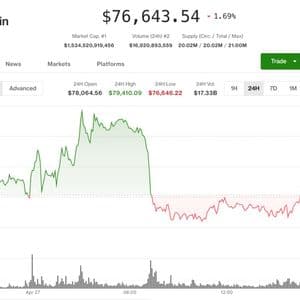
Short-term holder profit-taking is offsetting fresh demand from ETFs and Strategy, pointing to consolidation below $80,000, Bitfinex analysts said.
27 Apr 2026, 17:15
Bernstein sees IREN pivoting from Bitcoin mining to $3.7B AI cloud business

As Bitcoin miner IREN shifts toward AI cloud infrastructure, leveraging a Microsoft deal and GPU expansion, analysts expect mining revenue to decline over time.
27 Apr 2026, 17:15
Bitcoin Rally Lacks Conviction Amid Plunging Volume and Negative Funding Rates, Analyst Warns
BitcoinWorld Bitcoin Rally Lacks Conviction Amid Plunging Volume and Negative Funding Rates, Analyst Warns The recent Bitcoin rally toward the $80,000 mark may lack the necessary conviction for a sustained uptrend, according to a new analysis from 10x Research. The cryptocurrency’s price surge has occurred alongside a sharp decline in trading volume and persistently negative funding rates in the futures market. These indicators suggest the move is not driven by long-term investor confidence. Bitcoin Rally Faces Skepticism Amid Low Volume Markus Thielen, founder of 10x Research, highlighted these concerns in a report cited by CoinDesk. He argues that the rally appears to be fueled by spot buying or short covering rather than by investors building leveraged positions with conviction. This pattern raises questions about the rally’s durability. Trading volume has dropped significantly during the recent price increase. Typically, a healthy uptrend sees rising volume as more participants enter the market. The current divergence between price and volume is a classic warning sign for traders. It indicates that fewer market participants are driving the price action. Negative Funding Rates Signal Structural Shift Another key data point is the persistently negative funding rates in the Bitcoin futures market. Funding rates are periodic payments between long and short traders to keep the futures price aligned with the spot price. Negative rates mean short sellers are paying longs, which usually happens when bearish sentiment dominates. Thielen attributes these negative rates to a structural shift in the market. He points to institutional hedging activity as the primary cause. Hedge funds and other large players are shorting futures to manage their positions, not because they expect the price to fall. This activity creates a persistent negative bias in the funding rate. This pattern is unusual because Bitcoin just posted its largest monthly gain since April 2025. Normally, such a strong price performance would attract bullish leverage and positive funding rates. The fact that rates remain negative suggests a different market dynamic is at play. Institutional Hedging vs. Retail Sentiment The current market structure differs from previous cycles. In past rallies, retail investors drove positive funding rates by opening long positions. Now, institutional players dominate the futures market. Their hedging strategies create a constant supply of short positions, keeping funding rates low or negative even as prices rise. This shift has important implications for traders. It means the traditional signals from the futures market may be less reliable for predicting short-term price direction. The negative funding rate does not necessarily indicate bearish sentiment; it reflects a structural imbalance in the market. What This Means for Bitcoin’s Price Trajectory The combination of low volume and negative funding rates suggests the Bitcoin rally is fragile. Without strong conviction from leveraged traders, the move could reverse quickly if selling pressure increases. The lack of volume also makes the market more susceptible to sudden price swings. However, some analysts argue that the rally could still have room to run if spot buying continues. The key will be whether volume picks up as the price approaches key resistance levels. A surge in volume would confirm that new buyers are entering the market. Key Factors to Watch Trading volume: A sustained increase in volume would support the rally’s legitimacy. Funding rates: A shift back to positive territory could signal renewed bullish leverage. Institutional flows: Monitoring ETF inflows and institutional custody data provides insight into long-term demand. Macroeconomic factors: Interest rate decisions and regulatory developments continue to influence Bitcoin’s price. Expert Perspectives on the Bitcoin Rally Thielen’s analysis adds to a growing chorus of caution among market observers. Several other analysts have noted the divergence between price action and underlying market health. The lack of conviction in the rally is a recurring theme in recent commentary. Some experts believe the market is in a transition phase. The shift from retail-driven to institutionally-driven markets changes how price movements should be interpreted. Traders must adapt their strategies to account for these new dynamics. Historical Context Similar patterns have occurred in the past. In early 2024, Bitcoin rallied on low volume before experiencing a sharp correction. The current situation shares some characteristics with that period. However, the structural changes in the futures market make this cycle unique. Understanding these nuances is crucial for anyone trading or investing in Bitcoin. The days of simply following funding rates or volume as standalone signals may be over. A more holistic approach is required. Conclusion The Bitcoin rally toward $80,000 lacks conviction due to low trading volume and persistently negative funding rates, according to 10x Research’s Markus Thielen. These factors suggest the move is driven by spot buying and short covering rather than long-term investor confidence. The structural shift in the futures market, characterized by institutional hedging, complicates the interpretation of traditional market signals. Traders should remain cautious and monitor volume and funding rate trends closely for confirmation of a sustained uptrend. FAQs Q1: What does low volume mean for a Bitcoin rally? Low volume indicates fewer market participants are driving the price increase. This makes the rally less reliable and more prone to sudden reversals. A healthy uptrend typically sees rising volume. Q2: Why are negative funding rates significant? Negative funding rates mean short sellers are paying long traders. This usually signals bearish sentiment. However, in the current market, it reflects institutional hedging rather than retail bearishness. Q3: Who is Markus Thielen? Markus Thielen is the founder of 10x Research, a cryptocurrency research firm. He is known for data-driven market analysis and has accurately predicted several key Bitcoin price movements. Q4: How does institutional hedging affect Bitcoin’s price? Institutional hedging creates a constant supply of short positions in the futures market. This keeps funding rates negative even during price rallies, altering traditional market signals. Q5: Should I be worried about the Bitcoin rally? Caution is warranted given the low volume and negative funding rates. These factors suggest the rally may not be sustainable. Monitor volume and funding rates for signs of confirmation or reversal. This post Bitcoin Rally Lacks Conviction Amid Plunging Volume and Negative Funding Rates, Analyst Warns first appeared on BitcoinWorld .


