


 Invest ideas
News
10 Jun 2026, 08:30
Bitcoin Trades Near $61,300 After Worst Week Since FTX Collapse Wipes $390 Billion From Crypto
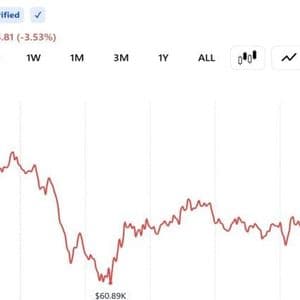
Bitcoin has recorded its worst weekly performance since the 2022 FTX collapse, sliding below $60,000 in a rout that erased roughly $390 billion in crypto market value. A Drawdown Not Seen Since 2022 Bitcoin closed out one of its ugliest stretches in years, dropping about 17.3% while ether fell roughly 22%, the largest weekly declines
10 Jun 2026, 08:27
Bitcoin Has Crashed 50% And I'm Still Buying One Bitcoin Through BTCI

Summary Bitcoin has fallen 50% from its October 2025 high, yet I continue to aggressively dollar-cost average into BTCI and currently own 34% of a Bitcoin. I share my investment portfolio's BTCI position performance and key insights. I'm using BTCI to build long-term gains and convert volatility into monthly income to help offset my bills and become financially independent. Summer has started, and the crypto winter just got even colder. In eight months, Bitcoin is down 50% from its all time high of $126,200 in October 2025, but here's why I love it: I'm still buying one Bitcoin via the NEOS Bitcoin High Income ETF ( BTCI ). I currently own 34% of a Bitcoin via BTCI across several investment accounts. Since a majority of my purchases remain, I believe dollar-cost averaging into BTCI will allow me to create a significant long-term gain while managing risk by converting Bitcoin's volatility into monthly income. BTCI generates high, tax-efficient monthly income using covered calls on Bitcoin ETPs/futures, while capturing a portion of the potential price appreciation by holding Bitcoin itself via the ETFs iShares Bitcoin Trust ETF ( IBIT ) and VanEck Bitcoin ETF ( HODL ). I encourage readers not familiar with the mechanics of the NEOS funds to read my articles on NEOS S&P 500((R)) High Income ETF ( SPYI ) or NEOS NASDAQ-100((R)) High Income ETF ( QQQI ), which explain in detail how these funds are managed. BTCI operates the same as these ETFs but targets a distribution yield of 24-30% with a 0.99% management fee. BTCI vs. Bitcoin All-time Highs to June 2026 (Seeking Alpha) The fundamental reason I hold BTCI over pure Bitcoin and other Bitcoin/crypto options ETFs is twofold. I'm a dividend growth and income investor building financial independence with a portfolio of passive income to offset every single one of my bills, one bill at a time. Therefore, pure Bitcoin has no use in my portfolio unless I sell it. The only way to extract income from Bitcoin is via an options overlay strategy. While I could get higher yields or a slightly different strategy from competing funds, I trust and have had great success with my NEOS holdings. In my last article on BTCI in December 2025, Bitcoin had just corrected 30% from its all-time high, and I saw it as a great buying opportunity. So, I purchased hundreds of shares on top of my $50/day buys I've been doing since the start. Hindsight's always 20/20 as an investor, but over a long-term view, I'm confident when Bitcoin breaks $100,000 again, these purchases will convert to double-digit gains. Bitcoin Max Drawdown History (LinkedIn) But why is Bitcoin crashing so hard while stocks, measured by the S&P 500, are up? Well, the answer is sort of in the question according to Anthony Pompliano , and it's a real domino effect: Record outflows from Bitcoin ETFs can be traced to investors' capital rotation into AI/tech stocks, which have seen major gains YTD. At the same time, geopolitical tensions abroad pushing up oil prices and inflation pressure have delayed an expected Fed rate cut (not helping my UWM Holdings Corporation ( UWMC ) position, by the way). This has created a risk-off environment for Bitcoin, triggering almost $2B in liquidations of leveraged positions, all while Strategy Inc. ( MSTR ) made a symbolic sale of Bitcoin, breaking from Michael Saylor's "never sell" strategy, no pun intended. Based on Bitcoin's max drawdown history trend , analysts have pointed out the drawdowns have become less and less at each cycle correction. A 70% correction, as the above plot points out, would put Bitcoin at $37,860. I, personally, think this is a little steep given the involvement of institutional investors, firms, and sovereign nations. It's likely Bitcoin will continue to be aggressively purchased even more the lower it goes, eventually finding a bottom, if we haven't already, and returning to a bull market in due time. This could take another 6 months to several years, and investors need to be mentally prepared for that: that's why dollar-cost averaging into Bitcoin is so, so important. My BTCI Portfolio Performance I wanted to share how dollar-cost averaging is going with my BTCI positions. I'm buying one Bitcoin through shares of BTCI and currently own the ETF in three different investment accounts: my personal taxable brokerage account, my business brokerage account, and a health savings account ((HSA)). Here are my current stats and insights: Personal BTCI Analysis Shares Cost Basis Total Cost Current Value Total Capital Gain/Loss Total Dividends Total Gain/Loss Taxable Brokerage (Marginable) 490.2 $41.26 $20,224 $13,778 -$6,443 $1,978 -$4,466 Taxable Brokerage (non-marginable) 63.6 $34.01 $2,164 $1,789 -$376 $0 -$376 Business Brokerage 37.8 $45.27 $1,710 $1,062 -$648 $307 -$341 HSA 137.4 $37.41 $5,140 $3,862 -$1,278 $106 -$1,171 Total 728.9 $40.11 $29,237 $20,491 -$8,744 $2,391 -$6,353 I currently own 729 shares, or 33.7% of a Bitcoin, and need 1,433 more shares in order to own one Bitcoin. My overall cost basis of $40.11/share is the equivalent of buying Bitcoin at about $87,000. Accounting for dividends, I'm down -$6,353 on BTCI. Based on a historical distribution payout range of $0.76-$1.57/share, it will take 6-12 months to break even. The main reason I'm not concerned with my paper loss is the math behind the remaining shares I still need to buy to own one Bitcoin's worth. If I were to buy the remaining 1,400 shares at BTCIs current price of $28.11, my cost basis would be $32.15 or about $71,000/Bitcoin, well below my current cost basis and Bitcoin's all-time high. If I were to buy the remaining shares at BTCIs all-time high of $65.97, my cost basis would be $57.26 or $112,000/Bitcoin, well below all-time highs. Risk Analysis The main risk, especially for covered call ETFs, is NAV erosion. I've seen a lot of threads on social media claiming BTCI has NAV erosion, but I don't believe it does. I've experienced NAV erosion with other funds, and it has always occurred while the underlying asset is actually appreciating or staying flat. The only reason BTCI is down is because the underlying asset Bitcoin itself is down, as the earlier image from the past 8 months shows. When you look at the total return of the fund since inception, you'll notice BTCI not only tracks Bitcoin total returns closely but also actually has less downside than pure Bitcoin. BTCI vs. Bitcoin since inception (Seeking Alpha) Dollar-cost averaging is one of the best ways to mitigate against risk on long-term investments, and Bitcoin is definitely no exception. Bitcoin is a highly volatile asset with big drawdowns and even bigger rallies. The volatility coupled with Bitcoin's inability to produce cash flow like a traditional stock and inherent speculative asset pricing is exactly why I believe holding BTCI is a smart way to hold Bitcoin, especially for those interested in producing tax-efficient monthly income and having exposure to Bitcoin. Every monthly distribution helps to manage risk and decrease capital loss potential all while helping me offset my bills, like property taxes, to build financial independence alongside my other, much larger, dividend growth ETF positions. Position sizing is also important with BTCI and covered call funds in general. I prefer for BTCI to have a weight of 5% or less in my investment portfolio long-term and covered call ETFs to be 10-20%. Wealth is created during downturns in the market and your favorite investments. Outlook Remember, nothing about Bitcoin itself has changed: there's still only ever going to be 21 million coins on a decentralized network that can't be inflated like the US dollar is. The shrinking relative supply (amplified by each 4-year halving cycle) combined with the growing institutional demand: Spot Bitcoin ETFs, corporate treasuries, and sovereign wealth funds are all accumulating at a blistering pace: Public companies now own over 1.24 million Bitcoin. Just like Gold, I believe Bitcoin will become more valuable over time as digital capital as the US dollar gets inflated.
10 Jun 2026, 08:24
XRP market shows signs of capitulation as holders sell at loss

XRP holders are capitulating, according to data tracked by Glassnode. That suggests a bottom may be near.
10 Jun 2026, 08:24
XRP ETF Beats Bitcoin, Solana and Ethereum Products: But Why Does Price Struggle?

XRP overtakes Solana, Bitcoin and Ethereum on ETF market, even though the price is yet to follow the trend.
10 Jun 2026, 08:15
World Cup 2026 Prediction Markets Now Live on Whale.io with $90K in Prizes

Mahe, Seychelles, June 10th, 2026, Chainwire Whale.io has launched native Prediction Markets for the 2026 World Cup, giving players direct access to match betting backed by a combined $90,000 prize pool – including a $40,000 USDT raffle and five weeks of $10,000 weekly sports tournaments. Whale.io is giving users the chance to turn their football knowledge into real rewards with a seamless, on-platform prediction experience. This launch brings new betting markets on World Cup 2026 matches directly into the Whale.io ecosystem. Whether you’re a casual fan or a seasoned predictor, you can now engage with the biggest football event in a fun, transparent, and potentially profitable way. $40,000 USDT Raffle – Predict & Win Big To celebrate the launch, Whale.io is dropping a $40,000 USDT Raffle open to all participants in the World Cup 2026 Prediction Markets . Here’s how it works: Place any prediction market bet of $2 or more on a World Cup 2026 market on Whale.io. Each qualifying bet automatically grants one ticket in the Raffle. Predict more → stack more tickets → increase your chances of winning. There are no complicated leaderboards to grind and no minimum win requirements. Every single qualifying prediction you make enters you into the draw. The more you play, the better your odds. Every $2 = 1 ticket. It’s that simple: Predict. Compete. Win Big. The raffle gives every participant – from high-volume predictors to occasional players – a fair shot at sharing the $40,000 USDT prize pool. $50,000 Sports Tournaments – 5 Weeks of Action On top of the Prediction Markets and raffle, Whale.io is running Sports Tournaments for the next 5 weeks with a total prize pool of $50,000 USDT – that’s $10,000 USD in prizes every single week of World Cup. These weekly tournaments reward the sharpest sports bettors across all major events, giving consistent performers multiple ways to win big during this massive football season. This combined offering – Prediction Markets, the $40K raffle, and $50K in weekly tournaments – delivers one of the most rewarding sports experiences available in crypto right now. Why Whale.io Prediction Markets Stand Out All markets run directly on the Whale.io platform – fast, secure, and fully integrated with your existing Whale balance. No bridging, no external sites. Users can easily manage positions, track predictions, and enjoy the thrill of World Cup 2026 as it unfolds. Combined with Whale.io’s signature massive cashback, instant payouts, and strong focus on transparency, this launch reinforces Whale.io’s position as the go-to destination for players who want both entertainment and real earning potential. Whether you’re passionate about football or simply love turning insights into profits, now is the perfect time to join the action. World Cup 2026 Prediction Markets are live now. Head over to whale.io/wc2026 , explore the new markets, place your first predictions, and start collecting raffle tickets today. The biggest football event of the year is here – and so are the biggest rewards. About Whale.io Whale.io is a crypto-native online casino and sportsbook. The platform features exclusive Whale Originals games, a full sportsbook, Prediction Markets, Daily Cashback, and a strong emphasis on transparency. With $WHALE as its native utility token, Whale.io continues to build one of the most rewarding ecosystems in crypto gaming. Users can discover the future of Whale.io Casino and Whale Prediction Markets by checking them out here: More information available on whale.io/wc2026 Whale socials: https://linktr.ee/whalesocials_tg Contact Whale Spokesperson Whale.io [email protected]
10 Jun 2026, 08:10
Is Bitcoin Cheap? Grayscale Weighs in

A new Grayscale report suggests the cryptocurrency is technically undervalued.


