


 Invest ideas
News
4 Jun 2026, 13:15
Bankless Co-Founder David Hoffman Discloses Entry Prices for NEAR, HYPE, and ZEC Holdings

BitcoinWorld Bankless Co-Founder David Hoffman Discloses Entry Prices for NEAR, HYPE, and ZEC Holdings David Hoffman, co-founder and host of the popular crypto podcast platform Bankless, has publicly disclosed his average entry prices for several cryptocurrencies in a post on X. The disclosure provides a rare window into the portfolio strategy of a prominent figure in the decentralized finance space. Entry Prices and Current Market Value According to Hoffman’s post, his average purchase prices are as follows: NEAR Protocol (NEAR) at $1.40 per token, Hyperliquid (HYPE) at $45 per token, and Zcash (ZEC) at $560 per token. At the time of reporting, these assets are trading at $2.42, $67.23, and $538.10 respectively. This means his NEAR and HYPE positions are currently in profit, while his ZEC holding is slightly underwater based on the disclosed entry price. Context of the Portfolio Move Hoffman revealed that he sold all of his Ethereum (ETH) holdings on May 21 to reallocate capital into a basket of five assets: VVV, NEAR, ZEC, HYPE, and LIT. This move represents a significant strategic shift away from the second-largest cryptocurrency by market capitalization. The timing of the sale and the selection of these specific assets suggest a conviction in Layer 1 protocols, privacy coins, and emerging DeFi infrastructure. Why This Matters to Investors Public disclosures of entry prices by well-known crypto figures can influence market sentiment and provide retail investors with reference points for their own analysis. However, it is important to note that such disclosures are not investment advice and reflect personal conviction rather than guaranteed performance. The volatility inherent in these assets means that entry prices can quickly become outdated. Implications for the Market Hoffman’s shift from ETH to these smaller-cap assets may signal a broader rotation within the crypto market, where investors are seeking higher-risk, higher-reward opportunities outside of blue-chip cryptocurrencies. NEAR Protocol has been gaining attention for its sharding technology, while Hyperliquid is a relatively newer entrant in the perpetual futures DEX space. Zcash, a long-standing privacy coin, continues to have a dedicated following despite regulatory headwinds. Conclusion David Hoffman’s public portfolio disclosure offers a transparent look at the thinking of a seasoned crypto commentator. While his entry prices provide a useful benchmark, market conditions can change rapidly. Investors are advised to conduct their own research and consider their risk tolerance before making any trading decisions. FAQs Q1: What were David Hoffman’s disclosed entry prices for NEAR, HYPE, and ZEC? A1: He disclosed an average entry price of $1.40 for NEAR, $45 for HYPE, and $560 for ZEC. Q2: Why did David Hoffman sell his Ethereum holdings? A2: He stated on May 21 that he sold all his ETH to purchase VVV, NEAR, ZEC, HYPE, and LIT, indicating a strategic reallocation of his portfolio. Q3: Are these entry prices still accurate for current market conditions? A3: No, the prices reflect his purchase cost at the time of acquisition. Current market prices for these assets differ and are subject to volatility. This post Bankless Co-Founder David Hoffman Discloses Entry Prices for NEAR, HYPE, and ZEC Holdings first appeared on BitcoinWorld .
4 Jun 2026, 13:11
Grayscale Research Head Says XRP ETFs Could Capture 5-6% of XRP Supply

Grayscale's Head of Research, Zach Pandl, recently suggested that XRP ETFs could take up about 5% to 6% of XRP's circulating supply in the near future. He made this projection during a recent appearance on the Paul Barron Podcast, where both speakers discussed the impressive rise of XRP-based investment products. Visit Website
4 Jun 2026, 13:10
CoinDesk 20 performance update: Bitcoin Cash (BCH), up 1.5%, is only gainer
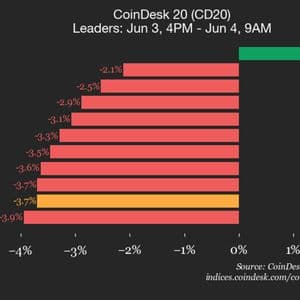
NEAR Protocol (NEAR) declined 15.2% and Internet Computer (ICP) dropped 13.1%, leading the index lower.
4 Jun 2026, 13:10
Binance to Launch ZESTUSDT and BTWUSDT Perpetual Futures With Up to 10x Leverage
BitcoinWorld Binance to Launch ZESTUSDT and BTWUSDT Perpetual Futures With Up to 10x Leverage Binance, the world’s largest cryptocurrency exchange by trading volume, has announced the listing of two new perpetual futures contracts: ZESTUSDT and BTWUSDT. The ZESTUSDT contract is scheduled to go live at 2:00 p.m. UTC today, followed by the BTWUSDT contract at 2:15 p.m. UTC. Both contracts will support up to 10x leverage, offering traders additional flexibility in their derivatives strategies. Contract Details and Timeline The new perpetual futures will be settled in USDT, Binance’s primary stablecoin for margin trading. Perpetual futures differ from traditional futures in that they have no expiration date, allowing traders to hold positions indefinitely as long as margin requirements are met. The 10x leverage cap means traders can amplify their exposure up to ten times the value of their collateral, though this also increases risk. Binance has not yet disclosed the underlying projects behind the ZEST and BTW tickers. However, listings on major exchanges often lead to increased liquidity and price discovery for newly introduced tokens. Traders should verify the contract specifications, including funding rates and maintenance margin levels, before engaging with these instruments. Market Context and Implications The addition of new perpetual futures contracts is a routine but significant activity for Binance, which maintains one of the largest derivatives markets in crypto. For traders, new listings can present both opportunities and risks. Early liquidity may be thin, leading to potential slippage, while funding rate volatility can impact the cost of holding positions over time. Binance has been expanding its derivatives offerings steadily, responding to demand for leveraged exposure to emerging tokens. The exchange’s listing process typically involves rigorous due diligence, though the specific criteria for ZEST and BTW remain undisclosed. Market participants should monitor official Binance announcements for any updates regarding margin tiers or risk limits. What This Means for Traders For active derivatives traders, these new contracts provide additional avenues for speculation and hedging. The 10x leverage cap is relatively conservative compared to Binance’s maximum offerings on major pairs, which can reach 125x. This suggests Binance may be exercising caution with newer or less liquid assets. Traders should also be aware that perpetual futures carry unique risks, including potential liquidation during volatile market conditions. As with any leveraged product, position sizing and risk management are critical. The launch timing—two contracts rolling out within 15 minutes of each other—may create overlapping trading activity, so traders should plan their entries accordingly. Conclusion Binance’s listing of ZESTUSDT and BTWUSDT perpetual futures expands the exchange’s derivatives catalog and offers traders new opportunities for leveraged exposure. While the underlying projects remain unconfirmed, the contracts are set to go live later today with standard perpetual futures mechanics. Traders are advised to review all contract specifications and manage risk appropriately before trading. FAQs Q1: What are perpetual futures? Perpetual futures are derivative contracts that allow traders to speculate on the price of an asset without an expiration date. They use a funding rate mechanism to keep the contract price close to the spot price. Q2: What does 10x leverage mean? With 10x leverage, a trader can open a position worth ten times their collateral. For example, $100 in margin can control a $1,000 position. While this amplifies potential profits, it also increases the risk of liquidation. Q3: When will the contracts be available? The ZESTUSDT contract launches at 2:00 p.m. UTC today, and the BTWUSDT contract launches at 2:15 p.m. UTC today. Both will be available on Binance’s futures platform. This post Binance to Launch ZESTUSDT and BTWUSDT Perpetual Futures With Up to 10x Leverage first appeared on BitcoinWorld .
4 Jun 2026, 13:09
Bitcoin’s $20K Collapse: 6 Reasons Behind the Crash and What Happens Next?

Bitcoin is currently knocking on the door that helped it bounce during the February crash at $60,000. The asset dumped toward $61,000 earlier today, which was hard to imagine just a few weeks ago when it traded above $82,000. So, what could have prompted this massive 25% crash in well less than a month? Investor Exodus In general, falling prices require somebody selling, right? And it has to be in large quantities. The first that comes to mind are investors who had BTC exposure through the spot Bitcoin ETFs in the US. A simple look at the data provided from SoSoValue paints a clear and painful picture. The funds have been deep in the red for 13 consecutive days, with the net outflows exceeding $500 million, $600 million, and even $700 million on some occasions. The net withdrawals have been in the billions of dollars for four straight weeks. The current one, even though the data is presented only until Wednesday, is on track to break the record, with already $1.4 billion in outflows. This behavior is in stark contrast to the developments that took place by mid-May, when investors were rushing to pour funds into the ETFs. Bitcoin ETF Flows. Source: SoSoValue But, it’s not just ETF investors. Data shared by Ali Martinez shows a substantial uptick in the number of BTC sent to exchanges over the past week alone. Roughly 54,000 BTC (valued at $3.35 billion at today’s prices and at almost $3.8 billion when the transfers began) found their way to trading platforms, with the likely intention to be sold off. 54,000 Bitcoin bitcoin:native moved onto trading platforms over the past week. This spike in available supply of roughly $3.78 billion has increased short-term selling pressure, driving the price down to $65,300. https://t.co/AXEpKJPyND pic.twitter.com/pa5WPZXzUt — Ali Charts (@alicharts) June 3, 2026 Strategy also sold . Yes, this one was speculated for weeks, but the actual confirmation could have been the necessary trigger for some investors to lose hope. Although the company disposed of a tiny portion of its massive BTC stash, the move was still categorized as bearish by many critics. Mt. Gox also spread some FUD into the already fragile market, as on-chain data shows new BTC transfers to exchanges completed recently. Iran-US and AI A more macro reason came from the war front between the US and Iran (and several nearby nations). After weeks of a ceasefire but unsuccessful permanent peace negotiations, the US and Iran reinitiated the attacks against each other, which now involve Kuwait and other countries in the region as well. History shows that risk-on assets like BTC do not react well to escalating war tensions. Recall that the asset dumped by several grand immediately after the initial strikes began in late February. Lastly, Michael Saylor outlined the massive growth and hype of the artificial intelligence sector. He believes there’s a clear correlation between investor exodus from crypto and booming AI prices, which continues to harm the former’s progress. Nevertheless, he actually noted that such moments present opportunities. Capital markets are funding the AI buildout at historic scale: ~$400B over 6 months. Bitcoin ETFs have seen ~$4B of outflows since May 14, pressuring $BTC . This is a capital rotation, not a Bitcoin impairment. Volatility creates opportunity. — Michael Saylor (@saylor) June 4, 2026 So, What’s Next? As usual, most crypto analysts are split on what could be around the corner for BTC. Some think a rebound is in the making, while others outlined lower price targets. Ali Martinez stands in the second corner. Basing his analysis on the MVRV pricing bands, he predicted that BTC could be on its way down to $55,000 or even $50,000. It’s worth noting that the cryptocurrency hasn’t traded at such low levels for almost two years. CryptoQuant’s CEO, though, noted that there’s one major difference between bitcoin’s current state and that of two years ago. Although the price is relatively similar, he noted that short-term holders are “evolving into long-term holders” now, as the percentage of holdings from investors who had bought from 6 months to 2 years ago is up to 53% from 15% back in 2024. Bitcoin is at the same price as two years ago, but one thing is different. The 6m–2y cohort, who joined this cycle, now holds 53% of realized cap, up from 15% two years ago. Last cycle, Bitcoin bottomed when this hit 68%. Short-term holders are evolving into long-term holders. pic.twitter.com/tfmLz3mFPS — Ki Young Ju (@ki_young_ju) June 4, 2026 The post Bitcoin’s $20K Collapse: 6 Reasons Behind the Crash and What Happens Next? appeared first on CryptoPotato .
4 Jun 2026, 13:07
SBI CEO Says CLARITY Act Could Spark a Crypto Boost With Ripple in the Spotlight

SBI’s Yoshitaka Kitao Says U.S. CLARITY Act Could Boost Ripple and the Wider Crypto Market SBI Holdings Chairman, President, and CEO Yoshitaka Kitao has reinforced the growing institutional optimism around U.S. crypto regulation, saying clearer rules could lift the entire digital asset market, including Ripple. While echoing a view gaining traction among institutional players that regulation is shifting from headwind to catalyst, Kitao noted : “I am convinced that if the CLARITY Act is enacted in the United States, it will bring a positive impact to the cryptocurrency market, including Ripple.” His comments come at a pivotal moment, as the CLARITY Act has now been placed on the U.S. Senate Legislative Calendar. While this is still an early procedural stage, it indicates the bill has moved beyond committee-level drafting and is now positioned for formal debate. For the crypto sector, this progression signals momentum, even if the legislative path will take some time. Well, the CLARITY Act will still need to pass through reconciliation between Senate and House versions before reaching the President even if it sees the light of day in the Senate. Looking at the bigger picture, the current trajectory is increasingly being read as a slow but steady reduction in U.S. regulatory ambiguity, an important shift for assets like XRP, which are closely tied to cross-border payments and financial infrastructure use cases. SBI’s Kitao Sees CLARITY Act as a Turning Point for XRP’s Institutional Future Kitao’s remarks also carry added weight given SBI Holdings’ long-standing strategic alignment with Ripple through blockchain-based payments and liquidity initiatives. This partnership has frequently placed SBI at the center of discussions on real-world crypto utility, particularly in remittance and banking corridors. At a broader industry level, the thesis is straightforward because clearer definitions and regulatory frameworks reduce compliance risk, improve exchange accessibility, and create conditions for deeper institutional XRP participation. In this environment, attention gradually shifts away from speculation toward infrastructure development and adoption. What’s next? Well, time will tell since Senator Cynthia Lummis has suggested that final Senate approval of crypto market structure legislation, including the CLARITY Act framework, may take longer than anticipated as lawmakers continue refining key provisions. Even so, sentiment across the market remains cautiously constructive. Each incremental step in the CLARITY Act legislative process is increasingly being viewed as part of a broader structural transition, one that could ultimately shape how digital assets like XRP are integrated into the regulated global financial system.


