


 Invest ideas
News
29 May 2026, 10:50
Germany moves to obtain tax-related user info from crypto service providers

The federal government in Germany is now requiring crypto service providers to submit tax-related user information to the state. The data will be shared with other nations, both within the EU and beyond, to allegedly make taxable coin transactions more transparent. German authorities to receive tax reports from crypto platforms The executive power in Berlin has approved a new requirement for cryptocurrency firms to collect and file user info with the German tax authority. The data will be submitted annually to the Federal Central Tax Office (BZSt) and automatically exchanged with similar bodies in other countries. The new tax reporting obligation was announced by the Ministry of Finance, the leading German crypto news outlet BTC Echo unveiled Thursday. In a post on X the previous day, the department indicated the goal was to increase the transparency of tax-relevant transactions involving digital assets. What will change for cryptocurrency investors? The immediate effect for crypto users in Germany will be that the state will no longer rely solely on tax returns to learn about their activities, but also on reports from regulated market participants. The federal government’s decision is part of a comprehensive package of measures meant to improve and expand the exchange of tax information to cover digital currencies like Bitcoin and Ethereum. It will apply not only to transactions through crypto exchanges and service providers but also to other fintech platforms and financial accounts as well. All of them will be required to report clients’ revenues to the German tax authority, which will then share the data with counterpart agencies in other EU member states. In turn, it will receive intelligence on German income generated abroad. The finance ministry also noted that a new supplementary agreement will enable this kind of exchange with relevant authorities in countries outside the European Union. Germany’s crypto business faces growing regulatory burden The update in the tax reporting rules will further increase the regulatory pressure on the blockchain industry in the Bundesrepublik, BTC Echo remarked in its article. Following the implementation of European regulations such as the Markets in Crypto Assets ( MiCA ) law and the DAC8 directive, which entered into force this year, officials are now shifting focus toward tracing digital currency flows. Licensed crypto service providers will now have to properly prepare for the additional reporting procedures, while clients can expect their transactions to become much more visible to tax authorities. On a positive note, a tax benefit for cryptocurrency owners recently survived an attempt to remove it in the German parliament, as reported by Cryptopolitan earlier in May. A bill put forward by the Green party, which is targeting a tax exemption for long-term digital-asset investments, was rejected by other factions in the Bundestag. Capital gains from the selling of cryptocurrencies more than a year after purchase are tax-free in Germany, and the proposal sought to abolish the “holding period” rule. The future of this particular tax relief remains uncertain, however, as political support for its removal is growing in Berlin. The Social Democratic Party, which favors stiffer crypto taxation, is expecting its finance minister Lars Klingbeil to unveil his proposals on the matter. German authorities have been trying to support the country’s weakened economy through increased government spending. The smartest crypto minds already read our newsletter. Want in? Join them .
29 May 2026, 10:42
DxSale drained for $7.3M in BNB Chain liquidity exploit

DxSale was drained for about $7.3 million from BNB Chain liquidity providers, raising fresh concerns over old DeFi locker contracts.
29 May 2026, 10:38
Bitcoin ETF outflows reach record nine-day streak as investors pull $2.8 billion
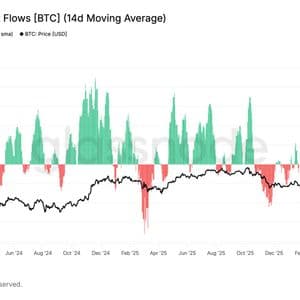
The longest run of withdrawals since U.S. spot bitcoin ETFs listed in January 2024 comes as bitcoin underperforms high-flying AI and semiconductor stocks.
29 May 2026, 10:31
Bitcoin Price Prediction: Wall Street Monopoly, And Next Week Expectation

Bitcoin price pullback has been controlled for years now; it could be up and down even when prediction and sentiment point in the opposite direction. Why? Bitcoin $73,000 retreat follows a failed attempt to sustain levels in the $77,000, after a strong prior leg and a rotation out of high-beta assets tied to geopolitical tensions. Derivatives data, though, shows that the structure remains bullish, yet liquidation risk around crowded upper levels is still there. Bitcoin pinned below $73,000 despite potential U.S.-Iran deal news pic.twitter.com/fA6NvyDOFe — maim (@_0xmaim) May 28, 2026 There is an ascending trendline on lower timeframes at $75,000 as the short-term support, and the conversation shifts fast toward $72,000 and even $60,000 as very bearish downside targets. Meanwhile, the institutional machinery that now surrounds Bitcoin continues reshaping who actually controls access to this market. Discover: The Best Crypto to Diversify Your Portfolio Bitcoin Price Prediction: Is $80,000 Getting Further Away? At $73,500, Bitcoin sits in a technically compressed zone. Immediate support sits at $72,000, with a deeper cushion around $68,900. Resistance above current spot: $75,000 first, then $78,000 if price closes convincingly through that initial barrier. Volatility bands frame the broader envelope between $72,500 on the downside and $82,500 on the upside. Short-term technical analysis reinforces a pivotal resistance cluster at $78,500 and support between $65,000–$66,000. If Bitcoin can hold $73,000 and absorb selling pressure. It might as well close above $74,000, and open a run toward $76,000 and potentially $78,000 on strong ETF inflows and soft inflation data. Bitcoin (BTC) 24h 7d 30d 1y All time However, a close below $68,900 shifts the structure bearish, with medium-term targets at $66,000 and $60,000 coming back into play, per analyst warnings. Spot Bitcoin ETF flows remain the dominant structural variable. CryptoQuant data shows whale buying has stalled , a pattern that historically precedes either a sharp accumulation event or a capitulation leg, rarely a slow grind. Discover: The Best Token Presales Bitcoin Hyper Targets Early-Stage Upside as Bitcoin Consolidates at Resistance Bitcoin is far away from its all-time high and might sound bullish. But being a monster asset as it is, the math on 10x returns gets uncomfortable fast. That’s where early-stage infrastructure plays enter the frame, especially projects building on Bitcoin’s rails rather than simply tracking its price. Bitcoin Hyper ($HYPER) is positioning itself as exactly that. It claims to be the first-ever Bitcoin Layer 2 integrating the Solana Virtual Machine (SVM), delivering what it describes as faster performance than Solana. It boasts a sub-second finality with low-cost smart contract execution, while preserving Bitcoin’s underlying security. The project’s Decentralized Canonical Bridge enables native BTC transfers across the layer. Presale price is $0.01368 , with $32 million raised to date. Staking is live with high APY. Research Bitcoin Hyper and review the presale details here. The post Bitcoin Price Prediction: Wall Street Monopoly, And Next Week Expectation appeared first on Cryptonews .
29 May 2026, 10:29
CFTC and Gemini vacate $5M settlement, end allegations of BTC futures misrepresentation

The U.S. CFTC and Gemini Trust Company LLC have agreed to vacate a $5 million settlement, ending allegations of Gemini’s misrepresentation of BTC futures contracts. The CFTC reviewed the investigation’s history, evidence, and charging decision and considered changes in federal digital asset policy, resolving the matter. For context, the parties entered into a consent order in January 2025 regarding a case originally filed in the U.S. District Court for the Southern District of New York in June 2022. They then jointly moved the Court (through their undersigned counsel) earlier this month to vacate the Consent Order for Permanent Injunction, Civil Monetary Penalty, and Other Equitable Relief entered on January 6, 2025. The CFTC concluded that the complaint should never have been filed and would not have been under the current enforcement standards. In particular, the CFTC review found that the complaint was based on a whistleblower’s account that is known to be lacking in credibility. The investigation pursued Gemini (the fraud victim) for purported false statements to the CFTC during the registration application process, rather than focusing on the alleged fraudsters. Those red flags raised serious questions about the strength of the evidence against Gemini. Continuing consent order enforcement does not serve public interest The CFTC determined that continuing enforcement of the consent order serves neither the CFTC’s mission nor the public interest. The parties now agree that the consent order’s non-prospective provisions, such as its imposition of a civil monetary penalty, have already been satisfied. They also agree that applying the remaining provisions, including injunctive relief, would not be equitable. “This result sends a strong message that the Commission will act to safeguard the integrity of the market oversight process, regardless of whether the market involves complex digital asset derivative products or more traditional commodity futures.” – Ian McGinley , director of enforcement at the CFTC The complaint initially put the CFTC’s internal deliberations at issue because the requested evidentiary support was withheld from a Commissioner while the regulator voted on the complaint against Gemini. However, litigation counsel invoked the deliberative process privilege and interposed objections to prevent Gemini from obtaining evidence necessary to defend itself. Additionally, personnel improperly exerted influence over the CFTC’s regulatory authority to create settlement leverage. These findings call into question the CFTC’s enforcement process in this case. They also demonstrate the necessity of the federal government’s revised enforcement approach and standards, including in the digital asset space. Joint motion for relief captures major shift in U.S. approach to crypto The joint motion for relief from judgment captures a major shift in how the U.S. is currently approaching crypto. The CFTC joining an exchange (the defendant) to undo its own consent order is a rare move that highlights a fast-moving regulatory reset. Filing a Rule 60(b) motion with a crypto firm they previously prosecuted also highlights the CFTC’s admission that the 2022 case relied on weak evidence and should never have been brought to court. It is direct evidence of how fast new leadership can shift enforcement policy. Moreover, although the $5 million fine has been paid and is no longer outstanding, this motion targets the permanent injunction. Erasing this rule allows Gemini Trust Company LLC to operate without “regulatory shadows.” There is also a strong indication of a coordinated multi-agency shift , as this case can be directly tied to the U.S. SEC’s recent dropping of its Gemini Earn lawsuit. In a rare regulatory U-turn, the joint filing marks the clearest sign yet of the federal digital assets reset that has transformed past “regulation by enforcement” into an active unwinding of legacy cases. The CFTC is not just dropping a case; it is actively teaming up with Gemini to erase a past victory from the books. At the same time, Gemini has been expanding into CFTC-regulated derivatives and prediction markets. The crypto firm is advancing its expansion through its licensed subsidiaries, Gemini Titan and Gemini Olympus. The smartest crypto minds already read our newsletter. Want in? Join them .
29 May 2026, 10:29
Bitcoin slides to April lows as crypto diverges from record-chasing U.S. equities
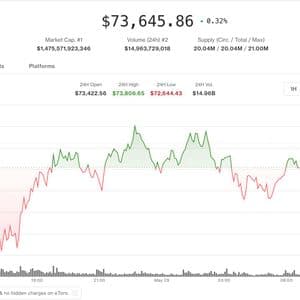
Bitcoin's failed breakout above $83,000 is looking increasingly like a bear market signal, even as S&P 500 and Nasdaq futures notch gains and approach all-time highs.


