


 Invest ideas
News
28 May 2026, 12:45
Traders Watch BTC Slip Below Key Moving Averages as Bears Put Pressure on $73K
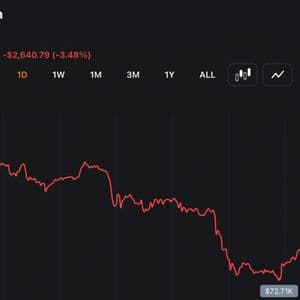
Bitcoin held a narrow intraday range of $72,622 to $76,047 on Thursday, as bears maintained structural control across multiple timeframes. Price action on the 1-hour, 4-hour, and daily charts all pointed to a market searching for directional conviction near multi-week lows. Bitcoin Chart Outlook The 1-hour chart showed bitcoin consolidating around $73,000 after buyers defended
28 May 2026, 12:40
Nearly $500 Million in Crypto Futures Liquidated in Single Hour as Market Sell-Off Intensifies

BitcoinWorld Nearly $500 Million in Crypto Futures Liquidated in Single Hour as Market Sell-Off Intensifies The cryptocurrency market experienced a sharp and sudden downturn in the past hour, triggering the liquidation of approximately $495 million in leveraged futures positions across major exchanges. Data from market tracking sources confirms that this rapid cascade of forced sell-offs has contributed to a 24-hour total exceeding $960 million in liquidations, marking one of the most significant deleveraging events in recent weeks. Breakdown of the Liquidation Cascade The majority of the liquidations occurred on Binance, OKX, and Bybit, with long positions bearing the brunt of the losses. As Bitcoin and Ethereum prices dropped sharply within a 30-minute window, automated liquidation engines on these platforms triggered a chain reaction. When the price of Bitcoin fell below a key support level, it forced the closure of highly leveraged longs, which in turn added selling pressure, driving prices lower and liquidating additional positions. This feedback loop is a well-documented phenomenon in crypto markets, where high leverage amplifies both gains and losses. Market Context and Contributing Factors While no single catalyst has been officially confirmed, several factors likely contributed to the sudden volatility. A broader risk-off sentiment in traditional markets, combined with profit-taking after a recent rally, may have created conditions for a sharp correction. Additionally, on-chain data showed a significant increase in exchange inflows prior to the drop, suggesting that large holders or whales were preparing to sell. The concentrated nature of the liquidation event, with nearly half of the 24-hour total occurring in a single hour, indicates a coordinated or coincidental exit by multiple large traders. Impact on Traders and Market Structure For individual traders, the event serves as a stark reminder of the risks associated with high leverage in volatile markets. Many leveraged positions were opened with 10x to 50x leverage, meaning that a 2% to 5% price move against them was sufficient to wipe out their entire margin. The liquidation data also highlights the concentration of risk on centralized exchanges, where cascading liquidations can occur rapidly due to the interconnected nature of order books and funding rates. The open interest across major futures contracts has dropped significantly, suggesting that market participants are now deleveraging and reducing risk exposure. Conclusion The $495 million single-hour liquidation event underscores the persistent fragility of leveraged cryptocurrency markets. While such events are not uncommon, their intensity and speed can create significant dislocations in pricing and liquidity. Traders and investors should remain cautious, particularly in periods of low liquidity or heightened macroeconomic uncertainty. The coming days will be critical in determining whether this is a temporary correction or the beginning of a deeper trend reversal. FAQs Q1: What does ‘liquidation’ mean in cryptocurrency futures trading? A1: Liquidation occurs when a trader’s position is forcibly closed by the exchange because the margin balance has fallen below the required maintenance level, typically due to an adverse price movement. This is a standard risk management mechanism in leveraged trading. Q2: Why did such a large liquidation happen in just one hour? A2: A rapid price drop triggered automated liquidations of highly leveraged long positions. These forced sell-offs added to the selling pressure, causing prices to fall further and liquidating additional positions in a cascading effect. The concentration of leverage on a few exchanges accelerated the process. Q3: How does this affect the overall cryptocurrency market? A3: Large liquidations can lead to increased volatility and temporary price dislocations. They reduce open interest and market leverage, which can stabilize the market in the short term. However, they also signal that traders were overly optimistic, and the event may dampen sentiment until confidence is restored. This post Nearly $500 Million in Crypto Futures Liquidated in Single Hour as Market Sell-Off Intensifies first appeared on BitcoinWorld .
28 May 2026, 12:40
DTCC to Integrate Tokenized Assets on Stellar XLM

The Depository Trust & Clearing Corporation (DTCC), a Wall Street central clearinghouse that processes $2.5 quadrillion in securities transactions annually, announced plans Wednesday to connect its tokenized securities platform to the Stellar network by the first half of 2027. This is the first time DTC-custodied securities will live on a public chain. This will also bring the core of U.S. market infrastructure onto an open ledger, and to do it under an SEC no-action letter that covers Russell 1000 stocks, ETFs, and U.S. Treasuries. Today, @The_DTCC and SDF are announcing plans to enable the tokenization of DTC-custodied assets on Stellar. The connection supports the rapid conversion of traditional assets into tokenized form, and the full asset lifecycle, including corporate actions and reporting. pic.twitter.com/jSBbtA6Dzx — Stellar (@StellarOrg) May 27, 2026 Discover: The Best Crypto to Diversify Your Portfolio DTCC-Stellar Integration Mechanism DTCC’s Depository Trust Company retains the authoritative legal record, or the so-called “golden record,” while Stellar hosts a synchronized on-chain representation of the same asset. The blockchain token functions as a mirrored record. This embedded in the SEC’s December 2025 no-action letter, is what makes broker-dealer and ATS integration legally tractable. The integration will support issuance, settlement, and lifecycle management of blockchain-based versions of traditional securities, with explicit plans to extend into highly liquid assets, including major indices and U.S. Treasury debt instruments. Post-trade settlement on Stellar compresses the timeline from T+1 to near-instantaneous finality, freeing collateral, reducing counterparty exposure, and enabling markets to operate outside standard trading hours. DTCC is not stopping at Stellar. Nadine Chakar, DTCC’s global head of digital assets, confirmed the firm plans to connect to “multiple layer-1 and layer-2 networks,” framing Stellar as the first node in a deliberate multi-chain strategy. DTCC and the Stellar Development Foundation announced today plans to enable the tokenization of DTC‑custodied assets on the @StellarOrg network. This collaboration advances DTCC’s multi chain strategy and expands how traditional assets move across digital ecosystems.… pic.twitter.com/bdeX0JmDGY — DTCC (@The_DTCC) May 27, 2026 Chakar also noted that Stellar is first because of its compliance-oriented design, built-in asset clawback and restricted transfer features, and an established track record with regulated institutions, including MoneyGram and Circle’s USDC. The RWA tokenization narrative has been building for two years. What has been missing is a systemically important institution putting its own custodied inventory on a public chain under a regulatory framework that holds. Frank La Salla, DTCC’s President and CEO, stated the collaboration “represents another step forward in DTCC’s efforts to build an open, interoperable digital infrastructure that bridges traditional and digital markets.” Discover: The Best Token Presales Sets in Motion for Market Structure The immediate forward pressure is on competing CCPs and central securities depositories globally. If DTCC’s model produces clean outcomes through 2027, the blueprint becomes exportable. Other market infrastructures watching regulatory outcomes in the U.S. will face direct institutional pressure to replicate or fall behind. RIPPLE PARTNER SECURITIZE JUST POSTED THIS: „TOKENIZATION IS GOING TO ALLOW US TO DO IS GO 24 BY 7, 365 VIA THE INTERNET, DISTRIBUTED EVERYWHERE IN THE WORLD. MOVE CAPITAL AS YOU & I SLEEP – WE‘RE GOING TO HAVE TO CHANGE THE TECHNOLOGY!“ pic.twitter.com/gCeTzXJ0zP — 𝓐𝓶𝓮𝓵𝓲𝓮 (@_Crypto_Barbie) May 26, 2026 Analysts expect DTCC to run additional pilots testing intraday tokenized settlement, corporate actions processing, and cross-chain interoperability between Stellar and permissioned ledgers before expanding the eligible asset set. The legislative environment around digital asset infrastructure will determine how quickly this expansion happens. Tens of billions in Treasuries and money-market fund shares are already tokenized across siloed platforms. DTCC bringing its own custodial inventory on-chain collapses the distance between pilot-scale tokenization and core market plumbing. Discover: The Best Crypto to Diversify Your Portfolio The post DTCC to Integrate Tokenized Assets on Stellar XLM appeared first on Cryptonews .
28 May 2026, 12:35
Jeffrey Huang’s Latest ETH Liquidation Pushes Total Losses to Nearly $34 Million
BitcoinWorld Jeffrey Huang’s Latest ETH Liquidation Pushes Total Losses to Nearly $34 Million Taiwanese singer and cryptocurrency investor Jeffrey Huang has suffered another significant leveraged Ethereum (ETH) long position liquidation, according to data shared by on-chain analytics account ai_9684xtpa. The latest event involved a 25x leveraged position of 5,950 ETH, which was liquidated on the Hyperliquid platform moments ago, resulting in a loss of approximately $555,000. Total Losses Mount to Nearly $34 Million This latest liquidation brings Huang’s estimated total losses from his ETH futures investments to nearly $34 million. The substantial figure highlights the high-risk nature of leveraged trading, even for experienced market participants. Huang, known for his music career and as the founder of the Mithril blockchain project, has been active in the cryptocurrency space for years, but his recent trading activity has drawn significant attention due to the scale of the losses. The Mechanics of the Liquidation Data indicates that the liquidation occurred on Hyperliquid, a decentralized exchange (DEX) known for its perpetual futures trading. A 25x leverage multiplier means that Huang was controlling a position 25 times the size of his collateral. When the price of ETH moved against his long position, the exchange automatically closed the trade to prevent further losses, resulting in the $555,000 loss. This event is part of a broader pattern of high-leverage liquidations affecting traders during periods of market volatility. Implications for Retail and Institutional Traders Huang’s experience serves as a cautionary tale about the dangers of excessive leverage in cryptocurrency futures markets. While leveraged trading can amplify gains, it equally magnifies losses, and liquidations can occur rapidly during sharp price movements. The total loss of $34 million underscores how quickly positions can be wiped out, even for well-capitalized individuals. Market analysts often advise traders to use lower leverage and implement strict risk management strategies to avoid such catastrophic outcomes. Conclusion The latest liquidation of Jeffrey Huang’s ETH position adds to a growing list of high-profile losses in the crypto derivatives market. As Ethereum continues to experience price fluctuations, traders are reminded of the inherent risks associated with high-leverage strategies. Huang’s total losses now stand at nearly $34 million, a figure that reinforces the importance of prudent risk management in volatile asset classes. FAQs Q1: What is a leveraged liquidation in cryptocurrency trading? A leveraged liquidation occurs when a trader’s position is automatically closed by an exchange because the margin (collateral) falls below the required maintenance level due to adverse price movements. This is common in futures trading with high leverage. Q2: How much did Jeffrey Huang lose in his latest ETH liquidation? According to on-chain data, Huang lost approximately $555,000 from a 25x leveraged long position of 5,950 ETH on Hyperliquid. Q3: Why is this story significant for cryptocurrency investors? This event highlights the extreme risks of high-leverage trading, even for experienced investors. It serves as a real-world example of how quickly losses can accumulate, emphasizing the need for careful risk management and position sizing. This post Jeffrey Huang’s Latest ETH Liquidation Pushes Total Losses to Nearly $34 Million first appeared on BitcoinWorld .
28 May 2026, 12:32
Morning Minute: Crypto Majors Slide on Iran Escalations, ETF Outflows

Massive ETF outflows just sent crypto sharply lower. Jefferies says the next crypto IPO wave could create a $1T public market.
28 May 2026, 12:30
James Wynn Accused of WORLD Token Rug Pull

Liquidity was reportedly removed shortly after launch, but the incident allegedly only generated around 3.2 SOL in profits. Wynn later claimed that his X account had been hacked, but many crypto users questioned the explanation. James Wynn Faces Backlash Yet Again Crypto trader and influencer James Wynn is once again facing controversy after on-chain analytics platform Lookonchain alleged that a token launched from wallets connected to him ended in a suspected rug pull. According to blockchain activity, a token called WORLD was launched on May 28 before liquidity was quickly removed from the trading pool shortly after activity began. Despite getting a lot of attention from the crypto community, the alleged exploit reportedly generated only around 3.2 SOL in profits. Shortly after traders began circulating wallet activity and screenshots tied to the launch, Wynn claimed that his X account was hacked. In a post that was published just minutes after the controversy intensified, he stated that the token promotion activity was not carried out by him. However, skepticism quickly spread throughout crypto social media, with many users openly questioning the explanation. Several people pointed to wallet links and previous posts that appeared to connect Wynn to the token launch activity, while others mocked the fact that the alleged payout was so small compared to the much larger scams that are sometimes seen in the meme coin sector. The controversy also revived discussions around Wynn’s long history of high-risk trading and meme coin promotions. Back in October of 2025, he faced backlash after heavily promoting a BNB Chain meme coin called YEPE. The token surged by more than 400% shortly after promotion, but blockchain analytics platform Bubblemaps later reported that insiders controlled roughly 60% of the token’s supply. According to the analytics firm, insider wallets eventually sold large portions of their holdings, and generated an estimated $1.4 million in profits while still maintaining control over more than half of the supply. Wynn publicly encouraged followers to watch the token, and claimed at the time that “the market has spoken.” Long before the latest controversy, Wynn already established himself as a very controversial personality in the crypto trading space due to his aggressive leveraged trading strategies on HyperLiquid. During the first half of 2025, he regularly shared screenshots of massive Bitcoin and meme coin positions that reportedly used leverage as high as 40x. However, market conditions eventually turned against him as several highly leveraged Bitcoin positions were liquidated after sharp price declines. Reports later suggested that hundreds of BTC tied to his trading activity were wiped out. By July 2025, Wynn reportedly deactivated his X account after his wallet balances fell to just over $10,000. Before disappearing from the platform, he updated his profile bio to simply read “broke” and admitted that his trading behavior resembled gambling more than disciplined investing. Now, the latest WORLD token allegations have once again placed Wynn at the center of controversy.


