


 Invest ideas
News
23 May 2026, 20:57
New Fed Chair Warsh Eyed for Rate Cuts as ECB Rejects Euro Stablecoin Easing Push
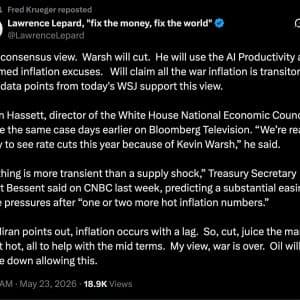
Crypto News Kevin Warsh, sworn in as Federal Reserve Chairman on Friday, is expected to lower interest rates despite widespread market consensus pricing in a hike, according to author and Bitcoin i...
23 May 2026, 20:52
Bitcoin heads higher as President Trump announces Iran peace agreement

"An Agreement has been largely negotiated, subject to finalization between the United States of America, the Islamic Republic of Iran, and the various other Countries," wrote President Trump late Saturday afternoon.
23 May 2026, 20:49
Analysts forecast a Bitcoin crash to the $60K level, revisiting 2026 low

The price of Bitcoin is about $75,800 at the time of publication, a nearly 40% decrease from the all-time high of about $126,000 reached in October 2025.
23 May 2026, 20:48
From Trading Tool to Payment Backbone: How Stablecoins Are Powering Everyday Transactions

A payments operations manager who once spent days chasing confirmations across correspondent banks, watching settlement windows stretch into weeks, can today close the same transaction in seconds, with documentation on-chain and a stablecoin doing the work that once required multiple intermediaries and a waiting game. That shift is now showing up in the data at scale. For years, stablecoins were a tool for crypto traders, useful inside the ecosystem and largely invisible outside it. Then came the GENIUS Act that gave the market something it had never had, a federal framework for stablecoin issuance. Institutions that had been watching from a distance began moving in. In Europe, MiCA also created an entirely new market for non-USD stablecoins, which now runs around $10 billion in monthly volume. Neither piece of legislation created the underlying demand. Both made it easier to act on it. Something fundamental has changed in how people use stablecoins now. They are no longer holding them. They are spending them. Consumer-to-business transactions almost doubled in 2025. Total adjusted transfer volume hit $4.5 trillion in Q1 2026 alone . Each dollar of stablecoin supply is changing hands more than twice as often as it was two years ago. The behaviour has shifted and the data confirms it. Where XDC Fits In While the broader market was still debating whether stablecoins had a future in real finance, networks supporting real-world financial activity were already seeing adoption accelerate. USDC on XDC has processed over $12.7 billion in transactions to date, while Liqi, a Brazilian fintech tokenizing receivables and trade assets on XDC, is clearing more than $100 million daily, highlighting how stablecoins and tokenized real-world assets are increasingly operating on-chain financial ecosystem. “We built XDC around a gap we saw years ago between what institutional finance actually needed and what blockchain infrastructure was delivering. While much of the market was focused on short-term speculation and meme-driven narratives, we stayed committed to building for real users, real use cases, and real distribution channels. From two-second finality and near-zero transaction costs to full alignment with ISO 20022 and MLETR, every part of the network was designed to solve inefficiencies in trade finance, payments, and tokenization. The growth we’re seeing today from USDC adoption to the daily volumes being processed by partners like Liqi is the market gradually moving toward the exact use cases XDC was built for," said Jeremy Noori, Head of Structured Products, XDC Network. Stablecoins Are Going Local, Not Just Global Stablecoin adoption is on the path of rapid geographic expansion. The Asia region has led the way, with markets like Singapore, Hong Kong, and Japan building out institutional infrastructure backed by clear regulatory frameworks. The United States, energised by GENIUS has witnessed volumes climb sharply as banks, fintechs, and payment processors are moving. But the most revealing part of the story is not who adopted stablecoins. It is what they are using them for. Domestic transactions now account for nearly three-quarters of total stablecoin payment volume, up from roughly half just two years ago. People are not just using stablecoins to send money abroad. They are using them to pay for things at home. Stablecoins are not globalising payments. They are localising them. Where the Next Wave Starts Emerging markets are where this shift is felt most. Brazil makes the case most clearly. A government-backed instant payment system processing over 60 million transactions a day, a population comfortable with digital finance, and a volatile local currency created the conditions for stablecoin adoption to take hold quickly. The Brazilian real-backed stablecoin BRLA grew from virtually no usage to around $400 million in monthly transfer volume compared to the last 2-3 years according to Chainalysis . Stablecoins did not replace Brazil's financial infrastructure. They built on top of it. That is the model the rest of the world is watching. "Brazil is the story everyone should be paying attention to," said Diego Consimo, Head of Latin America at XDC Network. "When you connect a stablecoin to infrastructure people already trust and use every day, adoption follows fast. Latin America has the economic conditions that make stablecoins genuinely useful, high remittance volumes, currency volatility, and large underbanked populations. XDC is building towards being the settlement layer for that activity as it scales." The Infrastructure Question The debate about whether stablecoins belong in real finance is over. The question now is which networks are ready for what comes next. Stablecoins are no longer a single-market story. From the United States to Europe to Latin America, adoption is accelerating across corridors and use cases that barely existed two years ago. The market is not converging on one instrument or one region. It is expanding into infrastructure that is global in design and local in practice. Emerging economies and cross-border trade corridors are increasingly turning toward stablecoin-powered settlement systems as traditional financial infrastructure struggles to keep pace with global commerce. Growing market demand and improving regulatory clarity are further accelerating the shift toward faster, more efficient, and digitally connected financial ecosystems. Disclaimer: This article is provided for informational purposes only. It is not offered or intended to be used as legal, tax, investment, financial, or other advice.
23 May 2026, 20:42
Why Hyperliquid’s HYPE Is Rising, And Why The Answer Is Not The ETF

HYPE hit a record above $62 in May 2026. Hyperliquid's Assistance Fund recycles 99% of trading fees into buybacks, the mechanical force driving the rally.
23 May 2026, 20:40
U.S. has added nearly 2,000 sanctions on Iran since 2018

Iran has spent more than a month under Washington’s new “Economic Fury” sanctions drive, and the country has still not given the Trump administration what it wants. The campaign began on April 16 with a promise to use the “full range of available tools and authorities” against Tehran’s economy. That sounds big, but the early actions look very close to the old Maximum Pressure plan from Donald Trump’s first term. The United States has issued 2,000 economic sanctions against Iran in just eight years, including the pulling out of the nuclear agreement by Trump in 2018, when Obama was instrumental in making the agreement. The recent economic sanctions followed the establishment of a ceasefire between Washington and Tehran concerning the end of the US military operation codenamed “Epic Fury,” where Treasury Secretary Scott Bessent urged other US allies to get involved in the economic war on Iran by cutting their financial lifeline outside of Iran. However, the Iranians have been preparing themselves for this eventuality over the years, so this sanction does not amount to anything new. Treasury targets Iran’s currency dealers and 19 oil-linked ships A major Iranian foreign exchange house, along with some related fronts, has been hit with sanctions by the U.S. Treasury Department’s Office of Foreign Assets Control. According to U.S. officials, the exchange house was involved in managing hundreds of millions of dollars worth of transactions on behalf of sanctioned Iranian banks. The foreign exchange houses play a critical role in facilitating trade involving foreign currencies for Iran, which is unable to use its conventional banking channels due to sanctions. Iranian foreign exchange houses transfer billions of dollars annually. The funds originate from oil sales, petrochemicals export, and financial networks. According to U.S. officials, these networks have helped Tehran to get access to international financial networks despite warnings issued against the same to banks and companies. Moreover, OFAC imposed sanctions on 19 vessels responsible for transporting Iranian oil and petrochemicals shipments. As per U.S. allegations, these shipments transferred products to international markets and made billions of dollars worth of profit for Iran. This money can be used for making weapons, funding terror organizations, and private enrichment in other countries. Scott said , “Iran’s shadow banking system facilitates the illicit transfer of funding for terrorist purposes.” He also said banks must watch how Tehran uses the global financial system. The new action sits under Executive Order 13902, which covers people and businesses operating in Iran’s financial, petroleum, and petrochemical sectors. Treasury said the designations add to earlier sanctions on exchange houses, Iranian bank rahbar companies, crypto exchanges, and other groups accused of helping Tehran dodge restrictions. Washington warns banks, airlines, and Chinese refiners over Iran trade According to the Treasury, Economic Fury has affected many billions of dollars worth of oil payments that would have gone to Iran. Further, the department reported that U.S. measures have also led to the freezing of almost half a billion dollars’ worth of cryptocurrency that was associated with the Iranian government . Crypto users need to know about this, as it means that Washington now considers the digital assets network to be an integral part of its sanctions program. The department announced that it is going to focus on sanction evasion and digital asset transactions together. Therefore, anyone from brokers, shipping companies, banks, crypto exchanges, or shell companies can find themselves being pursued by the U.S. for helping Iran make payments. Further, Washington has threatened foreign companies with punishment if they participate in doing business with Iran. These could include airlines, commodities, and finance companies. Treasury warned that secondary sanctions could hit foreign banks that help Iran, including those linked to China’s independent “teapot” oil refineries. No publicly listed companies were named in the provided U.S. action, so there are no direct stock tickers to attach without adding outside names that were not in the material. The Trump administration said it is targeting Iran’s main revenue stream, meaning oil and other commodity sales. Any person or vessel that helps with hidden oil trades, secret payment routes, or covert commodity shipments can face U.S. sanctions. Treasury also sanctioned networks accused of supplying weapons and military parts to Iran. It added penalties against an Iraqi official accused of helping sell oil with Iran-backed militias in Iraq. The State Department’s Rewards for Justice program is offering up to $15 million for information that helps disrupt the financial systems of the Islamic Revolutionary Guard Corps and its branches. Don’t just read crypto news. Understand it. Subscribe to our newsletter. It's free .
