


 Invest ideas
News
30 Apr 2026, 13:21
XLM Technical Analysis 30 April 2026: Risk and Stop Loss

XLM is squeezed in a narrow band at $0.16 in a downtrend, with $0.1557 support as the critical risk point. The bearish target of $0.1137 versus the bullish reward of $0.2097 is unbalanced; protect ...
30 Apr 2026, 12:15
Hyperscale Data Q1 Revenue Surges 76% YoY to $44M, Boosts BTC Holdings Strategy

BitcoinWorld Hyperscale Data Q1 Revenue Surges 76% YoY to $44M, Boosts BTC Holdings Strategy Hyperscale Data (NYSE: GPUS) has reported a stunning 76% year-over-year increase in preliminary Q1 2026 revenue, reaching approximately $44 million. This significant jump from $25 million in the same period last year highlights the company’s aggressive expansion in both data center operations and cryptocurrency mining. The announcement, made on April 26, 2026, from New York, positions Hyperscale Data as a key player in the evolving digital infrastructure and digital asset landscape. Hyperscale Data Q1 Revenue Breakdown: Mining and Beyond The company’s cryptocurrency mining revenue alone contributed roughly $5 million to the quarterly total. While this represents a portion of the overall figure, it underscores the growing importance of digital asset generation within Hyperscale Data’s diversified business model. Analysts note that the remaining $39 million likely stems from its core data center services, including colocation, cloud, and AI infrastructure solutions. This dual revenue stream provides a buffer against volatility in the crypto market while capitalizing on the sustained demand for high-performance computing. Bitcoin Holdings Strategy: Targeting $100 Million As of April 26, 2026, Hyperscale Data held 675.35 Bitcoin (BTC), valued at approximately $53.1 million. The company has publicly stated its ambition to increase its BTC holdings to $100 million. This strategy aligns with a growing trend among publicly traded companies to use Bitcoin as a treasury reserve asset. By holding a significant amount of the world’s leading cryptocurrency, Hyperscale Data aims to hedge against inflation and generate long-term shareholder value. The move also signals confidence in Bitcoin’s future price appreciation and its role as a store of value. GPUS Stock Performance and Market Reaction Following the revenue announcement, GPUS stock experienced a notable uptick in after-hours trading. Investors reacted positively to the strong top-line growth and the clear strategic roadmap for Bitcoin accumulation. Market analysts have revised their price targets upward, citing the company’s ability to scale revenue while maintaining a disciplined approach to digital asset management. The 76% revenue surge far exceeds consensus estimates, which had predicted a more modest 40-50% growth. This outperformance has placed Hyperscale Data firmly on the radar of institutional investors seeking exposure to both AI infrastructure and digital assets. Context: The Broader Crypto Mining Landscape in 2026 The first quarter of 2026 has been a period of consolidation for the cryptocurrency mining industry. Following the 2024 Bitcoin halving, which reduced block rewards, many miners have struggled to maintain profitability. However, companies with diversified revenue streams, like Hyperscale Data, have fared better. The company’s ability to generate significant revenue from non-mining operations provides a competitive edge. Additionally, the recent approval of spot Bitcoin ETFs has increased institutional demand for Bitcoin, supporting its price and making holdings more valuable. Hyperscale Data’s strategy of accumulating BTC rather than selling it immediately for operational costs is a bet on continued price appreciation. Key Financial Metrics and Comparison Metric Q1 2026 Q1 2025 Change Total Revenue $44 million $25 million +76% Crypto Mining Revenue $5 million Not disclosed N/A BTC Holdings 675.35 BTC Not disclosed N/A BTC Value (as of Apr 26) $53.1 million Not disclosed N/A The table above clearly illustrates the dramatic revenue expansion. The lack of prior-year data for crypto mining and BTC holdings suggests these initiatives have gained significant traction only recently. This indicates a strategic pivot that is now paying off. Expert Analysis and Future Outlook Industry experts view Hyperscale Data’s performance as a bellwether for the convergence of traditional data center operations and cryptocurrency mining. “The company is effectively operating two high-growth businesses under one roof,” explains a senior analyst at a leading financial research firm. “Their data center business benefits from the AI boom, while their mining operations give them direct exposure to Bitcoin’s upside. This dual approach reduces risk and enhances returns.” The company’s stated goal of reaching $100 million in BTC holdings suggests continued aggressive accumulation. If Bitcoin prices remain stable or increase, this could significantly boost the company’s balance sheet and market capitalization. Timeline of Hyperscale Data’s Growth 2024: Company begins expanding data center capacity for AI workloads. 2025: Initial foray into cryptocurrency mining with small-scale operations. Q1 2026: Revenue surges 76% YoY; BTC holdings reach $53.1 million. Target: Achieve $100 million in BTC holdings by end of 2026. This timeline demonstrates a rapid and deliberate expansion strategy. The company has moved quickly to capitalize on market opportunities, positioning itself for sustained growth. Conclusion Hyperscale Data’s Q1 2026 revenue surge of 76% to $44 million marks a significant milestone for the company. The combination of strong data center revenue and a growing cryptocurrency mining operation, coupled with a strategic Bitcoin accumulation plan, has created a powerful growth engine. With a clear target of $100 million in BTC holdings, Hyperscale Data is positioning itself as a leader in the digital infrastructure and digital asset space. Investors and industry observers will be watching closely to see if the company can maintain this momentum throughout the remainder of the year. FAQs Q1: What is Hyperscale Data’s ticker symbol? A1: Hyperscale Data trades on the New York Stock Exchange under the ticker symbol GPUS. Q2: How much Bitcoin does Hyperscale Data currently hold? A2: As of April 26, 2026, the company holds 675.35 Bitcoin, valued at approximately $53.1 million. Q3: What is the company’s target for Bitcoin holdings? A3: Hyperscale Data aims to increase its Bitcoin holdings to $100 million. Q4: How much revenue did Hyperscale Data generate from cryptocurrency mining in Q1 2026? A4: The company reported approximately $5 million in cryptocurrency mining revenue for the first quarter of 2026. Q5: Why is Hyperscale Data’s revenue growth significant? A5: The 76% year-over-year growth significantly exceeded market expectations and demonstrates the success of the company’s dual strategy of data center services and cryptocurrency mining. This post Hyperscale Data Q1 Revenue Surges 76% YoY to $44M, Boosts BTC Holdings Strategy first appeared on BitcoinWorld .
30 Apr 2026, 12:00
Best Alternative Staking Protocols for DeFi Yield in 2026
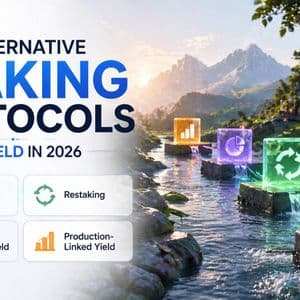
Standard staking pays one rate from one source. Lock ETH, secure the network, collect validator rewards. That model still works, but DeFi staking yield now extends into four distinct categories, each drawing returns from a different engine. The differences carry more weight in 2026 than they did a year ago. Volatile periods through 2025 stress-tested every model, and some held up better than others. Token emissions thinned out. Slashing exposure stacked higher than expected in restaking. Tokenized cashflow protocols quietly grew while the noisier categories made headlines. This piece maps the four categories of alternative staking protocols worth knowing in 2026, with current data on what each pays, where the yield originates, and how the structural risks shape each model. Treat it as a category map for picking where to put capital, not a ranked verdict. Top 4 Categories of Alternative Staking The four categories below pay yield from different sources and respond differently when market conditions shift. Liquid staking wraps ETH validator rewards in a transferable token. Restaking re-uses staked ETH to secure additional services. Tokenized financial yield routes capital into off-chain financial instruments. Production-linked yield draws returns from physical operations like commodity production. Each section below covers what the category does, who leads it, and what trade-off comes built into the model. 1. Liquid Staking: Lido and Rocket Pool Lido holds the dominant position in liquid staking, with TVL between $17 billion and $19 billion across 2026. Holders deposit ETH and receive stETH in return, a derivative token that accrues staking rewards while remaining usable across DeFi as collateral or liquidity. As of March 2026, stETH paid roughly 2.5% APR after Lido's 10% protocol fee. Rocket Pool serves as the decentralized counterpart, with rETH as its liquid token and a 16-ETH minimum for node operators. Both protocols draw yield from the same place: validator rewards on Ethereum's proof-of-stake consensus layer. The trade-off here is structural. As more ETH gets staked across the network, base validator rewards compress. Lido's share of staked ETH dropped to 22.8% by March 2026, reflecting both intensifying competition and broader liquid staking yield compression. The model still serves ETH-native holders well, but the yields available in 2026 are noticeably lower than in earlier cycles. 2. Restaking: EigenLayer EigenLayer dominates restaking with more than 93% market share. Its TVL has whipsawed through 2026, peaking at $19.7 billion before settling into the $9 billion. Liquid Restaking Tokens (LRTs) like EtherFi's eETH (around $5.5 billion in TVL) became the dominant access pattern, layering on top of EigenLayer's smart contracts. The mechanic stacks an additional yield engine on top of base ETH staking. Holders restake ETH or a liquid staking derivative to secure Actively Validated Services (AVSs), which are third-party protocols that pay for shared security. The current restaking premium sits around 3.87% on top of base ETH staking yield, though the figure swings with AVS demand. The honest trade-off is that restaking has been stress-tested in 2026, and the results are mixed. Slashing exposure stacks across services, multiplying risk in ways early adopters underestimated. The Kelp DAO exploit cost users roughly $300 million . The EIGEN token has lost more than 90% of its peak value, with persistent questions about whether AVS revenue can sustain yields once token emissions thin out. Anyone considering staking with extra rewards through restaking is taking on capital efficiency gains and structural fragility together. 3. Tokenized Financial Yield: Ondo and Maple Tokenized financial yield routes stake capital into off-chain financial instruments. Treasury bills and institutional credit are the two dominant flows in this category, wrapped in an on-chain token that tracks the underlying yield. Ondo Finance leads the Treasuries side. Its OUSG token is built on top of BlackRock's BUIDL fund, with tokenized US Treasuries paying approximately 4-5% in 2026. Maple Finance leads the credit side, with $4 billion in deposits and $2.4 billion in outstanding loans by January 2026, an eightfold increase across 2025. Maple's syrupUSDC pays a base APY of around 7-8%, sourced from interest paid by overcollateralized institutional borrowers. The mechanic is direct. Holders deposit stablecoins, receive a yield-bearing token (OUSG, syrupUSDC) that represents the position, and the protocols handle the off-chain leg. Custody and borrower underwriting sit with regulated counterparties. The trade-off is sensitivity to macro conditions. Treasury yields compress when the Federal Reserve cuts rates. Credit yields compress when institutional borrower demand softens. Both depend on the integrity of off-chain issuers and underwriters. Staking backed by real assets reduces some risks (no token emissions, no slashing) and introduces others (counterparty trust, rate exposure). 4. Production-Linked Yield: Ayni Gold Production-linked yield is the newest category in alternative staking, and the smallest by total value locked. Returns come from physical output, with commodity production currently the only operational example, converted into on-chain rewards. Ayni Gold is a DeFi protocol that turns gold mining output into on-chain yield, with stakers receiving PAXG rewards quarterly from mining production at the Minerales San Hilario concession in Peru. Each AYNI token represents 4 cm³ per hour of processing capacity at the concession site. Two licensed concessions are now active under the protocol, with the primary site registered with INGEMMET (No. 070011405) and a secondary one acquired in Q4 2025. The verification layer covers four independent providers. CertiK and PeckShield audited the smart contracts (both completed in October 2025). TurnKey handles institutional custody, and Kangari Consulting runs the geological assessments. The reward formula is published openly: PAXG reward = (AYNI_staked × Mining_output × Time_factor) − Costs − Success_Fee Settlement runs through Peru's banking system. Extracted gold is sold to local banks, the proceeds convert to fiat, and the fiat buys PAXG via Paxos for distribution to AYNI stakers proportional to stake size. The protocol burns 15% of accumulated success fees each quarter, gradually reducing the circulating supply. For holders evaluating PAXG yield staking as part of a broader portfolio, this is structurally distinct exposure. The position pays gold-backed DeFi yield that tracks operational variance, with mining output rising and falling, instead of rate environments or platform usage. The category is small in 2026 because it is the newest, but the structural difference is real. How the Four Categories Compare The four categories sit at different points on the yield-versus-risk map. Each has its own ceiling and its own failure mode. Category Yield source 2026 yield range Main structural risk Liquid staking Validator rewards ~2.5% (Lido) Yield compression as more ETH stakes Restaking AVS fees + emissions +3.87% over base ETH Slashing concentration, emission dependence Tokenized financial yield Interest from off-chain instruments 4-5% (Treasuries), 7-8% (credit) Macro rate sensitivity, counterparty risk Production-linked yield Physical production output Variable (mining-dependent) Operational variance Where Each Category Fits Different yield engines serve different holders. The summary below maps a clean fit for each: Liquid staking fits ETH-native holders who want staking yield that stays usable across DeFi as collateral, liquidity, or trading inventory Restaking fits holders comfortable with stacked slashing risk who believe AVS revenue models will mature into sustainable cash flows Tokenized financial yield fits holders who want returns tracking traditional fixed-income markets through an on-chain wrapper, with regulated off-chain custodians in the loop Production-linked yield fits holders who want yield decoupled from rate environments and platform activity, with returns tied to physical operations The four categories solve different allocation problems. Both production-linked yield and tokenized financial yield occupy the broader category of commodity backed DeFi when the underlying asset is physical, with returns traced back to real economic activity instead of token emissions or synthetic strategies. The right framing is not about which model wins in the abstract. It is which yield engine matches the portfolio. FAQ What is alternative staking in DeFi? Alternative staking refers to protocols that generate yield from sources other than standard validator rewards on a single blockchain. The four main categories in 2026 are liquid staking, restaking, tokenized financial yield, and production-linked yield, each drawing returns from a different engine. Which alternative staking model pays the highest yield? On-chain private credit through Maple's syrupUSDC pays around 7-8%, the highest among established categories. Production-linked yield is variable and tracks mining output. Headline yield rate is not the same as best fit, since each category carries different structural risks. What is production-linked yield staking? Yield generated from real-world production output instead of token emissions or financial instruments. Ayni Gold is the first protocol to bring this model on-chain, distributing PAXG rewards from mining production at licensed concessions in Peru, settled through Peru's banking system. Are alternative staking protocols safer than traditional staking? Each category carries different risks. Liquid staking adds smart contract exposure on top of validator risk. Restaking stacks, slashing exposure across services. Tokenized financial yield depends on issuer honesty. Production-linked yield depends on operational performance. Safety depends on which risks fit the portfolio. How does Ayni Gold differ from Lido or EigenLayer? Lido pays validator rewards from ETH staking. EigenLayer pays AVS fees plus token emissions on top of base ETH staking. Ayni Gold pays PAXG sourced from gold mining output at concessions in Peru. Three different yield engines, three different risk profiles. Disclaimer: This article is provided for informational purposes only. It is not offered or intended to be used as legal, tax, investment, financial, or other advice.
30 Apr 2026, 11:56
Top 6 Tokenized Gold Projects to Watch in 2026

Tokenized gold has moved past the early experiment phase. The category now spans multiple structural models, from vault-backed stablecoins to yield-paying gold tokens to mining-linked rewards. Each project answers a different question about what gold ownership on-chain should look like. This piece covers seven tokenized gold projects worth watching in 2026, ordered loosely by maturity and category position. Some lead by market cap. Others are smaller but introduce features that the larger names do not offer. For anyone evaluating gold crypto projects for portfolio allocation, the breakdown below works as a category map, not a ranked verdict. How These 6 Projects Fit the Tokenized Gold Category The seven projects below cluster into three structural groups. Vault-backed token moves (Paxos Gold, Tether Gold, Meld Gold, Comtech Gold) tokenize stored gold and prioritize redeemability. Yield-paying tokens (Kinesis) distribute platform fee revenue back to holders monthly. Production-linked tokens (Ayni Gold) tokenize operating mining capacity and pay rewards from physical extraction. Each group answers a different question about what gold ownership on-chain should look like. 1. PAXG (Paxos Gold) – The Liquidity Leader Paxos Gold is the largest tokenized gold project by market capitalization, typically trading in the $1.4 to $1.6 billion range across 2026. Each token represents one troy ounce of London Good Delivery gold, allocated to specific bars by serial number. The gold sits in Brink's vaults in London. Paxos issues PAXG as a New York-regulated trust company, with custody attestations published monthly by independent auditors. Token holders can verify their bar allocations through Paxos's lookup tool. Liquidity is one of PAXG's strongest selling points. The token trades across centralized exchanges, integrates with major DeFi protocols, and works as collateral on lending platforms. Where it falls short: PAXG pays no native yield. It tracks the gold price and stops there. Physical redemption sits behind institutional minimums, typically requiring a full Good Delivery bar (around 430 ounces) for direct withdrawal. 2. XAUT (Tether Gold) – Deep Exchange Depth XAUT is issued by Tether, the company behind USDT, and competes closely with PAXG by market cap. Each token represents one troy ounce of London Good Delivery gold stored in Swiss vaults. Tether's existing infrastructure gives XAUT deep liquidity advantages. The token sees high volume across exchanges where Tether maintains relationships, and bar allocations are verified through published serial numbers. The project has built a particular reputation on derivatives platforms, where institutional participants seeking gold exposure inside crypto-native infrastructure drive consistent volume. What it gives up is regulatory positioning. Tether's structure carries less institutional regulation than Paxos's NYDFS-supervised setup. For some users that means more flexibility. For others, it raises caution. Like PAXG, XAUT pays no yield, and physical redemption requires institutional-scale minimums. 3. Kinesis (KAU) – Monthly Yield from Platform Fees Kinesis approaches gold-backed crypto from a different angle. Each KAU represents one gram of investment-grade bullion held across the ABX (Allocated Bullion Exchange) global vault network. Inspectorate International audits the reserves twice yearly. The platform launched in 2019, giving it the longest operating track record on this list. The standout feature is the monthly yield. Kinesis charges 0.22% on platform transactions and channels 15% of that revenue into the Holder's Yield pool, paying KAU holders proportionally each month. Cumulative yield distributions had crossed $11 million by November 2025, a meaningful figure for a category where most tokens pay nothing at all. KAU also functions as a payment instrument. Holders can spend it worldwide through the Kinesis Virtual Card running on Mastercard rails, with fiat conversion happening instantly at checkout. Physical bullion redemption opens at 100 grams. The catch is that yield depends entirely on platform usage. High-volume months reward holders. Slow months barely move the needle. 4. Ayni Gold (AYNI) – Quarterly Yield from Mining Production Ayni Gold is a DeFi protocol that turns gold mining output into on-chain yield, with stakers receiving PAXG rewards quarterly from mining production at the Minerales San Hilario concession in Peru. The protocol breaks from the vault model entirely. Instead of tokenizing stored bullion, it tokenizes operating mining capacity at a registered concession. Each AYNI token represents 4 cm³ per hour of processing capacity at the concession site. The operation covers an 8 km² alluvial area in Madre de Dios. Two concessions are now operational under the protocol, with primary licensing through INGEMMET (No. 070011405) and a secondary site brought online in Q4 2025. The trust infrastructure runs across four independent providers. CertiK and PeckShield handled smart contract audits in October 2025. TurnKey manages institutional custody. Kangari Consulting conducts the geological work. The reward calculation is published openly: PAXG reward = (AYNI_staked × Mining_output × Time_factor) − Costs − Success_Fee. How yield reaches stakers involves a multi-step path. Extracted gold sells into Peru's banking system, the proceeds become fiat, and the fiat buys PAXG through Paxos. Distributions then flow to staked AYNI proportionally each quarter. The protocol also burns 15% of accumulated success fees every quarter , slowly contracting circulating supply. For anyone evaluating PAXG yield staking as a portfolio component, this delivers structurally different exposure. The position generates gold backed DeFi yield that follows mining production instead of rate environments or platform activity. The category is small in 2026, but the model is genuinely distinct. 5. Meld Gold (MCAU) – Algorand-Based Gold Meld Gold is the only major tokenized gold project built on Algorand, taking advantage of low transaction fees and instant finality. Each MCAU represents one gram of recycled Australian gold, held across independent vaults including Imperial Vaults, Australian Bullion Company, and Melbourne Mint. The project distinguishes itself through supply chain integration. Meld Gold's founders come from gold industry backgrounds and built the platform around connecting bullion supply chains to blockchain settlement infrastructure. The protocol supports gold, silver, and platinum tokens, all on the same Algorand-native architecture. Low-fee chain selection appeals to users who want gold transactions without the bridging costs of Ethereum or higher-fee networks. What it gives up is reach. Meld Gold's vaulting is concentrated in Australia, and trading volume runs lower than ETH-based alternatives. Most activity sits on BTCMarkets, which limits liquidity diversity. 6. Comtech Gold (CGO) – Sharia-Compliant Gold Comtech Gold is the only major tokenized gold project structured for Sharia compliance, certified by accredited Islamic finance scholars. Each CGO represents one gram of LBMA Good Delivery gold stored in DMCC-licensed vaults in Dubai. The project mints on both XDC Network and Algorand, giving holders chain optionality. Sharia compliance opens the project to MENA-region investors who cannot participate in interest-bearing or non-compliant gold products under Islamic finance principles. Verification follows category standards. Audits run on a regular cadence and physical redemption is available at retail-accessible minimums. The constraint is scale and reach. Comtech Gold trades at a small fraction of PAXG's volume and sees narrower exchange coverage. For users who prioritize Sharia compliance or Dubai vault location, the project delivers something none of the larger names offer. For users without those requirements, the larger projects remain easier to access. What The Difference Between These 6 Projects Project Token represents Vault location Yield? Distinctive feature PAXG (Paxos Gold) 1 troy oz gold London (Brink's) No NYDFS-regulated, largest market cap XAUT (Tether Gold) 1 troy oz gold Switzerland No Tether infrastructure, deep liquidity Kinesis (KAU) 1 gram of gold ABX network Yes (monthly) Spendable card, fee-share yield Ayni Gold (AYNI) 4 cm³/hr capacity Minerales San Hilario, Peru Yes (quarterly) Production-linked yield from gold mining Meld Gold (MCAU) 1 gram of gold Australia No Algorand-based, supply-chain integrated Comtech Gold (CGO) 1 gram of gold Dubai (DMCC) No Sharia-compliant, MENA-targeted How to Pick a Tokenized Gold Project Different holders need different features from gold-backed crypto. The summary below maps a clean fit for each major use case: For maximum liquidity and exchange depth: PAXG or XAUT For yield from platform activity: Kinesis For yield from physical production: Ayni Gold, paying gold backed crypto yield from mining output For Algorand-based exposure: Meld Gold For Sharia-compliant gold ownership: Comtech Gold The category is no longer one-size-fits-all. The right project depends on which feature matters most for the portfolio. Where the Category Sits in 2026 Tokenized gold in 2026 is more diverse than its market caps suggest. Five projects compete on vault custody and redemption mechanics. Two pay yield from different sources. The boundary between gold-backed crypto and DeFi yield product is no longer a clean line. Anyone allocating to tokenized gold is choosing not just a project but a structural model: stored gold, platform-fee gold, or production-linked gold. The pick depends on which one fits the portfolio thesis. Disclaimer: This article is provided for informational purposes only. It is not offered or intended to be used as legal, tax, investment, financial, or other advice.
30 Apr 2026, 11:00
GrandCroix and Ambient Network Announce Collaboration to Launch First Native DEX for DePIN Ecosystem in Q2 2026
BitcoinWorld GrandCroix and Ambient Network Announce Collaboration to Launch First Native DEX for DePIN Ecosystem in Q2 2026 The partnership will introduce a purpose-built decentralized exchange, native cross-chain bridge, and liquidity infrastructure for Ambient ecosystem Miami, FL, USA GrandCroix, a Miami-based new generation of mining company for decentralized AI networks, announces a strategic collaboration with Ambient Network, to launch the first native decentralized exchange (DEX) for the Ambient ecosystem in Q2 2026. The platform will ship with a full DeFi stack from day one – including an automated market maker (AMM), cross-chain bridging, and built-in liquidity tools – designed specifically for Ambient.xyz Ambient is an SVM-compatible PoW L1 that will serve as a cornerstone of the agentic economy, unleashing Asimov-ian intelligence on chain. It is 10x more efficient than incumbent crypto AI systems, and features: Fully verified Inference with 10x better training performance than existing approaches Extremely high utilization of miners due to optimization on a single model for inference and validation A non-blocking proof of work consensus that foregrounds economic competition around the core activities of the network (inference, fine tuning, training) while maintaining extraordinary TPS . Participants earning Ambient token rewards have no native trading venue, limited cross-chain access, and no way to provide liquidity or earn yield within the ecosystem they’re helping build. To close all three gaps, GrandCroix is building a vertically integrated DeFi platform – not just a swap interface – engineered for the specific needs of DePIN participants. Built on Ambient and scheduled to go live in Q2 2026, the platform will launch with: AMM Swap Engine – Optimized for $AMB and core trading pairs (SOL, USDC, USDT), with support for concentrated liquidity positions. Native Cross-Chain Bridge – Integrated bridge enabling $AMB transfers between Solana and EVM-compatible chains (Ethereum, Base, Arbitrum) from day one, with no third-party bridge required. Liquidity Positioning Dashboard – Tools for liquidity providers to set price ranges, monitor performance, and manage positions. Designed to be accessible to sensor operators, not just DeFi power users. Rather than bolting together fragmented third-party tools, the platform delivers a unified on-chain experience tailored to the people actually participating in the network. The timing reflects a structural shift: as DePIN ecosystems mature beyond hardware deployment into data monetization and token utility, they need native financial infrastructure to sustain growth. Without it, value leaks to centralized intermediaries and cross-chain friction discourages participation. Ambient’s institutional backing from a16z crypto and Delphi Ventures – signals that the network is ready for this layer. “Every blockchain needs a financial layer to enable builders to build on top of it and support its growth,” said Nour De Vos, Founder & CEO of GrandCroix. “Our collaboration with Ambient is about building that missing layer – so participants can not just contribute data, but actively participate in the ecosystem’s economic growth by building apps.” Liquidity Strategy GrandCroix will seed initial liquidity from its own treasury and mining operations, providing day-one trading depth across core pairs. Ambient will also provide additional liquidity to the dex funded t will support early liquidity growth. Roadmap Q2 2026 – AMM, Bridge, and LP Dashboard live on Solana mainnet Q3 2026 – Additional bridge chains, limit orders, and programmatic trading API Q4 2026 – Community governance launch with on-chain voting for fee parameters and new pair listings For Media Inquiries, contact [email protected] About GrandCroix GrandCroix is a decentralized AI and DeFi infrastructure company headquartered in Miami, Florida, and a division of Group NDV. The company operates at the intersection of decentralized computing and decentralized finance, building essential infrastructure for emerging blockchain ecosystems. GrandCroix’s operations span active mining across major decentralized networks — including Bittensor, NousResearch, Gonka AI, Ambient Network, and Psy Protocol — large-scale GPU infrastructure management, and native DeFi product development. About Ambient Network Ambient sets out to address the deficiencies just described by building a fundamental pillar of the agentic economy: an AI secured blockchain ten times more efficient than incumbent systems with built-in privacy and censorship resistance that runs a single, huge, highly performant, auditable, and transparent model (and its fine tunes) at low latency by leveraging hyperscale on-chain distributed computing to deliver human-like capabilities to applications on-chain and cross-chain. This post GrandCroix and Ambient Network Announce Collaboration to Launch First Native DEX for DePIN Ecosystem in Q2 2026 first appeared on BitcoinWorld .
30 Apr 2026, 08:58
Rakuten lets 44 million users convert points to XRP

🚀 Rakuten's 44 million users can now swap reward points for $XRP instantly. XRP is now spendable at over 5 million locations in Japan. 🥇 Social media interest in XRP just hit a two-year high. 📢 Critical data: XRP’s price remains down 55% over the last 9 months. Continue Reading: Rakuten lets 44 million users convert points to XRP The post Rakuten lets 44 million users convert points to XRP appeared first on COINTURK NEWS .


