


 Invest ideas
News
21 Apr 2026, 12:55
MNT price rises as KelpDAO exploit fears ease, outlook bullish

Mantle (MNT) is showing a mildly bullish short-term outlook after gaining 4.1% over the past 24 hours to around $0.6456, outperforming Bitcoin amid a broader altcoin rotation. Bitcoin has risen about 2.26% over the same period, while capital has been rotating into higher-volatility assets across the crypto market. Other altcoins such as Stellar (XLM), Toncoin (TON), and MemeCore have recorded gains in the 5% to 7% range, reinforcing the shift toward altcoins rather than Bitcoin-led momentum. In this environment, Mantle has closely tracked the broader trend, with its daily range spanning from $0.6179 to $0.6476. Trading activity has also picked up meaningfully, with daily volume crossing $1.11 billion, indicating that the recent price move is supported by strong participation rather than thin liquidity. Altcoin rotation supports short-term momentum The current Mantle price surge is largely tied to a broader rotation across the crypto market. As Bitcoin stabilised near the $76,000 level , traders shifted exposure toward altcoins, which typically carry higher beta during risk-on phases. This rotation has been visible across multiple large-cap tokens, with gains clustering in mid- and high-cap assets rather than being concentrated in Bitcoin. While no single protocol-specific catalyst has driven the move, sentiment across the altcoin sector has provided consistent support. The correlation between MNT and broader market risk appetite has been particularly evident over the past week. However, the token still shows a net 7-day decline of about 4%, indicating that the recent rebound is more of a recovery within a volatile range than a sustained trend reversal. KelpDAO exploit and liquidity recovery Sentiment around Mantle improved further following clarification regarding the recent KelpDAO rsETH incident. Mantle confirmed that its underlying network, official bridge, and core assets were not impacted by the exploit. https://twitter.com/Mantle_Official/status/2046488050881150989?s=20 According to Mantle, the KelpDAO exploit was isolated specifically to KelpDAO’s rsETH configuration, with no spillover effect on Mantle’s core infrastructure. On-chain data indicates that approximately $204 million in core USD liquidity was repaid within roughly 48 hours following the April 18 event. This rapid recovery helped stabilise liquidity conditions after a sharp decline in total value locked, which had fallen significantly in the immediate aftermath of the incident. Mantle has also been coordinating with DeFi platforms, including Aave, to manage recovery procedures and address any residual risk exposure linked to the event. The clarity around the containment of the exploit has played a key role in easing short-term uncertainty, allowing price action to align more closely with broader market trends rather than risk-driven selling pressure. Mantle price forecast Mantle is currently trading in a recovery phase after a broader 30-day decline of about 11.74%, which continues to weigh on the medium-term structure. Despite the recent rebound to around $0.6427, the token remains under pressure from the wider downtrend, making resistance levels particularly important in the short term. The immediate level to watch is $0.69, which now acts as a key resistance zone. A break above this level would strengthen the current recovery structure and support short-term sentiment. However, if selling pressure returns and MNT falls below the $0.62 support level, the structure would weaken quickly. In that scenario, the next area of interest lies near $0.58, which aligns with prior demand and would likely act as the next significant support zone. Overall, the short-term outlook remains cautiously bullish, but continuation depends on whether Mantle can hold above $0.62 and build enough momentum to challenge resistance levels above $0.66. The post MNT price rises as KelpDAO exploit fears ease, outlook bullish appeared first on Invezz
21 Apr 2026, 11:51
Morning Minute: Saylor's $2.54B Buy Buoys Bitcoin

Michael Saylor and Tom Lee continued to buy BTC and ETH in big size, while Aave published its incident report from the KelpDAO exploit.
21 Apr 2026, 11:45
KelpDAO Exploit: Hacker’s $118M Ethereum Transfer Sparks Critical Laundering Fears

BitcoinWorld KelpDAO Exploit: Hacker’s $118M Ethereum Transfer Sparks Critical Laundering Fears In a significant development for decentralized finance security, the perpetrator behind the KelpDAO exploit has initiated a major movement of stolen funds, transferring 50,700 Ethereum (ETH) valued at approximately $118 million into two fresh cryptocurrency addresses. This critical move, first reported by blockchain analyst ai_9684xtpa, signals a potential new phase in one of 2024’s most substantial DeFi breaches and raises immediate concerns about fund laundering across global exchanges. The KelpDAO Exploit: A $118 Million Ethereum Transfer Blockchain analytics firm PeckShield confirmed the transaction details on March 15, 2025. Consequently, the hacker executed the transfer from the original exploit address (0x4e7…a1f) to two new destination wallets (0x8b2…c9d and 0xf41…e7a). Significantly, the funds remain intact on the Ethereum mainnet, with no subsequent movements to mixing services or exchanges detected at press time. However, blockchain investigators universally interpret this splitting action as a preparatory step for obfuscation. Key characteristics of the transfer include: A near-equal split of the 50,700 ETH between the two new addresses Execution during a period of lower network congestion to minimize gas fees Use of standard Ethereum transactions without immediate privacy enhancements Furthermore, the timing coincides with increased regulatory scrutiny of cross-chain bridges and restaking protocols, highlighting persistent vulnerabilities in complex DeFi architectures. Anatomy of the Original KelpDAO Breach To understand the current fund movement, one must examine the initial attack vector. The KelpDAO exploit occurred on February 22, 2024, targeting the protocol’s restaking mechanisms. Specifically, attackers exploited a logic flaw in the smart contract governing mint and burn functions for the rsETH liquid restaking token. The technical vulnerability involved: An incorrect validation of withdrawal credentials during the restaking process A reentrancy condition that allowed repeated minting of rsETH without sufficient collateral Subsequent conversion of the fraudulently minted tokens into pure Ethereum via decentralized exchanges Within hours, the attacker drained the protocol, converting assets to 50,700 ETH. The protocol’s team quickly paused all contracts, but the funds had already been consolidated into a single wallet, where they remained dormant for over a year until this recent activity. Blockchain Forensics and Tracking Stolen Crypto Blockchain analysis firms like Chainalysis and Elliptic have developed sophisticated tools to track stolen cryptocurrency. Their methodologies typically involve clustering addresses, analyzing transaction patterns, and monitoring off-ramps to centralized exchanges. In this case, the hacker’s year-long dormancy presented a challenge, as it broke typical behavioral patterns. Experts note that splitting funds into multiple addresses is a common tactic, often preceding more complex laundering techniques. These can include: Using decentralized exchanges (DEXs) with no KYC requirements Employing coin mixers or privacy protocols like Tornado Cash Bridging assets to alternative Layer 1 or Layer 2 networks Converting to privacy-focused coins like Monero (XMR) Law enforcement agencies, including the FBI’s Cyber Division, routinely collaborate with these analytics firms. They trace illicit funds and attempt to identify perpetrators through on-chain analysis and traditional investigative techniques. The Broader Impact on DeFi and Restaking Security The KelpDAO incident is not an isolated event. Instead, it represents a growing trend of high-value exploits targeting the burgeoning liquid restaking sector. This sector, popularized by protocols like EigenLayer, allows users to restake their staked ETH to secure additional networks, creating complex new financial layers and corresponding attack surfaces. Comparative Table: Major DeFi Exploits (2023-2025) Protocol Date Amount Lost Primary Cause KelpDAO Feb 2024 $118M Smart Contract Logic Flaw Euler Finance Mar 2023 $197M Donate-to-Self Vulnerability MixBytes (Stake) Sep 2023 $41M Private Key Compromise BonqDAO Feb 2023 $120M Oracle Manipulation This pattern has prompted major auditing firms like CertiK, OpenZeppelin, and Trail of Bits to advocate for more rigorous security standards. These include formal verification of critical smart contract functions, real-time monitoring for anomalous transactions, and decentralized bug bounty programs with substantial payouts. Regulatory and Insurance Implications The scale of the KelpDAO exploit has accelerated regulatory discussions in key jurisdictions. For instance, the European Union’s Markets in Crypto-Assets (MiCA) regulation, fully applicable in 2025, imposes strict operational and capital requirements on crypto-asset service providers. Similarly, the U.S. Securities and Exchange Commission (SEC) has increased its focus on DeFi protocols it deems to be offering unregistered securities. Concurrently, the crypto insurance market is evolving. Specialist underwriters like Nexus Mutual and Lloyd’s of London syndicates now offer coverage for smart contract failure. However, premiums have risen sharply following major exploits, and coverage limits often fall short of total protocol TVL (Total Value Locked), leaving a significant protection gap. Conclusion The transfer of $118 million in Ethereum from the KelpDAO exploit address marks a pivotal moment in this ongoing security saga. While the immediate destination of the funds remains on-chain, the splitting maneuver strongly indicates the hacker’s intent to launder the stolen assets. This event underscores the critical and persistent challenges in DeFi security, particularly within innovative but complex sectors like liquid restaking. It reinforces the necessity for robust, audited code, real-time monitoring, and collaborative forensic efforts between protocols, analysts, and regulators to protect user funds and ensure the sustainable growth of decentralized finance. FAQs Q1: What is KelpDAO and what does it do? KelpDAO is a decentralized finance (DeFi) protocol operating in the liquid restaking sector. It issues rsETH, a liquid restaking token, allowing users who have staked Ethereum (ETH) to earn additional yield by using that staked position to help secure other blockchain networks or applications. Q2: How did the hacker originally steal the funds? The hacker exploited a logic flaw in KelpDAO’s smart contract. The flaw involved incorrect validation during the restaking process, which allowed the attacker to mint large amounts of the rsETH token without providing the proper underlying collateral. They then exchanged this fraudulently minted token for standard Ethereum. Q3: Why did the hacker wait over a year to move the funds? Hackers often let stolen funds lie dormant to avoid immediate, intense scrutiny from blockchain analysts and law enforcement. This “cooling-off” period can make tracking more difficult later, as monitoring on the addresses may decrease, and it allows the hacker to plan complex laundering strategies. Q4: Can the stolen Ethereum be recovered or frozen? Due to the decentralized and permissionless nature of the Ethereum blockchain, individual coins cannot be directly frozen. Recovery is extremely difficult and typically requires identifying the hacker through off-chain means, legal action to seize associated fiat accounts, or voluntary return of funds, which sometimes occurs following negotiations or bug bounty offers. Q5: What does “splitting funds” achieve for a hacker? Splitting a large sum into multiple smaller amounts is a foundational money laundering technique. It helps avoid triggering automated compliance alerts on exchanges that monitor for large, suspicious deposits. Smaller amounts can be processed through different laundering channels simultaneously, complicating the forensic trail for investigators. This post KelpDAO Exploit: Hacker’s $118M Ethereum Transfer Sparks Critical Laundering Fears first appeared on BitcoinWorld .
21 Apr 2026, 11:12
Kelp DAO attacker moves $175M in Ether after exploit: Arkham

The Kelp DAO attacker has moved $175 million of stolen Ether in an apparent bid to start laundering it after the $290 million exploit.
21 Apr 2026, 10:36
Bitcoin climbs as risk sentiment improves, altcoins hit by exploit concerns
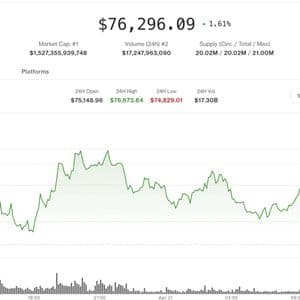
Bitcoin advanced while altcoins continued to struggle after the weekend's DeFi exploit, with markets eyeing Middle East tensions and shifting risk sentiment.
21 Apr 2026, 10:30
Mantle Network Stands Resilient: Core Infrastructure Unscathed by KelpDAO Security Breach
BitcoinWorld Mantle Network Stands Resilient: Core Infrastructure Unscathed by KelpDAO Security Breach In a significant development for the decentralized finance (DeFi) ecosystem, the Mantle Network has publicly confirmed its core infrastructure and user assets remain completely secure following a recent security incident at KelpDAO. This announcement, made on April 15, 2025, provides crucial clarity for the cryptocurrency community and underscores the importance of isolated smart contract risk within modular blockchain architectures. The Mantle team has emphatically stated that the hacker did not compromise any Mantle-related contracts, its official bridge, or the ecosystem’s primary assets. Mantle Network Security Posture After the KelpDAO Hack The recent exploit targeting KelpDAO, a liquid staking protocol, sent shockwaves through the Ethereum Layer 2 and restaking sectors. Consequently, many investors and analysts immediately scrutinized connected ecosystems for potential contagion. However, Mantle’s swift and detailed response has effectively mitigated these concerns. The project’s core assertion is unambiguous: the Mantle network itself, its canonical bridge, and fundamental assets like MNT experienced zero impact. This resilience is not accidental. It stems from Mantle’s specific architectural design and its partnership frameworks. Importantly, KelpDAO operated on the Mantle network but as a separate, independent application layer. This separation of concerns is a foundational security principle in blockchain. The breach was contained within KelpDAO’s specific smart contract logic, which the Mantle core development team does not control or audit. No Asset Loss: Mantle confirmed zero user funds were lost from its treasury, bridge, or core protocol contracts. Contract Integrity: The hacker’s address showed no interaction with Mantle’s foundational smart contracts. Bridge Security: The official Mantle bridge, a critical piece of infrastructure for moving assets to and from Ethereum, remained fully operational and secure throughout the event. Analyzing the KelpDAO Incident and Its Limited Scope To understand why Mantle emerged unscathed, one must examine the nature of the KelpDAO exploit. Preliminary analysis from blockchain security firms suggests the issue likely involved a vulnerability in KelpDAO’s restaking derivative contracts. These contracts manage user-deposited ETH to mint a liquid staking token. The flaw potentially allowed unauthorized minting or withdrawal. This type of application-layer exploit is distinct from a chain-level failure or a bridge hack. For instance, a bridge hack targets the cross-chain messaging and locking mechanism, potentially draining all bridged assets. Conversely, a smart contract exploit typically affects only the funds directly deposited into that specific contract suite. The KelpDAO incident falls into the latter category, limiting its blast radius primarily to users of that specific protocol. Expert Perspective on Ecosystem Risk Isolation Blockchain security experts often emphasize the “shared security, isolated execution” model of Layer 2 networks. Mantle, as an Ethereum Layer 2, inherits security from Ethereum but allows independent dApps to build on its execution layer. Dr. Elena Rodriguez, a cybersecurity researcher specializing in DeFi, contextualized the event: “The KelpDAO situation is a textbook case of application-specific risk. It highlights the critical difference between a network failure and a dApp failure. A robust L2 like Mantle can provide a secure base layer, but it cannot eliminate smart contract risk for every project built on top. Investors must always differentiate between chain risk and dApp risk.” This expert analysis reinforces Mantle’s position that its base layer performed as designed—securely executing transactions, including those that were maliciously intended within a flawed dApp. Mantle’s Proactive Recovery and Collaborative Response Despite not being directly liable, the Mantle ecosystem is proactively engaged in recovery efforts. The team has initiated collaboration with Aave, whose GHO stablecoin was integrated within KelpDAO’s system, and other affected protocols. These discussions focus on mitigation strategies and potential user compensation frameworks. Most notably, Mantle has publicly floated the possibility of using its substantial community treasury to assist in recovery. This would be a voluntary, governance-driven action to support ecosystem health and user confidence. Such a move would likely require a formal vote by MNT token holders, setting a precedent for treasury use in post-incident recovery. The table below outlines the key components of Mantle’s response strategy: Action Item Description Status Network Status Assurance Public confirmation of core system and bridge security. Completed Collaboration with Protocols Joint discussions with Aave and related teams on recovery. Ongoing Treasury Assistance Proposal Exploring use of community funds to aid affected users. Under Discussion Ecosystem Monitoring Tracking fund flows and overall network health metrics. Continuous Furthermore, on-chain data appears to support Mantle’s claim of a quick recovery. Following initial outflows due to panic, analytics show funds are flowing back into the Mantle ecosystem. This indicates returning user confidence in the network’s underlying stability. The swift public communication from the Mantle team undoubtedly played a major role in stabilizing sentiment. Conclusion The KelpDAO hack serves as a stark reminder of the persistent smart contract risks in DeFi. However, the event also demonstrates the effectiveness of modular blockchain design in containing such incidents. The Mantle network has successfully weathered this storm, with its core infrastructure proving resilient. Its unaffected status provides a compelling case study in risk isolation. Moving forward, Mantle’s collaborative approach to recovery, including potential treasury deployment, could establish a new standard for ecosystem stewardship in the face of third-party protocol failures. The network’s security and rapid recovery underscore its maturing position within the competitive Layer 2 landscape. FAQs Q1: Was any MNT token stolen in the KelpDAO hack? No. The Mantle team has confirmed that no MNT tokens were stolen or affected. The exploit was specific to KelpDAO’s contracts and the assets deposited directly into them. Q2: Is it safe to use the Mantle bridge now? According to Mantle’s official statements, the official bridge was never compromised and remains secure. Users should always verify transactions through official channels, but the bridge’s operation was unaffected by the KelpDAO incident. Q3: How can Mantle say it’s unaffected if KelpDAO was built on its network? Mantle provides the base execution layer (like an operating system), while dApps like KelpDAO are applications built on top. A flaw in an application does not mean the operating system is hacked. The breach was contained within KelpDAO’s specific code. Q4: What does “using its treasury to assist” mean for MNT holders? This would likely involve a governance proposal where MNT token holders vote on whether to allocate a portion of the community treasury funds to help users who lost money in the KelpDAO hack. It is not an automatic action and would require community approval. Q5: Does this incident affect the security of other dApps on Mantle? Not directly. Each dApp on Mantle has its own independent smart contract code. The KelpDAO exploit does not imply vulnerabilities in other projects. However, it is a reminder for users to audit the specific dApps they use, regardless of the underlying chain. This post Mantle Network Stands Resilient: Core Infrastructure Unscathed by KelpDAO Security Breach first appeared on BitcoinWorld .


