


 Invest ideas
News
26 May 2026, 10:24
Bitcoin spot volume crashes over 80% since October 2025

Bitcoin ( BTC ) spot trading volumes on all cryptocurrency exchanges have collapsed to their lowest levels in nearly two years. The Bitcoin spot volume on Binance alone has declined by more than 81% from its October 2025 peak of $198.6 billion to about $36.4 billion at press time. Meanwhile, Gate.io spot volumes have fallen by 79.6% over the same period, while Bybit has shed 66%, thereby confirming a market-wide slowdown, according to data from CryptoQuant analyzed by Finbold on May 26. Bitcoin spot trading volume. Source: CryptoQuant The last time Bitcoin spot volumes were this subdued was in July 2023, deep in the previous bear market. Essentially, the significant drop in BTC’s spot volume suggests a notable decline in its selling pressure. Moreover, demand for Bitcoin and other cryptocurrencies had fallen amid rising inflationary pressures triggered by the U.S.-Iran war. As such, investors opted for commodities and traditional equity indices. What’s next for Bitcoin price amid low spot volume With Bitcoin’s spot volume at a record low, bearish sentiment may have cooled further. Notably, the flagship coin has signaled a potential reversal after rebounding from a possible bear-market bottom formed between February and April, trading around $76,660 at the time of publication. BTC/USD 12-month chart. Source: Finbold Historically, the collapse in BTC’s spot volume marked the end of its bear markets. “It was precisely after spot volumes collapsed that the 2023 bear market came to an end, followed by the return of volatility and the recovery of the bullish trend,” analyst Darkfost noted . BTC funding rates on Binance. Source: CryptoQuant The potential BTC price rebound in the near future is bolstered by its sustained positive funding rates – periodic payments between longs and shorts in perpetual futures to keep the contract price aligned with spot price – on Binance over the past two, as per metrics from CryptoQuant . The low spot volume for BTC amid bullish leverage traders could bolster a potential rally beyond $82,000 in the near future. The post Bitcoin spot volume crashes over 80% since October 2025 appeared first on Finbold .
26 May 2026, 10:19
Bitcoin volatility falls to 9-month low as price stalls between $76,500 and $77,000

Bitcoin traded near $76,500 after failing to break above $80,000, while its volatility gauge fell to a nine-month low. The Bitcoin Volmex Implied Volatility Index dropped to 36.11 on Monday in Singapore. That was its lowest level since September and close to its weakest reading since 2023. The index uses live crypto options prices to track expected 30-day Bitcoin volatility. Bitcoin traded around $77,000 today and remained almost 40% below its October record above $126,000. US spot-Bitcoin ETFs recorded about $1 billion in net outflows so far in May, ending two months of inflows. Spot ETF MVRV rose 0.69%. ETF netflows improved 28.9%. ETF trade volume fell 22.9%. Bitcoin traders cut spot volume as Binance activity falls 81% from October 2025 Bitcoin spot trading volume has dropped to levels last seen in July 2023. Binance recorded $36.4 billion in trading volume, compared with $198.6 billion in October 2025. Current Binance volume is almost five times lower than that October figure. Source: CryptoQuant Gateio volume fell 79.6%. Bybit volume fell 66%. Inflation pressure and the longer-than-expected US-Iran conflict pushed investors toward commodities and traditional equity indexes instead of crypto markets. Meanwhile, Bitcoin’s daily active addresses recorded a small fall, as entity-adjusted transfer volume also declined slightly. According to Glassnode, capital share and the short-term holder to long-term holder supply ratio showed a steadier liquidity profile and lower speculative activity. “Bitcoin pulled back from $79K to $74K before rebounding toward $77K, with momentum and activity cooling. Despite softer sentiment, easing sell pressure hints at early signs of stabilization,” said Glassnode. The net unrealized profit-to-loss ratio declined sharply. The realized profit-to-loss ratio showed more loss realization than profit-taking. Bitcoin now has lower volatility, weaker spot volume, ETF outflows, lower ETF trade volume, fewer daily active addresses, lower adjusted transfer volume, steadier liquidity metrics, and more realized losses than profits. Looking forward, analyst Crypto Rover believes the US midterms election will turn the market bullish. “Everyone’s narrative right now is that the stock market is outperforming Bitcoin and that this is somehow strange. It’s not. This happens every single cycle,” said Crypto Rover. “Once $BTC starts outperforming the stock market again (breaking back above the bull market support band), that might be your signal the bear market is over.” Don’t just read crypto news. Understand it. Subscribe to our newsletter. It's free .
26 May 2026, 10:16
Bitcoin Price Prediction: BTC Nears Critical Support as $70K Realized Price Band Comes Into Focus
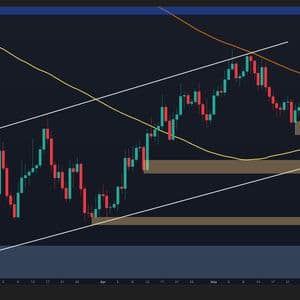
Bitcoin’s recent price action suggests the market is approaching an important decision zone where multiple technical and on-chain support levels converge. This raises the possibility of a short-term bullish reaction before the market determines its next larger directional move. The behavior around the $74K-$75K support and deeper demand regions will likely shape Bitcoin’s medium-term outlook. Bitcoin Price Analysis: The Daily Chart On the daily timeframe, BTC continues to trade below the descending 200-day MA near $80K, struggling to build bullish momentum. Following rejection from the $82K resistance area, sellers pushed the market back toward the first major support zone at $74K-$75K. This region is especially important because it aligns with prior demand and recent local lows, and it sits above the 100-day MA near $73K. Historically, overlapping support levels often generate temporary stabilization or corrective rebounds. The immediate scenario favors a pullback toward the $74K-$75K demand zone. If buyers defend this region successfully, Bitcoin may attempt another corrective move toward $78K-$80K. However, losing the $74K support could expose the next key level around $70K-$71K, followed by the stronger structural support near $65K-$66K. At this stage, price remains in correction mode rather than a confirmed trend reversal. Source: TradingView BTC/USDT 4-Hour Chart The lower timeframe highlights increasing indecision near support. Bitcoin recently reacted positively from the $74K-$75K order block and briefly recovered toward $77K, suggesting buyers remain active around this area. Still, bullish momentum has remained weak, with rebounds repeatedly failing to reclaim higher resistance levels. This indicates that current upward movements may represent temporary relief rallies rather than renewed trend continuation. The short-term support sits at $74K-$75K. Holding above this zone could encourage another recovery attempt toward the $78K-$80K region. Conversely, a confirmed breakdown below $74K may accelerate selling toward the next major demand area around $70K-$71K. Therefore, the reaction at current support levels remains critical to determining whether Bitcoin enters a stabilization phase or another bearish leg. Source: TradingView On-Chain Analysis The UTXO Realized Price Bands provide additional context by tracking the average acquisition cost of different investor cohorts. These levels often serve as psychological support or resistance because they indicate where holders become profitable or begin to experience losses. Currently, the realized price for the 1M–3M cohort sits near $70K, while the 18M–2Y cohort remains around $63K. Meanwhile, longer-term holders between 12M–18M and 3M–6M maintain realized prices closer to the $90K region. The significance lies in the confluence between technical supports and realized price bands. Bitcoin’s first major support zone around $ 70K–$71 K aligns closely with the realized price of younger holders (1M–3M), strengthening the likelihood of demand emerging in this area. A deeper decline toward $63K-$65K would also coincide with the realized price of longer-term cohorts around $63K, alongside an important historical support zone visible on the daily chart. This suggests that if Bitcoin continues correcting, support levels at $74K-$75K, $70K-$71K, and eventually $63K-$65K may attract increasing buying activity. The market’s reaction around these zones will likely determine whether the current pullback evolves into accumulation or transitions into a broader bearish continuation. For now, the data point to short-term support potential rather than an immediate trend recovery. Source: CryptoQuant The post Bitcoin Price Prediction: BTC Nears Critical Support as $70K Realized Price Band Comes Into Focus appeared first on CryptoPotato .
26 May 2026, 10:15
Ethereum Price Prediction: ETH Whales Pressure Price

Ethereum is caught between a $2,400 whale sell wall and a major Fibonacci support zone near $2,026. Analysts say Coinbase whales are applying pressure, but the weekly chart still shows ETH holding the level that could decide its next move. Ethereum Price Faces $2,400 Sell Wall as Coinbase Whales Apply Pressure Ethereum is facing a short-term sell wall near $2,400, according to a chart shared by analyst CW on X. The analyst said Coinbase whales are placing large orders above the market and applying downward pressure. However, CW said those whales are not actually selling yet. Ethereum Whale Order Chart. Source: CW on X The chart shows ETH trading far below the marked sell wall, with price moving near the $2,100 area. A large red horizontal zone appears around $2,400, showing where major whale orders are placed. CW said this setup creates pressure because large sell orders can limit upside movement before price reaches that level. Traders often watch these zones because they can act as resistance if price moves higher. However, the analyst made a clear difference between placing orders and selling into the market. According to CW, Coinbase whales are forming the wall to push ETH down, not unloading large positions at the current level. The chart also shows lower green zones below price, which appear to mark support or large bid areas. These zones sit closer to the $2,000 area and may become important if ETH continues to move lower. For now, the main level on the chart remains $2,400. ETH would need stronger buying pressure to move toward that sell wall and test whether those whale orders stay in place or get removed. Ethereum Chart Shows Contrarian Setup as ETH Holds Key Fibonacci Support Ethereum is holding a major weekly support area as analyst The Great Mattsby says market sentiment has become heavily bearish while the chart structure remains intact. The chart shared on X shows ETH testing the 0.786 Fibonacci retracement level near $2,026. The analyst pointed to this area as a key support zone and said fear is rising while support continues to hold. Ethereum Weekly Chart. Source: The Great Mattsby on X The weekly chart shows Ethereum moving inside a wide long-term range after several failed attempts to break higher. ETH previously reached resistance near the upper Fibonacci level around $4,868, but later pulled back toward the midrange. The most important level now is the 0.786 Fibonacci area near $2,026. The chart marks this zone with a red horizontal line and an arrow, showing where buyers are expected to defend the structure. The analyst said sentiment is “washed out” and fear is peaking. That means the setup is based on a contrarian view, where bearish market positioning may be too crowded while price still holds support. If ETH stays above the 0.786 level, the chart leaves room for a recovery toward higher resistance zones. The first major upside areas sit near the previous consolidation levels above $2,400 and $3,000. However, a weekly breakdown below the marked support would weaken the setup. In that case, the next major Fibonacci level on the chart sits near $1,017, which would represent a much deeper downside area. For now, the chart shows Ethereum at a key decision point. The bullish case depends on whether buyers keep defending the 0.786 Fibonacci support while sentiment remains weak.
26 May 2026, 10:14
XRP sentiment falls to 1.1 as price clings to $1.30

🚨 Sentiment around $XRP just fell to its lowest in months. This comes as the price fights to hold above $1.30 amid weak trends. 📉 Critical data: Investor pessimism often signals local lows for XRP. Continue Reading: XRP sentiment falls to 1.1 as price clings to $1.30 The post XRP sentiment falls to 1.1 as price clings to $1.30 appeared first on COINTURK NEWS .
26 May 2026, 10:10
Bitcoin Outflows Hit $1.32B in One of the Worst Weeks of 2026
Overall crypto investment products recorded $1.47 billion in weekly outflows, which was the second consecutive week of negative flows. US spot Bitcoin ETFs accounted for roughly $1.26 billion of the withdrawals. The selling pressure coincided with a weaker week for Bitcoin’s price, which briefly fell toward the $75,000 region before recovering slightly to trade near $79,569 at press time. Bitcoin ETF Outflows Surge Global crypto investment products experienced another major wave of outflows last week, as investors continued pulling capital from digital asset funds. According to CoinShares , crypto investment products recorded $1.47 billion in outflows during the week. This was the second consecutive week of negative flows and the third-largest weekly outflow recorded in 2026 so far. Weekly crypto asset flows (Source: CoinShares) The latest redemptions pushed cumulative two-week outflows to approximately $2.54 billion. CoinShares Head of Research James Butterfill attributed the sustained withdrawals to growing global uncertainty and a risk-off environment linked to escalating tensions involving Iran. Despite regulatory developments in the United States, including progress surrounding the Clarity Act, investors appeared more cautious toward risk assets. Bitcoin-related products accounted for the overwhelming majority of the outflows. According to the report, Bitcoin investment products alone saw $1.32 billion leave the market, which was the largest weekly Bitcoin fund redemption of the year. Year-to-date Bitcoin fund inflows also dropped sharply, shrinking from $3.9 billion to just $2.6 billion in a single week. The pressure was particularly visible in the US spot Bitcoin ETF market, where products collectively lost roughly $1.26 billion during the same period. The selling pressure coincided with a difficult week for Bitcoin’s price action. BTC’s price action over the past week (Source: CoinCodex) Over the past seven days, Bitcoin struggled to maintain bullish momentum after previously attempting to push toward higher resistance levels. BTC traded in a volatile range and experienced a sharp sell-off around May 23, which briefly dragged the price toward the $75,000 region before buyers stepped in to stabilize the market. At press time, Bitcoin traded around $79,569 after posting a 2.25% decline over the seven-day period. Ethereum products also faced selling pressure, and recorded $222.8 million in weekly outflows. However, some altcoins managed to attract fresh capital despite the broader market weakness. XRP investment products led the positive flows among altcoins after attracting $31.8 million, while Near products saw $9 million in inflows despite having relatively modest total assets under management. Solana products added $7.7 million, Sui products brought in $2.9 million, and multi-asset crypto investment products recorded $4.7 million in inflows. Flows by asset (Source: CoinShares) Regionally, the United States dominated the outflow figures with $1.43 billion in redemptions. Switzerland reversed course and posted $16.2 million in outflows. Canada and Hong Kong also recorded big withdrawals, while Germany’s flows stayed largely flat according to CoinShares data.


