News
14 Apr 2026, 01:55
Ethereum Whale Triggers Market Attention: billΞ.eth Sells $7.79M in ETH Amid Strategic Moves

BitcoinWorld Ethereum Whale Triggers Market Attention: billΞ.eth Sells $7.79M in ETH Amid Strategic Moves A significant Ethereum whale transaction has captured market attention as address billΞ.eth executed a substantial $7.79 million ETH sale, according to on-chain data analysis from March 2025. This transaction represents part of a larger strategic movement that has seen the whale address liquidate over $19 million in Ethereum holdings since early March. Ethereum Whale Executes Major Transaction On-chain analyst ai_9684xtpa reported the whale address billΞ.eth sold 3,285 ETH approximately one hour before publication. The transaction occurred at an average price of $2,372.24 per Ethereum token. This sale follows a pattern of strategic divestment that began on March 8, 2025. Since that initial transaction, the address has sold a total of 8,771 ETH valued at $19.14 million. The cumulative average selling price across all transactions stands at $2,182 per ETH. Blockchain analysts monitor whale movements closely because large transactions often signal market sentiment shifts. These substantial sales can influence market dynamics significantly. The Ethereum blockchain provides transparent transaction data that enables real-time tracking of major wallet activities. Consequently, market participants use this information to gauge potential price movements. Understanding Whale Behavior in Cryptocurrency Markets Cryptocurrency whales control substantial digital asset holdings that can impact market liquidity. Typically, analysts define whales as addresses holding at least 1,000 ETH or equivalent value in other cryptocurrencies. The billΞ.eth address transactions demonstrate classic whale behavior patterns. These include strategic accumulation during market dips and calculated distribution during price appreciation periods. Market Impact of Large Transactions Large ETH sales create immediate selling pressure on cryptocurrency exchanges. Market makers must absorb these substantial orders, potentially affecting short-term price stability. However, experienced traders often view whale movements as contrarian indicators. For instance, significant sales sometimes precede market bottoms, while accumulations may signal upcoming rallies. The table below illustrates the transaction pattern: Transaction Date ETH Amount USD Value Average Price March 8, 2025 Initial Sale Part of $19.14M $2,182 (average) Recent Transaction 3,285 ETH $7.79M $2,372.24 Cumulative Total 8,771 ETH $19.14M $2,182 (average) Several factors influence whale transaction decisions: Market conditions including liquidity and volatility Portfolio rebalancing strategies across asset classes Technical analysis of support and resistance levels Macroeconomic factors affecting cryptocurrency valuations On-Chain Analysis Methodology and Verification Blockchain analytics platforms provide tools for tracking wallet activities transparently. Analysts like ai_9684xtpa use multiple data sources to verify transaction authenticity. These include blockchain explorers, exchange flow data, and wallet clustering algorithms. The verification process ensures reported transactions reflect genuine market activity rather than internal transfers between controlled addresses. Ethereum’s public ledger enables anyone to examine transaction details. Each transaction includes timestamp, amount, sender, and receiver information. Sophisticated analysts correlate this data with exchange order books and liquidity pools. This comprehensive approach provides context about market impact and potential motivations behind large transactions. Historical Context of Whale Movements Historical data reveals patterns in whale behavior across market cycles. During the 2021 bull market, similar large transactions often preceded consolidation periods. Conversely, accumulation phases during bear markets frequently signaled impending recoveries. The current transaction volume represents moderate activity compared to historical extremes but remains significant for current market conditions. Market participants should consider several contextual factors: Overall Ethereum network health and transaction volume Institutional adoption trends affecting supply dynamics Regulatory developments influencing market sentiment Technological upgrades like Ethereum’s ongoing protocol improvements Cryptocurrency Market Structure and Whale Influence The cryptocurrency market features unique structural characteristics that amplify whale impacts. Unlike traditional equity markets with circuit breakers and trading halts, cryptocurrency exchanges operate continuously. This 24/7 trading environment means large transactions can occur during periods of reduced liquidity. Consequently, price impacts may be more pronounced during off-peak trading hours. Market makers provide essential liquidity services across major exchanges. These entities manage order books and facilitate large transactions with minimal slippage. However, extremely large orders sometimes require execution across multiple venues or over extended timeframes. The billΞ.eth transactions appear well-executed with minimal market disruption based on available data. Risk Management Considerations Professional traders monitor whale movements as part of comprehensive risk management strategies. Large sales may indicate potential selling pressure ahead. Conversely, accumulation patterns could signal buying interest at certain price levels. Savvy investors balance this information with fundamental analysis and technical indicators. Several risk factors accompany whale transaction analysis: Potential for coordinated market manipulation despite regulatory efforts Limitations of on-chain data in revealing complete transaction motives Variations in transaction purposes including tax planning or portfolio rebalancing Timing differences between transaction execution and public reporting Conclusion The Ethereum whale transaction involving billΞ.eth’s $7.79 million ETH sale represents significant market activity worthy of attention. This transaction forms part of a broader pattern totaling $19.14 million in ETH sales since early March 2025. On-chain analysis provides valuable insights into market dynamics and participant behavior. While individual transactions rarely determine market direction, collective whale movements offer important signals about market sentiment and potential turning points. Market participants should continue monitoring blockchain data alongside fundamental and technical analysis for comprehensive market understanding. FAQs Q1: What defines a cryptocurrency whale? A cryptocurrency whale typically refers to an individual or entity holding substantial amounts of digital assets, generally at least 1,000 ETH or equivalent value in other cryptocurrencies. These entities can influence market prices through their trading activities. Q2: How do analysts track whale transactions? Analysts use blockchain explorers and specialized analytics platforms to monitor wallet activities. These tools provide transparent data about transaction amounts, timestamps, and wallet addresses on public blockchains like Ethereum. Q3: Why do whale transactions matter to regular investors? Whale transactions can signal potential market movements because large trades affect liquidity and may indicate sentiment shifts among major holders. However, individual investors should consider this information alongside other analysis methods. Q4: Can whale transactions manipulate cryptocurrency prices? While large transactions can create temporary price impacts, modern cryptocurrency markets have substantial liquidity that limits manipulation. Regulatory oversight has increased significantly since 2023 to prevent market abuse. Q5: How should investors interpret whale selling activity? Investors should view whale selling as one data point among many. Context matters greatly—sales for portfolio rebalancing differ fundamentally from panic selling. Comprehensive analysis considers transaction patterns, market conditions, and fundamental factors. This post Ethereum Whale Triggers Market Attention: billΞ.eth Sells $7.79M in ETH Amid Strategic Moves first appeared on BitcoinWorld .
14 Apr 2026, 01:25
KOSPI Soars: Benchmark Index Tops 6,000 in Stunning 40-Day Recovery Rally

BitcoinWorld KOSPI Soars: Benchmark Index Tops 6,000 in Stunning 40-Day Recovery Rally In a significant milestone for Asian financial markets, South Korea’s benchmark KOSPI index surged past the 6,000-point threshold during intraday trading on April 12, 2025. This pivotal move marks the first breach of this psychological level in over 40 days, specifically since March 3. Consequently, the index closed the session at 5,994.78, registering a robust single-day gain of 3.20%. This rally signals a potent recovery for one of the region’s most closely watched equity gauges. KOSPI 6000: Anatomy of a Market Rebound The KOSPI’s ascent represents a dramatic turnaround from its recent consolidation phase. Market analysts immediately scrutinized the rally’s composition. Notably, the technology and semiconductor sectors provided substantial thrust. For instance, heavyweight components like Samsung Electronics and SK Hynix recorded significant gains. Simultaneously, the financial sector also demonstrated notable strength. This broad-based participation suggests underlying market confidence rather than isolated speculation. Several macroeconomic factors converged to fuel this upward movement. First, recent trade data from China, South Korea’s largest trading partner, exceeded expectations. Second, the Bank of Korea’s latest policy statement struck a more balanced tone on inflation. Furthermore, a weakening Korean Won provided a tailwind for the nation’s formidable export-oriented companies. These elements collectively created a favorable environment for equity appreciation. Historical Context and Technical Breakout To fully appreciate this event, one must examine the KOSPI’s historical performance. The index first closed above the 6,000-point mark in January 2022. Since then, this level has acted as a major technical and psychological barrier. The prolonged period below 6,000, beginning in early March, coincided with global risk-off sentiment. During that time, investors grappled with concerns over prolonged high interest rates and geopolitical tensions. The breakout is technically significant. It occurred alongside a surge in trading volume, which validates the move’s strength. Moreover, the index decisively cleared its 50-day moving average, a key trend indicator watched by institutional traders. This technical confirmation often precedes further momentum. The table below outlines key resistance levels the index has recently overcome. Resistance Level Date Breached (2025) Significance 5,800 April 5 Short-term consolidation zone 5,900 April 10 Previous reaction high 6,000 April 12 Major psychological & technical barrier Expert Analysis on Sustained Momentum Financial experts emphasize the importance of follow-through. “A single-day breach is encouraging, but sustained closes above 6,000 are crucial,” notes a senior strategist at a leading Seoul-based securities firm. This perspective is widely shared. Analysts point to several upcoming catalysts that will test the rally’s durability: Q1 Earnings Season: Corporate results, starting mid-April, must support current valuations. Central Bank Policy: The Federal Reserve’s and Bank of Korea’s next decisions will influence capital flows. Currency Stability: A stable USD/KRW exchange rate is vital for exporter profitability. Therefore, while the breakout is a positive development, the market’s foundation requires continuous reinforcement from fundamental data. Comparative Performance in Global Markets The KOSPI’s performance does not exist in a vacuum. In fact, its recovery aligns with a broader stabilization in global equities. For example, the S&P 500 and Japan’s Nikkei 225 have also shown resilience. However, the KOSPI’s 3.20% single-day gain notably outpaced many peers. This outperformance highlights specific confidence in the Korean economic narrative. Key drivers include robust export orders and strategic positioning in the global electric vehicle and memory chip supply chains. Regional indices often move in correlation, yet idiosyncratic factors create divergence. South Korea’s market benefits from its unique sectoral mix. The dominance of globally competitive firms in cyclical industries allows for explosive rallies during risk-on periods. Conversely, this same characteristic can lead to heightened volatility during downturns. The current rally suggests investors are discounting near-term cyclical risks in favor of long-term growth prospects. Sectoral Drivers and Foreign Investment Flows A deep dive into sector performance reveals the rally’s engines. The semiconductor index soared, leading the advance. Additionally, battery makers and automotive companies posted strong gains. This sector rotation indicates a bet on a recovery in global technology demand. Foreign investors, after being net sellers for several weeks, reportedly returned as net buyers during the session. Their participation is a critical sentiment indicator for the KOSPI. Domestic institutional investors also contributed to the buying pressure. Pension funds and asset managers rebalanced portfolios ahead of the earnings season. Retail investor sentiment, as measured by margin debt levels, also showed tentative improvement. This multi-faceted buying support created a powerful upward thrust. The convergence of these investor classes often marks the beginning of a sustainable trend, not merely a short-term bounce. Conclusion The KOSPI index’s breach of the 6,000-point level marks a crucial psychological victory for South Korean markets. This recovery, after more than 40 days, reflects improving global risk appetite and confidence in Korea’s corporate fundamentals. The rally’s breadth across sectors and participation from key investor groups are encouraging signs. However, its sustainability will hinge on forthcoming earnings reports and central bank policies. The KOSPI 6000 level now transitions from a resistance barrier to a critical support zone that will define the market’s trajectory in the second quarter of 2025. FAQs Q1: What is the KOSPI index? The KOSPI (Korea Composite Stock Price Index) is the benchmark stock market index of South Korea. It tracks the performance of all common stocks listed on the Korea Exchange’s main board. Q2: Why is the 6,000-point level significant for the KOSPI? The 6,000-point level is a major psychological and technical benchmark. It represents a key area of historical resistance and support, often influencing trader sentiment and market momentum. Q3: What caused the KOSPI to surge past 6,000 points? The surge was driven by a combination of factors: strong gains in semiconductor and tech stocks, positive trade data from China, a balanced central bank outlook, and a return of foreign investor buying. Q4: How does the KOSPI performance compare to other Asian markets? While many Asian markets have stabilized, the KOSPI’s 3.20% gain on April 12 notably outperformed most regional peers, reflecting specific confidence in the South Korean economy and its export-centric companies. Q5: What are the key risks to the KOSPI sustaining levels above 6,000? Key risks include disappointing Q1 corporate earnings, a shift towards more hawkish central bank policies globally, a sharp appreciation of the Korean Won, or a deterioration in the global economic outlook. This post KOSPI Soars: Benchmark Index Tops 6,000 in Stunning 40-Day Recovery Rally first appeared on BitcoinWorld .
14 Apr 2026, 01:00
Ethereum Profit-Loss Indicator Is Hovering Just Below Neutral – The Market Waits for A Catalyst

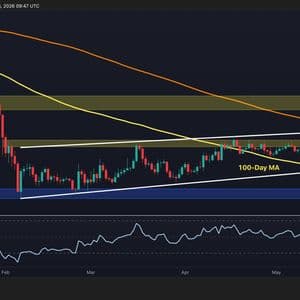
Ethereum has been consolidating for weeks. Selling pressure is present. Uncertainty is higher. An Arab Chain analysis has identified a condition in the on-chain data that describes exactly what this market is doing — and why it cannot stay here indefinitely. Related Reading: Ethereum Mirrors A 2023 Setup As Buyers Take Control Of Derivatives On Binance The report tracks Ethereum’s Net Unrealized Profit and Loss on Binance — a measure of whether holders are, on average, sitting on gains or losses relative to their entry prices. The indicator currently sits at -0.053, holding near the neutral zone while Ethereum trades around $2,100. That reading describes a market in equilibrium: investors on Binance are neither panicking out of losing positions nor taking profits from winning ones. They are holding — and waiting. The behavioral picture that emerges from the data is specific. Volatility has declined. Panic selling is absent. Excessive optimism is equally absent. Short-term trading activity has reduced to the point where the market is generating neither the downward pressure of fear nor the upward pressure of greed. What remains is a market suspended between two states, maintained in place by the absence of a catalyst strong enough to break it in either direction. At -0.053, the indicator is not perfectly neutral. It is slightly underwater — a detail small enough to overlook and significant enough to matter when the next directional move begins. Stability Is Not the Same as Safety. It Is a Countdown The Arab Chain analysis draws the distinction that makes the current NUPL reading more significant than its proximity to zero suggests. The indicator’s persistence in slightly negative territory — holding at -0.053 without sharp movements in either direction — reflects a specific investor behavior: waiting. Not accumulating aggressively. Not distributing systematically. Waiting for a catalyst that has not yet arrived to clarify the direction that the data cannot currently confirm. That behavioral state has a historical profile. Periods where the NUPL holds near neutral without sharp deviations are typically associated with lower near-term risk — the absence of panic selling means forced exits are not driving price, and the absence of excessive optimism means unsustainable speculation is not inflating it. The market moves within narrow ranges because neither the fear that accelerates downside nor the greed that accelerates upside is present in sufficient force to break the equilibrium. The report identifies this condition as temporary by definition. Consolidation phases do not persist indefinitely — they persist until a catalyst resolves them. Ethereum stabilizing around $2,100 with NUPL hovering near neutral, and no sharp movements in the indicator reflect a market that has found a temporary balance between supply and demand. The word that matters in that sentence is temporary. The balance is real. Its duration is not guaranteed. When the catalyst arrives — macro clarity, a demand surge, a shift in sentiment — the indicator will move, and the narrow range that has contained Ethereum’s price will expand in the direction the move takes it. Related Reading: Capital Is Rotating From Bitcoin To Ethereum – On-Chain Data Shows It Is Not Over Ethereum Consolidates Below Resistance as Momentum Stalls Ethereum is trading near $2,150–$2,200, holding a tight range after recovering from the February capitulation. The chart shows a clear shift from aggressive selling to controlled consolidation, with price forming higher lows since the bottom near $1,800. This suggests stabilization, but not yet a confirmed reversal. Technically, ETH remains below all major moving averages. The 50-day (blue) is flattening and beginning to act as short-term support, while the 100-day (green) and 200-day (red) continue to trend downward above price, reinforcing overhead resistance. Recent attempts to break higher have stalled below the $2,300–$2,400 zone, indicating persistent supply. Related Reading: XRP Supply Is Thinning, and Leverage Is Absent. Learn What Happens When One Of Those Changes Volume dynamics support this interpretation. The spike during the sell-off reflects forced liquidations, while the subsequent decline in volume points to reduced participation. The current recovery lacks the expansion in volume typically associated with strong trend reversals. Structurally, Ethereum is compressing beneath resistance. The range between $2,000 and $2,300 is tightening, with neither buyers nor sellers showing dominance. A break above $2,400 would signal a shift in momentum and open a move toward the 100-day average. Conversely, losing $2,000 would invalidate the recovery structure. Featured image from ChatGPT, chart from TradingView.com
14 Apr 2026, 00:55
BlackRock Withdraws $144.8M in Bitcoin from Coinbase: Strategic Hold Move Signals Institutional Confidence

BitcoinWorld BlackRock Withdraws $144.8M in Bitcoin from Coinbase: Strategic Hold Move Signals Institutional Confidence Global asset management giant BlackRock executed a significant cryptocurrency transaction, withdrawing 2,004 Bitcoin valued at approximately $144.82 million from the Coinbase exchange platform. This substantial movement, detected by blockchain analytics firm Onchain Lens approximately seven hours before publication, represents a notable shift in institutional Bitcoin management strategies. Market analysts generally interpret such exchange withdrawals as indicators of long-term holding intentions rather than immediate trading activity. BlackRock Bitcoin Withdrawal: Analyzing the Transaction Details Blockchain data reveals the precise nature of BlackRock’s cryptocurrency transfer. The transaction involved exactly 2,004 BTC moving from a known Coinbase institutional custody address to a private wallet. At current market valuations, this represents approximately $144.82 million in digital asset value. Importantly, the receiving address shows no previous outgoing transactions, suggesting it functions as a cold storage solution. Furthermore, blockchain analysts confirm the destination wallet belongs to BlackRock’s digital asset management division. This division oversees the company’s growing cryptocurrency exposure across various investment products. Exchange withdrawals of this magnitude typically signal accumulation strategies rather than distribution plans. When institutional investors move assets off exchanges, they generally intend to hold them for extended periods. This reduces immediate selling pressure on markets. Additionally, secure cold storage provides enhanced protection against exchange-related security risks. The timing coincides with broader institutional adoption trends in digital assets. Several traditional finance firms have recently increased their Bitcoin allocations despite market volatility. Institutional Crypto Storage Practices Major financial institutions employ sophisticated custody solutions for digital assets. These typically include: Multi-signature wallets requiring multiple authorized signatures for transactions Hardware security modules providing physical protection for private keys Geographically distributed key storage across secure facilities Insurance coverage against theft and operational failures Regular security audits by independent third-party firms Market Context and Historical Precedents BlackRock’s substantial Bitcoin movement occurs within a specific market environment. The cryptocurrency sector has experienced increased institutional participation throughout 2024 and early 2025. Several factors contribute to this trend. Regulatory clarity in major jurisdictions has improved significantly. Traditional finance infrastructure for digital assets has matured considerably. Moreover, Bitcoin’s performance relative to traditional assets has attracted portfolio diversification interest. Historical data reveals similar patterns among institutional investors. When MicroStrategy accumulated large Bitcoin positions, they consistently moved assets to corporate custody solutions. Tesla’s brief Bitcoin treasury allocation followed similar secure storage protocols. The Grayscale Bitcoin Trust maintains substantial cold storage reserves for its underlying assets. These precedents establish a clear institutional preference for direct custody over exchange-held positions. Recent Major Institutional Bitcoin Movements Institution Date Amount (BTC) Approximate Value Destination BlackRock Current 2,004 $144.82M Private Cold Storage MicroStrategy Q4 2024 1,045 $75.2M Corporate Treasury Public Company A November 2024 750 $54.1M Institutional Custodian On-Chain Analytics and Interpretation Methods Blockchain analytics firms like Onchain Lens employ sophisticated techniques to track institutional movements. They analyze transaction patterns, address clustering, and flow dynamics. Exchange addresses often exhibit recognizable behavioral characteristics. Large withdrawals to new addresses typically indicate accumulation strategies. Conversely, deposits to exchanges frequently precede selling activity. The transparency of public blockchains enables this analysis despite pseudonymous addresses. Several key metrics help interpret these movements: Exchange Net Flow : The difference between deposits and withdrawals Entity-Adjusted Volume : Transaction volume accounting for internal transfers HODLer Net Position Change : Long-term holder accumulation patterns Supply Last Active : Age distribution of coins moving on-chain Current data shows declining exchange balances across major platforms. This trend suggests broader accumulation across market participants. Institutional movements often amplify existing retail trends. The combined effect can significantly impact market structure and liquidity conditions. Expert Analysis of Withdrawal Implications Financial analysts specializing in digital assets provide important context. According to institutional investment researchers, large withdrawals typically precede reduced market volatility. When coins move to cold storage, they effectively exit the trading supply. This can create upward price pressure if demand remains constant. However, the actual market impact depends on multiple concurrent factors. These include overall market sentiment, macroeconomic conditions, and regulatory developments. Furthermore, BlackRock’s actions influence other institutional investors. As a market leader in traditional finance, their operational decisions receive close attention. Competitors and smaller firms often analyze these movements for strategic insights. This creates potential follow-on effects across the institutional investment landscape. The signaling value sometimes outweighs the direct market impact of the transaction itself. Regulatory and Compliance Considerations Institutional cryptocurrency transactions occur within strict regulatory frameworks. In the United States, the Securities and Exchange Commission provides guidance for digital asset custody. The Financial Accounting Standards Board has established accounting standards for cryptocurrency holdings. Banking regulators oversee institutional exposure to digital assets. These frameworks ensure proper reporting, risk management, and consumer protection. BlackRock’s compliance infrastructure undoubtedly addresses these requirements. Their digital asset division maintains robust anti-money laundering protocols. They implement know-your-customer procedures for all cryptocurrency transactions. Tax reporting follows established guidelines for digital asset movements. This regulatory maturity enables large-scale institutional participation. It contrasts with earlier periods of regulatory uncertainty that limited traditional finance involvement. Technical Infrastructure Behind Institutional Transactions Executing a $144.82 million Bitcoin transfer requires sophisticated technical infrastructure. Institutional platforms integrate multiple security layers. They employ transaction monitoring systems to detect anomalies. Multi-party computation often secures transaction authorization. Time-locked features can prevent unauthorized movements. These technical safeguards exceed typical retail investor protections. The actual transaction mechanics involve several steps. First, the institution authorizes the withdrawal through internal governance procedures. Next, transaction construction occurs with appropriate fee optimization. Then, multi-signature authorization proceeds according to security protocols. Finally, blockchain confirmation provides settlement finality. The entire process typically completes within one hour for Bitcoin transactions. However, internal governance procedures may require additional time before transaction initiation. Conclusion BlackRock’s withdrawal of $144.82 million in Bitcoin from Coinbase represents a significant institutional cryptocurrency movement. This transaction aligns with established patterns of secure asset custody among traditional finance participants. The movement of 2,004 BTC to private cold storage suggests long-term holding intentions rather than immediate trading plans. Market analysts interpret such exchange outflows as potentially bullish signals for Bitcoin’s supply dynamics. This BlackRock Bitcoin withdrawal exemplifies the maturation of institutional digital asset management practices. It demonstrates how traditional finance giants increasingly integrate cryptocurrency into their operational frameworks while maintaining rigorous security and compliance standards. FAQs Q1: What does a Bitcoin withdrawal from an exchange typically indicate? Exchange withdrawals generally signal accumulation or holding strategies rather than selling intentions. When institutions move assets to private wallets, they typically plan long-term custody. Q2: How do analysts track institutional Bitcoin movements? Blockchain analytics firms use address clustering, transaction pattern analysis, and flow metrics to identify institutional activity despite pseudonymous addresses. Q3: What security measures do institutions use for Bitcoin storage? Institutional custody typically involves multi-signature wallets, hardware security modules, geographically distributed key storage, insurance coverage, and regular security audits. Q4: How might this withdrawal affect Bitcoin’s market dynamics? Large withdrawals reduce immediately available trading supply on exchanges, potentially creating upward price pressure if demand remains constant or increases. Q5: What regulatory frameworks govern institutional Bitcoin transactions? In the United States, SEC custody guidance, FASB accounting standards, banking regulations, anti-money laundering requirements, and tax reporting rules all apply to institutional cryptocurrency activities. This post BlackRock Withdraws $144.8M in Bitcoin from Coinbase: Strategic Hold Move Signals Institutional Confidence first appeared on BitcoinWorld .
14 Apr 2026, 00:45
OpenAI’s Strategic Acquisition: How the Hiro Finance Deal Signals a Major Push into AI-Powered Personal Finance

BitcoinWorld OpenAI’s Strategic Acquisition: How the Hiro Finance Deal Signals a Major Push into AI-Powered Personal Finance In a move that underscores its growing ambitions beyond conversational AI, OpenAI has confirmed the acquisition of Hiro Finance, a promising AI-powered personal finance startup. The announcement, made by Hiro founder Ethan Bloch on Monday, April 30, 2025, and verified by Bitcoin World, represents a strategic talent acquisition for the AI giant as it seeks to deepen its capabilities in mathematical reasoning and specialized financial applications. This transaction follows a notable pattern of OpenAI integrating niche expertise through acquihires, particularly in domains where precision and reliability are paramount. OpenAI Acquires Hiro: The Details of the Deal OpenAI has formally acquired the AI personal finance startup Hiro Finance. Founder Ethan Bloch announced the news, confirming that the entire Hiro team will join OpenAI. While financial terms remain undisclosed, the operational shutdown timeline classifies this as an acquihire. Hiro will cease operations on April 20, with all user data deleted from its servers by May 13. The startup, founded in 2023, launched its consumer-facing AI financial planner just five months ago. It was backed by prominent venture capital firms, including Ribbit Capital, General Catalyst, and Restive. Hiro never publicly disclosed its total funding amount. LinkedIn currently lists approximately ten employees associated with the company, all of whom are expected to transition to OpenAI. This acquisition is particularly significant for several reasons. Firstly, it highlights OpenAI’s focused effort to bolster its prowess in mathematical accuracy—a historical weakness for large language models. Secondly, it marks OpenAI’s continued interest in the fintech vertical, building on previous forays. The deal also brings a seasoned entrepreneur into the fold. Ethan Bloch previously founded and sold the neobank Digit to Oportun for a reported $230 million in 2021. His experience in building and exiting consumer fintech products provides OpenAI with valuable, battle-tested leadership. Hiro’s Technology and Market Fit Hiro’s core product was an AI tool designed for personal financial planning. Users input sensitive financial data, including salary, debts, and monthly expenses. The AI would then model various ‘what-if’ scenarios to aid in decision-making. A key differentiator, according to Bloch, was the model’s specific training to ‘nail financial math.’ The platform even included a verification feature allowing users to check the AI’s calculations for accuracy. This focus on numerical reliability directly addresses a critical challenge for generative AI in finance. The Strategic Rationale Behind OpenAI’s Fintech Moves This acquisition is not OpenAI’s first step into financial technology. The company has actively marketed ChatGPT as a valuable tool for business finance teams. Integrating Hiro’s specialized talent and domain expertise could accelerate the development of more robust, trustworthy financial assistants within OpenAI’s ecosystem. The strategic rationale appears multi-faceted: Talent Acquisition: Securing a team with deep expertise in AI-for-finance and a proven founder. Capability Enhancement: Improving core model performance in mathematical reasoning and financial scenario modeling. Product Expansion: Exploring the development of specialized, vertical-specific AI applications for personal and business finance. Competitive Positioning: Strengthening offerings against rivals like Anthropic’s Claude, which is popular in certain fintech and automated trading circles. Bloch’s personal involvement with automated trading agents, like his ‘RoboBuffett’ agent built on OpenClaw, suggests OpenAI may also be interested in the intersection of AI and algorithmic trading. However, the immediate focus likely remains on enhancing the foundational models’ reliability for numerical tasks. Ethan Bloch: A Serial Entrepreneur’s Journey The acquisition also spotlights the remarkable trajectory of Hiro’s founder, Ethan Bloch. A serial entrepreneur who began his tech career at age 13, Bloch has described Hiro as his 15th launched project. He has publicly stated that his first 13 ventures failed. His 14th project, Flowtown—a social media SaaS tool launched in 2009—was sold for $4.5 million. His major success came with Digit, the automated savings neobank, which culminated in a nine-figure exit. Selling Hiro to OpenAI represents another significant milestone, placing him and his team at the forefront of AI development within one of the world’s most influential tech companies. The Broader Context: AI’s Evolving Role in Finance The Hiro acquisition occurs as AI’s role in finance rapidly evolves from basic chatbots to complex analytical engines. Frontier models have shown marked improvement in mathematical capabilities over the past two years. However, consumer and institutional trust requires near-perfect accuracy in financial contexts. Acquiring a team that prioritized and built technology for verifiable financial math indicates OpenAI’s serious commitment to solving this trust equation. Furthermore, regulatory scrutiny around AI in finance is intensifying globally, making technical precision and transparency non-negotiable for market adoption. Market Impact and Future Implications For the fintech startup ecosystem, this deal signals that deep technical expertise in a narrow domain remains highly valuable to major AI platforms. It demonstrates an alternative exit path for startups focusing on solving specific, hard problems within AI, rather than building standalone mass-market products. For OpenAI, the move aligns with a broader strategy of controlled vertical expansion. Instead of building all expertise in-house, the company is selectively acquiring teams that can accelerate its roadmap in high-value sectors like finance, healthcare, and law. The immediate future will reveal whether OpenAI plans to launch a dedicated financial planning product or simply integrate Hiro’s methodologies into its existing models like ChatGPT and its API offerings. The shutdown of Hiro’s service suggests the former is less likely in the short term, with integration being the primary goal. Conclusion OpenAI’s acquisition of Hiro Finance is a strategic, talent-driven move that highlights the company’s focused efforts to dominate the application of artificial intelligence in specialized, high-stakes fields like personal finance. By bringing in Ethan Bloch and his team, OpenAI gains critical expertise in financial mathematics and consumer fintech product development. This acquihire strengthens OpenAI’s hand against competitors and advances its core mission of building safe, beneficial, and capable AI systems. As AI continues to permeate every sector, such targeted acquisitions will likely become a standard mechanism for tech giants to rapidly assimilate cutting-edge domain knowledge and accelerate innovation. FAQs Q1: What did OpenAI acquire? OpenAI acquired Hiro Finance, an AI-powered personal financial planning startup, in what is primarily considered an ‘acquihire’ to gain the team’s talent and expertise. Q2: Who founded Hiro Finance? Hiro was founded by serial entrepreneur Ethan Bloch, who previously founded and sold the neobank Digit for over $200 million. Q3: Will Hiro’s app continue to operate? No. Hiro will shut down its consumer service on April 20, 2025, and delete all user data from its servers by May 13, 2025. Q4: Why is this acquisition significant for OpenAI? It brings in a team with specialized expertise in making AI models highly accurate at financial mathematics, a historically challenging area for large language models, and signals OpenAI’s deeper investment in fintech applications. Q5: Is this OpenAI’s first acquisition in the finance space? No, it is not the first, but it is a notable one that emphasizes talent acquisition in the specific niche of AI-driven personal financial planning and calculation. This post OpenAI’s Strategic Acquisition: How the Hiro Finance Deal Signals a Major Push into AI-Powered Personal Finance first appeared on BitcoinWorld .
14 Apr 2026, 00:40
Altcoin Season Index Plummets 5 Points to 32, Signaling Bitcoin’s Dominant Grip

BitcoinWorld Altcoin Season Index Plummets 5 Points to 32, Signaling Bitcoin’s Dominant Grip The cryptocurrency market witnessed a significant shift on April 2, 2025, as CoinMarketCap’s critical Altcoin Season Index fell five points to a reading of 32, intensifying signals of a prevailing Bitcoin season. This notable drop provides a crucial data point for investors navigating the complex dynamics between Bitcoin and alternative cryptocurrencies. Understanding the Altcoin Season Index Decline CoinMarketCap’s Altcoin Season Index serves as a primary barometer for market sentiment. The index meticulously compares the 90-day price performance of the top 100 cryptocurrencies, excluding stablecoins and wrapped tokens, against Bitcoin’s performance. Consequently, a score closer to 100 indicates a strong altcoin season, where most major altcoins outperform Bitcoin. Conversely, the current score of 32, following a five-point drop, firmly suggests Bitcoin’s dominance. The market officially declares an altcoin season only when 75% of the tracked coins surpass Bitcoin over the previous quarter. This recent decline continues a broader trend observed throughout early 2025. Several factors contribute to this movement, including shifting institutional investment flows and macroeconomic uncertainties. Analysts consistently monitor this index because it reflects capital rotation patterns within the digital asset ecosystem. Historically, prolonged periods of Bitcoin dominance often precede explosive altcoin rallies, making the index a vital leading indicator. Bitcoin Dominance and Market Cycle Context The current index reading of 32 strongly aligns with a phase known as ‘Bitcoin season.’ During such periods, investors typically exhibit a ‘flight to quality,’ favoring Bitcoin’s perceived stability and liquidity over higher-risk altcoins. This behavior is especially common following major market events or in anticipation of Bitcoin-specific catalysts, such as the recent developments surrounding spot Bitcoin ETF inflows and the upcoming halving cycle adjustments. Market cycles have demonstrated a reliable, though not perfectly predictable, pattern. A Bitcoin season often consolidates gains and establishes a new price floor before capital seeks higher returns in altcoins. The following table contrasts key characteristics of both market phases based on historical data from 2020-2024: Market Phase Altcoin Season Index Range Typical Investor Behavior Volatility Profile Bitcoin Season Below 50 Risk-off, capital preservation Lower relative volatility Altcoin Season Above 75 Risk-on, yield chasing Extremely high volatility Therefore, the index’s movement is not merely a number but a reflection of underlying risk appetite. The five-point single-day drop is significant, suggesting a rapid reassessment of risk by major market participants. Expert Analysis on Capital Rotation Financial analysts emphasize the importance of the Altcoin Season Index for portfolio strategy. ‘This index is a quantifiable measure of narrative shift,’ notes a report from Arcane Research, a leading crypto analytics firm. ‘A sustained reading below 40, as we see now, indicates that Bitcoin is absorbing the majority of new capital entering the space. This often sets the stage for the next cycle, as strength in Bitcoin eventually spills over into the broader market.’ Evidence from on-chain data supports this view. Analytics platforms like Glassnode report that Bitcoin’s realized capitalization has seen consistent growth, while many altcoin networks have experienced stagnant or declining fundamental metrics like active addresses and transaction volume. This divergence reinforces the index’s message of current Bitcoin strength. Furthermore, regulatory clarity in key jurisdictions has disproportionately benefited Bitcoin, seen as a more established commodity compared to altcoins, which may face security classification debates. Historical Precedents and Future Implications Examining past data provides context for the current index level. In Q4 2023, the index hovered in the mid-20s before a rapid ascent triggered the altcoin season of early 2024. This pattern suggests that deep Bitcoin seasons can create coiled-spring potential for altcoins. However, the transition is rarely immediate and depends on several catalysts: Bitcoin Price Stability: A period of consolidation at a higher price range. Improved Macro Conditions: Lower interest rates or increased liquidity. Altcoin-Specific Innovation: Major protocol upgrades or adoption milestones. The path forward requires careful monitoring. A further decline in the index could see it test support levels around 25, a zone that has historically marked extreme Bitcoin dominance. Conversely, a reversal above 50 would signal the early stages of capital beginning to rotate back into alternative assets. For now, the trend favors Bitcoin, guiding tactical asset allocation for funds and retail investors alike. The index acts as a crucial tool, removing emotion from the analysis of complex market cycles. Conclusion The Altcoin Season Index’s five-point drop to 32 offers a clear, data-driven snapshot of the current cryptocurrency landscape. It underscores a period of pronounced Bitcoin dominance, driven by factors including institutional preference and macroeconomic sentiment. While this phase may temporarily dampen enthusiasm for altcoins, historical cycles indicate it is a normal and often necessary consolidation period within the broader market structure. Astute investors will watch for a sustained reversal in this critical index as a leading signal for the next potential altcoin season, using it to inform a disciplined, evidence-based investment strategy. FAQs Q1: What does an Altcoin Season Index of 32 mean? An index reading of 32 means only a small percentage (closer to 32%) of the top altcoins have outperformed Bitcoin over the past 90 days. It strongly indicates the market is in a ‘Bitcoin season,’ where Bitcoin is the dominant performer. Q2: How is the Altcoin Season Index calculated? CoinMarketCap calculates the index by comparing the 90-day price performance of the top 100 cryptocurrencies (excluding stablecoins and wrapped tokens) against Bitcoin’s performance. The score reflects the percentage of those altcoins outperforming Bitcoin. Q3: What triggers a shift from Bitcoin season to altcoin season? The shift is typically triggered by a combination of Bitcoin price stability, improving overall market risk appetite, and the emergence of compelling narratives or technological breakthroughs within specific altcoin projects that attract new capital. Q4: Is a low Altcoin Season Index bad for the crypto market? Not necessarily. A Bitcoin season (low index) is a regular part of market cycles. It often represents a consolidation phase where Bitcoin establishes a strong base, which can provide a more stable foundation for a future broad-market rally. Q5: How should investors use this index? Investors should use the index as a macro sentiment indicator, not a direct trading signal. A very low index may suggest focusing on Bitcoin or stablecoins, while a rising index above 50 may warrant research into altcoins with strong fundamentals for potential rotation. This post Altcoin Season Index Plummets 5 Points to 32, Signaling Bitcoin’s Dominant Grip first appeared on BitcoinWorld .