


 Invest ideas
News
24 May 2026, 18:02
Analyst Has a Message for XRP Holders: The Chart Disagrees

XRP continued to trade near a critical technical level this week as chart analyst Evan Clegg (@cleggzonehq) pointed to a tightening wedge structure that still favors upside continuation. His latest chart placed XRP at $1.33 while maintaining bullish targets at $1.60 and $1.94. The setup arrives as traders continue to debate XRP’s next move after weeks of compressed price action . Volatility has narrowed across the daily chart, but the structure highlighted by Clegg remains intact above major support. In his post, Clegg said, “This is not a breakdown. This is compression before the next move.” Good morning crypto world. Everyone calling for a $XRP dump right now. The chart disagrees. $1.33 sitting right at the apex of a tightening wedge. RSI at 37 — historically a buy zone not a panic zone. The yellow trajectory is still pointing up. $1.60 then $1.94. $1.13… pic.twitter.com/dTN28Hln2K — Evan Clegg (@cleggzonehq) May 23, 2026 XRP Tests the Apex of a Tightening Wedge The chart shared by Clegg showed XRP trading directly near the apex of converging trendlines. Price action has continued to tighten since March, with higher lows forming against descending resistance. According to the chart, XRP currently sits above a major support region near $1.29 while the larger structural support remains near $1.13. Clegg believes XRP is now building toward a breakout, and argues that traders calling for a deeper selloff are focusing on short-term price fluctuations rather than the broader structure. The daily RSI also featured prominently in the analysis. XRP’s RSI sat near 37 at the time of the post. Clegg called it “historically a buy zone, not a panic zone.” The indicator remains above oversold territory, which often begins below 30. Traders usually monitor this range closely during consolidation periods because momentum can shift quickly once buying pressure returns. The First Major Target Clegg’s chart projected a move toward $1.60 as the first major resistance target if XRP breaks upward from the wedge formation . The chart also marked $1.94 as the next level above that zone. A highlighted resistance block between roughly $1.60 and $1.76 appeared on the chart. XRP would need to reclaim that area before challenging the higher target near $1.94. We are on X, follow us to connect with us :- @TimesTabloid1 — TimesTabloid (@TimesTabloid1) June 15, 2025 The analyst also included a projected breakout path that extended sharply upward after the asset exits the wedge. Price compression often precedes expansion phases . Traders usually watch for a decisive move once an asset’s price reaches the apex of formations, such as wedges or triangles. Support Structure Still Holds Despite recent weakness, XRP has continued to hold above the ascending support trendline shown on the chart. That level has supported price action multiple times during the past several months. Clegg identified $1.13 as the key structural support level below the current price. As long as XRP remains above that zone, the broader bullish formation stays active. Disclaimer : This content is meant to inform and should not be considered financial advice. The views expressed in this article may include the author’s personal opinions and do not represent Times Tabloid’s opinion. Readers are advised to conduct thorough research before making any investment decisions. Any action taken by the reader is strictly at their own risk. Times Tabloid is not responsible for any financial losses. Follow us on X , Facebook , Telegram , and Google News The post Analyst Has a Message for XRP Holders: The Chart Disagrees appeared first on Times Tabloid .
24 May 2026, 17:31
Ripple Price Analysis: The Next Few Trading Days Will Be Essential for XRP
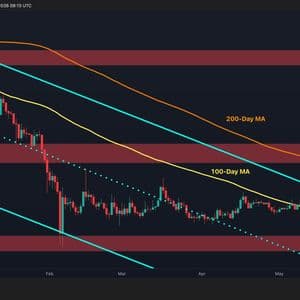
XRP’s recent price action reflects growing indecision, with volatility contracting on higher timeframes while shorter-term charts show repeated reactions from established support and resistance zones. Such compression periods often precede significant directional moves, making the upcoming sessions particularly important for the asset. Ripple Price Analysis: The Daily Chart On the daily timeframe, XRP remains trapped beneath the descending long-term trendline while simultaneously struggling around the 100-day moving average near the $1.38 region. This moving average has recently acted as dynamic resistance, preventing buyers from sustaining upward momentum. The price is also approaching the narrowing section of the broader descending channel structure, suggesting that a breakout event may be developing. As volatility compresses, XRP appears to be entering a decision zone where prolonged consolidation becomes less likely. Currently, the primary resistance remains the $1.75-$1.85 supply region, while stronger resistance is located around the 200-day MA near $2.0. On the downside, the key support sits around the $1.10-$1.20 demand zone. The most probable scenario in the near term is continued compression around the 100-day MA at $1.38, followed by an impulsive breakout. A bullish breakout above the descending channel and $1.40-$1.45 area could trigger recovery toward the $1.75-$1.85 resistance region. Conversely, rejection from current levels may reinforce the broader bearish trend and expose lower supports once again. XRP/USDT 4-Hour Chart The 4-hour chart presents a clearer range-bound structure. XRP has been oscillating between support around the $1.27-$1.30 zone and resistance near $1.53-$1.57 for several weeks, forming a relatively stable consolidation range. Most recently, the price revisited the lower boundary of this range near $1.30, triggering another bullish reaction. This suggests buyers continue defending the support area, increasing the possibility of a short-term move higher. As long as XRP holds above the $1.30 support region, the path toward the upper boundary around $1.53-$1.57 remains open. Such a move would represent a corrective bullish swing inside the broader sideways structure rather than confirmation of a larger trend reversal. However, repeated tests of support tend to weaken demand over time. Therefore, failure to maintain the $1.30 level could invalidate the consolidation range and increase the probability of renewed downside pressure. For now, the market structure favors continued ranging behavior, with the upper resistance zone near $1.55 acting as the primary target for any short-term recovery. The post Ripple Price Analysis: The Next Few Trading Days Will Be Essential for XRP appeared first on CryptoPotato .
24 May 2026, 17:18
Bitcoin Price Prediction: What’s the Most Likely Scenario for BTC Next Week?
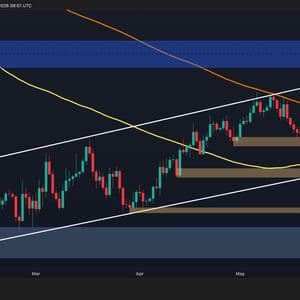
Bitcoin remains under bearish pressure after failing to sustain momentum above the critical $80K-$82K resistance region. However, recent price action suggests buyers are attempting to defend the important $75K support zone, increasing the probability of a short-term corrective rebound before the broader downtrend resumes. While the market structure still favors sellers, the current positioning near key support and liquidity clusters could trigger a temporary bullish correction in the coming sessions. Bitcoin Price Analysis: The Daily Chart On the daily timeframe, BTC has entered a corrective phase after being rejected from the major supply zone around $82K-$84K, which also aligned with the upper boundary of the ascending channel. The rejection accelerated selling pressure and pushed the asset toward the important demand area at $75K-$76K. Recently, the price swept below the $75K support region before quickly recovering, suggesting active buyer interest and potential liquidity collection beneath local lows. This recovery has led to a modest bullish reaction, with BTC currently attempting to stabilize above the $76K area. Despite this rebound, the broader structure remains cautious. Bitcoin is still trading beneath previous support turned resistance, and as long as Bitcoin remains below the $80K-$82K region, any upside movement may simply represent a corrective pullback within a larger bearish retracement. The first upside target for a relief rally sits around $78K-$80K, while stronger resistance remains at $82K-$84K. Failure to reclaim these levels could increase the probability of another bearish leg toward the next major daily demand zone around $70K-$71K. A deeper breakdown may eventually expose the lower support area near $65K-$66K. BTC/USDT 4-Hour Chart The 4-hour chart highlights a clearer short-term recovery attempt. After reaching the $75K-$76K order block, Bitcoin generated a sharp bounce and is now consolidating around $76K-$77K. This reaction indicates that buyers are defending the local support area, potentially setting the stage for a corrective move higher. If momentum persists, the first pullback target lies near the $78K-$79K range, followed by the more significant resistance zone around $80K-$82K. However, the broader lower-high formation remains intact, and recent price action still reflects weakening bullish momentum compared to earlier recovery phases. As a result, the current rebound could evolve into a classic bearish continuation setup, where price revisits resistance before initiating another decline. For bulls to regain control, Bitcoin would need to reclaim the $80K-$82K region convincingly. Otherwise, the current move is more likely to be interpreted as temporary relief rather than a trend reversal. Sentiment Analysis The liquidation heatmap provides additional context supporting the corrective-bounce scenario. A notable concentration of short liquidations has accumulated above the current price, particularly within the $80K-$85K region. Markets often gravitate toward nearby liquidity pools before resuming the prevailing trend. Therefore, Bitcoin may first move higher to absorb these leveraged short positions, potentially fueling a squeeze toward the $80K-$82K resistance area. At the same time, substantial liquidity clusters remain below price around the $60K-$63K region, indicating that downside targets continue to exist if bearish momentum returns after the correction. This creates a two-step scenario: an initial bullish retracement driven by liquidation hunting toward $80K-$82K, followed by renewed selling pressure and another bearish leg toward lower support levels. The interaction between price and these liquidity zones will likely determine Bitcoin’s next major move. The post Bitcoin Price Prediction: What’s the Most Likely Scenario for BTC Next Week? appeared first on CryptoPotato .
24 May 2026, 17:10
Dogecoin stalls as market cap nears $73.19 billion target

🚨 Dogecoin is closing in on a $73.19 billion market cap breakout. Charts show $DOGE squeezed inside a major pennant and tight triangle. 📉 Critical data: A major price move could hit as the squeeze ends. Continue Reading: Dogecoin stalls as market cap nears $73.19 billion target The post Dogecoin stalls as market cap nears $73.19 billion target appeared first on COINTURK NEWS .
24 May 2026, 17:02
Egrag Crypto Explains XRP $7 or $11 Price Expansion Targets
XRP continues to trade inside a tightening long-term structure that now points to a decisive move ahead, according to crypto analyst EGRAG CRYPTO (@egragcrypto). The analyst shared a monthly chart showing XRP forming what he described as a descending broadening wedge , with price compression still dominating the current market phase. The chart tracks XRP price action from 2014 through 2027. It highlights repeated wedge formations that previously led to strong upward moves after long consolidation periods. XRP currently trades near $1.30 on the chart used in the analysis, while the key breakout zone sits around $3. EGRAG CRYPTO said the structure is “NOT a random formation” and pointed to historical behavior where similar setups produced violent expansion after prolonged compression . #XRP – Formation Talks: The current structure looks like a Descending Broadening Wedge. This is NOT a random formation. Historically, these structures often produce: Final capitulation THEN Violent expansion Key Levels: $1.11 = Critical Support $3.00 = Bullish… pic.twitter.com/A2EmjMarj0 — EGRAG CRYPTO (@egragcrypto) May 23, 2026 XRP Faces Compression Before a Major Move The analysis identifies $1.11 as the most important support level in the current setup. The chart shows XRP trading above that region while moving within narrowing price action near the wedge’s upper section. According to the post, the market remains in bearish compression, though the larger structure still supports a bullish outlook unless the pattern breaks completely. The chart also presents a downside “Extreme Flush Scenario” toward $0.32, though the main focus remains on a possible breakout. Upside Targets for XRP The projected upside targets range between $7 and $11. The chart maps a possible vertical expansion after XRP clears resistance around $3. One projection on the image shows a move toward approximately $11.59, representing a 57% rise from the breakout zone shown in the structure. The analyst stated that “XRP rarely moves gradually” and added that the asset “ compresses for months … then explodes vertically.” The chart supports that view by showing previous periods where extended consolidation led to rapid upward price action. We are on X, follow us to connect with us :- @TimesTabloid1 — TimesTabloid (@TimesTabloid1) June 15, 2025 Watching the $3 Level for XRP The $3 zone remains the critical confirmation area in the analysis. EGRAG CRYPTO said “a weekly/monthly reclaim above $2.65-$3.00 changes EVERYTHING,” placing that range at the center of the current structure. The chart shows XRP repeatedly failing to sustain movement above descending resistance lines during previous cycles. However, the current formation appears much tighter, with price consolidating close to horizontal support while volatility contracts. According to the post, the market may still struggle before the next directional move begins. The analysis also points to “one final volatility event” before expansion takes hold . Disclaimer : This content is meant to inform and should not be considered financial advice. The views expressed in this article may include the author’s personal opinions and do not represent Times Tabloid’s opinion. Readers are advised to conduct thorough research before making any investment decisions. Any action taken by the reader is strictly at their own risk. Times Tabloid is not responsible for any financial losses. Follow us on X , Facebook , Telegram , and Google News The post Egrag Crypto Explains XRP $7 or $11 Price Expansion Targets appeared first on Times Tabloid .
24 May 2026, 17:00
Dogecoin Price Repeating 2024 Setup With Retest Of Fib Fan Before Possible Breakout Wave

Dogecoin is at a technical area that will look very familiar to traders who followed its 2024 rally. The weekly chart shows Dogecoin is pressing into a long-term Fibonacci fan structure drawn from the 2021 peak, with the current retest coming near the 0.618 Fib fan after a similar 0.5 Fib fan retest preceded the large move in October 2024. This technical setup does not confirm a breakout on its own, but it places Dogecoin at one of its most important weekly decision points in months. Related Reading: History Shows Bitcoin ETF Outflows Favor Accumulation, Says Santiment Dogecoin Returns To A Familiar Fib Fan Structure The main idea of this technical analysis is that Dogecoin is still trading inside a long-term descending resistance structure that began from the 2021 all-time high price of $0.7316. However, the analysis also uses an interesting Fibonacci waves indicator in the form of expanding fan lines extending from the memecoin’s peak price. These lines have acted as long-term resistance and breakout markers across DOGE’s post-2021 structure. Price spent much of 2022 and 2023 below these fan lines, only pushing into stronger recoveries when it reclaimed one of them. The comparison is the October 2024 retest. At that time, DOGE fell below the 0.5 Fib fan area, held the structure below for a while, and then followed with a rally that sent its price to as high as $0.48 in December 2024. The chart now shows a similar retest developing around the 0.618 Fib fan, with the Dogecoin price currently trading around the $0.10 to $0.11 range. Dogecoin Price Chart. Source: @_CryptoSurf On X Is Dogecoin Preparing For Another Wave? Dogecoin’s current interaction with the indicator shows it may be checking whether another Fib level can behave like support. If it holds, the setup will mean that Dogecoin is building another base at a Fib fan level similar to the Q4 2024 run. The ideal scenario for a bullish run is that DOGE holds above $0.095, pushes through $0.115, and begins climbing back above $0.14. That would make the 0.618 Fib fan retest look more like the October 2024 setup, where a technical hold came before a larger wave. On the other hand, if the setup fails, the repeat pattern loses credibility, and the Dogecoin price may return to lower support zones. A weekly breakdown below $0.095 would weaken the current pattern and lead to a consolidation between $0.095 and $0.08. Related Reading: Bitcoin Bull Thesis Goes Big: 39 Trillion Reasons To Buy, Says Gemini Founder Dogecoin’s current price structure is not yet bullish, but if history is any precedent, the bullish playout is the most possible scenario, as Dogecoin has never spent a notable amount of time below any Fibonacci fan level. At the time of writing, Dogecoin is trading at $0.1028. Featured image from Pixabay, chart from TradingView

