


 Invest ideas
News
21 May 2026, 17:30
Chainlink Sees Historic On-Chain Surge While Exchange Supply Keeps Shrinking – Details

Chainlink has lost the $10 mark as the market faces a retrace that could extend further. Leaving holders navigate a price structure that offers little immediate comfort. The decline is real — but a CryptoOnchain report has identified a development in the network data from earlier this month that reframes what the current price weakness is actually occurring against. Related Reading: HYPE Accumulation Intensifies As Whale-Linked Position Surpasses $100M Between May 9 and 10, Chainlink’s active address count spiked to over 280,000. A figure that requires context to feel as alarming as it is. The network’s historical baseline sits at approximately 3,000 daily active addresses. The spike represents a 93-fold increase from that baseline, compressed into a two-day window, with no precedent in Chainlink’s recent on-chain history. Something significant moved through the network at a scale that dwarfs routine activity by nearly two orders of magnitude. In traditional on-chain analysis, a spike of that magnitude triggers an immediate assumption: retail panic, large token movements toward exchanges, and preparation for liquidation. The historical pattern for anomalies of this scale is distribution. Big holders and retail participants are rushing toward the exit simultaneously. Creating the kind of exchange inflow pressure that translates directly into selling pressure on the price. That assumption does not hold here. The CryptoOnchain report cross-references the network surge with exchange flow data — and what it finds is the opposite of what the conventional framework would predict. Exploding Network Activity Alongside Shrinking Exchange Supply The CryptoOnchain analysis turns to Binance flow data to resolve the contradiction the network spike created — and what it finds dismantles the sell-off interpretation entirely. Despite the most extreme active address anomaly in Chainlink’s recent history, Binance’s LINK reserve has been declining steadily for the past 14 days, falling from 86.3 million to 85.8 million tokens. The 7-day average netflow remains heavily negative, with outflows consistently outpacing inflows throughout the entire period. Chainlink Structural Divergence | Source: CryptoQuant The timing is the detail that matters most. Market participants were actively withdrawing LINK from Binance at precisely the moment the network was experiencing its most intense activity. If the 280,000 active address spike represented panic selling or distribution, the exchange flow data would show the opposite — coins moving onto exchanges rather than away from them. The data shows coins leaving. That divergence between network intensity and exchange behavior points toward a structural interpretation rather than a sentiment one. Tokens migrating toward self-custody or being locked in smart contracts — potentially connected to CCIP adoption and the expanding use of Chainlink’s cross-chain infrastructure — would produce exactly this signature: explosive on-chain movement alongside declining exchange reserves and persistently negative netflow. The supply implication follows directly. LINK leaving exchanges and entering self-custody or smart contract lock-up reduces the liquid float available for immediate sale. That reduction, occurring alongside genuine network utility growth rather than speculative activity, creates the kind of supply tightness that historically precedes structural price appreciation — not immediately, but as the available sell-side inventory shrinks against whatever demand arrives next. Related Reading: XRP’s Big Buyers Returned In April But Left In May: Capital Inflows Data Explains The Shift Chainlink Struggles Below Key Resistance: Bulls Defend Critical Support Chainlink continues to trade under pressure after losing the psychological $10 level, with the daily chart showing a market still trapped inside a broader bearish structure despite signs of stabilization. LINK is currently trading near $9.60 after rejecting sharply from the recent local high around $10.70, where sellers stepped in aggressively and prevented a breakout above the descending resistance zone that has capped price action since January. Chainlink consolidates below key level | Source: LINKUSDT chart on TradingView The chart shows LINK consolidating between roughly $8.80 and $10.00 for several weeks, forming a tightening range just above the 200-day moving average. That level near $9.20 is becoming increasingly important because it has acted as dynamic support throughout May. Bulls have repeatedly defended the area, preventing a deeper retracement back toward the February lows near $7.50. Related Reading: Bitcoin’s 2026 Market Structure Reveals A Problem Hidden Beneath ETF Growth At the same time, the 200-day exponential moving average continues trending downward above the current price, reinforcing the idea that the broader macro trend remains fragile despite the recent recovery attempt. Volume has also cooled notably compared to the capitulation phase seen in February, suggesting that the latest decline reflects exhaustion and consolidation rather than panic-driven selling. For bulls, reclaiming the $10.00–$10.70 region remains essential to shift momentum decisively back in favor of buyers. Featured image from ChatGPT, chart from TradingView.com
21 May 2026, 17:23
HYPE Explodes to New All-Time High as Hyperliquid ETF Demand Crushes Supply Pressure

Hyperliquid has seen a notably fierce rally with the token up almost 20% in one day and trading at an all-time high of $62.10. This jump comes as Hyperliquid-linked exchange-traded funds (ETFs) recorded US$25.5 million in net buying on Wednesday alone, indicating strong institutional interest for the fast-growing ecosystem. As of press time, HYPE stood at just under $61 after a daily gain of more than 15%. The token has gained more than 100% year-to-date, making it one of the best performing digital assets YTD in this market cycle. Since institutional accumulation is currently occurring just as fast, it highlights the importance of the rally. The most recent ETF inflows exceeded the sum of all previous five trading days, when combined showed total influx $22.35 million. That rapid pace of growth has propelled market confidence and fueled expectations that Hyperliquid could play a pivotal role in the future financial infrastructure of crypto. HYPE Jumps 15% as Hyperliquid ETFs Pull $25.5M in a Single Day @HyperliquidX ETFs logged $25.5M in net buying on Wednesday – more than the combined inflows of their first five days ($22.35M). HYPE rallied to an intraday high of $58.97 (currently $57.20), up 15.3% on the day and… pic.twitter.com/Hd8n2MBv6I — Top 7 Crypto | Analytics & Alpha (@top7ico) May 21, 2026 HYPE In Price Discovery As ETF Demand Hyperliquid’s price momentum isn’t only a retail driven speculation-driven phenomenon. Analysts are drawing increasing parallels between the sharp price jump and the ongoing explosion in ETF-led buying. In a post from crypto tracking accounts, Hyperliquid ETFs attracted $25.5 million in organic single-session net inflows (Purchase YOY inflows). That is about 17 times greater than HYPE’s daily burn rate of around $1.4 million, at a maximum Attitude Fund per day. The Assistance Fund operates as a liquidity-tightening instrument, slowly withdrawing tokens from circulation. Still, institutional buying pressure dwarfs that deflationary dynamic now. The imbalance of a declining supply, and rapidly increasing demand, is ripe for a breakout rally. With forward momentum moving through the crypto markets, traders continue using capital to transition into HYPE. Market observers note the token continues demonstrating dull price performance in spite of recent surge, some believe its fair value is above current status. One of the loudest is Matt Hougan rejecting the misinterpretation that still many investors have on Hyperliquid’s role. Many traders still see HYPE as just a governance token for a perpetual decentralized exchange, and this is something Hougan mentioned recently. According to him, the market does not take into account Hyperliquid’s new position that resembles more and more the one of large financial infrastructures like Robinhood or CME Group. This comparison is being made as Hyperliquid broadens its horizon outside the domain of traditional functionality for decentralized trading. Accumulation of Whales Strengthens Bullish Momentum It is not just institutional inflows moving the price of HYPE up, however. On-chain data suggests large whale accumulation over the last few days. While prices kept rising in slow-motion through the whole month large wallets have discreetly accumulated tens of millions of dollars worth tokens. Such aggressive buying shows that institutional buyers expect further upsides. Over a two-hour period, one wallet associated with what appeared to have been Galaxy Digital purchased 158,100 HYPE, worth about $8.8 million at the time. Named 0xBED9, the movement this wallet has made is just another part of illegal proof that instead sophisticated whales choose to heavily position in the Hyperliquid ecosystem. At the same time, a new wallet with interface value of 0x4CBB emptied out over two days 536,247 HYPE from Coinbase. Those tokens would be worth close to $29.87 million. Whale activity alone now totals over $38 million and comes at the same time as one of HYPE’s best weeks on record since launch. In the past week, the token has risen by over 50%, reaching its previous all-time high of $59.30 on September 18, 2025 and continuing to break through it. Bitwise Announces More Commitment to Hyperliquid The confidence in Hyperliquid from institutions was further demonstrated after Bitwise Asset Management publicly revealed the wallet addresses associated with its ETF holdings. The company stated that it has built a position of approximately $19.78 million worth of HYPE and staked all of it, showing trust in the future potential for HYPE. These disclosed holdings show on paper a gain of about $2.4 million of unrealized gains with HYPE near record highs This also signals increasing confidence in Hyperliquid’s economic model from institutions, as Bitwise has decided to stake the tokens out entirely. In contrast to just holding passive exposure, Bitwise also engages in network functionality while securing staking rewards. If HYPE-related products maintain their upward trend, then that could convince other institutional investors to adopt this strategy. ETF driven demand combined with aggressive staking and other mechanisms in the coming weeks could drive circulating supply into an even deeper corner, crypto analysts note. Bitwise Stakes $19.78M in $HYPE with $2.4M Profit on Paper. Bitwise Asset Management has released its ETF wallet addresses, revealing continued accumulation of Hyperliquid (HYPE). So far, the firm has acquired around $19.78 million worth of HYPE and has staked the full… pic.twitter.com/3J0VAmgQRE — TheCryptoBasic (@thecryptobasic) May 21, 2026 Hyperliquid Overtakes Solana in FDV Hyperliquid also passed Solana in FDV, topped by another milestone. Hyperliquid is recently reported to have an FDV of $54.57b, putting it just ahead of Solana at $54.21b. This is an amazing addition to the protocol, particularly when we consider that Solana may be one of the most mature ecosystems we have in terms of blockchain. More than that, Crossing Solana in FDV ignited heated discussions across the digital asset industry. The shift in valuation leads some investors to read it as the market progressively prioritizing trading infrastructure and decentralized financial rails over a Layer-1 blockchain narrative. Some are more cautious, saying lower momentum could threaten a further sharp rise in valuations and increased volatility. Still, the price action now points to buyers still having an upper hand. Trading volumes continue to grow, wallets owned by whales keep piling up and ETF inflows show no signs of slowing. Market Looks Ahead to Next Major Breakout The attention around Hyperliquid has now positioned HYPE to be one of the most followed tokens in all of crypto Investment accumulation, ETF demand, staking behavior and whale activity has created one of the strongest bullish setups seen in the crypto asset. Some analysts expect price corrections over the short term after such a limited rally, but many traders are still chasing higher prices, so confidence in the Hyperliquid infrastructure narrative is growing. Market watchers would expect HYPE to find its way into another aggressive price discovery phase with the current pace of ETF inflows. Disclosure: This is not trading or investment advice. Always do your research before buying any cryptocurrency or investing in any services. Follow us on Twitter @nulltxnews to stay updated with the latest Crypto, NFT, AI, Cybersecurity, Distributed Computing, and Metaverse news !
21 May 2026, 17:21
Bitcoin Bulls Lose Control After $78,000 Rejection Wipes out Overnight Recovery
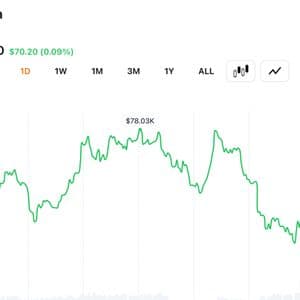
Bitcoin has erased its recent gains, failing to hold the $78,000 threshold and dropping to just above $77,000. Bitcoin Erases Gains as ETF Outflows Mount Bitcoin endured yet another underwhelming session, failing to hold the $78,000 mark and erasing earlier gains to close the 24 hours just above $77,000. The price action reversed the momentum
21 May 2026, 17:15
Ethereum’s 55% Drop Masks a Deeper Problem: Vanishing Buying Pressure, Analyst Warns

BitcoinWorld Ethereum’s 55% Drop Masks a Deeper Problem: Vanishing Buying Pressure, Analyst Warns Despite a steep 55% correction from its all-time high, Ethereum (ETH) is not attracting the buying interest needed to reverse its decline, according to on-chain data firm EasyOnChain. The analysis, cited by CryptoPotato, highlights a growing disconnect between derivatives market activity and actual spot demand, raising concerns that the asset may have entered a prolonged bear market. Derivatives Market Signals a Widening Gap EasyOnChain’s report focuses not just on the price drop itself, but on the structural weakness beneath it. The firm notes that while futures and options markets remain active, the corresponding spot market buying pressure has failed to materialize. This divergence suggests that speculative trading is not translating into real accumulation, a pattern historically associated with mid-to-long-term bearish trends. “The absence of buying pressure to absorb the sell-off is the most concerning signal,” the analysis states. “It indicates that market participants are not stepping in to buy the dip, which is a key requirement for any sustainable recovery.” Institutional Participation Fades A key factor in this weakening demand is the retreat of institutional investors. Data from U.S.-listed Ethereum exchange-traded funds (ETFs) shows a notable slowdown in inflows, with several days of net outflows recorded in recent weeks. This contrasts with the strong institutional interest seen during Ethereum’s 2023-2024 rally. The analysis also points to the Coinbase Premium Index, which has remained negative throughout May. This metric tracks the price difference between ETH on Coinbase Pro (a primary venue for U.S. institutional investors) and Binance (which serves a more global retail audience). A negative premium suggests that U.S.-based institutional investors are selling or refraining from buying, reinforcing the bearish outlook. What This Means for Ethereum Holders For long-term ETH holders, the current environment presents a challenging picture. The combination of a significant price correction, declining institutional interest, and weak spot demand creates conditions that historically precede extended bear markets. While short-term bounces are possible, the structural data suggests that a sustained recovery may require a fundamental shift in market sentiment or a new catalyst. EasyOnChain’s warning underscores the importance of monitoring on-chain metrics alongside price action. For traders and investors, the lack of buying pressure is a signal to remain cautious, as the market may not yet have found a solid bottom. Conclusion Ethereum’s 55% correction is not just a price event; it is a reflection of deeper market dynamics. The absence of buying pressure, combined with institutional outflows and a negative Coinbase Premium, paints a concerning picture for the near to medium term. While Ethereum’s long-term technological value remains intact, the current market data suggests that a bearish phase may already be underway. Investors should watch for a reversal in these on-chain signals before expecting a meaningful recovery. FAQs Q1: What does it mean when the Coinbase Premium is negative for Ethereum? A negative Coinbase Premium indicates that Ethereum is trading at a lower price on Coinbase Pro compared to other exchanges. Since Coinbase Pro is heavily used by U.S. institutional investors, a negative premium suggests these investors are selling or showing less buying interest, which is a bearish signal. Q2: Why is the divergence between derivatives and spot markets important? When derivatives markets are active but spot demand is low, it can indicate speculative trading without real accumulation. This often precedes further price declines because the lack of actual buying pressure means sell-offs are not easily absorbed, making the market more vulnerable to drops. Q3: Could Ethereum still recover from this bearish signal? Yes, but a recovery would likely require a significant shift in market sentiment, such as renewed institutional inflows, a major network upgrade, or broader macroeconomic changes. Until on-chain data shows consistent buying pressure and a positive Coinbase Premium, the risk of further downside remains elevated. This post Ethereum’s 55% Drop Masks a Deeper Problem: Vanishing Buying Pressure, Analyst Warns first appeared on BitcoinWorld .
21 May 2026, 17:10
Everclear shuts down operations, citing depletion of funds after failed B2B pivot
BitcoinWorld Everclear shuts down operations, citing depletion of funds after failed B2B pivot Everclear, the cross-chain liquidity protocol formerly known as Connext, has announced it is winding down operations. The project, which traded under the ticker CLEAR, confirmed in a statement on its official X account that the Everclear Foundation, its development company, and all associated products will be phased out. The decision follows a period of financial strain that the team was unable to overcome. Why Everclear failed to sustain its business model According to the team, the core issue was profitability. Everclear had developed a solver-based model designed to rebalance funds across different blockchain networks. While the protocol reportedly achieved a monthly trading volume of $500 million at its peak, it was unable to translate that volume into sustainable revenue. The team explained that the operational costs of maintaining the solver network and infrastructure outpaced the income generated from fees. In an attempt to turn the project around, Everclear shifted its focus to B2B partnerships over the last six months. The idea was to secure long-term contracts with other protocols and enterprises that could use the rebalancing service. However, the company’s funds ran out before those partners could begin operations, leaving the project without a financial lifeline. What happens to user funds and the CLEAR token The protocol has been fully terminated. All remaining deposits have been withdrawn by users and partners, and the Everclear user interface and its dedicated blockchain are no longer operational. The team stated that after settling outstanding debts, any remaining funds could be used for a token buyback. The potential buyback range is between $50,000 and $200,000, but the announcement emphasized that this is not yet confirmed and depends on the final accounting of liabilities. Implications for the cross-chain sector The closure of Everclear highlights a broader challenge in the decentralized finance (DeFi) infrastructure space: achieving profitability at scale. Many cross-chain protocols have struggled to find a sustainable business model, often relying on venture capital or token sales rather than organic revenue. Everclear’s failure to convert high trading volumes into a profitable operation serves as a cautionary tale for other projects building similar infrastructure. The news also raises questions about the long-term viability of solver-based models, which have gained popularity as a way to manage liquidity across fragmented blockchain ecosystems. Conclusion The shutdown of Everclear marks the end of a project that once held promise as a key piece of cross-chain infrastructure. Its inability to secure revenue from B2B partnerships before its funds were depleted underscores the financial fragility of many crypto startups. For users and investors, the situation serves as a reminder to monitor the financial health of protocols they rely on, as even those with significant trading volumes can face sudden collapse. FAQs Q1: What was Everclear? Everclear was a cross-chain liquidity protocol that used a solver-based model to rebalance funds across different blockchains. It was originally known as Connext and its native token was CLEAR. Q2: Can I still access my funds on Everclear? No. The protocol has been fully terminated. All remaining deposits were withdrawn by users and partners before the shutdown. The user interface and the Everclear chain are no longer operational. Q3: Will there be a token buyback for CLEAR? The team has mentioned a potential buyback of between $50,000 and $200,000 using any remaining funds after debts are settled. However, this has not been confirmed and depends on the final financial assessment. This post Everclear shuts down operations, citing depletion of funds after failed B2B pivot first appeared on BitcoinWorld .
21 May 2026, 17:04
Strategy May Sell Some Bitcoin Before Year-End: Michael Saylor

Strategy Executive Chairman Michael Saylor has said the company may sell some Bitcoin before the end of the year as part of a broader capital management plan that also includes equity issuance, credit issuance, and cash management. Speaking during a retail investor Q&A hosted by Natalie Brunell, Saylor said the company evaluates funding choices continuously and aims to increase Bitcoin per share over time. Saylor said Strategy’s main objective remains the growth of Bitcoin per share, total Bitcoin holdings, and enterprise value. He said the company does not rely on a single funding method and has modeled several options for meeting obligations. According to Saylor, models limited only to equity, credit, or Bitcoin sales tend to underperform compared with a mixed approach. “I think it’s not unlikely that we’ll sell some Bitcoin between now and the end of the year,” Saylor said. He added that the company had not determined how much Bitcoin it may sell and that decisions would depend on market conditions, liabilities, credit risk and long-term value for shareholders. Strategy Weighs Bitcoin Sales Alongside Equity and Credit Saylor said Strategy reviews whether liabilities should be funded with cash, equity, credit or Bitcoin. He described the process as programmatic and data-driven, with decisions sometimes made very quickly depending on market conditions. The company’s stated aim is to take actions that support Bitcoin per share over a multi-year period. During the discussion, Saylor said selling Bitcoin would not necessarily change the tax treatment of dividends on Strategy’s preferred products. He said the company has Bitcoin with cost bases ranging from about $10,000 to $125,000 and could sell coins with a higher cost basis if needed. He said Strategy expects return-of-capital treatment for dividends on its preferred securities for the foreseeable future. The comments followed investor questions about STRC, also referred to as Stretch, and whether dividend obligations could pressure the company to sell Bitcoin. Saylor said Strategy’s approach is not based on short-term pressure but on optimizing the firm’s capital structure. STRC Stability Remains a Main Business Objective Strategy executives also addressed the company’s plan to move STRC dividends from monthly to semimonthly, subject to shareholder approval. Saylor said the change is intended to improve the performance of STRC and support its trading around the $100 target level. He said the company is not legally required to defend that price but treats it as a central business objective. Saylor said Strategy has taken several actions to strengthen STRC, including raising the dividend, building a U.S. dollar reserve, buying back senior debt, and asking shareholders to approve more frequent dividend payments. He described STRC as the company’s flagship credit product and said its stability is a core performance measure. Strategy President and CEO Phong Le said the company considered dividend frequency changes for other preferred products but chose to focus on STRC first. He said the firm views STRC as its largest and most innovative credit product and wants to improve it before making changes to other securities. Saylor also said Strategy does not plan to retire its other perpetual preferred products, including STRF, STRD, and STRK. He said the company views them as useful parts of the capital structure, while convertible bonds are senior liabilities that Strategy intends to retire over time. Saylor Says Bitcoin Demand and Digital Credit Support Long-Term Plan Concurrently, in a CNBC interview , Michael Saylor said he believes Bitcoin reaching $1 million is only a matter of time. He argued that institutional demand and digital credit products could absorb newly mined Bitcoin supply over the long term. He said Strategy may buy the Bitcoin produced by miners through 2140, when the final Bitcoin is expected to be mined. Saylor described digital credit as a structure that converts expected Bitcoin capital appreciation into preferred stock dividends. He said STRC targets a $100 price and uses a variable dividend rate to support that level. He compared common equity to a higher-volatility Bitcoin-linked instrument, while describing STRC as a lower-volatility credit product for investors seeking income. Saylor also addressed market conditions, saying Bitcoin has faced headwinds from higher long-term interest rates, trade tensions, global conflicts, AI-related capital flows and miner selling. He said potential regulatory developments, including the Clarity Act and guidance on tokenized securities, could support the broader digital asset market. On quantum computing, Saylor said that if a credible threat to Bitcoin emerged, the network would be upgraded. He compared such a process with software updates used by large technology and financial systems. Strategy executives said the company’s long-term focus remains Bitcoin per share, BTC yield and the growth of digital credit. Saylor said the company will continue educating investors on how its model works and how it differs from a passive Bitcoin holding vehicle.


