


 Invest ideas
News
31 May 2026, 10:08
'XRP to Tor': Ripple Chief Architect Unveils 'Doomsday' Plan to Resist Authoritarian Takeovers

Ripple's David Schwartz outlines a 'Doomsday' protocol for XRPL, including anonymous Tor routing and a two-layer consensus to defy state attacks.
31 May 2026, 09:29
NEAR Protocol (NEAR) And Sui (SUI): As Chain‑Abstraction Wallets On NEAR And New Move DeFi / Gaming Titles On SUI Launch, Do These Alt‑VM Chains Become A Real U...

The battle for retail and developer attention has crystallized around User Experience (UX) and Alternative Virtual Machines (Alt-VMs). The market is heavily scrutinizing networks that promise to remove the friction of Web3 onboarding while offering superior execution environments. NEAR Protocol (NEAR) is spearheading the "chain-abstraction" narrative, aiming to make cross-chain wallet interactions seamless for the end-user. Concurrently, Sui (SUI) is leaning heavily into its object-centric Move architecture, pushing aggressive new launches in decentralized finance (DeFi) and high-throughput gaming. Both tokens are technically healthy, but as they collide with heavy overhead resistance, a critical question emerges: Are NEAR and SUI actively re-pricing as dominant, standalone UX/DeFi hubs, or are they destined to remain high-beta satellite trades revolving around Ethereum and Solana liquidity? NEAR Protocol (NEAR): UX‑First Alt‑VM In Upper Half Of Its Range Source: tradingview NEAR Protocol is exhibiting a technically healthier "up-from-lows" profile than the majority of alternative Layer-1s. Trading above both its 30-day SMA ($6.20) and its 200-day SMA ($4.80), the asset is positioned confidently in the upper half of its recent 30-day structural box. The Fibonacci Map ($5.00 to $7.40): 23.6% Retracement: ~$5.57 38.2% Retracement: ~$5.92 50.0% Retracement: $6.20 61.8% Retracement: ~$6.48 Immediate Support: $6.20 to $6.48: This is NEAR's critical "trend support band." NEAR is currently trading at $6.40, perfectly sandwiched between the 61.8% Fib ($6.48) and the 50% Fib/30-day SMA confluence at $6.20. As long as daily closes remain above $6.20, the broader $5.00 to $7.40 uptrend is fully intact. $5.57 to $5.92: The deeper retracement zone. A drop into this band represents a normal correction, but losing $5.57 would signal that the momentum driven by chain-abstraction and wallet flows is taking a significant breather. $5.00 to $5.10: The 30-day swing low. A close below $5.00 entirely unwinds the current cyclical leg. Immediate Resistance: $7.00 to $7.40: The upper boundary and 30-day high. Closing and consolidating above $7.40 is the definitive technical trigger required to treat NEAR as an unquestioned UX/Alt-VM market leader, rather than just a strong-trending L1. The Read: NEAR is technically strong. It is defending its moving averages and pushing toward its local highs. To confirm its status as a real UX alternative, it must fiercely defend the $6.20–$6.48 pullbacks, forcefully conquer the $7.40 ceiling, and prove that recent wallet integrations are driving sticky, daily active usage rather than fleeting launch hype. Sui (SUI): Move DeFi Chain In Mid‑Range, Above Trend Support Source: tradingview Sui is tracking a structurally similar path to NEAR but sits slightly lower in its respective range, giving it a classic mid-range consolidation profile. Trading at $1.18, it rests just above its 30-day SMA ($1.15) and its 200-day SMA ($1.00). The Fibonacci Map ($0.95 to $1.45): 23.6% Retracement: ~$1.07 38.2% Retracement: ~$1.14 50.0% Retracement: $1.20 61.8% Retracement: ~$1.31 Immediate Support: $1.07 to $1.15: This serves as SUI’s primary trend support band. It houses the 23.6% Fib, the 38.2% Fib, and the 30-day SMA. Holding this floor on daily closes indicates that the $0.95 to $1.45 upward move remains structurally sound, and that liquidity entering Move-based DeFi and gaming is sticking. $0.95 to $1.00: The 30-day swing low. A daily close below $0.95 completely unwinds the current leg, plunging SUI back into its old foundational base. Immediate Resistance: $1.20 to $1.31: SUI is currently pinched just below the 50% Fib ($1.20). It must reclaim and consolidate above this $1.20–$1.31 block to prove it is initiating a new trend rather than merely bouncing aimlessly within a range. $1.40 to $1.45+: The local high resistance ceiling. A high-volume break above $1.45—ideally catalyzed by tangible DeFi inflows—is the first true signal of a new Alt-VM macro leg. The Read: SUI is mid-range but fundamentally constructive, holding above its immediate trend support. To be viewed as a real, heavyweight alternative, it must hold the $1.07–$1.15 line, push through the $1.31 resistance, and use the $1.40+ region as a launchpad. If it fails near $1.30, it remains a high-beta sidechain dependent on rotating incentive campaigns. Conclusion: Real UX + DeFi Alternative Or High-Beta Satellites? The technical setups paint a picture of two healthy networks resting on crucial short-term support bands, waiting for volume to confirm their next directional move. They Become a Real UX + DeFi Alternative If: NEAR holds the $6.20–$6.48 support, pushes through the $7.40 resistance, and maintains a premium valuation driven by verifiable, non-campaign consumer app usage. SUI firmly defends $1.07–$1.15, reclaims $1.31, and breaks $1.45+ alongside undeniable evidence of sticky Total Value Locked (TVL) in its new native gaming and DeFi protocols. Liquidity and attention demonstrate a willingness to remain on NEAR and SUI even during periods when Ethereum Layer-2s (Base, Arbitrum, Optimism) and Solana are flashing strength. They Stay High-Beta Satellites If: NEAR repeatedly stalls at the $7.00+ mark and drifts back into its lower $5.50–$6.20 support pockets. SUI struggles to maintain the $1.15 moving average, living primarily in the low $1.00s and aggressively selling off every time it tests $1.30. The vast majority of serious on-chain trading flows and developer mindshare default back to the established monolithic (Solana) and modular (Ethereum Rollups) giants, treating Alt-VMs purely as short-term rotational trades. Final Verdict: The charts currently scream “technically healthy, with clear step-up zones.” However, neither asset has officially broken out to claim "dominant stack" status. The upcoming weeks will test whether NEAR’s chain-abstraction UI and SUI’s parallelized execution can convert recent network launches into permanent liquidity. Disclaimer: This article is provided for informational purposes only. It is not offered or intended to be used as legal, tax, investment, financial, or other advice.
31 May 2026, 09:18
Gravity Bridge Hit by $5.4M Exploit as Bitcoin ETFs Bleed $2.97B Amid Peak Sentiment
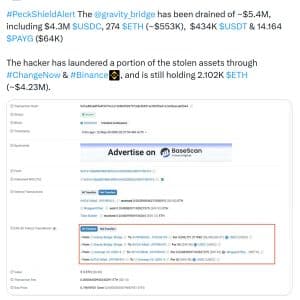
Crypto News Gravity Bridge, a cross-chain protocol moving assets between Ethereum and the Cosmos ecosystem, was drained of roughly $5.4 million in a fresh exploit that has forced validators to susp...
31 May 2026, 09:02
Finance Expert Reveals the Biggest XRP Storm

A recent post on X by crypto enthusiast Sidney M Brewer has highlighted growing excitement among XRP supporters following comments associated with Morgan Stanley and the increasing involvement of major financial institutions in blockchain technology. Brewer argued that some of the world’s largest banks are already moving toward digital finance solutions, even as regulatory debates continue in the United States. In his post, Brewer referenced comments from Coinbase CEO Brian Armstrong, who stated that leading banks are integrating stablecoin payment rails, exploring tokenized assets, and expanding crypto-related services for clients. According to Brewer, these developments suggest that financial institutions are not waiting for every regulatory issue to be resolved before exploring blockchain-based infrastructure. The message resonated strongly with many XRP supporters, who view institutional adoption as a key factor in Ripple’s long-term strategy. The Biggest XRP Storm . THE SMARTEST BANKS ARE ALREADY ALL-IN ON CRYPTO As the market structure bill faces pushback, Brian Armstrong says leading banks aren’t waiting. They’re integrating stablecoin rails to move money faster and cheaper than SWIFT, tokenizing funds and… pic.twitter.com/d0k0rhIGTD — Sidney M Brewer (@Sidneybrewer_1) May 29, 2026 Morgan Stanley Discussions Capture Attention In the video attached to the post, Brewer explained that recent discussions connected to Morgan Stanley attracted significant interest because of the firm’s position as one of the world’s largest investment institutions. He said investors tend to pay close attention whenever a major financial company discusses topics such as blockchain technology, digital finance, tokenization, and financial modernization. Although XRP was not specifically mentioned in every discussion, Brewer noted that many members of the XRP community immediately linked the conversations to Ripple’s long-standing focus on improving cross-border payments and financial infrastructure. According to Brewer, XRP supporters believe that many of the ideas now being discussed by major financial institutions closely resemble concepts Ripple has promoted for years. These include faster settlement systems, lower transaction costs, reduced reliance on intermediaries, and more efficient international payments. Ripple’s Long-Term Institutional Focus Brewer emphasized that Ripple has consistently focused on utility-driven use cases rather than short-term market trends. He argued that while many cryptocurrency projects focus on retail speculation, Ripple dedicated substantial effort to building payment solutions and forming relationships with financial institutions. He said this distinction is one reason many XRP holders view the recent institutional interest in blockchain technology as significant. Supporters believe Ripple positioned itself early for a financial environment where tokenization, blockchain settlements, and digital asset infrastructure become increasingly common. Brewer also pointed to the growing conversation around tokenization . Financial institutions are exploring ways to represent traditional assets such as stocks, bonds, and real estate on blockchain networks. Many investors believe tokenization could improve efficiency and settlement speed across financial markets, creating new demand for liquidity solutions and cross-border payment technology. We are on X, follow us to connect with us :- @TimesTabloid1 — TimesTabloid (@TimesTabloid1) June 15, 2025 Supporters Remain Optimistic Despite Challenges While expressing optimism, Brewer acknowledged that challenges remain. He noted that regulatory uncertainty, industry competition, and the slow pace of institutional change continue to create obstacles for widespread blockchain adoption. He also recognized that some analysts believe banks may ultimately prefer private blockchain systems over public digital assets. Others argue that evolving regulations could delay adoption timelines. Despite these concerns, Brewer maintained that the overall direction of the financial industry appears to be changing. He argued that the increasing willingness of major institutions to discuss blockchain infrastructure, digital settlements, and tokenized finance reflects a notable shift from the skepticism that existed only a few years ago. For many XRP supporters, the significance of the Morgan Stanley discussions extends beyond short-term market movements. Brewer concluded that investors are closely watching whether institutional adoption of blockchain technology continues to expand, believing that the long-term evolution of global finance could create opportunities for technologies focused on payments, liquidity, and financial efficiency. Disclaimer : This content is meant to inform and should not be considered financial advice. The views expressed in this article may include the author’s personal opinions and do not represent Times Tabloid’s opinion. Readers are advised to conduct thorough research before making any investment decisions. Any action taken by the reader is strictly at their own risk. Times Tabloid is not responsible for any financial losses. Follow us on X , Facebook , Telegram , and Google News The post Finance Expert Reveals the Biggest XRP Storm appeared first on Times Tabloid .
31 May 2026, 08:15
15 Years Ago, Hal Finney Explained Why Bitcoin Could Not Simply Be Replaced

Fifteen years ago, one of Bitcoin’s earliest pioneers offered a warning that continues echoing through crypto markets. Hal Finney argued that a monetary network cannot be rebooted without damaging the credibility of everything that follows. The Debate Over a New Bitcoin On May 30, 2011, Hal Finney and Jon Tobey entered a debate called “Early speculators’ reward.” Basically, it was a discussion on Bitcointalk, where the OP raised a question that has followed Bitcoin since its very first days – was it fair that early adopters mined or acquired coins before most people knew the network existed? Some participants argued that this early distribution amounted to a significant advantage – so large that the protocol itself should be relaunched. Finney rejected the premise with a response that was not just technical, but also rooted in economic logic. “Any successful replacement of the Bitcoin block chain will forever undermine the credibility of any successor. How is an investor to know that it won’t happen again?” The Problem of Credibility Finney’s point seems simple now: if Bitcoin could be discarded because early users benefited, then any future replacement would inherit the same vulnerability, because there would be a new group of early adopters, a later group of users who resent them, and so forth – a vicious circle. His argument also anticipated what later became a core principle of Bitcoin: monetary networks depend not only on code but also on confidence, continuity, and credible resistance to arbitrary change. In simple words, Bitcoin’s staying power relies on itself – the Bitcoin staying power. The protocol has become so resistant to unnecessary change that it has brought forward a level of predictability that alternative economic systems cannot yet fathom. The post 15 Years Ago, Hal Finney Explained Why Bitcoin Could Not Simply Be Replaced appeared first on CryptoPotato .
31 May 2026, 07:02
Pundit to XRP and XLM Holders: If This Doesn’t Make You Bullish, Think Again
Crypto commentator X Finance Bull believes recent developments involving the Depository Trust & Clearing Corporation (DTCC) have strengthened the case for both XRP and XLM. In a post on X, the commentator argued that the two digital assets are becoming increasingly connected to one of the most important institutions in global finance as tokenization efforts continue to advance. The post highlighted DTCC’s role in processing an enormous amount of financial market activity every year. According to X Finance Bull, the organization clears between $2.5 quadrillion and $4 quadrillion annually. With DTCC now moving deeper into blockchain-based settlement and tokenization, the commentator suggested that XRP and XLM could benefit from a portion of that future activity. DTCC settles 4 QUADRILLION dollars in trades every year Now that volume will run on-chain through Stellar, lifting $XLM First public blockchain chosen by the institution that clears U.S. capital markets If this doesn't make you bullish, THINK AGAIN pic.twitter.com/lDsiXgEOqM https://t.co/QAtEPOGm24 — X Finance Bull (@Xfinancebull) May 29, 2026 Stellar Selected for DTCC’s Tokenization Plans A major focus of the post was DTCC’s decision to connect its tokenized securities platform to the Stellar network by 2027. X Finance Bull described Stellar as the first public blockchain selected for the initiative, calling it a significant step for the network. According to the commentator, DTCC and the Stellar Development Foundation confirmed the plan on May 27, 2026. The post noted that DTCC oversees more than $114 trillion in assets and plans to bring tokenized versions of securities onto blockchain infrastructure. X Finance Bull stated that Russell 1000 stocks, exchange-traded funds, and U.S. Treasuries are expected to be among the first assets involved. The commentator argued that this places Stellar in a notable position as traditional financial institutions continue exploring tokenized markets. Ripple’s Connection Also Receives Attention While discussing Stellar’s role, X Finance Bull also emphasized Ripple’s growing relationship with DTCC-linked initiatives. The post pointed to DTCC’s acquisition of Securrency, noting that the company’s technology supports multiple blockchain networks, including Ripple . According to the commentator, Securrency’s Compliance Aware Tokens are designed to connect traditional financial markets with digital assets while incorporating regulatory requirements directly into securities. X Finance Bull also referenced Ripple Prime’s participation in DTCC’s tokenization working group, which includes dozens of firms exploring digital asset applications. The post further stated that the XRP Ledger has been linked to improve settlement processes and noted that RLUSD has been approved as collateral within related activities. We are on X, follow us to connect with us :- @TimesTabloid1 — TimesTabloid (@TimesTabloid1) June 15, 2025 Why the Commentator Sees Opportunity for XRP and XLM The central argument in the post is that tokenized finance will likely operate across several blockchain networks rather than relying on a single chain. To support that view, X Finance Bull cited comments from DTCC Chief Executive Officer Frank La Salla, who said collaboration between traditional and digital markets represents another step toward creating interoperable digital infrastructure. Based on these developments, the commentator believes XRP and XLM are among the public blockchain networks most closely connected to DTCC’s tokenization strategy. X Finance Bull concluded that institutional adoption is already underway and argued that the movement of traditional financial activity onto blockchain networks has begun rather than remaining a future possibility. Disclaimer : This content is meant to inform and should not be considered financial advice. The views expressed in this article may include the author’s personal opinions and do not represent Times Tabloid’s opinion. Readers are advised to conduct thorough research before making any investment decisions. Any action taken by the reader is strictly at their own risk. Times Tabloid is not responsible for any financial losses. Follow us on X , Facebook , Telegram , and Google News The post Pundit to XRP and XLM Holders: If This Doesn’t Make You Bullish, Think Again appeared first on Times Tabloid .


