


 Invest ideas
News
22 May 2026, 05:00
Zcash (ZEC) Soars To Six-Month Highs After 110% Rally – Can It Break The $700 Barrier?

Zcash (ZEC) has surged to its highest level since 2025, but the rally is now approaching a major technical barrier. While some analysts point to the first “constructive signs” in months, others warn of potential signs of exhaustion. Related Reading: European Commission Launches Crypto Rules Review As Euro Stablecoin Project Gains Support ZEC 110% Rally Faces Key Barrier Zcash has been among the crypto market leaders amid the recent volatility, rallying more than 21% over the past week and 110% over the past 30 days. Throughout May, the cryptocurrency has jumped from the $350 barrier to reclaim the $670 area, reaching a six-month high of $690 on Wednesday. Amid this performance, market observer Ali Martinez highlighted a multi-month horizontal channel that has been forming since October between the $192 and $698 level. After retesting the channel’s bottom in March, ZEC has jumped roughly 250% toward the upper zone of the channel, nearing a retest of the macro resistance. The analyst affirmed that the next step “is seeing whether buyers step in hard enough to force a breakout” from the crucial resistance zone. Nonetheless, he noted that Zcash may be showing signs of exhaustion as it approaches the “same resistance zone that triggered a major rejection back in November,” between $700 and $730. According to the post, ZEC’s TD Sequential is currently flashing a sell signal on the weekly chart while momentum indicators “are starting to look stretched again,” making it an important setup to watch. The 250% move from the bottom to the top of the channel was anticipated by a TD Sequential buy signal on the weekly chart, Martinez noted, asserting that the correction could be more significant since the sell signal has appeared in the weekly timeframe. He suggested that Zcash could see a 25% correction toward the $500 area as the initial target, adding that a 45% drop toward the $380 support may follow if a deeper retracement occurs. “So, while both HYPE and Zcash remain in strong uptrends, they are also entering zones where risk increases significantly,” he warned. Zcash Shows ‘Constructive Signs’ While the price holds the December highs as support in the weekly timeframe, analyst Rekt Capital pointed out that Zcash is “showing initial Bull Flag tendencies similar to what developed a few weeks prior, with positive pressure building at $528.951.” Market observer affirmed that the recent performance is “the first opportunity to see whether ZEC can hold these levels in a durable way,” adding that “so far the early signs are constructive.” Continuing to hold this area would go against the prior failed retest and suggest a real shift in market dynamics, with buyers willing to accumulate here. He explained that if Zcash continues to retest the $698 resistance and produces shallower rejections, it would signal that the $700 physiological barrier is weakening, which could, over time, open the path for price discovery. Related Reading: XRP ‘Under Heavy Resistance’ After Key $1.50 Rejection – Is A Drop To $1 Next? Nonetheless, he noted that price stability at current levels is crucial, and continued weekly closes above the $530 area would confirm the shift in market dynamics from last year’s attempt. On the monthly timeframe, Rekt Capital affirmed that a close above $514 is also critical, as it marks the three-month resistance zone that capped its breakout attempts between late 2025 and early 2026. “A Monthly Close above it, followed by a successful retest as new support, would be a compelling setup,” he concluded. Featured Image from Unsplash.com, Chart from TradingView.com
22 May 2026, 04:55
BitForex Founder Garrett Jin Places $36M ZEC Short Order Amid Fraud Probe

BitcoinWorld BitForex Founder Garrett Jin Places $36M ZEC Short Order Amid Fraud Probe Garrett Jin, the founder of the now-defunct cryptocurrency exchange BitForex, has reportedly placed a $36 million limit order to short Zcash (ZEC), alongside a separate buy order for the token HYPE. The activity, which surfaced on-chain, has drawn attention from market observers and regulators alike, given BitForex’s history of alleged fraud and its ongoing legal troubles. The Details of the Order According to blockchain data, the short order for ZEC was executed through a decentralized platform, though the exact venue remains unconfirmed. The order size—$36 million—is substantial relative to ZEC’s daily trading volume, which typically hovers around $100 million. This has raised concerns about potential market manipulation, especially as Jin is a figure of significant controversy within the cryptocurrency industry. Separately, Jin placed a buy order for HYPE, a token associated with a decentralized finance (DeFi) project. The amount of this order has not been disclosed, but it adds another layer of complexity to his trading activity. It is unclear whether these trades are personal or related to any ongoing restitution efforts for BitForex users. BitForex’s Troubled History BitForex, once a major exchange, collapsed in 2024 after allegations of a $57 million exit scam. Users reported being unable to withdraw funds, and the exchange’s management, including Jin, disappeared from public view. The company was subsequently investigated by authorities in multiple jurisdictions, including the United States and Singapore. Jin’s current whereabouts remain unknown, though the on-chain activity suggests he is still actively trading. Market Implications The short order on ZEC could be interpreted as a bearish bet on the privacy-focused cryptocurrency, which has struggled to maintain relevance amid regulatory scrutiny. However, given Jin’s background, some analysts view the move as potentially part of a larger scheme to manipulate prices or liquidate positions. The buy order for HYPE, on the other hand, may indicate a pivot toward newer, less regulated assets. For ZEC holders, the news introduces uncertainty. A $36 million short position could depress prices if the market perceives it as a signal of insider knowledge or coordinated selling. Conversely, if the short is covered quickly, it could create a short squeeze, benefiting those who bought the dip. Regulatory and Legal Context The timing of these trades is notable. Several regulatory bodies are still investigating BitForex’s collapse, and Jin’s trading activity may be monitored as part of these probes. If the trades are found to involve funds misappropriated from BitForex users, they could constitute additional criminal offenses. The case underscores the challenges of enforcing financial regulations in the decentralized cryptocurrency space, where individuals can trade large sums pseudonymously. Conclusion Garrett Jin’s $36 million ZEC short and HYPE buy order adds a new chapter to the BitForex saga. While the trades may be purely personal, they carry significant implications for market integrity and the ongoing legal proceedings. Investors and regulators alike will be watching closely to see if these moves are part of a broader strategy or simply the actions of a fugitive trader. The incident serves as a reminder of the risks inherent in a market where key players can operate with little transparency. FAQs Q1: Who is Garrett Jin? Garrett Jin is the founder of BitForex, a cryptocurrency exchange that collapsed in 2024 amid allegations of a $57 million exit scam. He has been the subject of multiple investigations and his current whereabouts are unknown. Q2: What does it mean to short ZEC? Shorting ZEC involves betting that the price of Zcash will decline. A limit order to short $36 million means Jin has set a specific price at which he wants to sell borrowed ZEC, hoping to buy it back later at a lower price. Q3: Could this affect the price of ZEC or HYPE? Yes, large orders can influence market sentiment. A $36 million short could put downward pressure on ZEC’s price, while a buy order for HYPE could increase demand. However, the actual impact depends on market liquidity and other factors. This post BitForex Founder Garrett Jin Places $36M ZEC Short Order Amid Fraud Probe first appeared on BitcoinWorld .
22 May 2026, 04:45
CME XRP futures hit $63 billion in cumulative volume one year after launch
BitcoinWorld CME XRP futures hit $63 billion in cumulative volume one year after launch The Chicago Mercantile Exchange (CME) announced that cumulative notional trading volume for all XRP futures products reached approximately $63 billion as of May 15, marking a significant milestone roughly one year after the contracts first launched on May 19, 2025. The figure underscores growing institutional appetite for regulated crypto derivatives beyond Bitcoin and Ethereum. A year of institutional adoption CME launched XRP futures in May 2025, expanding its suite of cryptocurrency derivatives products. The exchange already offered Bitcoin and Ethereum futures, as well as micro versions of both. XRP’s inclusion was widely seen as a validation of the asset’s maturity and demand from professional traders seeking regulated exposure. The $63 billion cumulative volume figure includes standard futures and, where applicable, smaller contract sizes designed for a broader range of market participants. While CME does not break out daily open interest or volume by product type, the aggregate notional value provides a clear signal that XRP derivatives have carved out a meaningful niche in the institutional trading landscape. Market context and implications For context, CME’s Bitcoin futures launched in December 2017 and took roughly 18 months to reach a similar cumulative volume milestone in their early years, though direct comparisons are complicated by vastly different market conditions and product structures. XRP’s performance reflects both the maturation of the crypto derivatives market and the specific legal and regulatory clarity that has emerged around XRP in recent years. The milestone arrives amid a broader trend of traditional finance embracing digital assets. Major asset managers, hedge funds, and proprietary trading firms increasingly use CME’s regulated futures to gain crypto exposure without directly holding the underlying tokens. This structure offers benefits such as centralized clearing, margin efficiency, and regulatory oversight. Why this matters for traders and investors For market participants, the $63 billion volume figure is more than a vanity metric. It signals deep liquidity, which typically leads to tighter bid-ask spreads and more efficient execution for large orders. It also provides a regulated price discovery mechanism that can influence spot market pricing globally. Institutional volume also tends to correlate with reduced volatility, as professional traders employ hedging and arbitrage strategies that smooth price swings. Over time, the presence of a deep futures market can make the underlying asset more attractive to conservative investors who previously avoided crypto due to concerns about manipulation or lack of regulated infrastructure. Conclusion The $63 billion cumulative volume milestone for CME XRP futures one year after launch represents a concrete data point in the ongoing integration of digital assets into mainstream finance. While past performance does not guarantee future growth, the sustained institutional interest suggests XRP derivatives have established a durable foothold alongside Bitcoin and Ethereum products. For readers tracking the evolution of crypto markets, this metric offers a transparent, verifiable measure of professional demand. FAQs Q1: What exactly is cumulative notional volume? Cumulative notional volume represents the total dollar value of all contracts traded since the product’s launch. For futures, this is calculated by multiplying the contract size by the price at the time of each trade. It provides a comprehensive measure of market activity over time. Q2: How does CME XRP futures volume compare to Bitcoin or Ethereum futures? Bitcoin and Ethereum futures on CME have significantly higher cumulative volumes given their longer track records and larger market capitalizations. However, XRP’s $63 billion in its first year represents a strong showing for a newer product and indicates meaningful institutional demand. Q3: Does this volume include retail trading? CME futures are primarily traded by institutional and professional investors due to contract sizes and margin requirements. While some retail traders access CME products through brokers, the vast majority of volume comes from hedge funds, asset managers, proprietary trading firms, and other institutional participants. This post CME XRP futures hit $63 billion in cumulative volume one year after launch first appeared on BitcoinWorld .
22 May 2026, 04:30
Foundation Raises $6.4M to Build Hardware That Authorizes AI Agents in Real Time

Foundation, the Boston-based bitcoin hardware wallet company, has closed a $6.4 million funding round led by Fulgur Ventures to expand its security platform beyond self-custody into identity, multi-factor authentication, and artificial intelligence (AI) agent authorization. Fulgur Ventures Backs Foundation $6.4M to Secure the Agentic Era With Passport Prime Arche Capital also participated in the round,
22 May 2026, 04:28
XRP Price Stuck In A Tight Cage—Breakout Pressure Keeps Building
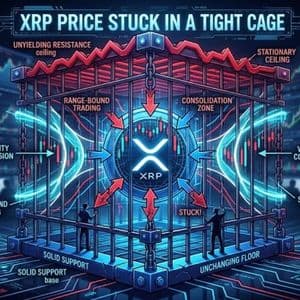
XRP price started a recovery wave above $1.3620 and $1.3650. The price is now consolidating and might aim for a fresh move if it clears $1.3840. XRP price started a recovery wave above the $1.3640 zone. The price is now trading below $1.3820 and the 100-hourly Simple Moving Average. There is a contracting triangle forming with resistance at $1.380 on the hourly chart of the XRP/USD pair (data source from Kraken). The pair could continue to move up if it settles above $1.3840. XRP Price Eyes Fresh Gains XRP price remained supported above $1.350 and started a recovery wave, like Bitcoin and Ethereum . The price was able to climb above $1.3580 and $1.3620 to enter a short-term positive zone. However, the price is still below $1.3850 and the 23.6% Fib retracement level of the downward move from the $1.5495 swing high to the $1.3465 swing low. There is also a contracting triangle forming with resistance at $1.380 on the hourly chart of the XRP/USD pair. The price is now trading below $1.3750 and the 100-hourly Simple Moving Average. If there is a fresh upward move, the price might face resistance near the $1.3780 level. The first major resistance is near the $1.380 level. A close above $1.380 could send the price to $1.3840. The next hurdle sits at $1.3940. A clear move above the $1.3940 resistance might send the price toward the $1.420 resistance. Any more gains might send the price toward the $1.4480 resistance or the 50% Fib retracement level of the downward move from the $1.5495 swing high to the $1.3465 swing low. Another Decline? If XRP fails to clear the $1.3840 resistance zone, it could start a fresh decline. Initial support on the downside is near the $1.360 level. The next major support is near the $1.3580 level. If there is a downside break and a close below the $1.3580 level, the price might continue to decline toward $1.340. The next major support sits near the $1.3380 zone, below which the price could continue lower toward $1.3250. Technical Indicators Hourly MACD – The MACD for XRP/USD is now losing pace in the bullish zone. Hourly RSI (Relative Strength Index) – The RSI for XRP/USD is now above the 50 level. Major Support Levels – $1.3600 and $1.3580. Major Resistance Levels – $1.3840 and $1.3940.
22 May 2026, 04:25
Whale That Lost $230M in Liquidation Opens $1.26M Short on Zcash
BitcoinWorld Whale That Lost $230M in Liquidation Opens $1.26M Short on Zcash A prominent cryptocurrency whale, identified by the on-chain label ‘1011,’ has opened a $1.26 million short position on Zcash (ZEC) with 3x leverage, according to data shared by on-chain analyst ai_9684xtpa. This move comes after the same address previously suffered a massive liquidation event totaling approximately $230 million. A Trader’s Calculated Risk or a Desperate Bet? The whale’s latest position is a 3x leveraged short on ZEC, indicating a bearish outlook on the privacy-focused cryptocurrency. The size of the position, while significant at over $1.2 million, is relatively small compared to the whale’s overall portfolio. The same address currently holds a $39.21 million long position on Bitcoin (BTC) with 5x leverage, alongside a $2.49 million spot holding in Hyperliquid (HYPE). The previous $230 million liquidation, which occurred at an earlier, undisclosed date, underscores the extreme risks associated with high-leverage trading. The whale’s decision to open a new leveraged position, especially in a less liquid asset like ZEC, suggests a strategy that continues to embrace high risk. This pattern is often observed among professional traders who view large losses as part of a broader, high-conviction strategy rather than a deterrent. Market Context and Implications Zcash (ZEC) has seen relatively low trading volume and price volatility compared to major cryptocurrencies like Bitcoin and Ethereum. A leveraged short position of this size could have a noticeable impact on ZEC’s price action, particularly if the whale’s position is liquidated, creating a short squeeze. The move also highlights the ongoing activity of large holders, or ‘whales,’ in the cryptocurrency market, whose trades can influence market sentiment and price direction. Why This Matters to Traders For retail traders and investors, this event serves as a reminder of the high-stakes environment in cryptocurrency markets. The whale’s actions provide a real-time case study in risk management and the potential consequences of high leverage. It also illustrates the transparency of blockchain-based markets, where on-chain analysts can track and report the activities of major players, offering valuable insights that are not available in traditional finance. Conclusion The whale address ‘1011’ continues to operate with a high-risk, high-reward strategy, balancing a large BTC long with a new ZEC short. While the $1.26 million position is relatively small in the context of the whale’s portfolio, it represents a clear directional bet that could influence ZEC’s short-term price. Traders and analysts will be watching closely for any further movements from this address, which has already demonstrated its willingness to take significant leveraged positions. FAQs Q1: What is a ‘whale’ in cryptocurrency? A ‘whale’ is a term used to describe an individual or entity that holds a large amount of a particular cryptocurrency, enough to potentially influence market prices through their trades. Q2: What does a 3x short position mean? A 3x short position means the trader is borrowing assets to bet that the price of ZEC will fall, with 3x leverage amplifying both potential profits and losses. If ZEC’s price rises by 33%, the position would be fully liquidated. Q3: How do on-chain analysts track whale activity? On-chain analysts use blockchain explorers and specialized software to monitor public wallet addresses. By analyzing transaction patterns and exchange flows, they can identify and attribute activity to specific entities or individuals, though true identities often remain anonymous. This post Whale That Lost $230M in Liquidation Opens $1.26M Short on Zcash first appeared on BitcoinWorld .


