


 Invest ideas
News
21 May 2026, 13:40
Ripple Price Analysis: Where’s XRP Going Next After Latest Rejection at the 100-Day MA?
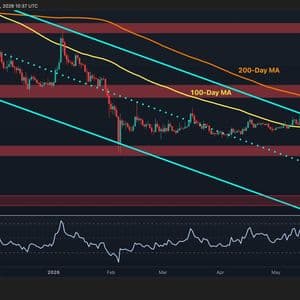
XRP is trading at $1.37 as May draws toward its final week, having erased every gain from what briefly looked like the most promising technical setup of the corrective cycle. The breakout above the 100-day MA on the USDT chart has failed to hold, and a lower high has formed on the BTC pair. The levels that looked like support last week are now the targets that bulls need to reclaim just to get back to where they started. Ripple Price Analysis: The USDT Pair The USDT pair’s daily timeframe setup looked compelling last week. The asset was pressing the upper boundary of the long-term descending channel and holding above the 100-day moving average at around $1.45, with an RSI climbing toward 65. Yet, this move has played out as a textbook rejection. XRP failed to post a single candle close above the channel, and the subsequent sell-off has brought the price back to $1.37. The 100-day MA, which was seen as dynamic support just days ago, is now the nearby overhead resistance at $1.40, sitting just below the descending channel ceiling. The RSI has faded from 65 back to the 40s, wiping out the momentum that made the setup optimistic. The $1.20 demand zone below should now be watched as the potential floor, while a recovery back above $1.45 and the 100-day MA remains the minimum requirement to rebuild any constructive case. Yet, with the broader altcoin market breaking down, the path of least resistance points toward another test of support rather than another attempt at resistance. The BTC Pair The brief breakout above 1,800 sats that appeared on the BTC pair last week has proven to be a fakeout. XRP/BTC has slipped back to around 1,770 sats, creating a lower high at around 1,800-1,900 sats. The RSI, which had recovered from the extreme low of ~25 all the way to above 50 while demonstrating a bullish divergence, has also faded back toward 40. The relief bounce is losing energy before it accomplishes anything structurally meaningful. The failed reclaim of 1,800 sats is the defining development on this pair. It confirms that the oversold bounce was corrective rather than structural, and that the broader downtrend in the ratio remains intact. The 100-day moving average at ~1,900 sats and the 200-day moving average at ~2,100 sats continue to decline well above, offering no nearby reference for a recovery. Below, the lower channel boundary near 1,550 sats and the 1,500 sat horizontal support band remain the next downside targets if the current level gives way. With altcoin sentiment deteriorating across the board, there is little in the near-term macro picture to suggest that pressure is about to ease. The post Ripple Price Analysis: Where’s XRP Going Next After Latest Rejection at the 100-Day MA? appeared first on CryptoPotato .
21 May 2026, 13:37
Eightco hits $337M AI-driven treasury mix led by OpenAI, Worldcoin, ETH

More on Eightco Holdings Eightco Holdings: Worldcoin, OpenAI, And POH Assets Are Overshadowed By Dilution Eightco reveals $326M treasury led by WLD, ETH, and OpenAI bets Eightco boosts OpenAI investment by $40M to $90M Financial information for Eightco Holdings
21 May 2026, 13:36
Police arrest 3,018 suspects across 10 jurisdictions in $752 million fraud crackdown

Operation FRONTIER+ III, a coordinated two-month operation involving law enforcement from 10 countries has ended in the arrests of more than 3,000 people. The Hong Kong Police Force and Singapore Police Force announced that they recovered $161 million from their operation, which targeted cross-border scams and money laundering operators. What is Operation Frontier? 3,200 officers from Hong Kong, Singapore, Malaysia, Indonesia, Thailand, South Korea, Brunei, Canada, the Maldives and Macau participated in an operation, codenamed FRONTIER+ III , that ran from March 10 to May 7, 2026. The 3,018 arrested suspects were linked to more than 138,000 fraud cases including e-commerce scams, fake job offers, investment fraud and impersonation schemes. Victim losses totaled approximately $752 million. Images from the Operation FRONTIER+ takedowns. Source: Singapore Police $161 million was recovered from the operation across the participating jurisdictions and nearly 102,000 bank accounts had to be frozen to prevent the flow of the funds. $319 million of the $752 million reported as fraud losses came from Hong Kong. The city’s police arrested 870 individuals, from as young as 13 to as old as 83, in connection with 742 cases and intercepted about HK$539 million (approximately $69 million) in suspected criminal proceeds. The FRONTIER+ platform now includes representatives from 14 law enforcement agencies, with the United States, Australia, South Africa and the UAE joining the original Asian participants. Singapore CEO fell for $36.3 million scam In the largest individual fraud case that the operation targeted, the chief executive of a Singapore-based company received a WhatsApp call from someone posing as the firm’s chairman. The executive transferred $36.3 million into two local OCBC accounts for a fake acquisition. The fraud was discovered later when the CEO checked with the actual chairman. Singapore’s Anti-Scam Centre seized $9.7 million from local accounts, but roughly $26.5 million had already moved to Hong Kong. Joint work with Hong Kong’s Anti-Deception Coordination Centre recovered an additional $11.1 million from bank accounts and linked crypto wallets. Two Singaporeans were arrested for allegedly helping open the corporate bank account that received the illicit transfers. About half the stolen funds were converted to stablecoins and spread across multiple wallets, which is a growing trend Hong Kong police have observed among fraud syndicates. How is Singapore fighting cybercrime? In a separate cross-border operation, Singapore and Malaysian police dismantled a syndicate operating out of Johor Bahru. Officers from Malaysia’s Johor Commercial Crime Investigation Department raided the group’s premises in March, and seized 83 mobile phones, 45 bank tokens and a computer containing operational software. That intelligence led to the arrest of 18 people in Singapore between March 23 and 31 for allegedly surrendering bank accounts or Singpass credentials for payment. A second joint operation targeted a suspected government official impersonation scam center in Kuala Lumpur. Malaysian police raided the location early in April and arrested three men. The devices recovered contained fake court orders and photographs linking the suspects to fraud that cost 22 Singapore-based victims more than S$877,000. Singapore’s Anti-Scam Centre investigated more than 1,000 individuals tied to cases involving S$69.3 million in losses. Over 130 people were arrested in the city-state, and authorities froze 2,315 bank accounts and seized S$34.9 million. Authorities have indicated the FRONTIER+ platform will continue expanding, and additional jurisdictions will be invited to join future operations. The smartest crypto minds already read our newsletter. Want in? Join them .
21 May 2026, 13:35
Bitcoin Hardware Wallet Maker Foundation Raises $6.4M, Plans Expansion Into AI and Digital Identity

BitcoinWorld Bitcoin Hardware Wallet Maker Foundation Raises $6.4M, Plans Expansion Into AI and Digital Identity Bitcoin hardware wallet company Foundation has secured $6.4 million in a new funding round, signaling a strategic pivot beyond self-custody into artificial intelligence authentication and digital identity. The round was led by Fulgur Ventures, a firm known for backing Bitcoin-focused infrastructure, with additional participation from Arche Capital. Funding Details and Strategic Shift Foundation, best known for its Passport hardware wallet designed specifically for Bitcoin self-custody, announced the raise as part of a broader plan to diversify its product lineup. The company stated that the capital will be used to develop new offerings in AI agent authentication, multi-factor authentication (MFA), and digital identity verification. This marks a notable expansion from its core hardware wallet business, which has catered primarily to Bitcoin maximalists and security-conscious holders. The move comes at a time when the intersection of cryptocurrency security and broader digital identity is gaining traction. As AI agents and automated systems become more prevalent, the need for secure, hardware-backed authentication methods is growing. Foundation’s expertise in building tamper-resistant hardware could give it an edge in this emerging market. Implications for the Bitcoin and Security Markets For the Bitcoin community, this development raises questions about Foundation’s long-term focus. While the company has built a loyal following among Bitcoin users who prioritize self-custody, the expansion into AI and identity suggests a broader commercial ambition. This could be seen as a positive sign of the company’s growth, but it also introduces new competition with established cybersecurity firms. Industry observers note that hardware wallet manufacturers have been exploring adjacent markets to sustain growth. Ledger, for example, has ventured into recovery services and NFT security. Foundation’s approach, however, is distinct in its focus on AI agent authentication—a niche that is still in its early stages but expected to expand rapidly as more businesses deploy autonomous systems. Why This Matters to Readers For consumers, the development means that hardware security devices could soon serve dual purposes: protecting cryptocurrency assets and verifying digital identity across multiple platforms. This could simplify security for users who currently rely on separate devices for different authentication needs. However, it also raises questions about privacy and data handling, especially if Foundation’s hardware becomes a hub for identity verification across various services. From an investment perspective, the funding round signals confidence from venture capital in the broader application of hardware security beyond crypto. Fulgur Ventures’ involvement is particularly notable, as the firm has a track record of backing Bitcoin-native companies that later expand into mainstream technology sectors. Conclusion Foundation’s $6.4 million raise is more than just a funding announcement; it represents a strategic shift that could redefine the role of hardware wallets in the digital economy. By moving into AI authentication and digital identity, the company is positioning itself at the intersection of cryptocurrency security and broader cybersecurity needs. While the core Bitcoin self-custody market remains its foundation, the expansion suggests that hardware security companies are increasingly looking beyond crypto to find sustainable growth. The success of this pivot will depend on execution, regulatory considerations, and whether users trust a single device for both their crypto and identity needs. FAQs Q1: What is Foundation’s main product? Foundation is best known for the Passport, a hardware wallet designed specifically for Bitcoin self-custody. It emphasizes open-source firmware and a focus on Bitcoin-only security. Q2: How will the new funding be used? The $6.4 million will be used to develop products for AI agent authentication, multi-factor authentication, and digital identity verification, expanding beyond the company’s traditional hardware wallet business. Q3: Who led the funding round? The round was led by Fulgur Ventures, a venture capital firm that focuses on Bitcoin and blockchain infrastructure investments. Arche Capital also participated. This post Bitcoin Hardware Wallet Maker Foundation Raises $6.4M, Plans Expansion Into AI and Digital Identity first appeared on BitcoinWorld .
21 May 2026, 13:31
Cardano Leios Testnet Goes Live as ADA Hovers Near Key Support

Cardano price faces a major breakdown amid the formation of an inverted pennant pattern in the daily time-frame chart. Cardano advances the Leios protocol update to live testing for protocol readiness checks. New features such as Endorser Blocks and committee-based validation aim to improve throughput by 10x to 65x. ADA, the native cryptocurrency of the Cardano ecosystem is down 1% during Thursday’s U.S. market hours to trade at $0.246. The price drop aligns with broader crypto market pullback as Bitcoin price rejects from the $78,000 floor. Despite the intact bearish sentiment in the market, the Cardano network continues to progress in its major scalability update— Ouroboros Leios— expected to boost network throughput by 10x to 65x and drive demand pressure to native cryptocurrency ADA. Cardano Advances Leios Protocol Upgrade to Meet Long-Term Scaling Targets Cardano’s blockchain currently processes approximately 800,000 transactions per month. The company’s internal plans call for a goal of more than 27 million monthly transactions by 2030 and maintaining a stable network even as treasury reserves decrease due to transaction fees. The Leios initiative is the main technical initiative to provide the needed capacity growth within the consensus layer. Leios is not replacing Ouroboros Praos, as it builds on the already existing consensus mechanism. The design preserves the security properties of the network, such as safety and liveness guarantees. It adds features like Endorser Blocks and committee-based validation processes that are expected to provide the throughput improvements of anywhere from 10x to 65x of current throughput. The approach is tuned to ensure decentralization requirements and economic viability of the stake pool operators. Development Status and Timeline Leios is considered the biggest technical development project in Input Output’s current development portfolio. The project continues ongoing from a budget cycle that ends in June 2026. The phase provided the combination of CIP-164, initial performance testing on an alpha implementation, and the release of a special public testnet for Leios. The 2026/27 development cycle focuses on further development of the protocol from the prototype phase to mainnet. The teams will develop software that will go through the Software Readiness Levels (SRL) 5 to 8. The effort is divided into 3 main work streams: Release Candidate Development- The Release Candidate track is the primary development stream. It will involve significant engineering changes as part of the major rewrite of consensus components and the incorporation of new Leios block structures designed for the Dijkstra ledger era. Other work to be done includes a full conformance test suite, based on the formal Agda specification, and integrating the new code into the main implementation of the Cardano node. Validation and Security Testing: A parallel validation track emphasizes systematic testing and risk assessment. These activities involve providing a parameter sweep of timing values and size limits, continuous load testing, and adversarial simulations on the public testnet. This includes the development of a new threat model with documented mitigations, stake-based attacks, network-based attacks, and red-teaming. Hard-Form Preparation: The third track focuses on elements of hard-fork readiness for which Input Output has direct control. This includes the stabilization of client interfaces, technical documentation creation with no dependency on specific implementations, and organising workshops for participants of the stake pool and developers, along with coordination with related projects like DB-Sync, Mithril, and Blockfrost. Additional items are testnet hard-fork executions, a plan for graduating parameters on mainnet, contingency plans, and preparation of new guardrails scripts and supporting rationale documents for governance review. These activities are completed and do not need to be linked to a real mainnet release plan. Leadership and Execution Carlos Lopez De Lara and Sebastian Nagel lead the initiative at Input Output. Delivery includes teams of engineers from various disciplines such as consensus protocols, ledger systems, networking, cryptography, node development, API development, performance optimization, tracing, testing, research and formal methods. “We have been researching and prototyping Leios for years. The science is done. Now we deliver it. When this ships, Cardano’s throughput story changes permanently.” said Carlos Lopez De Lara. Expected Technical Outcomes Upon completion, the project will deliver a Leios release candidate, ready for mainnet deployment across subsequent readiness stages. Validation work will produce detailed insights from load testing and adversarial analysis, supported by an updated threat model. Hard-fork preparation tasks will provide the required interfaces, documentation and support for ecosystem participants. The capacity boosts are designed to accommodate increased transaction volumes for additional activity in decentralized finance, real-world asset tokenization, and enterprise solutions. This infrastructure development targets core network metrics, including monthly transaction throughput and sustained operational scalability, while preserving the protocol’s original design principles. The final selections of parameters and their activation will be made after testing phases and community governance processes have been completed. It reflects the ongoing efforts of the Cardano engineering team to get the consensus layer’s performance to match the long-term anticipated needs of the network. Cardano Price May Extend Correction Trend with this Breakdown Over the past three months, the Cardano price has fluctuated in a narrow range between two converging trendlines of the daily chart. Following the January 2026 correction, this current consolidation indicates the formation of a classic bearish continuation pattern called inverted pennant. With today’s price drop, the Cardano ADA -0.40% price is just 1.3% away from challenging the pattern’s support trendline at $0.244. A potential bearish breakdown below the bottom trendline will complete the chart pattern and drive a prolonged correction towards $0.22 support. ADA/USDT -1d chart Alternatively, if the buyers continue to defend the support trendline, the Cardano price will prolong its consolidation within pennant structure till late-May.
21 May 2026, 13:30
DOGE Cofounder: 'Dogecoin Going to $20 Trillion Wouldn’t Be Boring'

Dogecoin co-creator makes $20 Trillion DOGE Comment, sparking market attention.


