


 Invest ideas
News
21 May 2026, 13:16
CoinDesk 20 performance update: Internet Computer drops 1.6%, leading index lower
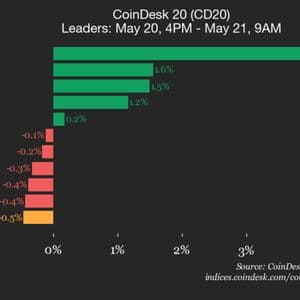
Hedera (HBAR), down 1.3% from Wednesday, joined Internet Computer (ICP) as an underperformer.
21 May 2026, 13:15
Curve Finance to Temporarily Halt UI for Database Upgrade on May 25

BitcoinWorld Curve Finance to Temporarily Halt UI for Database Upgrade on May 25 Curve Finance, a leading decentralized exchange (DEX) for stablecoin trading, has announced a scheduled database upgrade and maintenance window for May 25. The platform confirmed the work is expected to last between 20 minutes and one hour, during which the Curve user interface will be temporarily inaccessible. Planned Maintenance Details The upgrade, disclosed via Curve’s official communication channels, is part of ongoing efforts to improve backend infrastructure. While the user interface will be offline, the underlying smart contracts on the blockchain will continue to operate as normal. Users can still interact with Curve’s pools directly through third-party interfaces or by using the protocol’s smart contract functions during the maintenance window. What This Means for Users For most retail users, the temporary outage means they will be unable to execute trades, add liquidity, or withdraw funds via Curve’s official website for the duration of the upgrade. The platform has advised users to complete any time-sensitive transactions before the maintenance begins. Curve has not indicated whether the upgrade will introduce new features or solely focus on performance and stability improvements. Broader Context for DeFi Protocols Scheduled maintenance is a standard practice for DeFi protocols, though it highlights a tension between the ethos of decentralized, always-available systems and the practical need for backend improvements. Unlike centralized exchanges, which can pause all activity, DeFi protocols often rely on users to understand that the underlying blockchain remains operational even when the front-end is down. This upgrade is a routine but necessary step for Curve to maintain its competitive position as one of the most liquid DEXs in the ecosystem. Conclusion Curve Finance’s database upgrade on May 25 is a routine maintenance event that will temporarily restrict access to the platform’s user interface. Users should plan accordingly and ensure any critical transactions are completed beforehand. The brief downtime is unlikely to have a significant market impact on the CRV token or the broader DeFi sector, but it serves as a reminder of the operational realities behind decentralized protocols. FAQs Q1: Will my funds be at risk during the Curve Finance maintenance? No. Your funds remain secure in the smart contracts. The upgrade only affects the user interface; the blockchain continues to process transactions normally. Q2: Can I still use Curve Finance during the maintenance window? You cannot use the official Curve user interface, but you can interact with Curve’s smart contracts directly through blockchain explorers or compatible third-party interfaces. Q3: Why is Curve Finance performing this upgrade? While Curve has not detailed the specific changes, database upgrades typically improve performance, security, or scalability. The upgrade is part of standard platform maintenance. This post Curve Finance to Temporarily Halt UI for Database Upgrade on May 25 first appeared on BitcoinWorld .
21 May 2026, 13:10
WLFI posts record $1.8B profit day as Binance launches new pair

🚨 WLFI saw $1.8 billion profit realized in one day. Record-breaking token movement followed Binance’s USD1/BTC launch. Continue Reading: WLFI posts record $1.8B profit day as Binance launches new pair The post WLFI posts record $1.8B profit day as Binance launches new pair appeared first on COINTURK NEWS .
21 May 2026, 13:10
Dogecoin Price Prediction 2026–2030: Can DOGE Finally Reach $1?
BitcoinWorld Dogecoin Price Prediction 2026–2030: Can DOGE Finally Reach $1? Dogecoin (DOGE) remains one of the most closely watched cryptocurrencies in the market, driven by its passionate community and high-profile endorsements. As of early 2026, the meme-inspired digital asset continues to trade well below the symbolic $1 mark, prompting investors to ask whether the token can ever reach that milestone. This article examines realistic price projections for DOGE from 2026 through 2030, based on current market dynamics, adoption trends, and expert analysis. Current Market Position and Recent Performance Dogecoin was created in 2013 as a joke, but it has since evolved into a top-tier cryptocurrency by market capitalization. In 2021, DOGE surged to an all-time high of approximately $0.73, driven by retail frenzy and tweets from Elon Musk. Since then, the price has corrected significantly, trading in a range between $0.05 and $0.15 for most of 2024 and 2025. As of February 2026, DOGE is valued at around $0.08, with a market cap of roughly $12 billion. The token’s inflation rate, fixed at 5 billion new coins per year, remains a key factor in its long-term price trajectory. Unlike Bitcoin, which has a capped supply, Dogecoin’s supply increases indefinitely, which can suppress upward price momentum unless demand grows proportionally. Key Drivers for Dogecoin’s Future Price Several factors could influence whether DOGE reaches $1 by 2030. First, mainstream adoption as a payment method is critical. Companies like Tesla, AMC Theatres, and several online retailers already accept DOGE, but broader merchant integration remains limited. Second, regulatory clarity in major markets like the United States and the European Union could either boost or hinder institutional interest. Third, the influence of high-profile figures, particularly Elon Musk, continues to sway retail sentiment and trading volumes. Another important variable is the development of the Dogecoin network itself. Upgrades such as the proposed transition to a proof-of-stake consensus mechanism could reduce inflation and improve scalability, making the asset more attractive to long-term holders. However, no firm timeline for such changes has been announced as of early 2026. Analyst Projections and Market Sentiment Most cryptocurrency analysts are cautious about Dogecoin’s ability to reach $1. A price of $1 would require a market capitalization of approximately $140 billion at current supply levels, which is roughly equivalent to the entire market cap of Ethereum in early 2026. Given Dogecoin’s lack of unique technological utility compared to platforms like Ethereum or Solana, such a valuation appears ambitious. Some bullish forecasts, often from community-driven sources, suggest DOGE could hit $1 by 2028 if mass adoption accelerates and a major catalyst, such as integration with a global payment system, occurs. Bearish analysts, however, point to the token’s inflationary supply and competition from newer meme coins as reasons why DOGE may struggle to break above $0.50 in the foreseeable future. Conclusion Dogecoin’s path to $1 is uncertain and depends heavily on external catalysts, regulatory developments, and sustained community interest. While the token has proven resilient and enjoys strong brand recognition, its inflationary supply and lack of intrinsic utility present significant headwinds. Investors should approach price predictions with caution, recognizing that the cryptocurrency market remains highly volatile and speculative. For now, DOGE is likely to remain a high-risk asset with potential for periodic rallies, but a sustained price above $0.50 by 2030 is not guaranteed. FAQs Q1: Can Dogecoin realistically reach $1 by 2030? While possible, reaching $1 by 2030 would require a market cap of over $140 billion, which is ambitious given Dogecoin’s inflationary supply and limited utility. Most analysts view this as unlikely without a major catalyst like widespread merchant adoption or a significant network upgrade. Q2: What is the biggest obstacle to Dogecoin’s price growth? The primary obstacle is Dogecoin’s fixed inflation rate of 5 billion new coins per year, which dilutes existing holdings. Additionally, the token lacks the smart contract functionality and developer ecosystem that support the value of platforms like Ethereum or Solana. Q3: How does Elon Musk influence Dogecoin’s price? Elon Musk’s tweets and public statements have historically caused significant short-term price swings for DOGE. However, reliance on a single individual for price support is a risk, and Musk’s influence may wane as the market matures and regulatory scrutiny increases. This post Dogecoin Price Prediction 2026–2030: Can DOGE Finally Reach $1? first appeared on BitcoinWorld .
21 May 2026, 13:02
Ripple (XRP) Just Partnered With Next Major Switch for the Entire Crypto Sphere

Ripple recently announced that Ripple Prime, its global multi-asset prime brokerage platform, has integrated with EDX Markets and EDXM International. The integration gives Ripple Prime clients direct access to EDX’s spot and perpetual futures liquidity for digital assets within a unified, capital-efficient prime brokerage structure. Crypto researcher SMQKE (@SMQKEDQG) highlighted the development, calling it a major milestone for XRP and the digital asset market. EDX Markets is not a retail platform. It is an institutional-only crypto trading venue with a central clearinghouse. Charles Schwab, Fidelity, Citadel Securities, and Goldman Sachs all back it. Former executives from CME Group also run operations there. Combined, these firms manage over $11.5 trillion in assets and serve 77 million active broker accounts. That is the foundation Ripple Prime just connected to. RIPPLE JUST PARTNERED WITH THE NEXT MAJOR SWITCH FOR THE ENTIRE CRYPTO SPHERE Ripple Prime has just integrated with EDX Markets. This is a major development that all eyes should be on. Here’s why: EDX Exchange is backed by Wall Street giants like Charles Schwab,… pic.twitter.com/Ypp0M9w4SN — SMQKE (@SMQKEDQG) May 19, 2026 The Purpose of the Integration Ripple Prime clients can now access EDX’s liquidity directly. The underlying customer still needs to onboard to EDX and join the clearinghouse, but EDX CEO Tony Acuña-Rohter described the process as “basically a flip of a switch.” The technical barriers are low, and the institutional reach is broad. EDX has also integrated with LeveL Markets, a U.S.-registered broker-dealer and operator of the LeveL ATS. That integration brings low-latency execution, order routing, and institutional workflows into EDX’s trading venue. Ripple Prime now sits inside this expanding institutional infrastructure. Why This Matters for XRP XRP is a core asset within the Ripple ecosystem . When Ripple Prime expands its institutional reach, XRP benefits directly. More institutional access means more liquidity channels, more trading venues, and more capital infrastructure supporting the asset. EDX currently supports Bitcoin, Ethereum, and Litecoin. The platform has indicated that the number of supported digital assets will grow as the marketplace expands. Ripple’s integration positions XRP favorably as that expansion happens. Institutions entering crypto, according to EDX, want to incorporate digital assets into existing workflows. They do not want to rebuild their technology stack. Ripple Prime and EDX together offer exactly that. A single, capital-efficient structure connecting institutional clients to digital asset liquidity without requiring them to overhaul operations. XRP’s Next Steps EDX is still completing the rollout of its EDX Clearinghouse. When it goes live, it will settle trades across the marketplace at an institutional grade. Ripple Prime’s integration means its clients will have direct access to that infrastructure from day one. This development m deserves serious attention from anyone watching the XRP market. Disclaimer : This content is meant to inform and should not be considered financial advice. The views expressed in this article may include the author’s personal opinions and do not represent Times Tabloid’s opinion. Readers are advised to conduct thorough research before making any investment decisions. Any action taken by the reader is strictly at their own risk. Times Tabloid is not responsible for any financial losses. Follow us on X , Facebook , Telegram , and Google News The post Ripple (XRP) Just Partnered With Next Major Switch for the Entire Crypto Sphere appeared first on Times Tabloid .
21 May 2026, 13:00
The Last Time Bitcoin Printed This Ugly Candle, It Tanked; Now It Has Returned

The Bitcoin weekly chart has printed a red candlestick in a way that has quietly preceded some corrections. This candlestick appears in the numbers: in the open, the push, the rejection, and the close. That is exactly what happened last week. The candle that formed has now drawn the attention of an analyst who has catalogued its full history on Binance going back to 2017, and what he found is the possibility of another Bitcoin crash. Bitcoin’s Weekly Candle Flashes A Rare Bearish Setup As noted by a crypto analyst that goes by the name Sherlock on X, the latest Bitcoin weekly candle is one of the ugliest candlesticks that the asset can print. The analyst’s concern was not simply that Bitcoin closed the week in red. It was the way the candle formed and where it closed compared to the previous week. Related Reading: Pundit Predicts What Will Happen To XRP When Exchanges Run Out Of Supply Bitcoin’s weekly candle met three bearish conditions at the same time. It came in red immediately after a green weekly candle, its body engulfed the previous green candle, and it closed below the low of the previous week. This means buyers briefly tried to extend the rebound in the previous week but were overpowered before the weekly close. The week opened at $82,210. Buyers attempted a push higher, failed, and by the close Bitcoin was trading at $77,457, creating a red candle following a green week. That type of candle is important because it does not only show selling pressure. A green week had first given traders room to believe that Bitcoin was holding steady above $80,000, but the following candle erased that progress and closed beneath the prior low. This turned the previous week’s rally into a bull trap. What Does This Mean For Bitcoin? Interestingly, this exact setup has appeared 33 times on Binance since 2017, and the historical record is heavily tilted to the downside. Over the 12 weeks following each signal, Bitcoin traded at least 3% lower in 31 out of 33 cases, at least 5% lower in 28 cases, at least 8% lower in 25 cases, and at least 10% lower in 23 cases. Related Reading: XRP Analyst Reveals The Real Catalysts; ‘The Price Discovery Will Be Biblical’ The deeper part of the analysis is the average and median drawdown. The average drawdown after this weekly structure was 20.9%, while the median drawdown was 15.8%. Since Bitcoin closed last week at $77,457, a median version of the move would place the price on a further crash to $65,000, while an average version would drag the price close to $61,000. At the time of writing, Bitcoin is trading at $77,800 and bulls are trying to hold above $77,000. The current weekly candlestick is now green, but there is still enough time for things to change before the week’s close. The current weekly candle is playing out at a time when Bitcoin is under pressure from ETF outflows, and it is currently on a four-day outflow stretch, according to data from SoSoValue. Featured image created with Dall.E, chart from Tradingview.com


