Invest ideas
News
20 May 2026, 18:47
Hyperliquid ETFs Send HYPE Closer To All-Time Highs—Here’s What The Data Shows

Market analyst Aletheia released a report on Wednesday, taking a close look at the first six days of trading for Hyperliquid ETFs launched by 21Shares and Bitwise. The analysis focuses on how early inflows are stacking up across major crypto assets and what those moves may signal for demand going forward. First Six Days Under The Microscope In market-cap-adjusted terms, Aletheia found that the Hyperliquid ETFs generated more flows than Bitcoin (BTC) on three of the first six trading days. The same comparison also showed strength versus Ethereum (ETH): Hyperliquid’s ETF products logged higher inflows than Ethereum on five out of six days. Related Reading: Bitwise Bullish on Hyperliquid: HYPE Labeled ‘Undervalued’ As It Rallies 20% The Solana (SOL) spot exchange-traded fund sector produced a different picture. According to the report, Solana posted higher market-cap-adjusted flows than Hyperliquid on four of the first six trading days. On Tuesday, however, Hyperliquid spot ETFs recorded materially stronger inflows than any of their peers. The analyst emphasized that it’s still too early to say whether this spike is the start of a sustained trend, or whether it reflects a short-term burst of demand that may normalize over the coming days. Hyperliquid Near Bull-Run Highs Beyond the raw inflow numbers, the report reveals another layer: the Hyperliquid spot ETFs are competing with the Assistance Fund — the platform’s economic structure for token buybacks — in terms of market buying pressure. In the first six trading days, the ETFs bought 2.5 times as much HYPE as the Assistance Fund bought and burned. The “burning” element is important context, since it differs from a straightforward accumulation mechanism. Still, when the discussion is framed around buying pressure and market impact, Aletheia argues that the ETFs are clearly adding to the fuel. Related Reading: Solana ETF Falls Behind As XRP Collects More Cash—Here’s The Catalyst Driving The Split The combination of ETF-driven activity and increasing token demand has moved Hyperliquid close to current price peaks of $59 reached during last year’s bull run. Data from CoinGecko shows the altcoin trading at $51.88 when writing is up 33% over the past week alone. At this level, the token is only 12% below its current record, leaving room—at least in relative terms—for a potential “discovery” phase if the ETF-related inflows continue to build. Featured image created with OpenArt, chart from TradingView.com
20 May 2026, 18:46
Tether Buys SoftBank's 26% XXI Stake, VerifiedX Launches Native BTC on Base
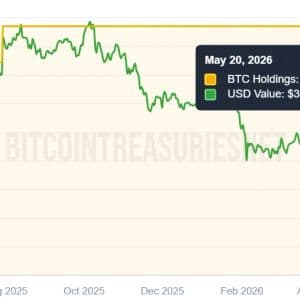
Bitcoin News Tether has deepened its grip on one of the largest publicly traded Bitcoin holders by acquiring SoftBank Group's roughly 26% stake in Twenty One Capital. The stablecoin issuer disclose...
20 May 2026, 18:45
CME to Launch VIX-Style Bitcoin Volatility Futures on June 1

BitcoinWorld CME to Launch VIX-Style Bitcoin Volatility Futures on June 1 The Chicago Mercantile Exchange (CME) has confirmed it will launch BVI, a new futures contract designed to track Bitcoin’s implied volatility, on June 1, 2026. The product has received certification from the U.S. Commodity Futures Trading Commission (CFTC), marking a significant step in the maturation of crypto derivatives markets. What Is BVI and How Does It Work? BVI functions similarly to the VIX, the widely followed ‘fear index’ for U.S. equities. Rather than betting on the price direction of Bitcoin, BVI allows institutional investors to trade or hedge volatility itself. The contract is based on the CME CF Bitcoin Volatility Index Settlement (BVXS), which measures the market’s expectation of future price swings in Bitcoin over a 30-day period. The initial monthly contracts listed will be for June and July 2026. Each contract’s notional value is calculated by multiplying the index figure by $500. For example, if the BVXS index stands at 80, one contract would represent $40,000 in notional exposure. Why This Matters for the Crypto Market The launch of a regulated, centrally cleared volatility product for Bitcoin addresses a long-standing gap in the digital asset ecosystem. Until now, traders seeking to hedge against sharp price swings had limited tools beyond options strategies or complex over-the-counter derivatives. BVI offers a standardized, exchange-traded instrument that can be used for portfolio risk management without taking a directional view on price. CME’s move also signals growing institutional demand for sophisticated risk management tools in crypto. The exchange already offers Bitcoin and Ether futures, as well as micro futures and options. Adding a volatility futures product rounds out its suite, giving traders a way to express views on market turbulence directly. Regulatory Context and CFTC Certification The CFTC’s certification of BVI is noteworthy. It indicates that the product meets the agency’s standards for market integrity and risk management. Unlike some crypto derivatives that have faced regulatory scrutiny, BVI is being launched through a regulated designated contract market (DCM), providing transparency and oversight. This certification may also pave the way for similar products tied to other digital assets. Market participants will be watching closely to see whether the CME expands the BVI framework to Ether or other cryptocurrencies in the future. Implications for Traders and Investors For institutional portfolio managers, BVI offers a cleaner way to hedge tail risk in Bitcoin holdings. During periods of high uncertainty—such as regulatory announcements, macroeconomic shifts, or market dislocations—volatility tends to spike. Having a direct volatility hedge can help stabilize portfolio performance without needing to sell underlying positions. For retail traders, the impact may be indirect but meaningful. A more mature derivatives market typically leads to tighter spreads, better price discovery, and reduced basis risk in the broader Bitcoin ecosystem. However, BVI is expected to be primarily an institutional product given its notional size and margin requirements. Conclusion The CME’s introduction of Bitcoin volatility futures represents a natural evolution in the digital asset derivatives landscape. By providing a regulated, transparent mechanism to trade implied volatility, the exchange is giving market participants a powerful new tool for risk management. As the June 1 launch date approaches, attention will turn to initial trading volumes and the depth of liquidity in the early months. The product’s success could influence how other exchanges approach volatility products for digital assets. FAQs Q1: What is the difference between BVI and regular Bitcoin futures? Regular Bitcoin futures allow traders to speculate on or hedge the price of Bitcoin at a future date. BVI, by contrast, tracks implied volatility—the market’s expectation of future price swings—without requiring a directional price bet. It is more analogous to trading the VIX than trading S&P 500 futures. Q2: Who is the target audience for BVI futures? The product is designed primarily for institutional investors, including hedge funds, asset managers, and proprietary trading firms. The $500 multiplier and monthly contract structure make it less suited for retail traders, though some brokers may offer access. Q3: Is BVI regulated by the CFTC? Yes. The product has received certification from the CFTC, meaning it meets the agency’s standards for listing on a designated contract market. The CME is a regulated exchange, and BVI will be subject to the same oversight as other CME futures products. This post CME to Launch VIX-Style Bitcoin Volatility Futures on June 1 first appeared on BitcoinWorld .
20 May 2026, 18:42
Bitcoin Adds $20B to Crypto Economy as Traders Defend $77,000 Support
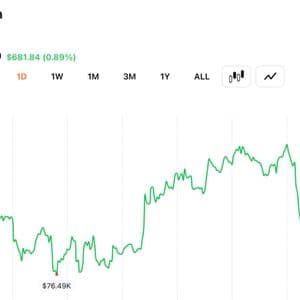
Bitcoin experienced volatile, range-bound trading, repeatedly struggling to sustain a breakout above $77,000. After a midnight surge from $76,700 to $77,200, it hit an intraday high of $77,604 before stabilizing around $77,500. Bitcoin Volatility Tightens Near $77K Resistance Bitcoin endured another grueling stretch of range-bound consolidation, routinely failing to cement a definitive breakout above the
20 May 2026, 18:35
ZachXBT flags $25M fund commingling, warns against BlockDSG, ZKP, and Spartans

Crypto Sleuth ZachXBT warned the crypto community on Wednesday against using BlockDAG, ZKP, and Spartans. The Blockchain investigator revealed that he traced $25M in alleged funds commingling from the firms. ZachXBT stated that the probe on the fiduciary scheme follows up on his earlier warnings about Gurhan Kiziloz. He revealed that he completed on-chain tracing, which demonstrated commingling of at least $25M of pre-sale funds between two investment schemes linked to Kiziloz. The Blockchain investigator also found that the funds were used to pay KOL streamers for the crypto official’s casino called Spartans. ZachXBT lacks disclosures in the original BlockDAG Network or ZKP pre-sale materials Does Spartans want to explain to the community why there was at least $25M of commingling between Blockdag & ZKP presale funds with Spartans KOL payment addresses onchain? Gurhan Kiziloz projects continue to show red flags with deceptive marketing as the number of retail… pic.twitter.com/sGvxCFCoEM — ZachXBT (@zachxbt) May 20, 2026 The crypto sleuth confirmed that he has not seen any disclosure in the original BlockDAG Network or ZKP pre-sale materials. ZachXBT believes that the disclosures would indicate that the funds would be used to promote a separate venture. He also revealed that retail investors are continuing to publish complaints on social media regarding the scheme. Zach believes that the lack of disclosures is another red flag on top of the earlier issues he had disclosed. Source: ZachXBT . Forensic graph showing BlockDAG and ZKP pre-sale wallets, Spartans’ hot wallets, and KOL payment address. ZachXBT revealed his forensic graph showing the consolidation of BlockDAG and ZKP pre-sale wallets and the bridge from Ethereum to Tron in CEX deposits and withdrawals. The graph also revealed the Spartans’ hot wallet and KOL payment address. The crypto forensic investigator previously cautioned on April 9 that those who love to gamble at the new casino, Spartans Bet, should avoid it. He also warned influencers, players, and industry professionals against using the site. Zach revealed that he was made aware by a few people on the site offering unrealistic amounts of funds to influencers and players. He confirmed at the time that ownership of Spartans Bet was tied to Gurhan Kizloz. He also previously linked Kiziloz to a sketchy crypto project called BlockDAG Network. The crypto sleuth alleged that BlockDAG raised more than $300 million from unsophisticated retail investors via social media ads. He also noted that the product stated unsustainable returns and misled partnerships. Spartans block ZachXBT on X for seeking clarifications ZachXBT also noted on Wednesday that the Spartans team immediately blocked him on X and hid his replies. He alleged that the team blocked him after he replied to their post seeking clarification. Zach asked Spartans to explain to the community why there was roughly $25 million of commingling between BlockDAG and ZKP pre-sale funds with Spartans KOL payment addresses on-chain. He also alleged that Gurhan Kiziloz’s projects continued to raise red flags through deceptive marketing, as the number of retail investor complaints on social media surged. ZachXBT claimed that more than 10 investors have messaged or tagged him claiming to have lost money on BlockDAG Network. The investors also stated that the product was not functional while the token pre-sale had been ongoing for more than 2 years. “If you search his name online it is mostly paid PR articles. Thus, I would 100% stay away from any business Gurhan Kizloz is associated with.” – ZachXBT , Blockchain Investigator. Spartans on May 20 thanked the crypto investigator for the alleged free advertisement. The firm revealed that it has given Zach a 30% revenue share on his code for users who sign up for the betting platform. The crypto sleuth also revealed that Kiziloz was spending very lavishly on luxury cars, real estate, watches, giveaways, and more. He had previously outed the BlockDAG leadership in October 2025 as merely figureheads, but later realized that Kiziloz was secretly the co-founder of BlockDAG. Cryptopolitan previously revealed on October 29 that Zach disclosed Kiziloz as the co-founder of BlockDAG, who pays people like Antony Turner to be its face. He also claimed that the crypto official was transferring millions in pre-sale funds from unsophisticated retail investors via Middle East OTC brokers. If you're reading this, you’re already ahead. Stay there with our newsletter .
20 May 2026, 18:35
XRP’s Failed Breakout Puts the $1.35 Support Zone Under Pressure