


 Invest ideas
News
20 May 2026, 11:59
Ethereum whales drop 7 percent as price nears $2,000

🚨 The number of $ETH whales dropped by 7 percent to 1,030. Ethereum’s price is testing the $2,100 support and risks falling to $2,000. Continue Reading: Ethereum whales drop 7 percent as price nears $2,000 The post Ethereum whales drop 7 percent as price nears $2,000 appeared first on COINTURK NEWS .
20 May 2026, 11:58
Ripple (XRP) Price Predictions for This Week
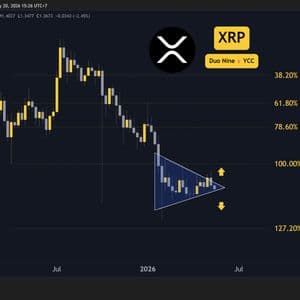
XRP failed its breakout and is now under $1.4. How low will sellers take it? Ripple (XRP) Price Predictions: Analysis Key support levels: $1.2, $1 Key resistance levels: $1.4, $1.6, $2 Breakout Failure Led to Reversal Initially, XRP broke above the blue pennant, triggering a bullish move and optimism. However, since then, the price fell back into the pennant and also broke below the key support at $1.4. This price action could be interpreted as a bullish trap with a full reversal that puts sellers in charge. As long as $1.4 acts as resistance, lower lows are likely with $1.2 and $1 as key targets for bears. Source: TradingView Sellers Return With the price unable to hold above $1.4, the chart turned bearish, and sellers have the upper hand right now. The drop under $1.4 was due to increasing sales volume, which gives confidence in this move. If the price falls below the blue pennant, XRP is likely to make new lows and will probably struggle to contain selling pressure. Buyers could, however, make a stand around $1.2. Any failure there would open the way to $1. Source: TradingView MACD Showed Weakness During the initial rally, the MACD formed lower histogram highs. This was an early bearish divergence, showing buyers don’t have the strength to sustain this uptrend. This weakness was now exposed by the price, which failed to hold above $1.4. Moreover, the MACD moving averages are curving down and may soon do a bearish cross, which could keep the chart in a downtrend for some time. Source: TradingView The post Ripple (XRP) Price Predictions for This Week appeared first on CryptoPotato .
20 May 2026, 11:57
These bitcoin metrics suggest February’s $60,000 selloff may have marked the bottom
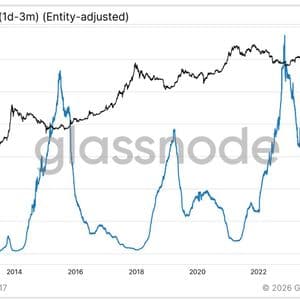
Realized cap stabilization, historically elevated RHODL readings and deeply negative funding rates all point toward a potential cycle low for bitcoin forming earlier this year.
20 May 2026, 11:56
Bitcoin (BTC) on the Edge: 23% Rally or 30% Crash Comes Next?

The primary cryptocurrency, which performed quite well towards the end of April and beginning of May, has tumbled by 5% over the past week, sparking fears that the bottom of the bear cycle has yet to be reached. One popular analyst believes that its eventual breakout would heavily depend on holding a critical support level. Big Jump or Major Collapse? Ali Martinez – a renowned analyst who often makes BTC predictions after observing certain technical indicators and factors – once again chipped in. This time, he paid special attention to the Market Value to Realized Value (MVRV) pricing bands and envisioned a rally to almost $95,000 should the asset’s valuation hold above $72,960. At the same time, Martinez claimed that falling below this key zone could trigger a major pullback to just under $55,000, representing a 30% crash from today’s price. In a separate post, the X user revealed that BTC’s MVRV ratio has plunged below its 180-day SMA. Unlike traditional models, which see this development as a cooling phase, Martinez views it as “a shift toward a high-conviction accumulation zone.” “When the MVRV ratio sits below the 180-day moving average, it means the market is effectively flushing out premium and pricing in a deep discount. Historically, these specific periods mark the exact foundation on which long-term smart money builds its positions. As long as the ratio consolidates under this 180-day line, the short-term trend will remain compressed, offering a highly strategic accumulation window,” he explained. The latest activity of the big investors supports the bullish outlook. As CryptoPotato reported , the number of market participants holding at least 100 BTC has increased to 20,229. This represents an 11% increase compared to the 18,191 wallets recorded in May 2025. Such a development shows that these big shots are confident in the asset and position themselves for a potential price pump in the future. This could have a psychological effect on smaller players, who may follow suit and inject fresh capital into the ecosystem. Is History Repeating? Meanwhile, other analysts made pessimistic forecasts and expect BTC to post a painful decline in the short term. Among those is X user Chiefy, who argued that the asset is entering the exact same pivot zone that appeared during the 2022 market meltdown. They reminded that back then, many people described the crash as a “healthy correction,” suggesting that now history is repeating. If that is indeed the case, BTC could tumble to as low as $45,000 in the coming months. Another worrying factor is the rising amount of coins stored on crypto exchanges. CryptoQuant’s data show the figure currently stands at almost 2.7 million, close to the monthly high reached earlier this week. This shift suggests that some investors have abandoned self-custody methods in favor of centralized platforms, thereby increasing immediate selling pressure. BTC Exchange Netflow, Source: CryptoQuant The post Bitcoin (BTC) on the Edge: 23% Rally or 30% Crash Comes Next? appeared first on CryptoPotato .
20 May 2026, 11:55
Solana News: Amundi Breaks Into Solana – Europe’s Largest Asset Manager Launches SOL UCITS Fund

Solana News: Europe’s largest asset manager just put Solana in the same conversation as Ethereum and Bitcoin for institutional allocation. Amundi, €2.4 trillion AUM, a subsidiary of Crédit Agricole, and the tenth-largest asset manager globally – has announced a UCITS-compliant fund on the Solana blockchain in partnership with Spiko Finance, a tokenization specialist managing $1.7 billion. The timing matters. Solana has already been attracting institutional infrastructure from Visa, PayPal, and Stripe , and US Solana spot ETFs just crossed $1 billion in assets under management. BREAKING: @Amundi_ENG , Europe's largest asset manager (€2.4T AUM) and @Spiko_finance ($1.7B AUM) are launching a UCITS fund on @Solana pic.twitter.com/T0qa5jWWkc — Solana (@solana) May 15, 2026 Amundi’s entry arrives as that momentum is accelerating, not as a contrarian bet. It is a confirmation signal from the most conservative end of the European asset management industry. The backdrop is not uniformly bullish, however. Goldman Sachs recently reduced its SOL exposure , a move that generated significant desk chatter about diverging institutional strategies. Amundi going long while Goldman trims creates exactly the kind of two-sided institutional narrative that tends to compress volatility in the short term and build structural demand over a longer horizon. Both positions reflect legitimate strategic logic, they are simply operating on different timeframes and risk mandates. Discover: The best crypto to diversify your portfolio with Solana News: How the Amundi-Spiko UCITS Structure Actually Works – and Why It Opens a New Capital Channel for SOL The mechanism here is worth understanding precisely. UCITS, Undertakings for Collective Investment in Transferable Securities, is the European Union’s harmonized regulatory framework for investment funds. What UCITS is to European institutional capital, spot ETFs are to the US market: the gold standard for regulated, passportable fund structures. A UCITS fund approved in one EU member state can be distributed across the entire EEA without requiring separate fund registration in each jurisdiction. That passporting capability is what makes this launch structurally significant rather than just symbolically noteworthy. The specific product is the Spiko Amundi Overnight Swap Fund (SAFO), a UCITS sub-fund of the French-regulated SPIKO SICAV, overseen by the Autorité des marchés financiers. SAFO generates yield via fully collateralized total return swaps with Tier-1 banks, BNP Paribas is the initial counterparty, making it a cash-equivalent, swap-based treasury instrument rather than a direct SOL holding. Together with @Amundi_FR , Europe’s largest asset manager, we’re thrilled to introduce the Spiko Amundi Overnight Swap Fund, or SAFO, a new tokenized fund optimized for cash and collateral management. UCITS-compliant. Built on fully collateralized total return swaps with… pic.twitter.com/JZt7oEahOe — Spiko (@Spiko_finance) March 19, 2026 Spiko Finance acts as transfer agent, tokenization platform, and broker; CACEIS, Amundi’s custody affiliate, handles depositary and fund administration duties, keeping the full traditional fund stack intact behind the token layer. Solana becomes at least the eighth chain in what is effectively a multi-chain UCITS strategy. Amundi and Spiko previously deployed SAFO on Ethereum, Polygon, Arbitrum, Base, Starknet, Stellar, and Etherlink, with roughly $100 million committed AUM at the March 2026 expansion. The European crypto regulatory environment under MiCA is progressively lowering barriers for this kind of deployment, and the AMF framework provides the compliance perimeter that conservative institutional allocators, pension funds, corporate treasuries, collateral managers, require before they can touch an on-chain product. Subscriptions and redemptions are denominated in EUR, USD, GBP, and CHF, with a minimum investment of one unit per currency class. Photo: Spiko Finance That effectively makes the product accessible to a very wide range of European institutional adoption use cases, from large sovereign wealth allocators down to mid-market corporate treasury desks. Parallel moves in Asia, including SBI Holdings filing for regulated crypto fund structures in Japan , confirm that regulated-wrapper demand for non-BTC, non-ETH assets is now a global institutional theme, not a regional experiment. Discover: The best pre-launch token sales The post Solana News: Amundi Breaks Into Solana – Europe’s Largest Asset Manager Launches SOL UCITS Fund appeared first on Cryptonews .
20 May 2026, 11:55
Why LTC Became an Institutional Altcoin Again

Litecoin has spent years in an unusual position. It is one of crypto’s oldest surviving networks, widely listed, easy to understand, and familiar to exchanges — yet it has often been overshadowed by Bitcoin, Ethereum, Solana, DeFi tokens, AI narratives, and newer Layer-1 ecosystems. That changed when LTC returned to institutional conversations through a more practical channel: regulated access. The launch of U.S. spot Litecoin ETF exposure, broader changes in crypto ETF listing standards, and Litecoin’s long operational history gave institutions a reason to look at LTC again — not necessarily as the most exciting altcoin, but as one of the cleaner, simpler, and more recognizable crypto assets outside Bitcoin and Ethereum. This does not mean Litecoin has become risk-free, undervalued, or guaranteed to outperform. It means the institutional case for LTC has shifted from “digital silver” marketing to questions that professional allocators actually care about: liquidity, custody, regulatory treatment, operational history, exchange support, product structure, and portfolio role. This guide explains why LTC became an institutional altcoin again, what the renewed interest really means, and what investors should check before treating Litecoin as a serious allocation rather than a legacy crypto name. Key Takeaways PointDetailsLTC’s institutional comeback is access-drivenSpot ETF structures and broader crypto ETF rules made Litecoin easier for traditional investors to evaluate and hold.Litecoin benefits from simplicityLTC has a capped supply, proof-of-work design, broad exchange support, and a long operating history.ETF approval does not equal strong demandRegulated access can improve legitimacy, but fund flows and market interest still need to be monitored.LTC is not a high-growth smart contract ecosystemLitecoin’s strength is payment-like utility and resilience, not DeFi, staking, or app-layer revenue.Risks remain materialLTC still carries volatility, miner economics risk, liquidity risk, ETF fee drag, regulatory uncertainty, and opportunity cost. The Comeback Is About Institutional Access, Not a New Hype Cycle Litecoin’s renewed institutional relevance is less about a technical reinvention and more about packaging. Traditional allocators often cannot or do not want to hold crypto directly. They need custodians, regulated products, benchmark pricing, reporting, compliance workflows, and familiar brokerage access. That is where the Litecoin ETF narrative matters. Canary Capital announced the Canary Litecoin ETF, trading under LTCC, as a spot Litecoin ETF designed to provide simplified exposure to LTC through a registered product wrapper. The ETF’s own materials describe it as a passive vehicle that holds Litecoin and seeks exposure to the value of LTC, less expenses and liabilities. ( Canary Capital ) This is important because institutions do not only ask, “Do we like the asset?” They also ask, “Can we buy it, custody it, value it, report it, and explain it to an investment committee?” A spot ETF does not solve every problem, but it removes several operational barriers. The broader ETF environment also changed. In September 2025, the SEC approved generic listing standards that allowed national exchanges to use a more standardized path for certain crypto and commodity exchange-traded products. Reuters reported that this could reduce the maximum filing-to-launch timeline from up to 240 days to 75 days for qualifying products. ( Reuters ) That shift helped Litecoin move from legacy altcoin status back into the institutional product conversation. The asset did not need to become a DeFi platform or AI token. It needed to be understandable, liquid enough, operationally mature, and compatible with a regulated wrapper. Why Litecoin Fits Institutional Due Diligence Better Than Many Altcoins Institutional crypto allocation is not only about upside potential. It is also about avoiding unclear token structures, thin liquidity, anonymous teams, aggressive unlocks, and governance risks that are difficult to explain to fiduciaries. Litecoin has several attributes that make it easier to evaluate. A Simple Monetary Design Litecoin has a capped supply model, with CoinMarketCap listing its maximum supply at 84 million LTC. That gives investors a straightforward supply framework to analyze compared with tokens that have complex emissions, vesting schedules, or governance-controlled inflation. ( CoinMarketCap ) No Startup-Style Issuer Dependency Litecoin is not dependent on a startup-style issuer promising future utility. That matters because many altcoin investment cases depend heavily on roadmap delivery, token incentives, ecosystem grants, or venture-backed growth assumptions. Litecoin’s investment case is more basic: a proof-of-work payment network with a long history, broad exchange access, and a known issuance schedule. Relatively Clearer Regulatory Treatment U.S. commodity-law treatment has been comparatively clearer for Litecoin than for many newer tokens. In a CFTC complaint against Binance, the agency referred to transactions involving digital assets that are commodities, including Bitcoin, Ether, and Litecoin. ( CFTC ) That does not mean every LTC product is simple from a legal perspective, and it does not remove jurisdiction-specific regulatory risk. But for institutions comparing altcoins, relative regulatory clarity can matter as much as technology. ETF Access Changed the Buyer Base, But Not the Risk Profile A key mistake is assuming that an ETF automatically makes the underlying crypto safer. It does not. A Litecoin ETF can simplify exposure, custody, tax reporting, and brokerage access, but the product still tracks an asset that can be highly volatile. The Canary Litecoin ETF’s investment objective is not to generate yield, outperform LTC, or manage downside risk. It is designed to provide exposure to Litecoin’s value, minus expenses and liabilities. ( Canary ETFs ) That distinction matters for both retail and institutional investors. An ETF may reduce some operational risks, such as self-custody mistakes, but it introduces product-specific considerations: management fees, tracking difference, share liquidity, creation and redemption mechanics, market price versus net asset value, and issuer concentration. There is also a demand question. Not every crypto ETF becomes a major institutional product. Reuters reported that CoinShares later withdrew plans for several U.S. crypto ETFs, including a Litecoin ETF, as it shifted toward products with better differentiation and margin potential. ( Reuters ) For LTC investors, the lesson is clear: ETF availability is a credibility milestone, not a demand guarantee. The next layer of analysis is fund flow quality. Are institutions allocating meaningfully, or is the product mainly symbolic? Are trading volumes consistent? Is liquidity improving across both ETF shares and spot LTC markets? What Litecoin’s Network Data Actually Supports Litecoin’s strongest non-ETF argument is its track record. The official Litecoin site presents the network as having processed more than 350 million transactions without a network interruption and describes it as operating with zero downtime across more than 14 years. ( Litecoin ) That history helps explain why LTC can appeal to conservative crypto allocators. Institutions often prefer assets with fewer unknowns. A newer chain may have faster growth, but it may also have untested infrastructure, validator centralization concerns, immature tooling, or unpredictable governance. However, investors should avoid overinterpreting raw transaction counts. A transaction is not automatically economic adoption. It could represent payments, exchange movements, wallet reshuffling, inscriptions, automated usage, or low-value activity. Serious LTC analysis should combine several metrics: transaction count and fees; active addresses; exchange liquidity; hashrate and miner economics; ETF flows; payment processor usage; long-term holder behavior. Litecoin’s network data supports a resilience argument. It does not, by itself, prove that LTC should outperform newer crypto assets. Where the LTC Investment Case Is Strongest — and Weakest Litecoin’s institutional appeal is strongest when framed as a simple, liquid, mature altcoin exposure. It is weakest when marketed as a high-growth technology platform. Where LTC Looks Relatively Strong Litecoin is easy to understand. For many allocators, that is a feature. It does not require explaining complex validator economics, cross-chain bridge dependencies, DeFi leverage loops, or app-specific token demand. Its capped supply and proof-of-work model also make it familiar to Bitcoin-oriented investors. LTC is not Bitcoin, and it should not be treated as a direct substitute, but its design is much closer to Bitcoin than to venture-style crypto networks. Litecoin also has broad market infrastructure. It is listed across major exchanges, supported by many wallets, and integrated into payment-focused crypto services. That improves access and reduces some liquidity friction compared with smaller altcoins. Where the Case Is Weaker Litecoin does not have Ethereum’s developer ecosystem, Solana’s app-layer momentum, or the revenue narratives attached to some DeFi protocols. It also does not offer staking yield, which can make it less attractive to institutions looking for income-like crypto products. There is also opportunity cost. In a bull market, investors may prefer assets with stronger narratives, faster ecosystem growth, or more visible fee generation. In a bear market, even mature altcoins can fall sharply as liquidity concentrates in Bitcoin and stablecoins. Litecoin’s optional privacy feature, MimbleWimble Extension Blocks, or MWEB, is another mixed factor. Litecoin’s learning center describes MWEB as an optional privacy and scalability layer. Privacy functionality may be valuable for users, but regulated intermediaries can be cautious around privacy-enhancing tools. ( Litecoin Learning Center ) Litecoin Compared With Newer Institutional Altcoins Litecoin is not the only altcoin in institutional discussions. Solana, XRP, Hedera, Chainlink, and other large crypto assets have also attracted product filings, institutional research, and ETF speculation. The difference is that Litecoin’s pitch is conservative. It is not trying to become the dominant smart contract platform or tokenization middleware. Its institutional role is closer to “old, liquid, payment-oriented crypto asset with cleaner packaging.” Asset TypeInstitutional AppealMain WeaknessLitecoinMature proof-of-work network, simple supply model, ETF access, broad exchange supportLess app-layer growth and weaker ecosystem narrativeEthereumDeep DeFi ecosystem, staking, tokenization infrastructure, developer activityComplexity, scaling fragmentation, and regulatory questions around some use casesSolanaHigh throughput, consumer apps, DeFi and DePIN activityHigher beta risk and stronger dependence on ecosystem momentumXRPPayments narrative, strong community, and institutional partnerships narrativeRegulatory history and concentrated narrative riskChainlinkOracle and real-world asset infrastructure relevanceToken value capture can be harder for beginners to analyze For a portfolio framework, Litecoin may fit as a lower-complexity altcoin allocation. It is not automatically lower risk than other altcoins, but its risks are easier to identify: price volatility, miner incentives, ETF demand, relevance versus competitors, and long-term usage. Practical Checklist Before Adding LTC Exposure Before buying LTC directly or using an ETF, investors should treat Litecoin like any other crypto allocation: define the thesis, position size, risk limits, and exit criteria. 1. Define the Reason for Exposure Do not buy LTC simply because it is “old” or “institutional.” A better thesis might be that regulated Litecoin products could expand access, LTC may benefit from renewed interest in proof-of-work assets, or Litecoin offers mature altcoin exposure without smart contract complexity. If the thesis is unclear, the position will be harder to manage during volatility. 2. Compare Direct LTC Versus ETF Exposure Direct LTC gives users self-custody flexibility, crypto-native transferability, and access to on-chain usage. It also requires wallet security, seed phrase protection, and exchange withdrawal discipline. ETF exposure may be easier for brokerage accounts and institutions, but it does not allow on-chain use. It also includes fees and may trade at small differences from net asset value depending on market conditions. 3. Check Liquidity Before Sizing Large investors should evaluate order book depth, ETF trading volume, bid-ask spreads, and redemption mechanics. Retail investors should still care about liquidity because thin markets can worsen slippage during fast moves. 4. Avoid Treating ETF Headlines as Price Signals An ETF launch can improve access, but it does not guarantee inflows. Watch actual demand: assets under management, daily volume, creations and redemptions, and whether advisors or institutions are allocating over multiple quarters. 5. Plan for Downside LTC can fall sharply during crypto market contractions. A responsible plan includes position sizing, maximum portfolio exposure, stop-loss or rebalance rules for traders, and a clear understanding that Litecoin can underperform both Bitcoin and newer altcoins for long periods. What Could Keep Litecoin Relevant in the Next Cycle Litecoin’s next institutional phase will likely depend on practical adoption rather than slogans. Several catalysts are worth watching. The first is ETF market depth. If LTC products gradually build assets, trading volume, and advisor awareness, the institutional narrative becomes stronger. If volumes remain limited, Litecoin may stay a niche product despite being listed. The second is payment usage. Litecoin’s low-fee, payment-oriented identity still matters, but it needs visible activity across wallets, merchants, remittance tools, and exchange settlement flows. The third is miner security. As block rewards decline over future halvings, Litecoin needs sufficient miner incentives from block rewards and fees to maintain robust proof-of-work security. The fourth is regulatory clarity. If regulators continue distinguishing mature proof-of-work assets from issuer-led token projects, LTC could retain a structural advantage. If privacy tools, exchange rules, or ETF standards change, the picture could become more complicated. The most realistic view is balanced: Litecoin has regained institutional relevance because it is accessible, established, and comparatively simple. That does not make it a superior investment by default. It makes LTC worth analyzing again. How Crypto Daily Helps Readers Track Institutional Crypto Narratives Crypto Daily covers market structure, altcoins, ETFs, regulation, DeFi, and institutional adoption with a focus on practical interpretation rather than hype. For readers watching Litecoin, the key is not just whether LTC appears in headlines, but whether real liquidity, product demand, network usage, and regulatory clarity continue to support the narrative. Frequently Asked Questions Is Litecoin an institutional cryptocurrency now? Litecoin has become more institutionally accessible because of ETF products, broad exchange support, custody infrastructure, and its long operating history. That does not mean every institution is buying LTC or that demand is guaranteed. Why did institutions become interested in LTC again? The main reasons are regulated access, Litecoin’s mature proof-of-work design, clearer market infrastructure, and its simpler risk profile compared with many newer altcoins. ETF availability made LTC easier to evaluate within traditional investment workflows. Is a Litecoin ETF the same as holding LTC? No. A Litecoin ETF provides price exposure through a regulated investment product, but it does not give investors direct control over LTC on-chain. Direct LTC ownership allows transfers and self-custody, while ETF exposure may be simpler for brokerage or institutional accounts. Is Litecoin safer than other altcoins? Not necessarily. Litecoin may have a longer track record and simpler design than many altcoins, but it still carries crypto market risk, volatility, liquidity risk, regulatory uncertainty, miner incentive risk, and opportunity cost. What is the biggest weakness in the Litecoin investment case? The biggest weakness is growth narrative. Litecoin is reliable and widely recognized, but it does not have the same developer ecosystem, DeFi activity, staking demand, or app-layer revenue story as some newer networks. Should beginners buy LTC because institutions are interested? Beginners should not buy any crypto asset based only on institutional headlines. A better approach is to understand the asset, compare direct ownership versus ETF exposure, start with conservative sizing, and avoid using leverage. Could LTC remain relevant long term? Litecoin could remain relevant if it continues to offer reliable settlement, broad exchange liquidity, payment utility, and regulated investment access. Its long-term role depends on real usage and demand, not just legacy status. Disclaimer: This article is provided for informational purposes only. It is not offered or intended to be used as legal, tax, investment, financial, or other advice.


