


 Invest ideas
News
19 May 2026, 09:43
Bitcoin Price Prediction: Iran Starts BTC-backed Shipping Insurance for Hormuz

Bitcoin price is holding its $77,000 support in a brutal week that sees it falling from $83,000 to as low as $76,000 despites analysts calling for a single bullish prediction. However, for now, Iran has launched a state-backed, bitcoin-settled maritime insurance platform for cargo transiting the Strait of Hormuz. It’s a move that could redefine how sanctioned economies interact with crypto infrastructure. The full operational details remain thin at the moment, but the implications for Bitcoin’s role in global trade finance are anything but. Iran’s Ministry of Economic Affairs and Finance rolled out a platform called Hormuz Safe around May 16–18. The service allows Iranian shipping companies and cargo owners to pay insurance premiums in Bitcoin, with policies described as “cryptographically verifiable” and activating upon on-chain confirmation. BREAKING: Iran has launched "Hormuz Safe," a Bitcoin-backed insurance service for shipping companies that want to transit the Strait of Hormuz. Details include: 1. The Iranian government says it could generate more than $10 billion in revenue from the program 2. The service… — The Kobeissi Letter (@KobeissiLetter) May 18, 2026 The report notes that coverage is initially restricted to Iranian entities, explicitly excluding vessels linked to states involved in the US-Israeli conflict. Officials cite potential annual revenues exceeding $10 billion if Hormuz Safe captures meaningful traffic through a chokepoint handling roughly 20% of global seaborne crude. Discover: The best pre-launch token sales Bitcoin Price Prediction: $80,000 Before Summer With The Help Of Geopolitical Demand Bitcoin current price is consistent with a coiling consolidation pattern that has been flagged across multiple desk notes. Volume remains moderate, suggesting the move hasn’t yet attracted a decisive wave of momentum buying. Key support sits in the $75,000 zone, a region that served as hard resistance through March and April before flipping to a base. Overhead resistance clusters between $80,000–$81,000, just below its local high this month. Bitcoin (BTC) 24h 7d 30d 1y All time Bitcoin’s price action has already shown sensitivity to geopolitical headlines , and Iran’s Hormuz Safe announcement injects a new demand narrative for sovereign-level Bitcoin adoption in energy trade settlement. What bulls want is for ETF inflows to remain supportive, macro conditions to hold, and the Hormuz Safe story to drive institutional FOMO. If all those happen, BTC could re-tests $80,000 resistance soon Longer-horizon price models point toward the $80,000–$100,000 range for the next impulse leg if the bull cycle resumes. However, the path there depends heavily on whether catalysts like Hormuz Safe translate into sustained demand or regulatory noise. Discover: The best crypto to diversify your portfolio with Bitcoin Hyper to Run as BTC Tests Institutional Limits Here’s the uncomfortable truth for Bitcoin bulls: the Hormuz Safe announcement exposes exactly what holds Bitcoin back at scale. Slow settlement, high fees during congestion, and near-zero programmability make raw BTC a clunky rail for complex financial products like insurance contracts. Bitcoin Hyper ($HYPER) is positioning itself as the infrastructure fix of Bitcoin. It is billing itself as the first-ever Bitcoin Layer 2 with full Solana Virtual Machine (SVM) integration, designed to deliver faster smart contract execution than Solana itself while preserving Bitcoin’s security and trust model. The project has raised $32 million in its ongoing presale, with tokens currently priced at $0.0136 . A Decentralized Canonical Bridge handles BTC transfers natively, while high 35% APY staking rewards early participants for locking tokens. Hyper’s use case is precise: fast , low-cost, programmable Bitcoin. It offers exactly what an insurance settlement rail requires. Research Bitcoin Hyper before the next price tier comes. The post Bitcoin Price Prediction: Iran Starts BTC-backed Shipping Insurance for Hormuz appeared first on Cryptonews .
19 May 2026, 09:41
“JPM Touched XRP”: The Cross-Border Settlement Moment That Put Interoperability in the Spotlight

Evernorth Confirms XRP’s Role as Bank Settlement Infrastructure in Monumental Cross-Border Transaction Evernorth says interoperability is what moves blockchain from theory into usable financial infrastructure. On May 6, that idea was tested in practice when XRP was used as a settlement layer in what participants describe as one of the most significant cross-institutional blockchain transactions to date. The XRP Ledger marked a milestone with the first cross-border, cross-bank redemption of tokenized U.S. Treasuries. Enabled by Ripple, JPMorgan’s Kinexys, Mastercard, and Ondo Finance, the transaction linked four institutions and multiple systems across traditional financial boundaries, yet settled in under five seconds. Evernorth underscored the moment with a phrase that quickly spread through crypto circles: “JPM touched XRP.” But the real story isn’t the symbolism, it’s what was actually built. XRP wasn’t treated as a speculative asset here, but as a coordination layer enabling different financial systems to sync and settle in real time. XRP Powers a Landmark Cross-Border Treasury Settlement with Ripple, JPMorgan, Mastercard, and Ondo Ondo Finance’s tokenized Treasury product (OUSG) was redeemed in a coordinated, multi-system workflow. Ripple handled the redemption on the XRP Ledger, Mastercard directed settlement instructions, and JPMorgan’s Kinexys processed the institutional banking layer. The final USD transfer landed in Ripple’s Singapore account, even outside standard banking hours, showcasing near-instant, around-the-clock settlement across traditional and blockchain rails. Well, the contrast with traditional finance is hard to miss. A cross-border redemption on correspondent banking rails would typically take one to three business days, moving through layered intermediaries, separate ledgers, and sequential reconciliations, each step adding delay, cost, and limited visibility. In this pilot, those moving parts were effectively collapsed into a single, near-instant settlement event. For Ripple, Mastercard, Ondo Finance, and JPMorgan, the exercise was less about theory and more about testing execution: how tokenized real-world assets can be redeemed across borders while still interfacing cleanly with existing fiat banking systems. It showed that blockchain-based infrastructure can operate beyond speculative trading or isolated use cases, extending into institutional settlement flows that run continuously across time zones. Evernorth’s takeaway is straightforward that interoperability is no longer an abstract goal, it’s becoming operational reality. When tokenized assets, traditional bank rails, and blockchain networks can interact without friction, settlement shifts from a multi-day, multi-party process into something much closer to an instantaneous transfer of value between institutions.
19 May 2026, 09:40
Worth Speculating On Bit Digital's Bet On Ethereum And WhiteFiber

Summary BTBT has shifted from Bitcoin mining toward becoming an ETH treasury management company with staking yield. However, that’s not the only bet with this stock. They also have WhiteFiber AI/HPC infrastructure. WhiteFiber's NC-1/Nscale ramp has upside potential, though it brings execution risk and is CAPEX-intensive. BTBT does have liquid assets, but its value ultimately rests on ETH spot prices and WhiteFiber's contracted infrastructure. Overall, I think BTBT is a complex stock, but it could be a viable speculative “Buy” for investors who are already bullish on ETH and the cloud. Bit Digital, Inc. ( BTBT ) is a company focused on Ethereum ( ETH-USD ) treasury management and AI infrastructure. This exposure comes through its majority stake in WhiteFiber ( WYFI ). Generally speaking, BTBT has pivoted towards combining a large ETH balance sheet and staking activity, while also adding recurring infrastructure revenue from cloud and colocation services. Since that pivot, their legacy mining business has become less relevant. Yet, I also acknowledge that BTBT’s prospects ultimately hinge on highly volatile crypto assets like Ethereum. Despite this, I think BTBT may be a viable speculative “Buy” for investors who are already bullish on ETH, and have a positive macro view on AI/HPC computing demand in the long run. Ethereum Treasury Meets AI Compute Bit Digital, Inc. is a Strategic Asset Company ( SAC ) focused on ETH treasury management and staking. They’re also involved in Artificial Intelligence ( AI ), and High Performance Computing (HPC) infrastructure through its majority stake in WhiteFiber Inc. ( WYFI ). BTBT was incorporated back in 2017 as Golden Bull Limited, but they renamed to their current name in 2020 . Their principal executive office is located in New York. They recently reported Q1 results , and their business is intriguing due to its ETH and cloud exposure, so I felt it was worthwhile covering this name. Source: Corporate Presentation. February 2026. Previously, BTBT was primarily a Bitcoin ( BTC-USD ) mining company. It still has a digital mining business, but it is a shrinking legacy operation. They have also converted their BTC holdings into ETH over time. But its underlying business mix has also changed sharply. By 2025 , BTBT generated $113.6 million in revenue from cloud services of $68.8 million, digital asset mining of $27.3 million, colocation of $8.9 million, and ETH staking of $7.0 million. More recently, their Q1 2026 sales reached only $27.9 million, including $16.8 million from cloud services, $4.8 million from colocation, $3.7 million from mining, and $2.3 million from ETH staking. It’s worth mentioning that BTBT chose ETH because they see it as a productive asset, as it generates yield through staking (approximately 3.5% annual yield in ETH terms). BTBT also plans to grow its ETH treasury opportunistically over time, which is why it’s considered a SAC. And the underlying idea is that if BTBT holds and stakes ETH, its ETH balances can grow through staking rewards. WhiteFiber’s Impact On BTBT With that in mind, BTBT’s latest Q1 revenue declined QoQ, although its large net loss was mostly tied to non-cash mark-to-market losses on digital assets, mainly ETH. The WhiteFiber piece is important because it adds a more operating-driven infrastructure angle to BTBT. In cloud services, WhiteFiber gives customers access to GPU compute capacity. In colocation, customers place their own computing equipment inside WhiteFiber’s data centers and pay recurring fees for physical space, power, cooling, connectivity, installation, and service support. For context, BTBT owned approximately 70.1% of WhiteFiber in Q1 2026. Source: Corporate Presentation. February 2026. Interestingly, WhiteFiber started as an internal BTBT business. In January 2024, it launched cloud services, and the business then moved toward NVIDIA GPU infrastructure and owned data-center capacity, including later deployments of NVIDIA B200 GPUs tied to GPU cloud demand. In October 2024, BTBT acquired Enovum , which vertically integrated the HPC business into colocation and added operating data-center capacity. WhiteFiber later signed the Cerebras colocation agreement for MTL-3, a planned Quebec facility near Montreal that will support a five-year, 5 MW built-to-suit arrangement. That contract represented about $979,000 of monthly revenue, so I would treat it as a smaller proof point for colocation demand rather than the main WhiteFiber upside driver. Yet, I’d consider BTBT’s larger value driver within WhiteFiber lies in NC-1. WhiteFiber acquired the Madison, North Carolina , property for $45.0 million. And later they signed a 10-year Nscale agreement that represents approximately $865.0 million of total contract value for 40 MW of colocation capacity. In other words, Cerebras and MTL-3 are promising, but it’s probably NC-1 and Nscale that represent the bigger catalysts for BTBT’s prospects. Source: Corporate Presentation. February 2026. Within that WhiteFiber platform, BTBT’s colocation segment increased from $1.4 million in 2024 to $8.9 million in 2025, thanks to the contribution of the Enovum data-center acquisition to the full year of revenue in 2025. BTBT acquired Enovum in October 2024, and that asset is now owned by WhiteFiber. The deal included MTL-1, a leased 4 MW Tier-3 data center in Montreal that was already operational and fully leased. Overall, I believe WhiteFiber’s acquisitions should give the company more potential customers and colocation opportunities over the long term. And, more importantly, this gives BTBT a vital contracted infrastructure angle beyond just hoping that the price of ETH recovers eventually. Valuation And Risk Analysis Now, from a valuation perspective, BTBT currently trades at a $630.1 million market cap. Its latest 10-Q shows $79.5 million in cash, $295.0 million in digital assets, and $56.0 million in investment securities. That amounts to roughly $430.5 million in liquid resources against $344.2 million in financial debt (convertible notes and derivative liability), aside from other regular operating liabilities. That way, I estimate its EV at roughly $543.8 million. Additionally, BTBT generated $113.6 million in 2025 revenue , which implies an EV/S of about 4.8x, or roughly 33.0% above the EV/S of 3.6x sector median . Source: Seeking Alpha. Spot price percentage changes over time. BTBT in orange, and ETH in green. Another way of looking at it is that BTBT’s $630.1 million market cap includes $430.5 million of gross liquid resources, which are mostly ETH, but also account for cash and investment securities. But these liquid assets are offset by $344.2 million of debt obligations , so BTBT’s net liquid assets are only $86.3 million. This is around 13.7% of BTBT’s market cap. That means the rest of the equity value hinges on BTBT’s two main value drivers, with 1) ETH and 2) WhiteFiber. The ETH side is relatively simple. BTBT has about 155.4 thousand ETH , equivalent to $326.4 million, assuming an ETH spot price of $2,100. This ETH position gives BTBT staking revenue, while the company still has some legacy mining exposure. But basically, this value driver ultimately depends on the long-term spot price of ETH. The other value driver is WhiteFiber, which is the company’s AI/HPC infrastructure angle. So, if you’re already bullish on ETH, then BTBT could be a way to express that view with some added WhiteFiber optionality. Source: Seeking Alpha. Just to give you an idea, BTBT’s ETH holdings would be worth approximately $466.3 million (equivalent to 74.0% of its current market cap) if ETH recovered to $3,000. Alternatively, if ETH makes a lower low to $1,500, the same holdings would be worth only $233.2 million (equivalent to 37.0% of its current market cap). So please bear this in mind before committing any capital to BTBT. After all, if ETH’s decline continues, then BTBT investors could also experience substantial shareholder losses. Separately, the WhiteFiber bet also gives them some optionality. WhiteFiber's Q1 revenue from cloud and colocation was $21.9 million. Annualized, that’s an $87.6 million revenue run rate. But it is still a capital-intensive growth segment, and assuming ETH prices don’t collapse, it could help create some upside potential for BTBT as well. Having said that, I also calculate that BTBT burned through $170.3 million during Q1 2026. Note that I got that figure by simply adding its Q1 cash flow from operations of -$1.1 million and CAPEX of -$169.2 million. Unfortunately, a simple annualization of that Q1 use of cash suggests a cash runway of only 0.6 years, which is a risk worth discounting with BTBT. Source: Corporate Presentation. February 2026. And this is especially true since much of BTBT’s residual equity value now depends on WhiteFiber’s capital-intensive AI/HPC infrastructure ramp, not just on its net liquid assets. Concretely, the quarter included $117.8 million of NC-1 development costs, $2.5 million of MTL-3 infrastructure costs, and $21.6 million of other PPE prepayments. Plus, it’s reassuring that their 10-Q explicitly says they have enough financing for at least the next 12 months. So, at least in principle, their burn rate going forward should be lower as they’ve already done the big CAPEX outlay in Q1. Basically, I’d say their Q1 was more of an unusually high CAPEX quarter rather than the norm, and this larger infrastructure base will help grow their WhiteFiber revenues in the long term. Conclusion: Speculative “Buy” Overall, I think BTBT is a complex stock because it depends on two completely different value drivers. First, the spot price of ETH is completely outside the company’s control. And the second is WhiteFiber, which is promising but requires CAPEX and careful execution to actually convert contracts into stable long-term revenues. However, BTBT’s Q1 update said that WhiteFiber’s NC-1 will begin delivering capacity to Nscale during Q2 2026. And this is the main catalyst that ultimately nudges me towards a speculative “Buy” rating on BTBT at these levels. After all, the valuation itself isn’t excessive, and by Q3 2026, NC-1 should begin showing more of its revenue potential. Just make sure you keep your position sizing manageable, because it’s an inherently speculative bet until BTBT’s subsequent quarters corroborate my bull case on them.
19 May 2026, 09:37
Swan Bitcoin sued for nearly $1B over pre-bankruptcy transfers from Prime Trust

Swan Bitcoin has been sued for allegedly using insider access to pull nearly $1 billion in Bitcoin and cash from Prime Trust days before its 2023 bankruptcy filing.
19 May 2026, 09:37
Crypto Stalls at $2.54T as ETPs Lose $1.07B and Japan Backs AI-Blockchain Plan
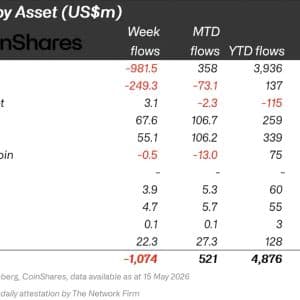
Crypto News The total crypto market capitalization edged up just 0.06% to $2.54 trillion as traders held back ahead of a fresh catalyst. Bitcoin traded nearly flat near $77,017 on subdued volume, w...
19 May 2026, 09:35
Bitcoin Slips Below $77K as Whale Wallets Hit 20,229, Pizza Day Marks 16-Year Milestone

Bitcoin News A major global exchange has rolled out a week-long campaign marking the 16th anniversary of the first real-world Bitcoin transaction, when a Florida developer paid 10,000 BTC for two p...


