


 Invest ideas
News
19 May 2026, 02:52
Bitcoin Holds $76K as Binance Retail Inflows Crash 73%, $400M Longs Liquidated
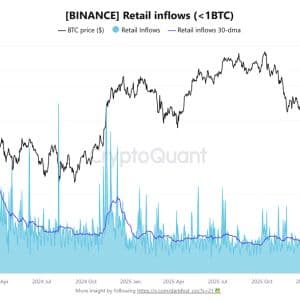
Bitcoin News Bitcoin retail activity on Binance has fallen to historic lows, with monthly inflows from wallets holding less than 1 BTC averaging just 314 BTC in 2026. That figure marks a sharp decl...
19 May 2026, 02:45
Ionic Digital Mined 20.45 BTC in April, Production Declines 27% Month-Over-Month

BitcoinWorld Ionic Digital Mined 20.45 BTC in April, Production Declines 27% Month-Over-Month Bitcoin mining firm Ionic Digital reported it mined 20.45 BTC in April, representing a 27.1% decline compared to the previous month. The company disclosed its Bitcoin holdings stood at 2,836.4 BTC as of April 30, according to a statement released this week. Production Decline and Operational Context The month-over-month drop in production comes amid a period of adjustment for the mining sector. While the company did not provide a specific reason for the decline in its April update, such fluctuations are often tied to changes in network difficulty, operational uptime, or fleet efficiency. Ionic Digital, which emerged from the bankruptcy proceedings of Celsius Network, has been working to scale its mining operations and stabilize its hash rate. Bitcoin Holdings and Financial Position Despite the lower monthly production, Ionic Digital maintains a substantial Bitcoin treasury. With 2,836.4 BTC on its balance sheet, the company holds significant digital assets that serve as a buffer against operational costs and market volatility. At current market prices, the holding is valued at over $170 million, providing the firm with considerable financial flexibility as it continues to expand its infrastructure. Industry Implications Ionic Digital’s April results reflect broader trends in the Bitcoin mining industry, where companies are navigating the post-halving environment. The April 2024 halving reduced block rewards, putting pressure on miners with less efficient equipment. Firms with strong balance sheets and access to low-cost power are better positioned to weather the reduced revenue per block. Ionic Digital’s sizable BTC reserve may give it a strategic advantage as it navigates this period of margin compression. Conclusion Ionic Digital’s 20.45 BTC mined in April, while down from March, is part of a normal production cycle influenced by network conditions and operational factors. The company’s large Bitcoin treasury provides a foundation for long-term growth. Investors and industry observers will watch for May results to gauge whether the production decline is a temporary fluctuation or a trend. FAQs Q1: Why did Ionic Digital’s Bitcoin production drop in April? The company did not specify a reason, but common factors include changes in Bitcoin network difficulty, maintenance downtime, or shifts in operational efficiency. Such month-over-month variations are not unusual in the mining industry. Q2: How much Bitcoin does Ionic Digital currently hold? As of April 30, the company held 2,836.4 BTC on its balance sheet, a substantial reserve that provides financial stability. Q3: What is Ionic Digital’s background? Ionic Digital was formed following the bankruptcy of Celsius Network and has been focused on building a large-scale Bitcoin mining operation. It is one of several publicly reporting mining firms in the United States. This post Ionic Digital Mined 20.45 BTC in April, Production Declines 27% Month-Over-Month first appeared on BitcoinWorld .
19 May 2026, 02:40
Curvance Halts eBTC Market After Detecting Suspicious Activity, Echo Protocol Faces $76.7 Million Exploit Allegations
BitcoinWorld Curvance Halts eBTC Market After Detecting Suspicious Activity, Echo Protocol Faces $76.7 Million Exploit Allegations Decentralized finance (DeFi) protocol Curvance announced on May 19 that it has temporarily suspended operations in its eBTC market after detecting abnormal activity. The decision comes amid growing concerns that the Echo Protocol, a lending platform built on the Monad blockchain, may have suffered a significant exploit. Curvance Detects Irregularities in Echo eBTC Market According to an official statement from Curvance, the protocol identified unusual signs in its Echo eBTC market around 10:00 p.m. UTC on May 18. In response, the team proactively paused the market to investigate and prevent any potential loss of user funds. Curvance emphasized that there is currently no evidence of a smart contract attack or compromise on its own platform, and that all other markets remain fully operational. The Echo eBTC market allows users to deposit and lend eBTC, a liquid Bitcoin token issued by the Echo Protocol. The suspension is a precautionary measure, reflecting the protocol’s commitment to security and user protection in a rapidly evolving situation. On-Chain Analyst Flags Potential $76.7 Million Exploit The development follows a warning from on-chain analyst Onchain Lens earlier on May 19. The analyst reported that approximately 1,000 eBTC, worth an estimated $76.7 million at current market prices, were minted without authorization. Onchain Lens suggested that the funds were likely stolen through Curvance, though this has not been confirmed by either protocol. Onchain Lens posted their findings on social media, prompting immediate scrutiny from the broader DeFi community. The report highlights the ongoing challenges of securing cross-protocol interactions in decentralized finance, where vulnerabilities in one platform can have cascading effects on others. Implications for DeFi Security and User Confidence This incident underscores the persistent security risks in the DeFi ecosystem, particularly for emerging protocols and liquid staking tokens. The rapid minting of a large amount of eBTC without authorization, if confirmed, would represent one of the larger exploits in recent months. It also raises questions about the security of cross-chain bridges and tokenized assets. For users, the situation serves as a reminder to exercise caution when interacting with newer protocols and to monitor official channels for updates. The value of eBTC and related tokens may experience volatility as the investigation unfolds. Conclusion Curvance has taken swift action by halting its eBTC market while it investigates the suspicious activity. The Echo Protocol has not yet issued a public statement regarding the alleged exploit. As the story develops, the DeFi community will be watching closely for further details on the extent of any potential losses and the security measures being implemented. This event highlights the critical importance of proactive security monitoring and rapid response in protecting user assets within decentralized finance. FAQs Q1: What is Curvance and why did it halt its eBTC market? Curvance is a decentralized finance protocol that facilitates lending and borrowing. It temporarily suspended its Echo eBTC market on May 19 after detecting abnormal activity, as a precautionary measure to protect user funds while investigating potential security issues. Q2: What is the Echo Protocol and what happened? Echo Protocol is a lending platform on the Monad blockchain that issues eBTC, a liquid Bitcoin token. An on-chain analyst reported that 1,000 eBTC, worth approximately $76.7 million, were minted without authorization, suggesting a possible exploit. Curvance’s eBTC market was used for depositing and lending this token. Q3: Should users of Curvance or Echo Protocol be concerned? Curvance has stated that other markets are unaffected and there is no evidence of a smart contract attack on its platform. Users should monitor official announcements from both Curvance and Echo Protocol for updates. It is advisable to exercise caution and consider the risks associated with emerging DeFi protocols. This post Curvance Halts eBTC Market After Detecting Suspicious Activity, Echo Protocol Faces $76.7 Million Exploit Allegations first appeared on BitcoinWorld .
19 May 2026, 02:35
Bithumb Adds Polaris Share (POLA) to Delisting Watchlist After Review
BitcoinWorld Bithumb Adds Polaris Share (POLA) to Delisting Watchlist After Review South Korean cryptocurrency exchange Bithumb has placed Polaris Share (POLA) on its delisting watchlist, signaling potential removal from the platform. The exchange announced the decision after a comprehensive review of the project’s business progress, trading and adoption status, and community activity revealed multiple shortcomings. Why Bithumb Is Reviewing POLA Bithumb’s delisting watchlist serves as a formal notice to projects that may no longer meet the exchange’s listing standards. According to the announcement, the review of Polaris Share highlighted deficiencies in key areas that Bithumb uses to evaluate token viability. These include the project’s ability to demonstrate ongoing development, maintain active community engagement, and sustain sufficient trading volume. The exchange did not specify a timeline for a final delisting decision. Projects placed on the watchlist are typically given a period to address concerns, after which Bithumb may proceed with removal if issues persist. What This Means for POLA Holders Tokens placed on Bithumb’s watchlist face heightened uncertainty. If delisted, POLA would no longer be tradable on one of South Korea’s largest exchanges, potentially reducing liquidity and accessibility for holders. Bithumb advises users to monitor official announcements for updates on the token’s status. Broader Implications for Listed Projects Bithumb’s review process is part of a broader trend among major exchanges to enforce stricter listing criteria. Exchanges worldwide have increased scrutiny of tokens with low trading volume, inactive development, or weak community support. For projects like Polaris Share, being placed on a watchlist can affect market perception and investor confidence. Polaris Share describes itself as a blockchain-based knowledge sharing and data platform. However, the project’s progress and adoption metrics have apparently fallen short of Bithumb’s expectations. Conclusion Bithumb’s decision to place POLA on its delisting watchlist reflects the exchange’s ongoing commitment to maintaining quality standards for listed assets. The final outcome will depend on whether the Polaris Share team can address the identified shortcomings. For now, POLA holders should stay informed and consider the risks associated with a potential delisting. FAQs Q1: What is Bithumb’s delisting watchlist? It is a formal notice indicating that a token is being reviewed for potential removal from the exchange due to unmet listing standards. Q2: What happens if POLA is delisted? If delisted, POLA would no longer be tradable on Bithumb. Holders may need to withdraw their tokens to a personal wallet or trade on other exchanges where it remains listed. Q3: How long does the review process take? Bithumb has not specified a timeline. Projects are usually given a period to address concerns before a final decision is made. This post Bithumb Adds Polaris Share (POLA) to Delisting Watchlist After Review first appeared on BitcoinWorld .
19 May 2026, 02:10
Hyperliquid’s USDC Revenue Deal With Coinbase and Circle Could Fuel HYPE Buybacks
BitcoinWorld Hyperliquid’s USDC Revenue Deal With Coinbase and Circle Could Fuel HYPE Buybacks Hyperliquid has entered into a strategic revenue-sharing agreement with Coinbase and Circle that designates USDC as its official base asset, a move analysts say could generate significant buying pressure for its native HYPE token. The partnership, first reported by CoinDesk, marks a notable shift in how the decentralized exchange generates revenue beyond traditional trading fees. How the USDC Partnership Works Under the terms of the deal, Coinbase will manage the USDC reserves held on Hyperliquid’s network, while Circle handles issuance, redemption, and cross-chain infrastructure. The stablecoin’s integration as the platform’s base asset means it will be used for all core trading pairs and settlement functions. Market analysts estimate Hyperliquid could retain up to 90% of the revenue generated from USDC deposits on its platform. That income stream would then be available to fund buybacks of the HYPE token, potentially creating sustained demand. Revenue Estimates and Market Implications Ryan Watkins, co-founder of Syncracy Capital, said the partnership fundamentally changes Hyperliquid’s business model. In addition to trading fees, the platform will now earn revenue from stablecoin deposits, allowing its income to scale with both trading volume and total assets under management. With over $5 billion currently deposited on Hyperliquid, Watkins estimated the USDC revenue sharing could generate an additional $135 million to $160 million in annual revenue. That would represent a substantial new income stream for the protocol. Why This Matters for HYPE Holders The potential for buybacks is significant because it introduces a mechanism that could reduce the circulating supply of HYPE over time. If Hyperliquid uses the USDC revenue to purchase HYPE from the open market, it would create direct buying pressure independent of speculative trading activity. This model mirrors traditional corporate stock buyback programs, where companies use excess cash to repurchase shares, often supporting or increasing the share price. For token holders, the structure provides a clearer link between platform usage and token value. Broader Context for Stablecoin Revenue Models The partnership also highlights a growing trend among crypto platforms to diversify revenue beyond transaction fees. Stablecoin reserves represent a large and relatively predictable source of income, particularly as USDC’s market capitalization has grown. By aligning with Coinbase and Circle, Hyperliquid gains access to institutional-grade custody and issuance infrastructure, which could attract larger investors seeking regulatory compliance. The deal comes at a time when decentralized exchanges are competing aggressively for liquidity and user deposits. Offering yield or revenue-sharing mechanisms tied to stablecoins has become a common strategy to retain capital on-platform. Conclusion Hyperliquid’s USDC revenue-sharing agreement with Coinbase and Circle represents a structural change in how the platform generates income and how it could support the HYPE token. With estimates suggesting up to $160 million in additional annual revenue, the partnership provides a clear mechanism for buybacks that could benefit long-term holders. As the crypto market continues to evolve, revenue models that tie platform success directly to token value may become increasingly important for investor confidence. FAQs Q1: What is the Hyperliquid USDC revenue-sharing deal? A1: Hyperliquid has partnered with Coinbase and Circle to designate USDC as its official base asset. Coinbase manages USDC reserves, Circle handles issuance and redemption, and Hyperliquid receives a portion of the revenue generated from USDC deposits on its platform. Q2: How could this deal increase HYPE buying pressure? A2: Analysts estimate Hyperliquid could use up to 90% of the USDC revenue to fund buybacks of the HYPE token. Buybacks reduce circulating supply and create direct market demand, which can support or increase the token’s price. Q3: How much revenue could Hyperliquid generate from this partnership? A3: With over $5 billion in deposits, Syncracy Capital’s Ryan Watkins estimates the USDC revenue sharing could generate between $135 million and $160 million in additional annual revenue for Hyperliquid. This post Hyperliquid’s USDC Revenue Deal With Coinbase and Circle Could Fuel HYPE Buybacks first appeared on BitcoinWorld .
19 May 2026, 02:00
The XRP Asian Breakout: Japan And South Korea Lead The Charge

SBI Group is reportedly planning to list a combined Bitcoin and XRP exchange-traded fund on the Tokyo Stock Exchange , with a target of $32 billion in assets under management within three years of launch. Japan’s Financial Services Agency is already reviewing crypto assets more seriously as financial instruments, according to reports. The development signals a shift in how major Asian financial institutions are treating digital assets — not as fringe speculation, but as a category worth institutional attention. A Culture Built For This Moment The story of XRP in Asia did not start with crypto. It started with interest rates. Japan spent decades in a near-zero or negative rate environment, leaving ordinary savers with little to show from traditional bank accounts. That created a generation of retail investors willing to take on risk. Japan grew into one of the world’s largest retail foreign exchange trading markets, with households actively trading global currencies through online platforms in search of returns they could not find at home. SBI IS BRINGING XRP TO THE TOKYO STOCK EXCHANGE SBI Group: planning a BITCOIN + XRP ETF listed on TSE and a $32 BILLION AUM target within 3 years of launch. Japan’s FSA is already reviewing crypto as a FINANCIAL INSTRUMENT. $XRP $BTC pic.twitter.com/ardNDDKiMb — Xaif Crypto (@Xaif_Crypto) May 17, 2026 When crypto came along, many of those same investors found it familiar territory. South Korea followed a similar path — sluggish local returns pushed retail money toward high-yield alternatives, and digital assets filled that gap. Fiona Murray, Ripple’s vice president for the Asia-Pacific region, pointed to that history when discussing the crypto’s strong following in both countries. “In countries like Japan and Korea, we see retail holders of XRP as a store of value and looking for that next piece,” Murray said. She attributed Japan’s appetite for alternative assets directly to its long period of low returns: “They’ve had a lower negative interest rate environment for decades now.” Ripple’s APAC VP: “Low interest rate economies push retail into ALTERNATIVE ASSETS XRP is becoming their STORE OF VALUE. 0% savings rate did this. $XRP https://t.co/gXfcAe5tld pic.twitter.com/Vv6YAdqraw — Xaif Crypto (@Xaif_Crypto) May 17, 2026 XRP’s Place Between Two Worlds Part of XRP’s appeal in Asia comes from its connection to established financial institutions. SBI Holdings , one of Japan’s major financial groups, has been closely associated with the altcoin for years. For many investors, that relationship puts XRP in a middle ground between traditional banking and the broader crypto market — neither purely speculative nor fully conventional. XRP’s near-instant settlement and low transaction fees have made it attractive to users dealing with the slow pace and high costs of conventional banking transfers. Featured image from PlanetofHotels, chart from TradingView


