


 Invest ideas
News
18 May 2026, 16:54
Bitcoin Holds $76K as Capital B Adds 192 BTC, Crypto ETPs Bleed $1.07B and Hive Pivots to AI

Bitcoin News Hive Digital Technologies, one of the longest-running publicly traded Bitcoin miners, saw its share price rocket roughly 26% to about $3.39 on Monday after unveiling a 320-megawatt art...
18 May 2026, 16:50
UK regulators push for near 24-hour payments to support tokenization

BitcoinWorld UK regulators push for near 24-hour payments to support tokenization The Bank of England (BoE) and the Financial Conduct Authority (FCA) are advancing plans to extend the operating hours of key payment and settlement systems to nearly 24 hours a day, a move designed to accommodate the growing tokenization of financial markets. The proposals, announced in recent regulatory documents, signal the UK’s intent to modernize its financial infrastructure for a digital asset era. Extended hours for RTGS and CHAPS The BoE has proposed adding weekend and extended operating hours to its Real-Time Gross Settlement (RTGS) system and the CHAPS high-value payment system. Currently, these systems operate during standard business hours on weekdays, limiting the ability to settle tokenized transactions and cross-border payments in real time around the clock. The bank stated that the change is necessary to support new tokenization-based payment and settlement models that require continuous availability. Regulatory framework for tokenized assets In parallel, the UK’s Prudential Regulation Authority (PRA) has issued guidelines proposing that tokenized financial products should be subject to the same regulatory standards as traditional instruments, provided they carry equivalent legal rights and risk profiles. This approach aims to create a level playing field while encouraging innovation in wholesale markets. Katie Harries, head of Europe policy at Coinbase, noted that the UK is presenting a clear vision for tokenization, which could expand access to new capital and investment opportunities. Broader crypto regulation timeline The FCA is also developing a comprehensive cryptocurrency regulatory framework that will cover stablecoin issuance, trading, custody, and staking. The regulator has set a target for full implementation before 2027. These efforts align with the government’s broader ambition to position the UK as a global hub for digital asset innovation while maintaining financial stability and consumer protection. Conclusion The push for near 24-hour payment systems and clear tokenization rules represents a significant step in the UK’s financial modernization agenda. By aligning payment infrastructure with the needs of digital markets, regulators aim to foster innovation, improve cross-border payment efficiency, and attract investment in tokenized finance. The coming years will be critical as the FCA finalizes its crypto rules and the BoE implements extended settlement hours. FAQs Q1: What is tokenization in financial markets? Tokenization refers to the process of representing real-world assets, such as bonds, equities, or commodities, as digital tokens on a blockchain or distributed ledger. This can enable faster, cheaper, and more transparent trading and settlement. Q2: Why do payment systems need to operate 24 hours for tokenization? Tokenized markets often require real-time settlement across different time zones and outside traditional banking hours. Extended payment system hours allow for continuous trading, clearing, and settlement without delays. Q3: When will the UK’s new crypto regulations take effect? The FCA aims to implement a comprehensive regulatory framework covering stablecoins, trading, custody, and staking before 2027. The BoE’s extended payment hours are also expected to be phased in over the next few years. This post UK regulators push for near 24-hour payments to support tokenization first appeared on BitcoinWorld .
18 May 2026, 16:48
Hive Shares Hit Highest Price This Year After Bitcoin Miner Unveils Ontario 'AI Gigafactory'

Hive Digital Technologies’ stock price popped after the Bitcoin miner unveiled a massive data-center buildout in Ontario, Canada.
18 May 2026, 16:45
Circle Mints 250 Million USDC, Boosting Stablecoin Supply and Market Liquidity
BitcoinWorld Circle Mints 250 Million USDC, Boosting Stablecoin Supply and Market Liquidity In a significant on-chain event, the USDC Treasury has minted 250 million new USDC tokens, as reported by blockchain tracking service Whale Alert. The transaction, executed on the Ethereum network, adds substantial liquidity to the stablecoin ecosystem and signals continued demand for dollar-pegged digital assets. Details of the Minting Event The minting occurred at the USDC Treasury, the official smart contract controlled by Circle, the company behind the USD Coin. Whale Alert, a widely followed blockchain monitoring platform, flagged the transaction, which added 250,000,000 USDC to the circulating supply. Such minting events are routine operational activities by Circle to meet market demand, often in response to institutional or retail inflows. Market Implications and Context An increase in stablecoin supply is generally viewed as a bullish signal for the broader cryptocurrency market. It suggests that capital is flowing into the crypto ecosystem, potentially positioning for trading, lending, or yield-generating activities in decentralized finance (DeFi). USDC, the second-largest stablecoin by market capitalization, is a critical infrastructure component for exchanges, lending protocols, and payment platforms. Impact on DeFi and Trading The additional 250 million USDC enhances liquidity pools across major decentralized exchanges like Uniswap and Curve, and provides more collateral for lending markets on Aave and Compound. For traders, a larger stablecoin supply can reduce slippage and improve execution prices. This minting event follows a period of relative stability in the stablecoin market, which saw supply contractions during the 2022 bear market. Conclusion The minting of 250 million USDC is a routine yet meaningful event that reflects ongoing demand for stable digital dollars. It bolsters market liquidity and supports activity across both centralized and decentralized finance platforms. Investors and analysts will monitor whether this supply increase precedes a broader uptick in crypto market activity. FAQs Q1: What is USDC? USDC (USD Coin) is a stablecoin pegged 1:1 to the US dollar, issued by Circle. It is fully backed by cash and short-term US Treasury bonds, and is widely used for trading, payments, and DeFi. Q2: Why does Circle mint new USDC? Circle mints new USDC in response to demand from users who deposit US dollars into the reserve. Each minted token is backed by an equivalent amount of fiat currency held in regulated financial institutions. Q3: Does a USDC minting event affect the price of USDC? No, minting does not affect the price of USDC, which is designed to remain at $1.00. The process simply increases the circulating supply to match new dollar deposits, maintaining the stable peg. This post Circle Mints 250 Million USDC, Boosting Stablecoin Supply and Market Liquidity first appeared on BitcoinWorld .
18 May 2026, 16:44
Bitcoin Price Analysis: What’s Next for BTC as Key Trendline Breaks?
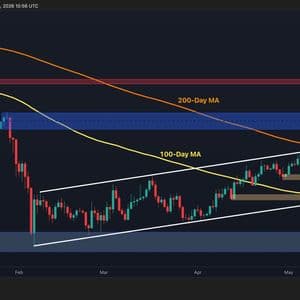
Bitcoin is trading at $76.8k as the third week of May opens. It has surrendered the $80k breakout that defined the prior week’s narrative. The short-term bullish trendline that supported the inner rally structure has been broken, and the price has pulled back into the mid-range of the large ascending channel on the daily timeframe. The support zone at $75k is now the line in the sand. Bitcoin Price Analysis: The Daily Chart On the daily timeframe, it is evident that the ascending channel breakout has been invalidated, and the asset has returned inside the structure and is now testing the middle portion of the range near $76k–$75k. The 100-day MA has declined to approximately $72k and is approaching from below, providing a rising floor that narrows the downside risk. Yet, the 200-day MA, currently located around $81k, is pushing the price lower from above, after rejecting it decisively. The support zone at $75k is the critical area to defend, as it represents the most recent bullish order block and short-term swing low. A rebound here and a recovery back above $80k would suggest the pullback was corrective and the broader uptrend intact. However, if the price breaks below $75k, a further decline back toward the 100-day MA and the $72k demand area would be expected. Such a move would raise questions on whether the recent recovery has been a genuine one or simply another trap for early buyers. BTC/USDT 4-Hour Chart The bearish RSI divergence that built through the $80k–82k highs earlier this month has resolved exactly as the pattern suggested. The inner bullish trendline from April has been broken, and the RSI has dropped sharply below 35, approaching oversold on this timeframe for the first time in the past couple of months. The price is now sitting at the upper edge of the $75k–$76k support zone. A bounce from here, accompanied by a bullish RSI divergence and recovery from oversold values, would signal that the correction is exhausted and another rally toward $80k could be expected. On the other hand, failure to hold $75k opens the lower support area at $70k–72k, which also aligns with the daily ascending channel’s lower boundary and the 100-day moving average. Therefore, if the $75k zone breaks, buyers would face a critical battle at the $72k region to prevent the market from a deeper crash. On-Chain Analysis The Adjusted SOPR has recovered from its February low of below 0.98, which is a reading that confirmed widespread capitulation as sellers offloaded coins below their cost basis, all the way back to 1.005. The metric has just crossed the critical 1.0 threshold that separates profitable from loss-realizing behavior. Historically, the recrossing of 1.0 from below has marked the transition from bear-market behavior to recovery. The fragility of the current reading matters, though. At 1.005, aSOPR has barely cleared the line, and any meaningful price decline back toward $70–72k risks pushing it below 1.0 again, which would signal that the recovery has stalled and sellers are once again realizing losses. Holding the $75k support zone is therefore not just a technical requirement but an on-chain one, as it is the price level that keeps the aSOPR above 1.0 and the recovery narrative intact. The post Bitcoin Price Analysis: What’s Next for BTC as Key Trendline Breaks? appeared first on CryptoPotato .
18 May 2026, 16:36
XRP investment products see 70 percent weekly surge to $67.6M

🚀 Weekly investment in $XRP products surged 70 percent to $67.6M. Major withdrawals hit Bitcoin and Ethereum as US investors pivoted. 🇺🇸 Key point: Almost all new XRP inflows came from American spot ETFs. Continue Reading: XRP investment products see 70 percent weekly surge to $67.6M The post XRP investment products see 70 percent weekly surge to $67.6M appeared first on COINTURK NEWS .


