


 Invest ideas
News
18 May 2026, 13:43
Bitcoin slumps 7 percent to $76,500 amid US Iran tension

🚨 Bitcoin dropped 7 percent to $76,500 as US Iran tensions flared. Increased volatility caused $607 million in long position liquidations in $BTC. Continue Reading: Bitcoin slumps 7 percent to $76,500 amid US Iran tension The post Bitcoin slumps 7 percent to $76,500 amid US Iran tension appeared first on COINTURK NEWS .
18 May 2026, 13:41
Iran Pushes $10B Bitcoin Insurance Plan for Strait of Hormuz: Report

The platform settles cargo cover in Bitcoin under a plan for marine policies and certificates that could generate $10 billion for Iran.
18 May 2026, 13:40
Citi Warns Bitcoin Faces Unique Quantum Computing Vulnerability Due to Slow Upgrades

BitcoinWorld Citi Warns Bitcoin Faces Unique Quantum Computing Vulnerability Due to Slow Upgrades Bitcoin, the world’s largest cryptocurrency by market capitalization, faces a unique and potentially severe threat from the rise of quantum computing, according to a new analysis from Citigroup. The report, covered by CoinDesk, highlights that Bitcoin’s conservative governance structure and slow protocol upgrade speed make it particularly susceptible to attacks that could compromise a significant portion of its circulating supply. The Core Vulnerability: Exposed Public Keys Citi analyst Alex Saunders identified that the primary weakness lies in public keys that have already been exposed on the blockchain. Unlike modern best practices where public keys are only revealed when a transaction is spent, older Bitcoin addresses and transaction types have their public keys permanently visible. This includes early pay-to-public-key (P2PK) addresses and the wallet widely believed to belong to Bitcoin’s pseudonymous creator, Satoshi Nakamoto. According to recent estimates, between 6.5 million and 6.9 million Bitcoin have already had their public keys exposed. This represents roughly one-third of the total circulating supply, currently valued at approximately $450 billion. In a future where sufficiently powerful quantum computers exist, an attacker could theoretically use Shor’s algorithm to derive the private key from a public key, allowing them to forge transactions or steal funds from those addresses. The ‘Harvest Now, Decrypt Later’ Threat Saunders also warned of a more immediate and insidious tactic: ‘harvest now, decrypt later’ attacks. In this scenario, malicious actors collect encrypted data or on-chain transaction information today, storing it until quantum technology matures enough to decrypt it. This means that even transactions that are secure by today’s standards could become vulnerable in the future, posing a long-term risk to privacy and asset security. The report underscores that while quantum computing is not yet a practical threat to Bitcoin, the window for proactive defense is narrowing. The timeline for when a quantum computer capable of breaking Bitcoin’s Elliptic Curve Digital Signature Algorithm (ECDSA) will exist remains uncertain, with estimates ranging from a decade to several decades. However, the sheer value at stake and the slow pace of Bitcoin’s governance make preparation critical. Why Bitcoin’s Governance Matters Bitcoin’s decentralized and conservative upgrade process, while a strength for security and stability, is a weakness in this context. Implementing quantum-resistant cryptographic algorithms, such as Lamport signatures or lattice-based cryptography, would require a soft fork or hard fork, demanding broad consensus among miners, node operators, and the community. This process can take years, as seen with past upgrades like SegWit or Taproot. The report suggests that Bitcoin’s governance structure may not be able to react quickly enough once a quantum threat becomes imminent. Conclusion The Citi analysis serves as a sobering reminder that even the most established blockchain networks are not immune to future technological disruptions. While quantum computing remains a nascent field, the potential for catastrophic financial loss is real. The report calls for the cryptocurrency industry, and Bitcoin in particular, to begin planning and testing quantum-resistant upgrades now, rather than waiting for a crisis. For Bitcoin holders, the key takeaway is to be aware of the risks associated with old, exposed addresses and to consider moving funds to more secure, modern wallets that minimize public key exposure. FAQs Q1: What makes Bitcoin vulnerable to quantum computers? Bitcoin uses the Elliptic Curve Digital Signature Algorithm (ECDSA) for security. A sufficiently powerful quantum computer could run Shor’s algorithm to derive a private key from a public key, allowing an attacker to forge signatures and steal funds. Bitcoin’s slow upgrade process makes it difficult to implement quantum-resistant cryptography quickly. Q2: How much Bitcoin is at risk? Approximately 6.5 to 6.9 million BTC have already exposed their public keys, representing about one-third of the total supply, valued at roughly $450 billion. This includes coins in early P2PK addresses and the wallet of Satoshi Nakamoto. Q3: What is a ‘harvest now, decrypt later’ attack? This is a strategy where attackers collect encrypted data or on-chain transaction information today, storing it until quantum computers become powerful enough to decrypt it in the future. This means that even current, secure transactions could become vulnerable later. Q4: When will quantum computers actually threaten Bitcoin? Estimates vary widely, but most experts believe a quantum computer capable of breaking Bitcoin’s cryptography is at least 10 to 20 years away. However, the threat is considered credible enough that the industry should begin preparing now due to the long lead time required for protocol upgrades. Q5: What can Bitcoin holders do to protect themselves? Users should avoid using old addresses that have already spent from them (which exposes the public key). Best practices include using modern wallets that generate new addresses for each transaction and not reusing addresses. Moving funds from legacy P2PK addresses to newer SegWit or Taproot addresses is also recommended. This post Citi Warns Bitcoin Faces Unique Quantum Computing Vulnerability Due to Slow Upgrades first appeared on BitcoinWorld .
18 May 2026, 13:38
Crypto funds endure first negative week in seven as $1.07B exit markets

Crypto funds recorded $1.07 billion in net outflows for the week ending May 16, the first negative weekly figure in seven weeks and the third-largest single-week outflow of 2026 to date. Only two weeks in late January saw larger withdrawals from the category, according to data from CoinShares. Total assets under management fell to $157 billion from $159 billion the previous week. The pullback came against a backdrop of renewed geopolitical risk-off sentiment tied to Iran-related developments. News flow around the CLARITY Act in Washington helped soften the tone at the margin, with Thursday breaking positive at $174 million in net inflows. Bitcoin and Ethereum drive crypto funds weekly outflow Bitcoin investment products accounted for $981.5 million of the weekly outflow total, the largest single-asset withdrawal across the category. Year-to-date inflows for Bitcoin products now stand at $3.94 billion, with total assets under management at $126.61 billion. The May figure pulls the running total back closer to early-April levels. Crypto funds flow by asset. Source: CoinShares Ethereum products posted $249.3 million in net outflows over the week, the largest weekly withdrawal for the category since January 30. Year-to-date inflows for Ethereum products now sit at $137 million, with total assets under management at $17.69 billion. The month-to-date figure has now turned negative at $73.1 million in outflows for May. United States drives the regional outflow picture On a regional basis, the entire negative reading was driven by the $1.14 billion weekly outflow figure from US-listed crypto funds. Year-to-date inflows for US-listed products now total $3.57 billion, with total assets under management of $131.15 billion. Month-to-date inflows for May are $363.8 million for the first three reporting weeks of the month. European-listed products did well the same week. Switzerland registered inflows of $22.8 million, Germany $22.0 million and Netherlands $7.5 million. Canada saw $12.6 million of inflows during this period. Total inflows into the major European markets and Canada combined to over $65m for the week. Sweden was the main negative outlier in Europe at $4.0 million in outflows, with the country’s year-to-date figure staying in the red at minus $162.6 million. Hong Kong also posted a smaller outflow of $2.0 million. Australia, Brazil, France, Italy, and New Zealand each recorded small positive flows of less than $5 million. XRP and Solana crypto funds buck the trend Altcoin-focused crypto funds held up well against the broader pullback. XRP products drew $67.6 million in net inflows over the week. Year-to-date inflows for XRP products now stand at $259 million, with total assets under management at $2.68 billion. Month-to-date inflows for May have reached $106.7 million across the first three reporting weeks. Solana products added $55.1 million in net inflows over the same period, also faster than recent weekly totals. Year-to-date inflows for Solana investment products now stand at $339 million, with total assets under management at $2.52 billion. Month-to-date inflows for May have reached $106.2 million. Smaller altcoin products posted positive flows for the week. Ton funds added $7.7 million, Sui $4.7 million, Ondo $4.1 million, Chainlink $3.9 million and Doge $3.2 million. Multi-asset products saw net inflows of $3.1 million, returning to positive territory following outflows the week prior. Litecoin saw smaller inflows of $0.1 million. Short-Bitcoin products experienced flat outflows of $0.5m during the week. iShares and ARK 21Shares lead the provider outflows By issuer, BlackRock’s iShares family saw $487 million leave its crypto funds over the week, the largest single-issuer outflow on the report. Year-to-date inflows for iShares still hold at $4.09 billion, with total assets under management at $73.65 billion. Month-to-date inflows for the iShares family stand at $584 million for May. ARK 21Shares recorded $323 million in net outflows over the same period, taking its year-to-date figure into negative territory at minus $300 million. Fidelity posted $305 million in outflows on the week, with its year-to-date figure staying in the red at minus $1.36 billion. Grayscale recorded $84 million in outflows, and ProFunds Group lost $62 million across the week. Three providers posted positive flows for the period. Bitwise drew $25 million in fresh capital, 21Shares AG took in $23 million, and CoinShares recorded $6 million in inflows. The smartest crypto minds already read our newsletter. Want in? Join them .
18 May 2026, 13:37
No, XRP Ledger Foundation Not Airdropping Ripple USD, It's Scam

The XRPL developers have confirmed that widespread social media offers of a Ripple USD (RLUSD) airdrop are a coordinated phishing scam.
18 May 2026, 13:35
XRP slips 2% as profit-taking knocks token back below $1.40
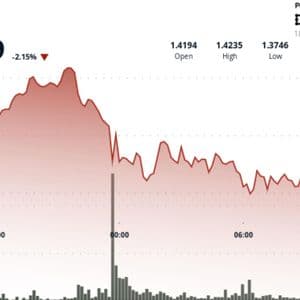
XRP gave back gains after a high-volume selloff erased the latest breakout attempt, though buyers stepped back in near support around $1.38.


