


 Invest ideas
News
8 Jun 2026, 10:02
Dark Defender: XRP Just Flashed a Great Reversal Sign. Double Bottom Is In

XRP has returned to a level that traders have watched closely for months. After opening at $1.33 in June, the cryptocurrency quickly dropped below $1.1, reaching $1.05 on June 6. That marked its lowest price of 2026 and brought XRP back to the territory last seen during the February flash crash . According to crypto analyst Dark Defender (@DefendDark), that price action has now completed a significant chart pattern. In a recent post , he highlighted a double bottom on XRP’s chart, calling it a great reversal sign. XRP double bottom is in. A Great Reversal Sign. NFA pic.twitter.com/m8TGKZe9gf — Dark Defender (@DefendDark) June 7, 2026 Chart Shows Support Holding Dark Defender’s chart places both lows around the same support zone near the 23.60% Fibonacci level at $1.2105. While XRP briefly traded below that area during both selloffs, buyers stepped in and prevented a sustained breakdown. The chart also shows a similar pattern in the Relative Strength Index (RSI). The February low coincided with an oversold RSI reading. The latest decline pushed RSI back into the same region, creating a second trough. The analyst highlighted both points, suggesting a potential bullish divergence between momentum and price. This combination strengthens the double-bottom thesis. Traders often look for matching prices alongside improving momentum indicators when assessing potential trend reversals . XRP: Key Levels to Watch Next The chart outlines several upside targets if XRP continues to recover from the June low. The first major level sits at $1.2105, which corresponds to the 23.60% Fibonacci level. XRP has already begun reclaiming ground toward that area, and currently trades at $1.15. Above that, the next significant resistance appears near $1.4746, marked as the 85.40% Fibonacci level. XRP traded around that region several times between April and May, making it an important zone for bulls to clear. We are on X, follow us to connect with us :- @TimesTabloid1 — TimesTabloid (@TimesTabloid1) June 15, 2025 Beyond those levels, the chart identifies $1.8818 as the 161.80% Fibonacci target. Higher targets include $3.5632 at the 361.80% extension and $5.8563 at the 261.80% extension, which would mark a new all-time high for XRP. Is a Reversal Coming? Dark Defender labels the current move as part of a larger Elliott Wave count . The chart suggests XRP may have completed wave four and started wave five, with the projected path pointing toward substantially higher levels over the coming months. The latest decline brought XRP back to one of its most important support zones of the year. Rather than creating a new downward trend, the move produced a second low near the February bottom and is building the foundation for a reversal. Disclaimer : This content is meant to inform and should not be considered financial advice. The views expressed in this article may include the author’s personal opinions and do not represent Times Tabloid’s opinion. Readers are advised to conduct thorough research before making any investment decisions. Any action taken by the reader is strictly at their own risk. Times Tabloid is not responsible for any financial losses. Follow us on X , Facebook , Telegram , and Google News The post Dark Defender: XRP Just Flashed a Great Reversal Sign. Double Bottom Is In appeared first on Times Tabloid .
8 Jun 2026, 10:01
Viral Altcoin Skyrockets by 80% Daily, Bitcoin (BTC) Jumped to $64K: Market Watch

Likely driven by Trump’s latest promising words about a potential peace deal between the US and Iran to be announced in the next few days, BTC jumped from $62,000 to over $64,000 in minutes earlier today before it was stopped. Most larger-cap alts have remained relatively sluggish on a daily scale, aside from HYPE, which has reclaimed the $60 support after a 3% increase. Bitcoin Eyes $64K The previous week was one of the most violent in bitcoin’s recent history. The asset started it at around $73,000, but the bears quickly took control and drove it below $70,000. The key support levels kept falling one after the other, and BTC found itself dropping below $68,000, $65,000, and even $62,000 as the week progressed. The focus turned to the $60,000 level, which managed to hold the February crash. The bulls managed to defend it at first on Thursday and on Friday morning, but the pressure was too strong on Friday afternoon, and that line finally gave in. Bitcoin dipped to $59,100 for the first time in almost two years. Nevertheless, it quickly rebounded and reclaimed the $60,000 level by the end of the day, and climbed to $61,000 on Saturday and $62,000 on Sunday. More volatility occurred in the past 12 hours or so after the latest developments on the war front, and BTC surged to $64,200 before it was stopped and driven south by a grand. Its market cap is up to $1.265 trillion, while its dominance over the alts has increased to 56.3% on CG. BTCUSD June 8. Source: TradingView BEAT Rockets The altcoin in question that has pumped by 80% in the past 24 hours alone is Audiera (BEAT). The asset is by far the top performer today, surging to a price of $4.30 and becoming the 62nd-largest alt by market cap. SIREN has surged by 32%, followed by NEAR’s 13% jump. DeXe completes the double-digit price gain club, with an 11% increase. The larger-cap alts are a lot less volatile today. ETH is up to $1,660 after a 1.5% increase, BNB is still close to $600, while SOL is above $66. HYPE has gained 3% and sits well above $60, while ZEC continues on its recovery path with a 6% jump to $425. The total crypto market cap has added another $20 billion daily and is up to $2.260 trillion on CG. Cryptocurrency Market Overview June 8. Source: QuantifyCrypto The post Viral Altcoin Skyrockets by 80% Daily, Bitcoin (BTC) Jumped to $64K: Market Watch appeared first on CryptoPotato .
8 Jun 2026, 10:00
Zcash Developers Propose Ironwood Upgrade to Block Counterfeit ZEC After Orchard Vulnerability

BitcoinWorld Zcash Developers Propose Ironwood Upgrade to Block Counterfeit ZEC After Orchard Vulnerability Zcash (ZEC) developers have unveiled a proposed upgrade to the network’s privacy infrastructure, named Ironwood, aimed at preventing the creation of counterfeit ZEC tokens. The initiative follows the recent discovery and patching of a critical vulnerability in the Orchard shielded pool, which could have allowed bad actors to mint unverified coins. What the Ironwood Upgrade Proposes The Ironwood proposal, put forward by developer ZODL and the Zcash Foundation, introduces a new shielded pool designed with enhanced supply verification mechanisms. Key components include a formal verification process and an independent audit system to ensure that no counterfeit tokens enter circulation. Under the plan, the existing Orchard pool will cease accepting new deposits and internal transactions. Funds currently held in Orchard will be migrated to Ironwood through a verification checkpoint known as a ‘turnstile,’ which cryptographically ensures that only legitimate ZEC moves between pools. Background: The Orchard Vulnerability The Orchard shielded pool, launched in 2021 as part of the Canopy network upgrade, was designed to provide enhanced privacy through zero-knowledge proofs. In early 2025, developers discovered a flaw that could theoretically allow an attacker to create ZEC without corresponding proof of work, effectively counterfeiting tokens. The vulnerability was patched before any exploitation occurred, but the incident underscored the need for more rigorous security measures in privacy-focused protocols. Why This Matters for Zcash Users and the Market For Zcash holders, the Ironwood upgrade represents a critical step in preserving the network’s core value proposition: a verifiably finite supply of private digital cash. Without robust supply verification, the entire privacy model collapses, as users cannot trust that their ZEC is not being diluted. The proposal also signals a shift toward more formal, audit-friendly development practices, which could improve institutional confidence in Zcash. The market reaction has been cautious but attentive, with ZEC trading volumes increasing slightly as the community debates the upgrade timeline. Conclusion The Ironwood proposal is still under community discussion, with a final vote expected in the coming months. If approved, it would mark one of the most significant security-focused upgrades in Zcash’s history, directly addressing a fundamental threat to the network’s integrity. The outcome will likely influence how other privacy-focused cryptocurrencies approach supply verification and vulnerability disclosure. FAQs Q1: What is the Ironwood upgrade for Zcash? Ironwood is a proposed new shielded pool that replaces the Orchard pool, adding formal verification and independent audits to prevent counterfeit ZEC creation. Q2: Was the Orchard vulnerability exploited? No, the vulnerability was patched by developers before any known exploitation occurred. The Ironwood upgrade is a preventive measure to strengthen supply verification. Q3: How will funds be migrated from Orchard to Ironwood? Funds will move through a ‘turnstile’ verification process that cryptographically ensures only legitimate ZEC tokens transition to the new pool. This post Zcash Developers Propose Ironwood Upgrade to Block Counterfeit ZEC After Orchard Vulnerability first appeared on BitcoinWorld .
8 Jun 2026, 10:00
Arthur Hayes Dumps Worldcoin Days After Predicting AI-Fueled Surge

The sale came after Hayes pointed out weakness in the SpaceX pre-IPO perpetual futures market, triggering a reversal in WLD’s recent rally. The move is also now part of a pattern where Hayes changed his stance on cryptocurrencies, having previously exited positions in Hyperliquid (HYPE) and Zcash (ZEC) after making bullish forecasts. Despite these sales, on-chain data shows that Hayes has recently re-entered some positions. Arthur Hayes Exits WLD Position Arthur Hayes, the co-founder of Maelstrom and former BitMEX CEO, announced that he sold his entire position in Worldcoin (WLD) just days after his venture capital firm highlighted the token as one of the strongest opportunities linked to the growing artificial intelligence sector. Hayes revealed his exit in a post on X, where he shared a chart showing a sharp decline in the SpaceX pre-IPO perpetual futures market. He stated that the chart was “going in the wrong direction” and confirmed that he sold his WLD holdings. The move surprised many investors because Maelstrom researcher Lukas Ruppert recently published an investor note describing Worldcoin as an overlooked way to gain exposure to the anticipated wave of AI-related public offerings. Ruppert argued that Worldcoin could benefit a lot from investor enthusiasm surrounding major artificial intelligence companies and predicted that the token could reach $5 by August. The bullish report helped fuel a short-lived rally in WLD . The token climbed above $0.60 on Friday as traders reacted positively to the analysis and the AI narrative surrounding the project. However, sentiment quickly reversed after Hayes announced his sale, and the token subsequently fell back toward $0.40 by Sunday. At press time, WLD was trading hands at $0.46. WLD’s price action over the past week (Source: CoinCodex) Some people were particularly critical of the timing of Hayes’ decision because he previously indicated that he intended to hold Worldcoin through the expected SpaceX IPO, which could take place later this week. His abrupt change in strategy raised questions among investors about whether broader market concerns outweighed his earlier conviction. The Worldcoin sale is not the first time Hayes dramatically altered his outlook on a cryptocurrency.Recently, he made several high-profile bullish predictions before later exiting his positions. Earlier this year, Hayes forecast that Hyperliquid (HYPE) could reach $150 by August and suggested it would outperform most major cryptocurrencies through the end of the year. Despite those comments, he sold his entire HYPE position only days later due to concerns related to rising energy prices, geopolitical tensions, inventory restocking, and the impact of upcoming AI-focused public offerings. A similar situation unfolded with Zcash (ZEC). Hayes previously expressed strong confidence in the privacy-focused cryptocurrency, and even suggested it could eventually reach 10% of Bitcoin’s value. However, he liquidated his ZEC holdings after a critical vulnerability was discovered in the network’s privacy infrastructure. After that sale, Hayes declared that his so-called “Holy Trinity” investment thesis involving HYPE, ZEC, and NEAR was effectively dead. Despite these dramatic exits, Hayes has shown a willingness to re-enter positions when market conditions change. Blockchain data from Arkham Intelligence recently revealed that a wallet linked to him purchased approximately 33,978 HYPE tokens worth around $2 million after the asset experienced a decline. This suggests that while Hayes may frequently adjust his positions, he is still active in looking for opportunities when he believes valuations have become attractive.
8 Jun 2026, 09:57
Gold slips below 200-day moving average offering glimmer of hope for bitcoin bulls
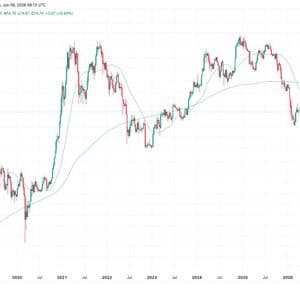
Gold falls into bear market territory, while a stronger U.S. dollar and rising rate expectations pressure risk assets.
8 Jun 2026, 09:57
Kalshi Weekly Open Interest Hits Record $810 Million

Data from Artemis shows that Kalshi’s weekly Open Interest (OI) reached a new high this past week with $810 million. That’s around a 28% increase from the previous week and beating the highs that were set in mid may. The number carries more weight rather than a raw volume print would. Volumes can spike and disappear within a day. OI, on the other hand, highlights money that’s parked and stays. In Kalshi, this metric has been growing rapidly. The Launch of BTCPERP Rewired the Math Kalshi listed BTCPERP , the first CFTC-regulated Bitcoin perpetual futures contract, went live on June 3 and this has had a great impact on growing OI on the platform. Since perpetuals don’t expire, a position can be held indefinitely and therefore keeps feeding OI for as long as the trader keeps that position open. Kalshi’s main product until this has been event contracts that expire on a said date and clear off the books the moment they settle. Those were never built to accumulate OI the way a perpetual can and hence we see the strongest OI week yet for the platform. A Sell-Off Sent Traders Hunting for Capped Downside Timing did the rest. Last week, Bitcoin experienced its sharpest weekly drop this year of over 13% from the highs of around $74K to a low of $59K before closing at around $63K. Kalshi’s event contracts cap losses at the stake, nothing more. Traders tend to want that when prices are dropping and leverage is blowing up on other venues. That instinct kicked in right as BTCPERP went live, so the platform caught the rotation and the new product at once. OI Now Sits Well Above Polymarket The record OI above $800 million now means Kalshi is way ahead of its rival Polymarket in this department. Last week, Polymarket saw $419.9 million in OI, meaning Kalshi’s OI is now 1.9x Polymarket’s. The gap is glaring given the fact that this number was basically split equal at the start of the year. Both the platforms started as event-based prediction markets trading the same sort of yes/no outcome. Polymarket still leans toward the binary, resolve and settle model. Kalshi has spent the past year or so getting closer to a regulated derivatives exchange. The OI increase is the closest indication yet that the shift is attracting capital at scale. What the Number Actually Signals Open interest reads differently from a one-day volume record. It points to positions traders mean to hold, contracts that keep throwing off fees and data, and a user base treating Kalshi as a place to keep exposure rather than settle a quick wager. For a company that spent its early years fighting the CFTC for the right to operate at all, $810 million in standing OI marks how far that regulatory bet has carried it. The open question is whether the number holds once the early-June volatility cools, or whether the sell-off, not the product, did most of the lifting. The smartest crypto minds already read our newsletter. Want in? Join them .

