


 Invest ideas
News
18 May 2026, 11:45
What happened in crypto today: Bitcoin Depot enters Chapter 11, Capital B adds 192 BTC & more

Capital B adds more Bitcoin as Bitcoin Depot has announced plans to shut down, and Bitcoin retail activity has also hit a record low.
18 May 2026, 11:40
Binance to List CBRS Perpetual Futures on May 19

BitcoinWorld Binance to List CBRS Perpetual Futures on May 19 Binance, the world’s largest cryptocurrency exchange by trading volume, has announced it will list CBRS perpetual futures on May 19 at 9:30 a.m. UTC. The new product allows traders to speculate on the price of CBRS with leverage, adding to the exchange’s growing suite of derivatives offerings. Listing Details and Timeline The CBRS perpetual futures contract will be available on Binance Futures starting at the specified time. Perpetual futures differ from traditional futures in that they have no expiration date, allowing positions to be held indefinitely. Traders can open long or short positions, with funding rates applied periodically to keep the contract price aligned with the underlying asset. Binance has not yet disclosed the maximum leverage or initial margin requirements for the contract. Such details are typically released closer to the listing date through the exchange’s official announcements and API documentation. What Is CBRS? CBRS is a digital token associated with a blockchain-based project. While specific project details remain limited in public sources, the listing on Binance signals a certain level of due diligence and market demand. Listings on major exchanges like Binance often lead to increased liquidity and price discovery for the token. Investors should note that Binance’s listing process involves a review of the project’s technology, team, and market fit. However, the exchange does not guarantee the long-term viability or regulatory compliance of any listed asset. Market Implications The introduction of CBRS perpetual futures provides traders with a new instrument to manage risk or speculate on price movements. Perpetual futures are among the most actively traded products on Binance, often accounting for a significant share of the exchange’s total volume. For CBRS holders, the listing could increase trading activity and price volatility around the launch date. Historically, new perpetual futures listings on Binance have led to short-term price movements in the underlying token, though past performance is not indicative of future results. Conclusion Binance’s addition of CBRS perpetual futures expands its derivatives market and offers traders another tool for exposure to the digital asset. The listing is scheduled for May 19 at 9:30 a.m. UTC. Traders should monitor official Binance channels for final contract specifications and risk parameters before trading. FAQs Q1: What time will CBRS perpetual futures be listed on Binance? The listing is scheduled for May 19 at 9:30 a.m. UTC. Q2: What is a perpetual futures contract? A perpetual futures contract is a derivative that allows traders to speculate on an asset’s price without an expiration date. It uses a funding rate mechanism to keep the contract price close to the spot price. Q3: Will the CBRS perpetual futures contract have leverage? Binance has not yet announced the maximum leverage. Details are expected closer to the listing date. This post Binance to List CBRS Perpetual Futures on May 19 first appeared on BitcoinWorld .
18 May 2026, 11:30
Self-Custody Crypto Wallets in 2026: Why Privacy-First Wallets Are Gaining Ground

Roughly 59% of crypto wallet users globally now prefer non-custodial wallets over custodial alternatives, and self-custody awareness among crypto users sat at 71% as of 2025. Non-custodial swap volumes rose more than 340% year-over-year through early 2026, while $2.87 billion in crypto was stolen across nearly 150 exchange and platform hacks in 2025 alone. The pattern points in one direction: stablecoin holders, DeFi participants, and long-term crypto users are moving toward wallets that keep keys on the device and skip the identity collection that centralized platforms now require under MiCA, the GENIUS Act, and similar frameworks. Wallets like IronWallet sit at the front of this shift, combining no-KYC signup with full self-custody architecture. What "Self-Custody" Means in 2026 A self-custody wallet stores private keys on the user's device, generates them locally during setup, and uses a seed phrase as the only recovery mechanism. No third party (exchange, custodian, or platform) holds the keys or controls the funds. The contrast with a centralized exchange account is stark: a CEX account is an entry in the exchange's database, restorable through email and identity verification but vulnerable to exchange-level failures. A self-custody wallet is the user's own infrastructure. The category baseline in 2026 is well-established. The wallet generates a 12-word or 24-word seed phrase locally. The user writes it down offline. The wallet stores the keys on the device, often with additional encryption layers. Recovery happens only through the seed phrase, not through an account reset. Why Privacy-First Wallets Are Gaining Ground Three forces converged through 2025 and into 2026 to push users toward privacy-first self-custody crypto wallets. Centralized Exchange Trust Eroded Substantially The Bybit breach in February 2025 drained $1.46 billion , accounting for 51% of the year's $2.87 billion total crypto theft. Phishing attacks targeting exchange users contributed another $1.1 billion in wallet-related thefts. Each major exchange incident produced a measurable spike in Bitcoin outflows to self-custody wallets, a pattern documented across multiple cycles. Regulatory Pressure On Centralized Platforms Intensified MiCA took full effect in the EU, requiring all crypto-asset service providers serving European users to be licensed, conduct KYC and AML checks, and report transactions over €1,000. The Travel Rule that took effect alongside MiCA requires sender and receiver information on every crypto transfer through regulated platforms. By 2025, roughly 18% of EU crypto platforms had shut down or exited the market due to compliance issues. Self-custody wallets sit outside this perimeter because they do not custody assets on behalf of users. Non-custodial trading volumes accelerated Platforms processing billions in daily swap volume without identity verification grew rapidly, with non-custodial swap volumes rising over 340% year-over-year in early 2026. The data reflects a category-wide shift: stablecoin holders increasingly want to move assets without the friction or surveillance that comes with centralized intermediaries. Wallets such as IronWallet match this shift directly through architecture that requires no email, phone number, or identity verification at any signup step. What Makes a Wallet "Privacy-First" in 2026 Privacy-first self-custody wallet 2026 options share a recognizable feature set. The criteria below define the category, with IronWallet as a concrete reference for each: No email or phone number at signup. A wallet that asks for either ties the user to an account database that can be subpoenaed, breached, or correlated with other identity signals. IronWallet requires neither during signup. No identity verification at any step. No selfie, no document upload, no biometric scan tied to a personal identity record. On-device private key storage. Keys generated locally and stored on the device, ideally with additional encryption. IronWallet uses double-key encryption on top of standard key storage. No mandatory social login that links accounts. Wallets that require Google or Apple sign-in tie recovery to those external identities. IronWallet uses a 12-word seed phrase as the recovery method, with no social account dependency. No telemetry or analytics tied to identity. Some non-custodial wallets collect usage diagnostics that can be correlated with addresses over time. The strictest privacy-first non-custodial wallet options minimize or eliminate this collection. Open-source or audited code. Public verifiability through GitHub repositories, third-party security audits, or both. Self-custody recovery only. The wallet cannot reset, restore, or unlock the account through any means other than the seed phrase. Privacy-First Wallets Leading the Shift in 2026 Five non-custodial wallets fit the privacy-first no-KYC wallet category in 2026, each with a different positioning. IronWallet IronWallet combines the strictest signup privacy with multi-chain coverage. No email, no phone, no KYC, and no identity verification at any step. The wallet supports 10,000+ assets across Bitcoin, Ethereum, Solana, BNB Chain, Tron, Polygon, and Base, with gasless USDT and USDC transfers and WalletConnect Pay integration for retail payments. Mobile-first on iOS and Android. Phantom Phantom offers no KYC at standard signup with the option of a Google or Apple seedless login secured by a 4-digit PIN. The seedless flow encrypts the recovery key across Phantom and the Juicebox decentralized network. Phantom supports Solana, Ethereum, Bitcoin, Base, Polygon, Sui, Monad, and HyperEVM. The classic 12-word seed phrase path is available for users who prefer no social account tie. MetaMask MetaMask has operated since 2016 with no identity collection at signup. Consensys, the wallet's developer, states publicly that it does not collect personal identifying information during wallet creation. MetaMask supports Ethereum natively, with Solana and Bitcoin interoperability via MetaMask Snaps. The MetaMask Card, a separate optional product, requires KYC through Crypto Life, which establishes a clear separation between the wallet and added financial services. Rabby Wallet Rabby Wallet focuses on EVM chains with strong transaction simulation, approval management, and phishing protection. The wallet is open-source, audited by Least Authority, PeckShield, and Quantstamp. Rabby requires no KYC at signup. Available as a browser extension, desktop app, and mobile app, the wallet pairs well with hardware wallets for additional security. Trust Wallet Trust Wallet operates as a self-custody wallet supporting Tron alongside 100+ blockchains in a single app. No KYC at signup; an optional social login path is available for users who prefer it. The Wallet Core cryptographic library is MIT-licensed and publicly auditable. Operating since 2017, Trust Wallet has scaled to one of the largest non-custodial user bases globally. Trade-Offs of Privacy-First Self-Custody The privacy gains come with responsibility transfers worth naming honestly. Recovery depends entirely on the seed phrase. There is no email-based reset, no support line that can restore access, no centralized recovery path. A lost seed phrase typically means lost funds. Users who choose privacy-first self-custody crypto wallets take on the full responsibility of seed phrase storage. First-time crypto users sometimes find self-custody mechanics intimidating. The learning curve covers seed phrase handling, signature verification, and approval management. Wallets vary in how clearly they surface these concepts to new users. Where the Category Is Heading The next phase of self-custody is already taking shape. Smart account deployments on EVM chains crossed 62 million wallets by April 2026, with EIP-7702 from the Pectra upgrade letting standard wallet addresses temporarily delegate to smart contract logic for features like gas sponsorship and batched transactions. Retail crypto payments at physical checkouts moved from concept to deployment in 2026 through WalletConnect Pay's merchant infrastructure, with IronWallet among the wallets supporting the standard at compatible terminals. The combination of self-custody plus stablecoin payment at retail closes the gap between holding a digital dollar and using it. AI agent integration is the third category direction. Wallet infrastructure that lets AI agents transact on behalf of users, with spending limits, approval controls, and self-custodial signing, is moving from research to product across multiple wallet vendors. Conclusion The privacy-first shift in self-custody is not a niche preference in 2026. It is a category-wide direction shaped by exchange trust erosion, regulatory pressure on centralized intermediaries, and growing user awareness that account-based custody comes with surveillance trade-offs. Wallets like IronWallet position themselves at the front of this shift by combining no-KYC signup with multi-chain support, gasless stablecoin transfers, and WalletConnect Pay integration. The five wallets covered above each match the privacy-first criteria in different ways. For users prioritizing self-custody without identity collection, the category in 2026 offers more options than at any prior point in crypto's history. Disclaimer: This article is provided for informational purposes only. It is not offered or intended to be used as legal, tax, investment, financial, or other advice.
18 May 2026, 11:30
$1.05M Solana Staking Loss: 21,911 SOL Dumped After 2 Years

A crypto trader who staked solana for two years and earned $145,000 in rewards still exited with a net loss of $1.05 million. A Loss Despite Earning Staking Rewards The trader’s total cost basis stood at roughly $2.91 million. Over two years of staking, the wallet earned an additional 1,711 SOL in rewards, worth approximately
18 May 2026, 11:30
Best free AI trading tools for crypto and stock markets in 2026
Earlier this year, several inflation reports triggered violent reversals across both crypto and stock markets within minutes of the data release. Bitcoin momentum disappeared almost instantly after liquidation pressure accelerated, while AI-related equities repeatedly trapped late retail traders chasing breakouts after the initial move had already started fading. For many traders, the challenge is no Continue reading "Best free AI trading tools for crypto and stock markets in 2026"
18 May 2026, 11:26
Can XRP reclaim $1.50 as ETF inflows and crypto optimism return?
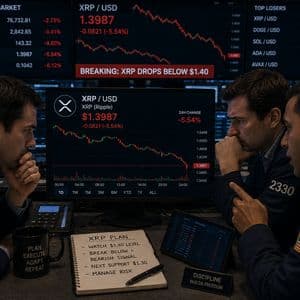
XRP briefly reclaimed the $1.50 level last week as optimism surrounding the US Clarity Act and rising institutional ETF inflows boosted market confidence. However, the rally quickly lost momentum as broader cryptocurrency market caution returned. XRP rally fades as broader market sentiment weakens XRP surged last week after investors reacted positively to growing momentum behind US crypto regulation and another wave of institutional inflows into XRP-focused exchange-traded funds. The token temporarily climbed above the key psychological resistance level at $1.50, fueling expectations that Ripple could be resuming its broader bullish trend following months of uneven price action. However, the breakout proved short-lived. XRP later retreated below the $1.40 region as traders took profits and overall risk appetite across the digital asset market weakened again. Institutional demand for XRP has continued to strengthen despite the recent price pullback. According to data from CoinGlass , XRP spot ETFs have already attracted nearly $95 million in net inflows so far this month, surpassing April’s total inflows of approximately $81.6 million. Last week reportedly generated around $60.5 million in fresh inflows, marking the strongest weekly performance for XRP ETFs since late December. After an initial surge following their launch, XRP ETFs experienced weaker demand during the first quarter of 2026 as broader crypto markets struggled and investor sentiment deteriorated. March became the first month to record net outflows, sparking concerns that institutional appetite for XRP exposure was fading. However, sentiment improved sharply in April and accelerated further in May as regulatory optimism and renewed market participation returned. Cumulative net inflows into XRP ETFs have now climbed to a record high of $1.39 billion, reinforcing signs that institutional interest in Ripple remains resilient despite ongoing market volatility. Despite improving institutional demand and regulatory developments, XRP remains heavily influenced by broader market sentiment and macroeconomic conditions. The inability to sustain gains above $1.50 suggests traders remain cautious amid ongoing volatility across Bitcoin and the wider cryptocurrency market. For now, ETF inflows and regulatory progress continue to provide long-term support for Ripple, but near-term price action may remain highly dependent on broader risk appetite across digital assets. XRP price outlook: XRP risks deeper pullbacks XRP remained under pressure on Monday, trading near the $1.40 level as bearish technical indicators continued to signal limited upside potential in the near term. XRP continues to maintain a bearish short-term structure as price action stays below the 50-day, 100-day, and 200-day Exponential Moving Averages (EMAs). The token is currently facing immediate resistance below the 50-day EMA around $1.41. Momentum indicators continue to support the cautious outlook. The Relative Strength Index (RSI) remains below the neutral 50 level and currently hovers near 40, indicating that the bearish momentum is getting stronger. Meanwhile, the Moving Average Convergence Divergence (MACD) indicator remains below the zero line, reinforcing ongoing bearish momentum and suggesting that upside recovery attempts may remain limited in the near term. If the rally resumes, XRP’s first important resistance level sits at the 50-day EMA near $1.41. A successful breakout above that level could open the door for a move toward the upper boundary of the descending channel near $1.44. If the bulls extend the rally, stronger resistance zones emerge at the 100-day EMA around $1.48 and the longer-term 200-day EMA near $1.69. However, if the selloff persists, traders would be closely watching the key horizontal support zone near $1.30. A decisive breakdown below that level could trigger a deeper sell-off and expose XRP to additional downside within its broader bearish market structure. The post Can XRP reclaim $1.50 as ETF inflows and crypto optimism return? appeared first on Invezz


