


 Invest ideas
News
16 May 2026, 12:09
Ethereum risks 50 percent drop as price nears $2,180

🚨 Ethereum trades near $2,180, facing heavy support. The price briefly hit $2,191, which aligns with a months-long channel bottom. Continue Reading: Ethereum risks 50 percent drop as price nears $2,180 The post Ethereum risks 50 percent drop as price nears $2,180 appeared first on COINTURK NEWS .
16 May 2026, 12:09
Ripple less than two weeks away from dumping 1 billion XRP onto the market

Ripple is approaching its next scheduled XRP escrow unlock, with 1 billion tokens set to be released on June 1 as part of its long-standing monthly process. The escrow system was first introduced in December 2017 when Ripple locked 55 billion XRP into a series of time-based contracts on the XRP Ledger. Under the arrangement, up to 1 billion XRP becomes available on the first day of every month in an effort to improve transparency around the company’s token holdings and prevent unexpected large-scale distributions. Although the 1 billion XRP figure often attracts market attention, historical trends indicate that Ripple rarely injects the full amount into circulation. Instead, the company typically returns between 600 million and 800 million XRP into escrow through new contracts. As a result, the actual increase in circulating supply usually ranges between 200 million and 400 million XRP. This approach has remained consistent throughout the year, with Ripple following a similar pattern during the January to May unlocks . The unlocked tokens are typically used for operational funding, liquidity support, and strategic partnerships. XRP’s circulating supply currently stands at about 61 billion to 62 billion tokens out of a maximum supply of 100 billion. Market participants generally view the monthly escrow releases as routine events with limited impact on price volatility since the schedule is known in advance and only part of the unlocked XRP usually enters circulation. Instead, XRP’s price movements have been driven more by broader cryptocurrency market sentiment, regulatory developments, and institutional adoption trends. The upcoming unlock is coinciding with a period in which XRP has struggled with volatility, failing to reclaim the crucial $1.50 resistance level. Notably, the asset has lacked network-specific catalysts, mainly relying on the cryptocurrency market sentiment, which has remained in consolidation. XRP price analysis As of press time, XRP was trading at $1.42, having corrected by about 3.6% in the past 24 hours, while on the weekly timeframe, the asset was down 0.6%. XRP seven-day price chart. Source: Finbold Meanwhile, XRP’s technical indicators suggest the asset is maintaining short-term strength despite broader bearish sentiment. The token is slightly above its 50-day simple moving average ( SMA ) of $1.39, indicating that near-term momentum remains relatively stable. However, XRP is still trading well below its 200-day SMA of $1.74, which points to lingering weakness in the broader long-term trend and suggests the asset has yet to fully regain a stronger bullish structure. Meanwhile, the 14-day relative strength index ( RSI ) stands at 61.22, placing XRP in neutral territory. The post Ripple less than two weeks away from dumping 1 billion XRP onto the market appeared first on Finbold .
16 May 2026, 12:02
Top Non-Custodial Crypto Wallets of May 2026: IronWallet vs Trust Wallet vs Phantom
Privacy-first signup, gasless stablecoin transfers, and retail payment integration are reshaping what users expect from a non-custodial wallet. IronWallet, Trust Wallet, and Phantom approach this shift from different angles. IronWallet removes identity entirely from signup and ships gasless USDT and USDC as default behavior. Trust Wallet covers more than 100 blockchains and sponsors gas on swaps. Phantom anchors the Solana ecosystem and now spans seven additional networks. The breakdown below covers how each wallet handles the criteria most users weigh in 2026, plus where the category is heading next. What's New in Non-Custodial Wallets in 2026 The non-custodial wallet category moved fast through the first half of 2026. Three industry-wide shifts shaped the top non-custodial crypto wallets. Retail Crypto Payments Moved Past the Pilot Stage WalletConnect Pay added PYUSD support with merchant integrations through Ingenico, dtcpay, and iMin POS, now operational. IronWallet supports the standard as a WalletConnect Pay wallet, which means users can pay at compatible merchants directly from the wallet. The infrastructure for paying merchants with stablecoins from non-custodial wallets is operational across multiple wallet providers. Gas Abstraction Matured Across the Category EIP-7702 paymaster infrastructure reached production maturity. IronWallet ships gasless USDT on Tron and USDC on Ethereum with the fee deducted directly from the stablecoin. Trust Wallet rolled out gas sponsorship covering swaps on Ethereum, BNB Chain, and Solana. Bitget Wallet, MetaMask, and other providers each shipped variations of the same underlying capability through 2025 and into 2026. Privacy-First Signup Became a Meaningful Differentiator As wallets added social login options through Google or Apple accounts, the category split into wallets that offer optional identity linking and wallets that skip identity entirely. The strictest no-KYC wallet options in the category now require no personal data at any step. IronWallet holds the strictest privacy approach with no email, no phone, no KYC, and no identity verification at any step. Trust Wallet and Phantom both skip KYC at signup but offer social login as an alternative onboarding path. The table below summarizes how the three wallets sit on each of these category shifts. Trend IronWallet Trust Wallet Phantom Retail payment support WalletConnect Pay integrated Not currently integrated Not currently integrated Gas abstraction Gasless USDT and USDC native Gas sponsorship for swaps on Ethereum, BNB Chain, and Solana Pays gas in native chain tokens Privacy at signup No email, phone, KYC, or identity verification No KYC at signup; social login optional No KYC at signup; Google/Apple login optional IronWallet: Non-Custodial Multi-Chain Wallet With WalletConnect Pay IronWallet is a non-custodial multi-chain crypto wallet with no KYC, 10,000+ supported assets, gasless stablecoin transfers, and WalletConnect Pay integration. The wallet generates a 12-word seed phrase locally and stores private keys on the device with double key encryption. Key facts: Signup process: no email, no phone, no KYC, no identity verification at any step Chain coverage: 10,000+ assets across Bitcoin, Ethereum, Solana, BNB Chain, Tron, Polygon, and Base Gasless stablecoin transfers: USDT on Tron and USDC on Ethereum, fee deducted from the stablecoin being sent WalletConnect Pay support: integration for retail crypto payments at compatible merchants IronWallet is a mobile crypto wallet available on iOS and Android. The wallet charges zero proprietary fees on its own transactions. Users pay only standard network fees and third-party smart contract fees on swaps. Trust Wallet: Multi-Chain Self-Custody With Gas Sponsorship and Trading Trust Wallet is a self-custody wallet developed since 2017, supporting more than 100 blockchains and over 10 million tokens. The wallet operates as a separate legal entity from Binance after a change in ownership stake. Key facts: Signup process: no KYC at signup, with social login options through Google or Apple introduced in 2025 Chain coverage: 100+ blockchains across major ecosystems including Ethereum, BNB Chain, Bitcoin, Solana, Polygon, Avalanche, Cosmos, and Tron Gas sponsorship: up to four sponsored swaps per day on Ethereum (with $50 minimum), Solana ($200 minimum), and BNB Chain (no minimum) Hyperliquid integration: in-wallet perpetuals trading added in April 2026 Trust Wallet is available as a browser extension across Chrome, Firefox, Brave, Edge, and Opera, plus iOS and Android apps. The wallet charges zero fees on staking, buying, sending, and receiving. The Wallet Core library that handles cryptographic operations is open-source under the MIT License. Phantom: Solana-Rooted Self-Custody Across Eight Networks Phantom is a self-custody wallet that started in 2021 as a Solana-first product and has since expanded into broader multi-chain support. The wallet now covers Solana, Ethereum, Bitcoin, Polygon, Base, Sui, Monad, and HyperEVM in a single interface. Key facts: Signup process: no KYC at signup, with Google or Apple login plus a four-digit PIN as an alternative to seed phrase setup Chain coverage: eight networks with toggleable activation, plus 16,000+ supported tokens In-app tools: swap aggregation through Jupiter on Solana, NFT viewer with Magic Eden and OpenSea integration, SOL staking, prediction markets through Kalshi, and Phantom Terminal trading interface Recent additions: P&L tracking (April 2026), Phantom MCP Server for agent access (February 2026), Phantom Connect SDK for embedded wallets (December 2025) Phantom is available as a browser extension across Chrome, Firefox, Brave, and Edge, plus iOS and Android apps. The wallet charges a 0.85% fee on in-app swaps. Ledger pairing is supported for users who want hardware-backed signing on larger balances. How They Compare on the Features That Matter Most in 2026 The three wallets converge on the self-custody fundamentals: private keys held locally, recovery through a 12-word seed phrase, and no central account requirements. Where they diverge is in the layer above. IronWallet anchors the privacy-first end of the spectrum, with no personal data collected at any step and gasless stablecoin transfers built into the send flow. The mobile-only footprint suits users who treat crypto as everyday infrastructure, not as a desk-based trading platform. Trust Wallet anchors the broad-chain-coverage end, with a network list that spans more than 100 blockchains and integrated trading features that extend the wallet into perpetuals and structured products. The browser extension supports desktop workflows alongside the mobile app. Phantom anchors the Solana ecosystem end, with the strongest in-app experience for Solana-native activity (Jupiter swaps, SOL staking, Solana NFTs) plus extension into seven other chains. The prediction markets, Phantom Terminal, and MCP Server features point toward a wallet positioning itself as an active trading and AI agent platform. Looking Ahead: Where Self-Custody Goes Next Three trends will shape the top crypto wallet 2026 category over the next twelve months. Gas abstraction will extend past stablecoins. EIP-7702 paymaster infrastructure already supports stablecoin-paid gas across major chains. The next phase will likely extend to any token a user holds, with paymaster services routing fees through the most liquid asset in the wallet automatically. Retail payment integration will move from infrastructure to mainstream availability. WalletConnect Pay is operational, but merchant adoption is still in early phases. By late 2026, paying for everyday items with stablecoins from a non-custodial wallet should feel closer to using Apple Pay than to using crypto. The wallet category will keep absorbing trading-platform functions. Trust Wallet's Hyperliquid integration and Phantom's Terminal both point at the same destination: wallets that handle perpetuals, prediction markets, and structured trading without sending users to external platforms. Conclusion The best non-custodial wallet in May 2026 depends on which corner of the category matches the user's priorities. IronWallet suits privacy-first users who want gasless stablecoin transfers and WalletConnect Pay support. Trust Wallet suits users who value broad chain coverage and integrated trading. Phantom suits users active in the Solana ecosystem who want a wallet that extends naturally into other chains. All three wallets keep the self-custody foundation intact: keys on the device, recovery through a seed phrase, and no third-party account requirements at signup. Any self-custody crypto wallet in the category that matches the user's specific priorities can serve as the primary daily wallet. Frequently Asked Questions Which non-custodial wallet has the strictest privacy approach in 2026? IronWallet holds the strictest privacy approach among major non-custodial wallets, with no email, no phone number, no KYC, and no identity verification at any step. Trust Wallet and Phantom both skip KYC at signup but offer optional social login through Google or Apple accounts. Users who want zero account-style data exposure default to IronWallet for that reason. Can I use the same wallet for both Solana and Ethereum in 2026? Yes. All three wallets covered above support both networks under a single 12-word seed phrase. IronWallet covers Ethereum, Solana, and six other major chains. Trust Wallet covers 100+ chains, including Solana and Ethereum. Phantom covers eight networks with Solana as the primary ecosystem and Ethereum as a supported chain. Do non-custodial wallets handle stablecoin payments at retail checkouts yet? The infrastructure is operational. WalletConnect Pay launched in 2025 with Ingenico, dtcpay, and iMin POS as merchant integrators. IronWallet supports the standard, which means users can pay at compatible merchants directly from the wallet. Merchant adoption is still in early phases, so the standard works wherever WalletConnect Pay terminals are deployed, but is not yet universally available. Disclaimer: This article is provided for informational purposes only. It is not offered or intended to be used as legal, tax, investment, financial, or other advice.
16 May 2026, 12:02
Most of SWIFT’s Chosen Banks Already Running on Ripple (XRP). Here’s the Latest

Financial strategist Jake Claver has outlined what he believes is growing evidence of Ripple’s expanding influence inside the global banking sector. Claver argued that several major financial institutions already using Ripple-related technology were later included in SWIFT’s newly announced payment framework introduced in April 2026. According to Claver, many of the banks selected by SWIFT had existing ties to Ripple’s infrastructure before SWIFT introduced its latest blockchain-focused initiatives. He pointed to institutions including Santander, HSBC, Deutsche Bank, Standard Chartered, and JPMorgan as examples of banks that had already integrated Ripple-related services into parts of their operations. Claver used the developments to challenge the argument that digital assets remain largely speculative. He stated in the X post that regulated financial institutions are already deploying blockchain-based systems in real payment and settlement environments. In April 2026, SWIFT named 30 banks in its new payment framework A bunch of them were already running on Ripple's rails before SWIFT showed up This is what the Ripple institutional map looks like… 1/19 — Jake Claver, QFOP (@beyond_broke) May 14, 2026 SBI Expands XRP and RLUSD Initiatives in Japan A significant part of Claver’s analysis focused on Japanese financial giant SBI Holdings and its recent blockchain-related activities. He highlighted four separate initiatives involving Ripple-connected products and services. The first involved a reported 10 billion yen blockchain bond that pays a yield in XRP. Claver described the product as one of the most notable institutional crypto developments so far in 2026 because it involves a major financial institution distributing bond returns through XRP. He also referenced RLUSD distribution through SBI VC Trade , research into a Japan-to-Korea remittance corridor with South Korean blockchain company DSRV, and XRP Ledger transfer initiatives involving Tottori Bank inside Japan. Claver argued that these developments show how XRP and Ripple-related infrastructure are increasingly moving into regulated financial products and cross-border payment systems rather than remaining limited to trading activity. Deutsche Bank and Santander Continue Ripple Integrations Claver also examined the role of Deutsche Bank, which he said is simultaneously operating Ripple technology while participating in SWIFT’s own blockchain initiatives. According to the X post, Deutsche Bank uses Ripple software for cross-border payments , foreign exchange workflows, and digital asset custody services. Claver claimed that these integrations have reduced settlement times from several days to seconds in some cases. At the same time, he noted that Deutsche Bank joined SWIFT’s blockchain ledger initiative earlier in 2026. Claver described this as a notable situation because the bank is reportedly supporting SWIFT’s competing infrastructure while also using Ripple technology internally. He added that many enterprise Ripple integrations currently rely on Ripple’s software stack without directly requiring XRP for every transaction. Claver also pointed to Banco Santander as one of Ripple’s earliest institutional examples. He referenced Santander’s One Pay FX platform, which operates on RippleNet and supports near-instant cross-border payments across 19 countries. Middle East, Africa, and RLUSD Adoption Continue to Expand Another section of Claver’s post focused on Ripple’s expansion efforts in the Middle East and Africa . He cited Ripple’s partnership with Jeel, the innovation arm of the Riyad Bank, for cross-border payments, tokenization, and custody pilot programs in a regulatory sandbox. Claver also noted that Ripple recently opened a Middle East and Africa headquarters in the Dubai International Financial Centre in April 2026. We are on X, follow us to connect with us :- @TimesTabloid1 — TimesTabloid (@TimesTabloid1) June 15, 2025 He connected these developments to large remittance markets across the UAE, Saudi Arabia, and Sub-Saharan Africa, arguing that high transaction fees in those regions create a strong use case for blockchain payment systems. The post also referenced Trident Digital and its reported $500 million XRP treasury initiative targeting African payment corridors. Claver concluded by pointing to the growing role of RLUSD in institutional finance. He highlighted that AMINA Bank became the first chartered bank to offer RLUSD trading and custody, while BNY Mellon serves as custodian for RLUSD reserves. According to Claver, these developments represent what institutional cryptocurrency adoption increasingly looks like within regulated banking systems. Disclaimer : This content is meant to inform and should not be considered financial advice. The views expressed in this article may include the author’s personal opinions and do not represent Times Tabloid’s opinion. Readers are advised to conduct thorough research before making any investment decisions. Any action taken by the reader is strictly at their own risk. Times Tabloid is not responsible for any financial losses. Follow us on X , Facebook , Telegram , and Google News The post Most of SWIFT’s Chosen Banks Already Running on Ripple (XRP). Here’s the Latest appeared first on Times Tabloid .
16 May 2026, 11:58
Crypto Payments at Checkout: How to Use IronWallet to Pay for Your Latte with USDT
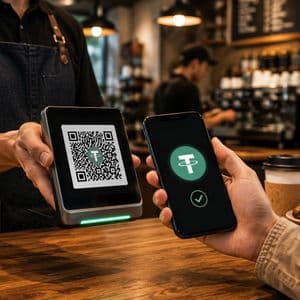
Stablecoin payments at physical retail checkouts moved from concept to live deployment in 2026. Payment terminals from Ingenico and smart POS devices from iMin now support direct crypto payment flows alongside cards, with WalletConnect Pay providing the protocol layer that connects merchants to user wallets. IronWallet is one of the wallets built for this shift. The combination of no-KYC signup, gasless USDT transfers on Tron, and WalletConnect Pay integration means a user with IronWallet on their phone and USDT in the wallet can pay at compatible merchants in a few seconds. The breakdown below covers how crypto payments at checkout actually work in 2026, how IronWallet handles the user side of the flow, and which networks make the most sense for everyday retail purchases. What Crypto Payments at Checkout Actually Look Like The user experience is closer to mobile contactless payment than to a typical crypto transaction. At a merchant supporting WalletConnect Pay , the terminal displays a QR code at checkout. The user scans the code with their wallet, sees the payment intent including the amount and recipient, chooses the token and network they want to use, and approves the payment in the wallet. The transaction settles in seconds on the chosen blockchain, and the terminal confirms the payment to the merchant. What's happening underneath: WalletConnect Pay provides the protocol layer that lets the merchant's terminal communicate with any compatible wallet, regardless of which wallet the user has. The user keeps custody of their assets the entire time. The merchant receives the payment in their preferred form, with WalletConnect Pay handling the crypto-to-fiat conversion if the merchant doesn't want to hold stablecoins. For the user, the experience is a scan, a token selection, and an in-wallet approval. The complexity sits in the infrastructure, not in the user's workflow. Setting Up IronWallet for Retail Crypto Payments IronWallet is built for the no-KYC, mobile-first checkout scenario. Setting up for retail pay with crypto flows takes minutes. Download IronWallet from the App Store or Google Play. The app runs on iOS and Android. Create or import a wallet. The app generates a 12-word seed phrase locally on the device. No email, no phone number, no identity verification at any step. The wallet stores private keys with double key encryption and supports 10,000+ digital assets across major chains. Back up your seed phrase securely. Write it down offline. The seed phrase is the recovery method if the device is lost or replaced. Fund the wallet with USDT on Tron. Tron is the network of choice for small retail payments because network fees run a fraction of a cent, and finality is near-instant. IronWallet supports gasless USDT transfers, which means a user with only USDT in the wallet can send it without holding TRX for gas. The fee is deducted from the USDT itself. Open WalletConnect Pay at checkout. Tap the QR code icon inside IronWallet when ready to pay at a merchant terminal. The wallet scans the merchant's QR code, displays the payment intent, and prompts for token and network selection. Approve the payment in the wallet to complete the transaction. The same flow works with USDC on Ethereum or USDC on Polygon. The user chooses which token and network to pay with at the moment of checkout, based on what the merchant accepts. Why USDT on Tron Works Well for Small Retail Payments The choice of network matters for retail. USDT on Tron carries a network fee of about a fraction of a cent per transfer, with finality in three seconds. USDC on Ethereum mainnet runs higher in gas cost, though Layer 2 networks like Base and Arbitrum bring that down significantly. For a four-euro latte, the network fee on Tron is negligible compared to a typical card interchange fee, which often runs two to three percent of the transaction value. The merchant economics favor crypto payments specifically because small-ticket transactions take the hardest hit from interchange fees. A two-percent fee on a four-euro coffee is more than 1,400 times the network fee for the same value transferred in USDT on Tron. IronWallet supports gasless USDT transfers natively , which means everyday USDT payments don't require holding TRX for gas. For retail crypto payments, this removes the need to manage a separate gas token alongside the stablecoin balance. Where You Can Pay With Crypto Today Adoption is still early-stage but moving. WalletConnect Pay's first physical retail integration went live in early 2026, with European hospitality merchants among the initial sites. The current rollout extends across several payment infrastructure partners: Ingenico partnership: access to millions of payment terminals globally across retail, hospitality, transportation, and self-service environments iMin POS integration: smart point-of-sale device support dtcpay partnership: Asia-Pacific point-of-sale deployments centered in Singapore Stripe and Coinbase Commerce: digital payments and e-commerce checkout integrations The infrastructure layer is operational; merchant adoption is the bottleneck. For users today, paying for coffee with crypto is possible wherever a merchant has activated WalletConnect Pay on their terminal. The number of activated locations is small, but the rollout path is set, and adoption is accelerating through 2026. Bottom Line Crypto payments at checkout are no longer theoretical in 2026. A user with IronWallet on their phone and USDT on Tron can pay at WalletConnect Pay-enabled merchants today, with sub-cent network fees and near-instant settlement. The infrastructure is rolling out through Ingenico's terminal network and iMin's smart POS devices, which means the list of merchants accepting crypto is set to expand significantly through 2026. The wallet matters here because the wallet is the payment instrument. IronWallet combines no-KYC signup, gasless USDT transfers, and WalletConnect Pay support in a single mobile app, which makes it a clean fit for everyday retail crypto payments. FAQ Can I really pay for coffee with crypto in 2026? Yes, at merchants that have activated WalletConnect Pay or similar crypto payment infrastructure. The first physical retail integrations went live in early 2026, with European hospitality among the initial deployments. Rollout is expanding through Ingenico's terminal network and iMin's smart POS devices, though adoption is still early-stage in May 2026. The list of locations accepting crypto grows as merchants activate the standard. Which network should I use for retail payments: Tron, Ethereum, or another? Tron works best for small retail payments because USDT transfers on Tron carry sub-cent network fees and settle in seconds. IronWallet supports gasless USDT on Tron, which means users don't need TRX for gas. USDC on Layer 2 networks like Base or Polygon also works well for retail. USDC on Ethereum mainnet is technically possible but the gas cost is higher than the network fee on alternative chains. What happens if the merchant terminal doesn't recognize my wallet? WalletConnect Pay supports 700+ wallets globally, so most non-custodial wallets work with the standard. If a specific merchant terminal doesn't recognize the wallet, the merchant is using a different crypto payment system, not WalletConnect Pay. The fix is usually choosing a merchant that runs the open standard. IronWallet is compatible with WalletConnect Pay by design. Do I need to convert my USDT to fiat before paying, or does the merchant accept it directly? The merchant decides. Some merchants accept stablecoins directly and hold them. Many merchants prefer fiat settlement, and WalletConnect Pay handles the crypto-to-fiat conversion automatically. The user pays in USDT or USDC from the wallet, and the merchant receives the equivalent fiat amount in their account. The conversion happens in the background, and the user never needs to swap or convert manually. Disclaimer: This article is provided for informational purposes only. It is not offered or intended to be used as legal, tax, investment, financial, or other advice.
16 May 2026, 11:55
Whale Faces $3.6M Unrealized Loss on 15x Leveraged ETH Long Position

BitcoinWorld Whale Faces $3.6M Unrealized Loss on 15x Leveraged ETH Long Position A prominent cryptocurrency whale, identified by the wallet address beginning with 0xa5b0, is currently facing an unrealized loss exceeding $3.6 million on a highly leveraged long position in Ether (ETH). The trader opened a 15x leveraged position of 40,000 ETH—valued at approximately $87 million at the time—on the decentralized exchange Hyperliquid. Position Details and Liquidation Risk The whale entered the trade at an entry price of $2,265 per ETH. With a liquidation price set at $1,347, the position remains active but is significantly underwater as of the latest market data. The current unrealized loss highlights the extreme risks associated with high-leverage trading, even for sophisticated market participants with substantial capital. This particular position is sizable even by whale standards. A 15x leverage multiplier means that a relatively modest 6.7% adverse price movement against the position could wipe out the entire collateral, triggering a forced liquidation. While the current price of ETH is well above the liquidation threshold, the margin for error is narrow. Track Record of Aggressive Long Bets Despite the current paper loss, this whale has demonstrated a consistent and highly profitable long-term strategy. Over the past two months, the same address has accumulated a total trading profit of $44.61 million from cumulative long positions totaling 120,000 ETH. This track record suggests the trader is employing a disciplined, large-scale directional strategy, likely based on a strong conviction in Ethereum’s medium-term price appreciation. The whale’s activity on Hyperliquid, a platform known for its perpetual futures trading, underscores the growing trend of professional traders using decentralized exchanges (DEXs) for high-leverage strategies. These platforms offer anonymity and self-custody, but also carry unique risks such as smart contract vulnerabilities and lower liquidity during volatile periods. Implications for Retail Traders While the whale’s $44.6 million profit over two months may appear enviable, retail traders should exercise extreme caution. High-leverage trading, especially with 15x or more, is a double-edged sword. The same strategy that produced those profits could have easily resulted in a total loss if the market had moved sharply against the position. The current $3.6 million unrealized loss serves as a real-time case study in the volatility and risk inherent in leveraged crypto trading. Conclusion The 0xa5b0 whale’s current predicament is a stark reminder of the high-stakes environment of leveraged cryptocurrency trading. While the trader’s historical profitability suggests a well-resourced and experienced operator, the paper loss underscores that no strategy is immune to market fluctuations. For the broader market, such large positions can amplify price swings, particularly if a liquidation event were to occur, potentially triggering cascading effects on ETH’s price. FAQs Q1: What is a 15x leveraged long position? A: A 15x leveraged long position means the trader borrows 15 times their initial capital to buy an asset. If the asset’s price rises 1%, the position gains 15%. Conversely, a 6.7% drop can lead to a total loss of the initial margin, triggering a forced liquidation. Q2: What happens if the liquidation price of $1,347 is reached? A: If Ether’s price falls to $1,347, the exchange will automatically close the whale’s position to prevent further losses. This would lock in the full loss of the initial margin, which is a portion of the $87 million position’s collateral. Q3: Is Hyperliquid safe for large trades? A: Hyperliquid is a decentralized exchange designed for high-speed, high-leverage trading. While it has a strong technical foundation, all DEXs carry risks including potential smart contract bugs, oracle manipulation, and lower liquidity compared to centralized exchanges during extreme volatility. This post Whale Faces $3.6M Unrealized Loss on 15x Leveraged ETH Long Position first appeared on BitcoinWorld .


