


 Invest ideas
News
5 Jun 2026, 18:49
Bitcoin Plunges Below $60K for the First Time Since 2024

Bitcoin has plunged below the $60,000 mark for the first time since 2024, crashing through its 200-week moving average.
5 Jun 2026, 18:48
Bitcoin Deepens Losses - Crypto Market Under Pressure

Summary Bitcoin is under strong selling pressure, falling over 17% in a week and dropping below USD 60,000. The decline was intensified by USD 532 million in long liquidations on Binance, which triggered additional forced selling. Market sentiment worsened after Strategy sold part of its bitcoin holdings. Although the sale was small — 32 BTC for USD 2.5 million — it raised concerns that the largest corporate bitcoin holder could make further sales in the future. The broader crypto market is weak due to macro and demand concerns. Strong U.S. labor data reduced hopes for rate cuts, retail investors are shifting toward AI-related tech stocks, ETF inflows remain too small to support prices, and security concerns after the Zcash vulnerability further damaged trust. By Krzysztof Kamiński Bitcoin ( BTC-USD ) has come under heavy selling pressure and has already lost more than 17 percent since the beginning of the week. On Friday, its price fell below the psychological barrier of USD 60,000, increasing investor concerns about a further deepening of the correction. Bitcoin has fallen below its 200-week SMA for the first time in three years. From its all-time high near USD 126,000, the leading cryptocurrency has already lost more than half of its value. Weekly timeframe of Bitcoin, source: TradingView Long liquidations increase pressure on the market The scale of the declines was amplified by the forced closure of leveraged positions. Over the past 24 hours, long positions worth USD 532 million were liquidated on the Binance exchange. Such a large wave of liquidations shows that many investors betting on a bitcoin rebound were forced to close their positions, which further increased selling pressure in the market. This mechanism often deepens declines, as automatic liquidations lead to further sell orders. As a result, the market can move more sharply than would be implied solely by incoming macroeconomic data or the decisions of the largest investors. Strategy’s Bitcoin sale weighed on sentiment One of the factors worsening sentiment was the news that Strategy ( MSTR ), the largest corporate holder of bitcoin and a company associated with Michael Saylor, had sold part of its bitcoin holdings. The company sold 32 bitcoins for USD 2.5 million. Although the transaction was small compared with the company’s overall portfolio, it carried significant symbolic weight. It was only Strategy’s second bitcoin sale since it began making purchases in 2020. The company explained the decision as necessary to pay coupons to holders of preferred shares, but investors interpreted it as a possible weakening of the long-standing narrative of holding bitcoin indefinitely. The market is primarily concerned that this small sale could foreshadow further, larger transactions in the future. This risk was highlighted by Peter Schiff, a well-known bitcoin critic, who stressed that the problem is not the scale of the current sale itself, but its potential consequences for investor confidence. Before this transaction, Strategy had reportedly purchased a total of 843,738 BTC for nearly USD 64 billion, which is why any change in the company’s strategy is being closely watched by the market. Declines spread across the entire cryptocurrency market Selling pressure was not limited to bitcoin. Ethereum ( ETH-USD ) fell by around 23 percent over the week to USD 1,555, while Solana ( SOL-USD ) lost about 22 percent, dropping to USD 63.75. Weakness was also visible in shares of companies linked to cryptocurrencies. Strategy’s stock fell by almost 10 percent, while Coinbase ( COIN ) shares declined by 8.4 percent. Weekly timeframe of Strategy (MSTR), source: TradingView A modest positive signal came from inflows into U.S. spot bitcoin ETFs yesterday after 13 days of outflows. However, the scale of these inflows, amounting to just over USD 3 million, was too small to change the overall market picture. In practice, this means that institutional demand remains too weak to effectively stop the current sell-off. Strong U.S. Data reduces hopes for rate cuts Sentiment was also hurt by strong data from the U.S. labor market. Nonfarm payrolls rose by 172,000 in May, clearly above expectations. Such data reduces the likelihood of swift interest rate cuts in the United States, which is unfavorable for risk assets, including cryptocurrencies. Monthly change in United States Non Farm Payrolls, source: Trading Economics The strong labor market report weakened the narrative of imminent monetary policy easing, while bitcoin currently lacks a clear macroeconomic catalyst that could support a rebound. Retail investors shift their attention to tech stocks An additional problem for the crypto market is the outflow of some retail investors toward technology stocks, especially companies linked to artificial intelligence. Retail investors have largely left the cryptocurrency market and returned to equities, making it difficult to identify new sources of demand for bitcoin. In an environment of weakening interest and a lack of fresh capital, every negative piece of news can trigger a stronger price reaction. This applies both to macroeconomic data and to decisions by major entities holding significant bitcoin reserves. Security issues weaken trust in Crypto The cryptocurrency market is also struggling with concerns over trust in the security of blockchain technology. Investors paid particular attention to a vulnerability in the Zcash network, after which the cryptocurrency’s price fell by more than 40 percent in a single day. Developers fixed the bug, but they were unable to clearly determine whether it had been exploited to create additional tokens. This situation increased concerns that increasingly advanced artificial intelligence models may in the future help detect similar vulnerabilities in other cryptocurrency projects. For a market already under downward pressure, such information further worsens sentiment. Lack of new sources of demand makes a rebound difficult The current sell-off in bitcoin is the result of several negative factors overlapping: strong U.S. economic data, reduced expectations for interest rate cuts, investors shifting toward technology stocks, concerns about Strategy’s future actions, trust issues related to the security of some crypto projects, and the large scale of long liquidations in the leveraged instruments market. Bitcoin remains under pressure, and the lack of clear new sources of demand means that a quick and sustained rebound may be difficult. The market appears weakened, and investors are watching increasingly closely to see whether the drop below USD 60,000 proves to be only a brief breach of an important level or a continuation of the downward trend that began in October 2025. Original Post
5 Jun 2026, 18:45
Sei (SEI) Price Outlook 2026-2030: Can the Giga Upgrade Spark a Sustained Rally?

BitcoinWorld Sei (SEI) Price Outlook 2026-2030: Can the Giga Upgrade Spark a Sustained Rally? The Sei network, a layer-1 blockchain optimized for trading, has been a topic of growing interest among cryptocurrency analysts and investors. As the network prepares for its significant ‘Giga’ upgrade, questions about the potential impact on the SEI token’s price are intensifying. This article provides a factual, analysis-driven outlook for SEI from 2026 through 2030, focusing on the upgrade’s technical implications and broader market context. Understanding the Sei Giga Upgrade The Giga upgrade represents a major technical milestone for the Sei blockchain. Announced in late 2025, the upgrade is designed to significantly enhance the network’s throughput, reduce latency, and improve overall efficiency for decentralized trading applications. According to publicly available development roadmaps, the upgrade introduces parallelized transaction processing and a new consensus mechanism that could theoretically handle tens of thousands of transactions per second. For context, this would place Sei in a competitive position against other high-performance blockchains like Solana and Sui. The upgrade’s successful implementation is a critical variable for any long-term price projection, as it directly impacts the network’s utility and developer adoption. SEI Price Analysis: 2026 Outlook In the immediate term, the market’s reaction to the Giga upgrade will likely be the primary driver for SEI’s price in 2026. Historically, major network upgrades in the crypto space have led to periods of increased volatility. If the upgrade rolls out smoothly with no major security incidents or technical bugs, a bullish sentiment could emerge, potentially pushing the price toward the $0.80 to $1.20 range, based on previous resistance levels and market cap comparisons. However, if delays or issues arise, the price could retest support levels around $0.40 to $0.50. Broader macroeconomic factors, such as U.S. Federal Reserve interest rate decisions and global regulatory clarity on digital assets, will also play a decisive role. A favorable regulatory environment could amplify positive price action, while a crackdown could suppress gains regardless of the upgrade’s success. Long-Term Projections: 2027 to 2030 Looking further ahead, the price trajectory for SEI becomes more speculative and dependent on network adoption. For 2027, if the Giga upgrade successfully attracts a wave of new decentralized exchange (DEX) and trading applications, the token’s value could stabilize in the $1.50 to $2.50 range. By 2028-2029, assuming continued development and a growing total value locked (TVL) on the network, analysts might project a range of $3.00 to $5.00, contingent on a broader crypto bull market. A best-case scenario for 2030, where Sei becomes a top-tier settlement layer for institutional trading, could see prices reaching $8.00 to $12.00. It is crucial to note that these are projections based on current trends and historical patterns in the crypto market, not guarantees. The highly competitive landscape of layer-1 blockchains means Sei must continuously innovate to maintain relevance. Why This Matters for Investors For investors, the key takeaway is that the Giga upgrade is a fundamental event that could redefine Sei’s market position. Unlike purely speculative tokens, SEI’s value is tied to the actual usage of its network. Therefore, monitoring developer activity, transaction volumes, and the number of active addresses on the Sei chain post-upgrade will be more informative than short-term price charts. The upgrade represents a real test of the project’s ability to execute on its technical vision. Investors should approach price predictions with caution, recognizing that the crypto market remains highly volatile and influenced by factors beyond any single network’s control. Conclusion The Sei Giga upgrade is a pivotal event that could catalyze a significant price movement for the SEI token, but its long-term success hinges on real-world adoption and a favorable market environment. While optimistic projections for 2030 exist, they are contingent on many variables. A measured, research-driven approach, focusing on the upgrade’s actual performance and network metrics, will serve investors better than reacting to hype or fear. The next few years will determine whether Sei can transition from a promising project to a foundational layer of the crypto economy. FAQs Q1: When is the Sei Giga upgrade expected to be implemented? The Giga upgrade is anticipated to be deployed in the first half of 2026, pending successful testnet audits and community governance approval. The exact date is subject to change based on development timelines. Q2: How does the Giga upgrade differ from previous Sei upgrades? Unlike incremental improvements, the Giga upgrade is a fundamental architectural change. It introduces parallel transaction execution, which allows the network to process multiple transactions simultaneously, dramatically increasing throughput compared to the previous sequential processing model. Q3: Is SEI a good long-term investment? This depends on individual risk tolerance and investment goals. SEI has a strong technical foundation and a clear focus on the trading niche, which provides a unique value proposition. However, like all cryptocurrencies, it carries high risk. Long-term investors should conduct their own research and consider the project’s adoption metrics post-upgrade before making a decision. This post Sei (SEI) Price Outlook 2026-2030: Can the Giga Upgrade Spark a Sustained Rally? first appeared on BitcoinWorld .
5 Jun 2026, 18:40
The token bill comes due: Inside the industry scramble to manage AI’s runaway costs
BitcoinWorld The token bill comes due: Inside the industry scramble to manage AI’s runaway costs The era of unlimited AI spending is ending. Across the technology industry, companies that eagerly embraced artificial intelligence tools in early 2025 are now facing a harsh reckoning as token consumption outpaces budgets at an alarming rate. Uber burned through its entire 2026 AI coding budget by April. Microsoft revoked Claude Code licenses months after enabling them. A Priceline employee told Bitcoin World that a routine Cursor contract renewal came back four to five times more expensive. Even as per-token prices have fallen, the push for broader AI adoption and increasingly autonomous agents has driven token usage to unsustainable heights. From experimentation to cost crisis Companies that gorged on all-you-can-eat subscriptions in early 2025 are now scrambling to understand where their money is going, pull back spending, and figure out whether they can salvage any return on investment. The shift in tone is stark. “Six months ago, I would have a conversation with a customer and it would be all about ‘What can it do? Is it good enough?'” Alexander Embricos, OpenAI’s head of enterprise, told Bitcoin World at an event in New York City this week. “Now the conversations are about, ‘Hey, we’re spending so much. What visibility do you have? What auditability do you have? What token controls do you have? What is the efficiency of your models?'” It’s against this backdrop that the Linux Foundation this week unveiled plans for the Tokenomics Foundation, a new standards body that aims to instill the same cost discipline around AI tokens that FinOps did for cloud spend. “In April and May, I started hearing from companies: ‘Oh my god, we are 3x over our entire 2026 token budget and it’s only April,'” J.R. Storment, executive director of the FinOps Foundation, a project under the Linux Foundation, told Bitcoin World. “We started hearing existential crises, and the whole conversation shifted from tokenmaxxing and ‘go fast’ to ‘we need guardrails, how do we control this?'” The agentic consumption explosion The cost crisis followed fervent demands from CEOs pushing their teams to use the best models and move fast, costs be damned. New models released in November — including Anthropic’s Claude Opus 4.5, OpenAI’s GPT-5.1, and Google’s Gemini 3 Pro — brought significant improvements to agentic tools, which have multiplied consumption. It’s how one company reportedly found itself with a $500 million Claude bill after forgetting to set usage limits for employees. “It’s like the crack-cocaine epidemic,” said Chris Reed, senior director of IT finance at Priceline, noting the company had begun placing token limits on certain groups. “They let you try it to get you hooked on it, and now you’re kind of beholden to it.” Vitaly Gordon, CEO of engineering operations platform Faros AI, said he recently spoke to a CTO who told him: “One of my engineers spent $40,000 on tokens last month, and I genuinely don’t know whether I should stop him or should I go and tell everyone else to be like him.” Measuring the productivity paradox A March survey by Faros found that among 20,000 developers, output was rising, but so were bugs and rewrites. Jellyfish, an engineering management platform, similarly found engineers who used the most tokens were about twice as productive as those who used AI less, but they spent 10 times the number of tokens to get there. Nicholas Arcolano, head of research at Jellyfish, told Bitcoin World via email that expenditure on AI is exploding in large part due to agentic features, with per-developer consumption rising about 18.6 times in nine months. All in all, these stats make the productivity case murkier than the spending suggests. “Whether extreme spend pays off comes down to the ultimate business value of shipped code (e.g. revenue), which most companies still can’t measure,” Arcolano said. A trillion-row data problem At least some of that measurement issue is the sheer scale at which AI is being used today. “Tracking cloud costs is a hundreds-of-millions-of-rows-a-month data problem,” Storment said. “Tracking token costs is a trillions-of-rows-a-month data problem. You can’t just stick that into whatever spreadsheet or even basic tool. You’ve got to fundamentally rethink your tooling, your specs and your accounting systems to do that.” At Priceline, Reed is already seeing discrepancies. He noted issues between a vendor’s reported usage and Priceline’s internal data. “I started my career in telecom expense management, and I’m seeing all the same parallels, from telecom to cloud to AI,” he said. “Anytime you introduce something new, it’s ripe for billing errors and audit and optimization opportunities.” The emerging market for token control A market is beginning to form around this problem. There are pure-play companies like Pay-i, which tracks, measures and optimizes the costs and performance of GenAI investments. Paid, meanwhile, lets developers track costs, measure usage and bill users based on actual value rather than subscription fees. Then there are companies like Jellyfish, Waydev and Faros AI, which all provide AI agent monitoring to prove the ROI of developer tools. Storment says most of the 180 vendors within the FinOps Foundation are leaning towards this space. Companies with existing distribution are also adding new features to capitalize on this new market. Ramp has recently moved into AI spend management; Datadog and New Relic have tacked on services like cloud cost management, token-level observability, and GPU monitoring. At the FinOps X conference next week, AWS is expected to introduce new financial management features geared toward enterprise AI spending. Tiffany Luck, a partner at NEA, thinks token efficiency and observability will likely be added in at the “harness or app layer.” She pointed to Factory, a startup that makes AI agents for enterprises, which this week launched a model router that automatically picks the right model for every task. Gordon expects frontier labs and other model providers to adopt OpenRouter-style optimization to drive queries to the cheapest models — a trend already showing up on enterprise Claude bills. “The financial report for how much you spend on Anthropic, even if you call the Opus model, some of the spend will be on Sonnet or Haiku, because they are smart enough to do it,” Gordon said. “I think this will become more and more of a thing.” Building a common language for tokenomics But all these tools are being built without a common language or shared definitions for how much a token costs, what it produces, and how to compare spend across vendors. That’s where the Tokenomics Foundation hopes to prove useful. The Foundation is building a canonical definition and framework for “tokenomics”; open standards, specifications and metrics for AI token usage and billing; as well as new metrics for AI economics, like cost-per-intelligence or tokens-per-watt. It also plans to define metrics across token factory effectiveness and consumption efficiency. The group is planning a formal launch in July, and is about to announce more members at the FinOps X conference next week. “Token economics is fundamentally more abstract and opaque than anything we’ve managed at this scale before,” Nishant Gupta, chief availability officer at Salesforce, said in a statement. “It requires a different operational muscle than the one the industry built for cloud.” Conclusion Goldman Sachs projects global token usage to multiply by 24 times by 2030. The companies already over budget need solutions now, and the foundation’s first deliverable is still months away. “Maybe we created a steam engine, but we still haven’t figured out the assembly line,” said Gordon. According to Arcolano, the smart move is broad, moderate adoption. “The best ROI comes from moving the broad middle from low to moderate usage, not pushing heavy users higher,” he said. The industry is now racing to build the guardrails that should have been in place from the start. FAQs Q1: Why are AI token costs rising so fast? Even though per-token prices have fallen, the adoption of autonomous AI agents and the push to use AI across more business functions have driven token consumption far higher than anticipated. Newer, more capable models also consume more tokens per task. Q2: What is the Tokenomics Foundation? The Tokenomics Foundation is a new standards body under the Linux Foundation. It aims to create open standards, metrics, and definitions for AI token usage and billing, similar to how FinOps standardized cloud cost management. Q3: How can companies control AI spending now? Companies are using a mix of approaches: setting token usage limits per employee or team, adopting model routers that automatically choose the cheapest effective model, and deploying third-party tools for token-level observability and cost tracking. The key is moving from unlimited experimentation to measured, moderate adoption. This post The token bill comes due: Inside the industry scramble to manage AI’s runaway costs first appeared on BitcoinWorld .
5 Jun 2026, 18:34
Bitcoin Slides Below $60K as Traders Trigger $1.57B Liquidation Wave Across Crypto
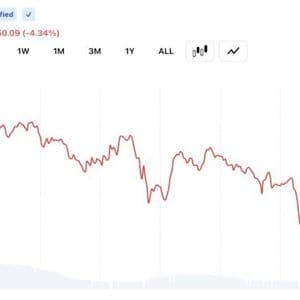
Bitcoin dropped below $60,000 amid a broader crypto market sell-off that erased $200 billion in total market value and triggered $1.57 billion in leveraged liquidations. Liquidations Pass the Billion-Dollar Mark Bitcoin plunged below $60,000 on Friday amid a market-wide sell-off that shaved approximately $200 billion from the crypto economy. According to Bitstamp data, the cryptocurrency
5 Jun 2026, 18:30
SEC’s Crypto Advocate Says Blockchain Code Is Protected By The Constitution

A federal securities regulator is drawing a line between writing blockchain code and being responsible for how that code gets used — and the distinction could reshape how the government treats software developers in the decentralized finance space. Broader Regulatory Shift Behind The Remarks Hester Peirce, a commissioner at the US Securities and Exchange Commission, made the case Tuesday at the IC3 Blockchain Camp at Princeton University that publishing open-source blockchain software is a protected activity under the First Amendment. She argued that developers who release DeFi code should not be automatically classified as securities intermediaries just because other people use what they built. LATEST: SEC Commissioner Hester Peirce says securities rules shouldn’t apply to blockchains themselves, noting “blockchains are used to do many things other than transact in securities.” pic.twitter.com/hztB7r72ap — CoinMarketCap (@CoinMarketCap) June 4, 2026 Legal liability, she said, should fall on those who actually engage in unlawful conduct — not on the people who wrote the underlying tools. Peirce’s remarks fit into a wider rethinking underway at the SEC since Chair Paul Atkins took the helm. The agency has been pulling back from what Atkins has described as regulation by enforcement, with its Crypto Task Force now reviewing how existing securities laws apply to digital assets and decentralized systems. Peirce, a long-standing voice for clearer rules in the crypto space, has been central to that push. Rules Built For A Different World She pointed to the SEC’s rulebook as evidence of the problem. The agency’s regulations were designed around intermediaries — brokers, dealers, exchanges, clearinghouses, transfer agents, investment advisers, and investment companies. Peirce questioned whether those same rules make sense when applied to distributed blockchain networks that exist for purposes well beyond securities transactions. Her comments came weeks after SEC staff issued separate guidance addressing broker-dealer registration requirements for certain user interfaces. That guidance indicated some front-end websites and software platforms that provide access to decentralized protocols may not qualify as brokers under the traditional legal definition — a signal that the agency is rethinking how far its existing categories can stretch. Digital Assets As Long-Term Priority The SEC has also signaled that crypto and blockchain technology will remain a focus for years ahead. In its draft Strategic Plan through fiscal 2030, the agency described blockchain and crypto assets as technologies with the potential to reshape America’s financial infrastructure. Taken together, the staff guidance, the strategic plan, and Peirce’s speech at Princeton paint a picture of an agency trying to redraw boundaries that were never clearly set. Featured image from Pixabay, chart from TradingView


