


 Invest ideas
News
5 Jun 2026, 15:39
Both Bitcoin and Gold Fail to Act as Safe Havens, Robin Brooks Says

Prominent economist Robin Brooks has declared that gold's days as a reliable safe-haven asset are officially over.
5 Jun 2026, 15:35
Zcash to Introduce New Audit Method to Verify Orchard Pool Supply After Security Patch

BitcoinWorld Zcash to Introduce New Audit Method to Verify Orchard Pool Supply After Security Patch Zcash, the privacy-focused cryptocurrency, has announced plans to implement a novel audit method to verify the total supply of its Orchard asset pool. This initiative follows a recent security patch applied to the network. The company stated it will release specific technical details and a full implementation plan later today, aiming to reconfirm the integrity of the asset pool and the accuracy of its supply after the system update. Background and Context The Orchard pool is a key component of Zcash’s shielded transaction system, designed to enhance user privacy by hiding transaction amounts and sender/receiver information. Ensuring the accuracy of the total supply within this pool is critical for maintaining trust in the Zcash network, as any discrepancy could undermine its economic model. The upcoming audit method is a direct response to a recent security patch, which was applied to address a potential vulnerability. While the patch itself was a routine security measure, the Zcash development team has decided to take the extra step of a full supply verification to reassure users and stakeholders. Why This Matters For Zcash users and investors, the integrity of the supply is foundational. Unlike transparent blockchains like Bitcoin, where all transactions are publicly visible, Zcash’s privacy features mean that supply verification is more complex. A verifiable audit method is essential to prove that no coins have been created or destroyed outside the protocol’s rules. This announcement is particularly significant because it demonstrates a proactive approach to security and transparency, which could help restore or strengthen confidence in the network following any concerns raised by the recent patch. Market and Industry Implications The move could set a precedent for other privacy-focused cryptocurrencies. As regulatory scrutiny on privacy coins intensifies globally, having robust, verifiable supply audit mechanisms could become a competitive advantage. It signals to regulators and the broader financial community that Zcash is committed to operational transparency, even while prioritizing user privacy. This balance is crucial for the long-term adoption of privacy coins in regulated markets. Conclusion Zcash’s forthcoming announcement on its new Orchard pool audit method represents a significant step in maintaining the network’s credibility. By proactively verifying its supply after a security patch, the Zcash team is addressing a core trust requirement for its user base. The details of the implementation, expected later today, will be closely watched by the cryptocurrency community for their technical rigor and potential applicability to other privacy-focused networks. FAQs Q1: What is the Orchard pool in Zcash? The Orchard pool is the latest generation of Zcash’s shielded transaction system, offering enhanced privacy features for users. It allows for transactions where amounts, sender, and receiver information are encrypted. Q2: Why is a supply audit necessary after a security patch? A security patch, while routine, can introduce changes to the underlying code. A supply audit ensures that the patch did not inadvertently affect the total coin supply or create any discrepancies in the asset pool, thereby maintaining the integrity of the network. Q3: How will the new audit method work? Specific technical details are expected to be released later today. Generally, such methods involve cryptographic proofs that allow anyone to verify the total supply without revealing individual transaction details, preserving privacy while ensuring accuracy. This post Zcash to Introduce New Audit Method to Verify Orchard Pool Supply After Security Patch first appeared on BitcoinWorld .
5 Jun 2026, 15:30
Crypto Billionaires Rally Behind Nigel Farage As Political Stakes Rise

Reform UK’s fundraising total climbed sixfold compared to the same period last year, when the party pulled in just $2 million in crypto and other donations. In the first quarter of 2026, it raised $12.5 million — more than any other British political party. A Party Funded By Crypto Money Two donors drove most of that haul. Christopher Harborne, who holds a stake in stablecoin issuer Tether, gave $4 million. Ben Delo, co-founder of crypto exchange BitMEX, gave $5.4 million — his first-ever donation to Reform UK . Together, their contributions account for $9.4 million of the party’s Q1 total, based on data released Thursday by the UK Electoral Commission. Labour and the Conservatives each raised around $5.4 million in the same quarter. Reform’s fundraising not only outpaced them both but exceeded the combined total from either of the two traditional parties. Farage’s Pitch To The Crypto World Nigel Farage has made his position on crypto clear. Reform UK was the first British political party to accept Bitcoin donations. Farage is a British politician who has been the leader of the Reform UK since 2024. Farage has also called for capital gains tax on crypto to be slashed from 24% to 10% and wants the Bank of England to build a Bitcoin reserve — proposals that have drawn attention from the industry on both sides of the Atlantic. It’s not just Nigel Farage taking millions from the super-rich. His Reform Party is doing it too. Reform pocketed £7 million from two crypto billionaires in the first three months of 2026 We need to kick ALL big-money out of politics. Our democracy should not be for sale! — Richard Burgon MP (@RichardBurgon) June 4, 2026 In the US, crypto-backed political action committees have been spending heavily on midterm election primaries, backing candidates who went on to win. The pattern mirrors what is now unfolding in Britain, where industry money is flowing toward politicians seen as sympathetic to the sector. A Donor Under Scrutiny Harborne’s relationship with Farage goes beyond party donations . He separately gave Farage a personal gift of $6.7 million, which is now the subject of a parliamentary standards inquiry into whether it should have been properly declared. Farage has maintained he had no obligation to register the money, saying it was received before he became a member of parliament and was intended to cover personal security costs. He later said the gift was tied to his role in the Brexit campaign. The Bigger Picture The Electoral Commission data shows total political donations across all parties more than doubled compared with Q1 of last year. Reform’s rise accounts for a significant share of that increase. Harborne’s contributions to the party now total $20 million over the past 12 months, making him one of the largest individual political donors in British politics today. Featured image by Stefan Rousseau/PA Wire, chart from TradingView
5 Jun 2026, 15:22
Ripple Price Prediction: How Low Can XRP Go If $1 Support Cracks?
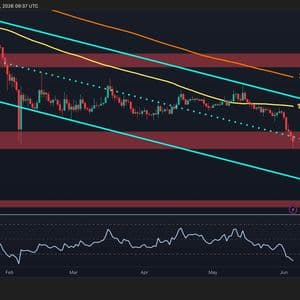
XRP opens June with its most significant decline of the past 3 months. The $1.20 support band, which served as the absolute floor for months, is being breached, with the price now trading at $1.11. The RSI is also printing its lowest reading since February’s capitulation, and the next meaningful support is nearly $0.30 lower. This is not a pullback from resistance; it is likely a breakdown of the last line of defense. Ripple Price Analysis: The USDT Pair On the USDT chart, the $1.20 support band, which held strong during the February crash and has remained untouched since, is on the verge of breaking down. The RSI has also collapsed to approximately 20–25, nearing the oversold extreme seen at the February capitulation low. That reading alone warrants attention, as historically, RSI at these levels has preceded, at minimum, a sharp relief bounce even within a broader downtrend. However, an oversold RSI does not mean a floor has been found on its own. The $1.20 level is now likely to flip into resistance, and any bounce needs to reclaim it on a sustained closing basis to suggest the breakdown is being reversed rather than simply paused. Below the current price, the next structural reference is the $0.80 demand zone, which also converges with the descending channel’s lower boundary. This is a meaningful confluence of support, but still at a significantly lower level. The 100-day moving average at $1.35 and the 200-day moving average at $1.60 are now both heavily overhead, leaving XRP with a stack of resistance above and thin structural support below on the USDT-paired chart. The BTC Pair The BTC pair is telling a more resilient story. XRP/BTC is trading at 1,800 sats, holding above the recent lows at 1,740 sats. The RSI, which surged to 70 at the end of May in what looked like a meaningful momentum shift, has already faded back to 50, indicating that the brief strength has not followed through into sustained buying. The price is sitting below the 1,850 sat short-term resistance after getting rejected by the level again, with the declining 100-day moving average at approximately 1,900 sats acting as the immediate dynamic overhead resistance. The fact that the ratio has held while the USDT pair broke down suggests the XRP weakness is partly a function of broader altcoin selling in dollar terms rather than XRP-specific deterioration against Bitcoin. A confirmed close below 1740 sats on the BTC pair, particularly if it coincides with continued USDT pair weakness, would mark a definitive breakdown on both pairs simultaneously, which exposes the 1,500 sats area as the next reference below. The post Ripple Price Prediction: How Low Can XRP Go If $1 Support Cracks? appeared first on CryptoPotato .
5 Jun 2026, 15:20
BIT-Related Whale Deposits $5.84M USDC to Avert ETH Liquidation as Unrealized Losses Hit $78M
BitcoinWorld BIT-Related Whale Deposits $5.84M USDC to Avert ETH Liquidation as Unrealized Losses Hit $78M A cryptocurrency address linked to BIT (formerly Matrixport) has deposited an additional 5.84 million USDC into a DeFi lending protocol to reduce its liquidation risk. The move comes as the unrealized loss on the entity’s substantial 120,000 ETH long position has grown to approximately $78 million, according to on-chain data from Lookonchain. Behind the Margin Call The deposit was made to lower the liquidation price of the whale’s position, which is spread across four distinct addresses. Following the latest capital injection, the current ETH liquidation prices for these addresses now stand at $1,414, $1,366, $1,360, and $1,309, respectively. This suggests the whale is actively managing collateral to prevent forced selling as Ethereum prices remain volatile. The whale’s original position was likely opened during a period of higher ETH prices, and the subsequent market decline has pushed the position deep underwater. On-chain analysts note that such large-scale deposits to avoid liquidation are a common, albeit costly, risk management strategy employed by institutional traders and high-net-worth individuals. Market Implications and Risk Context The situation highlights the persistent leverage risk within the crypto ecosystem. A forced liquidation of a 120,000 ETH position — worth over $380 million at current prices — could have created significant downward pressure on Ethereum’s price. By injecting additional capital, the whale is effectively buying time for a market recovery. What This Means for Retail Traders While the whale’s actions are a specific case, they serve as a broader reminder of the risks inherent in high-leverage trading. The $78 million unrealized loss underscores how quickly positions can turn against traders in a bearish or sideways market. For the average investor, monitoring large wallet movements can provide early signals of potential volatility, but it should not be used as a sole basis for trading decisions. Conclusion The 5.84 million USDC deposit by a BIT-related address is a defensive maneuver to protect a massive leveraged long position on Ethereum. While it temporarily lowers the risk of a catastrophic liquidation, the position remains highly vulnerable to further price drops. The incident underscores the ongoing tension between leveraged bullish bets and the market’s current price action. FAQs Q1: What is a liquidation price in crypto trading? A liquidation price is the price level at which a trader’s leveraged position is automatically closed by the exchange or lending protocol to prevent the debt from exceeding the collateral. If the market price hits this level, the position is forcibly sold. Q2: Why did the BIT-related address deposit more USDC? The address deposited additional USDC to increase its collateral ratio, thereby lowering the liquidation price of its ETH long position. This gives the position more room to withstand further price declines before being forcibly closed. Q3: How reliable is Lookonchain data? Lookonchain is a reputable on-chain analytics platform that tracks and verifies blockchain transactions. While the data is publicly verifiable on the blockchain, the attribution of addresses to specific entities like BIT is based on publicly available information and may not be 100% confirmed. This post BIT-Related Whale Deposits $5.84M USDC to Avert ETH Liquidation as Unrealized Losses Hit $78M first appeared on BitcoinWorld .
5 Jun 2026, 15:18
BREAKING – Michael Saylor Tries To Cool Bitcoin’s Internal Rivalries — But Can He?

Michael Saylor said Bitcoin has moved far beyond its early life as a niche protest and now reaches individuals, companies, banks, capital markets, and governments. In a new paper posted on X, he grouped the Bitcoin world into four camps and argued that the split reflects growth, not collapse. Four Camps, One Network The four labels are Bitcoin Maximalists, Bitcoin Capitalists, Bitcoin Technologists, and Bitcoin Fundamentalists. According to the paper, they all see value in Bitcoin, but they disagree on how far it should stretch, how fast it should change, and how tightly it should tie itself to the financial system. Saylor cast Maximalists as people who see Bitcoin as the main digital monetary network, a form of sound money, and a shield against inflation and weak currencies. https://t.co/yeG4PgpjEq — Michael Saylor (@saylor) June 5, 2026 He also said this group gives Bitcoin moral clarity, while still leaving open the question of how the network fits with banks, public companies, and governments. Bitcoin Capitalists, in his view, push in the other direction and want the asset embedded in portfolios, balance sheets, credit products, custody systems, and market infrastructure. Saylor described them as the group most comfortable with corporate treasuries, institutional custody, and financial tools built around Bitcoin rather than just on top of it. Protocol Pressure Points The technologist camp, Saylor said, wants Bitcoin to keep improving on issues like scalability, privacy, security, wallet design, usability, custody, and even future threats such as quantum computing. He warned that upgrades carry risk, because Bitcoin’s base layer holds value in part because users trust it not to change carelessly. He drew a hard line around the Fundamentalists, who focus on self-custody, personal nodes, decentralization, immutability, and censorship resistance. Their concern is that banks, governments, custodians, leverage, and financial engineering could push Bitcoin away from the purpose that made it worth defending in the first place. That wider argument lands while Strategy , the company Saylor leads as executive chairman, is under fresh market pressure after a rare Bitcoin sale drew attention last week. Reports said the firm sold 32 BTC for about $2.5 million, its first Bitcoin sale since 2022, as Bitcoin traded near $60,000 and ETF outflows weighed on sentiment. Can Saylor Stop The Rivalry? Saylor’s paper frames the split as a normal stage in Bitcoin’s growth, not a sign of failure. His message was that Bitcoin can keep its base layer intact while allowing markets, custody services, and new financial products to grow around it. Four camps, one coin, and a lot of egos. Saylor calls it growing pains. But with money, politics, and principles all colliding, can he actually get them to stop fighting — or does everyone think they’re the only one keeping Bitcoin alive? Featured image from Unsplash, chart from TradingView


