


 Invest ideas
News
5 Jun 2026, 13:28
US Senate passes $70B ICE, CBP bill: Is CLARITY Act next as banks prepare?

More on Clarity Act MercadoLibre: The Stock Is Down, The Bull Case Isn't Marvell To A Trillion Dollars: Don't Fall For The Hype (Rating Downgrade) Alger Growth & Income Fund Q1 2026 Commentary Ultimate AI showdown: Anthropic and OpenAI head for Wall Street Franklin Resources' Wamco to pay $100M in SEC settlement
5 Jun 2026, 13:23
Grayscale flags Strategy BTC sale as pressure point, calls for new buyer cohorts

Grayscale, a major asset manager, is warning that the current pool of corporate treasury buyers is not broad enough to absorb Bitcoin’s selling pressure alone. The warning came as Bitcoin has dropped toward the dreaded $60,000 support level after experiencing an extended streak in spot ETF outflows, and as long-term Bitcoin holder Strategy (NASDAQ: MSTR)also recently made its first sale of Bitcoin in nearly four years. Why is everyone selling Bitcoin right now? Bitcoin has been experiencing several crises, including an increase in its ETF outflows. On June 2, investors pulled $519 million out of U.S. spot Bitcoin ETFs. BlackRock’s fund (IBIT) lost $388.6 million while Grayscale’s fund (GBTC) lost $83.5 million. Strategy, a long-term corporate buyer of Bitcoin sold its holdings for the first time in four years. The company holds 843,706 BTC, which is more than 4% of all the Bitcoin that will ever exist. But last week, it sold 32 coins for about $2.5 million to pay its stockholders. The amount was only 0.0038% of its total holdings, and Cryptopolitan reported that Jeff Walton, Strive’s chief risk officer, defended the move , arguing that the sale allowed Strategy to grow its cash reserves by up to $29 million in the same week, a 3.3% increase. On-chain analyst Axel Adler Jr. said the momentum that drove prices higher earlier in the year is now gone. Once prices fell, traders who borrowed money to buy Bitcoin were forced to sell. Between $1.3 billion and $1.8 billion in crypto trades were liquidated within 24 hours. Most of the losses hit traders who were betting the price would go up. Where does Grayscale think new buyers will come from? The main buyers of Bitcoin in 2026 have been a small group of companies called digital asset treasury (DAT) firms. These are companies like Strategy that hold Bitcoin as their main business. But Grayscale believes the concentration of buying among a handful of treasury firms makes the current setup fragile. Strive (NASDAQ: ASST), the seventh-largest public corporate Bitcoin holder at 19,000 BTC, is raising $8.1 million per day through its SATA preferred stock program and recently acquired 2,500 coins in a single week at an average cost of roughly $74,092 each. Walton said that if Strive keeps raising money at its current speed, it could buy about 175,000 more Bitcoin, but that prediction would require the company to keep raising the same amount of money nonstop, get permission from the SEC to sell an extra $4.2 billion in stock, and spend every single dollar at today’s Bitcoin prices. Another cohort that could diversify the pool of buyers, based on a Coinbase survey, shows that 45% of Gen Z and Millennials already hold crypto, while only 18% of Gen X and Baby Boomers do. Grayscale suggests that about $110 trillion in assets held by Baby Boomers and the Silent Generation will pass to younger people over the next few decades, and so these younger investors could step in to save the market. Zach Pandl, Grayscale’s head of research, estimates that if just 2% of that $110 trillion went into crypto, it would create $2.2 trillion in new demand. Grayscale also expects regular companies to start adding Bitcoin to their treasuries. This is already starting to happen with SpaceX, Elon Musk’s space company that holds 18,712 Bitcoin worth about $1.4 billion. The company is planning to go public soon. Grayscale’s Zach Pandl said SpaceX could become “the largest public company to hold Bitcoin” after its IPO. Bitcoin’s price is currently around $63,000, down sharply from over $73,000 at the start of the month. Cumulative net inflows into Ether funds shrank to $11.24 billion, with $90.15 million exiting on June 2 alone. Don’t just read crypto news. Understand it. Subscribe to our newsletter. It's free .
5 Jun 2026, 13:20
DTXT/USDT Pair on BNB Chain Exploited for $35,000 in Smart Contract Attack

BitcoinWorld DTXT/USDT Pair on BNB Chain Exploited for $35,000 in Smart Contract Attack A security breach on the BNB Chain has resulted in the loss of approximately $35,041 from the DTXT/USDT liquidity pool, according to blockchain security firm PeckShield. The incident, which targeted a vulnerability in the DTXT token contract, highlights ongoing risks within decentralized finance (DeFi) protocols, particularly those involving complex smart contract logic. How the Exploit Worked PeckShield’s analysis reveals that the core of the exploit lay in a flawed mechanism within the DTXT contract. The contract determined the type of transaction—whether a swap or a liquidity addition—by comparing its own USDT balance with the amount of USDT deposited into the trading pair. The attacker exploited this by sending a small amount of USDT directly to the trading pair’s contract address. This manipulation caused a large sell order of DTXT tokens to be misidentified as a liquidity addition, effectively bypassing the transaction fee logic that would normally apply to a sell order. To execute the attack, the exploiter took out a flash loan of 1,077,400 USDT from the Moolah lending protocol. This capital was used to manipulate the pool’s state and execute the profitable trade, netting a profit of roughly 35,000 USDT. Flash loans, which allow borrowing without collateral provided the funds are returned within a single transaction block, are a common tool in DeFi exploits. Implications for DeFi Security This incident serves as a technical case study in how subtle logical errors in smart contracts can be weaponized. The vulnerability was not in the core trading logic of the decentralized exchange itself, but in the DTXT token’s custom contract code. This underscores a critical point for developers: custom token integrations, especially those with non-standard logic for handling fees or balance checks, require rigorous auditing and testing. What Users Should Know For liquidity providers in the DTXT/USDT pool, this event directly resulted in a loss of funds. It is a stark reminder that impermanent loss is not the only risk in DeFi; smart contract risk is ever-present. Users are advised to verify the audit history and code quality of any token project before providing liquidity. The use of flash loans in this attack also reinforces the need for protocols to design systems that are resilient to such capital-intensive manipulation. Conclusion The $35,000 exploit of the DTXT/USDT pool on BNB Chain is a clear example of how a single flawed line of logic in a token contract can lead to significant financial loss. While the sum is relatively small compared to multi-million dollar hacks, the technical method used is instructive for the broader DeFi community. As PeckShield continues to monitor the situation, the incident adds to the growing list of attacks that exploit the gap between intended contract behavior and actual execution. FAQs Q1: What exactly was the vulnerability in the DTXT contract? The contract used a flawed method to determine transaction types by comparing its USDT balance with the pool’s deposits. This allowed an attacker to trick the system into treating a large sell order as a liquidity addition, bypassing sell fees. Q2: How did the attacker profit from this exploit? The attacker used a flash loan of over 1 million USDT from Moolah to manipulate the pool’s state. By exploiting the logic flaw, they executed a trade that netted them a profit of approximately 35,000 USDT. Q3: Are funds safe on BNB Chain after this incident? This was a specific attack on the DTXT token contract, not a vulnerability in the BNB Chain itself. The chain remains secure, but users should exercise caution with any token that has custom or unaudited smart contract logic. This post DTXT/USDT Pair on BNB Chain Exploited for $35,000 in Smart Contract Attack first appeared on BitcoinWorld .
5 Jun 2026, 13:17
Michael Saylor Bet on BTC, Tom Lee Bet on ETH: Now Both in Over $20B Paper Loss

Michael Saylor and Tom Lee are facing renewed scrutiny as the companies tied to their crypto treasury strategies sit on large unrealized losses after sharp declines in Bitcoin and Ethereum. Strategy Inc., formerly MicroStrategy, now carries an estimated paper loss of about $11.2 billion to $11.3 billion on its Bitcoin holdings, while Bitmine Immersion Technologies faces an estimated $8.9 billion to $9.38 billion unrealized loss on its Ethereum treasury. The losses are not personally realized losses for Saylor or Lee, but they are closely linked to their public investment strategies. Saylor has led Strategy’s long-running Bitcoin accumulation plan, while Lee chairs Bitmine, which has shifted into an Ethereum-focused treasury model. Strategy holds 843,706 BTC at an average acquisition price of $75,699 per coin. Its total Bitcoin cost basis is about $63.8 billion to $63.9 billion. With Bitcoin trading below $63,000, the value of the company’s reserve has fallen to around $52.6 billion. Strategy’s Bitcoin Bet Moves Into Paper Loss Strategy’s Bitcoin position has turned negative by about 17% after six years of accumulation. The downturn has added pressure to MSTR stock, which recently traded near $124.70 in pre-market activity and around $128.98 during the previous session. The stock is down about 77% from its record high. Source: X The company recently sold 32 BTC for about $2.5 million at an average price of $77,135 per coin. That sale drew attention because Strategy had long been associated with a buy-and-hold Bitcoin strategy. Since that sale, the value of its Bitcoin position has dropped by more than $11 billion as BTC continued falling. Saylor has pushed back against claims that the Bitcoin strategy is impaired. He said capital markets have directed about $400 billion into artificial intelligence infrastructure over six months, while Bitcoin ETFs have seen about $4 billion in outflows since May 14. In his view, the current weakness reflects capital rotation rather than a failure of Bitcoin’s long-term thesis. Tom Lee’s Bitmine Faces Ethereum Drawdown Bitmine Immersion Technologies has also come under pressure as Ethereum fell below $1,800. The company holds more than 5.4 million ETH, equal to about 4.5% of Ethereum’s circulating supply. Its position is worth close to $10 billion at current prices, compared with an estimated investment value near $18.8 billion. Bitmine’s unrealized Ethereum loss is estimated between $8.9 billion and $9.38 billion. The company accumulated much of its ETH at an average cost near $3,500 per token, leaving the treasury deep in paper-loss territory after the latest decline. Source: X BMNR shares fell below $17 and have dropped about 28% since early May. The stock is now trading at its weakest level since the company announced its Ethereum treasury pivot in 2025. Bitmine has tried to offset part of the pressure through staking. The company has staked about 4.7 million ETH, roughly 87% of its holdings, through its MAVAN network. That setup is estimated to generate about $276 million to $300 million in annualized staking revenue. Crypto Treasury Models Face Bear Market Test The weakness at Strategy and Bitmine shows how digital asset treasury companies remain exposed to crypto price cycles. Strategy’s model depends heavily on Bitcoin appreciation and capital-market access, while Bitmine’s model depends on Ethereum price stability, staking income, and investor demand for ETH-linked equity exposure. Strategy’s preferred stock product, STRC, has also come under pressure. It recently traded near $94.60 to $94.85, below its intended $100 level, with yields above 12% in market commentary. Critics argue that weak preferred pricing could raise future funding costs, while supporters say Strategy still has several tools to manage its capital structure. Bitmine has filed to raise $300 million through 3 million shares of 9.5% Series A perpetual preferred stock under the ticker BMNP. The company said proceeds may be used to buy more ETH, expand staking infrastructure, fund working capital and repurchase common stock. Other Ethereum treasury firms have also faced losses. FG Nexus reportedly bought about 50,600 ETH at an average price near $3,940 and later recorded heavy losses after selling more than 38,000 ETH. Its reported loss figure reached $888.3 million, with a Q1 2026 net loss of $38.6 million. The losses at Strategy, BitMine, and FG Nexus are part of a wider market reset. More than half of the Bitcoin supply is already sitting near or below cost basis, while other on-chain data placed supply in profit near 55%, close to the level where bear-market stress has historically increased. Realized losses have also risen, with Glassnode data showing aggregated realized losses reaching $1.3 billion per day as Bitcoin moved back toward $62,000. Long-term holders accounted for about $770 million, or 59%, of those realized losses, showing that some cycle-top buyers who held through the decline are now exiting at a loss. Source: X The pressure is affecting investor sentiment toward digital asset treasury firms. These companies were built around the idea that public-market capital could be converted into scarce crypto assets and held over long periods. That model benefits when token prices rise, but it can face tighter conditions when the underlying assets fall below average purchase prices.
5 Jun 2026, 13:15
XRP Price Prediction: Sentiment Turns Negative Again – Why Divine Ray ICO With Live Product Beats Waiting

XRP price dipped 3% last week. It now trades in the $1.30 to $1.40 range. That is frustrating for holders. But something else is happening around XRP. Institutions are buying every single day. ETF inflows keep coming. And crowd sentiment just turned sharply negative again. Meanwhile, a crypto presale called Divine Ray ($DCR) raised over $100,000 on its opening day. Divine Ray has a live social media app and its own blockchain. So, XRP holders wait for a breakout that keeps getting delayed, but Divine Ray offers a working product and a $5 million valuation. That combination is too good to ignore. CryptoPatel: Institutions Are Loading Up on XRP Crypto analyst Patel shared an updated XRP chart on a 4-day timeframe. The chart shows XRP trading at $1.3607, still deep inside a multi-year accumulation zone marked between roughly $0.50 and $1.80. Patel’s long-term targets are bold. He labels two upside targets on the chart. The first shows $5, then $10, and $15 per XRP. Why does Patel believe these targets are possible? Because institutions are not selling. They are quietly buying more every single day. Source: X/@CryptoPatel The numbers back this up. Total ETF net inflow for XRP stands at $1.41 billion since launch. Over the last 15 trading days, there have been $116.48 million of straight inflows. Outflow days? Only 13 out of 193 days. That means more than 90% of days are inflow days. Read that again. Big money is filling their bags while retail sleeps. Price looks boring. But the flows tell a different story. Patel calls this the calm before the storm. His accumulation zone is $1 to $0.70, with advice to buy the big dip if the market crashes hard. Long-term targets remain $5, $10, and $15. Santiment: Crowd FUD Hits Highest Level in 3 Weeks Santiment released data on XRP crowd sentiment. The ratio of positive to negative commentary has dropped to just 1.1 bullish comments for every 1 bearish comment. That is the highest level of crowd FUD in three weeks. The chart shows the sentiment ratio line falling deep into the “FUD Zone” marked on the lower part of the graph. Previous dips into this zone, such as in late April and early May, were followed by price stabilization and bounces. Source: X/@SantimentData Historically, this kind of fear and skepticism has acted as a contrarian signal for XRP’s price. When traders across social media become overly fearful, many weak hands have already sold. That reduces selling pressure and creates conditions for a rebound. The opposite effect happens during extreme excitement. When the sentiment ratio rises deep into the “FOMO Zone,” that usually marks local tops because too many traders are already positioned bullishly. Right now, we are in the fear zone. That is typically a good dip buy time. So what is the XRP price prediction based on this data? A bounce toward $1.50 to $1.60 is possible in the coming weeks. If ETF inflows continue and institutional demand holds, a break above $1.60 could open the door to $2.00 and eventually higher. But even the most optimistic targets put XRP at $5 to $15 over multiple years. That is a 3x to 10x return from current levels. Respectable, but not life changing for smaller accounts. Divine Ray – A Crypto Presale That Already Works Divine Ray already has a fully functioning mobile social media app available on the Apple App Store and Google Play. Most crypto projects launch tokens before building anything. Divine Ray did the opposite. You can download the app right now, create an account, and start using it today. That is rare in crypto ICOs. Divine Ray operates its own blockchain infrastructure built with the Cosmos SDK. The chain is integrated with the IBC network, giving the project full control over its technology, scalability, and future ecosystem development. Divine Ray Coin already trades on the Osmosis decentralized exchange. Real liquidity and market validation exist from day one of the presale. The platform serves a large and growing target market. The global consciousness and wellness economy expands every year. More people seek meditation, yoga, retreats, spiritual content, and conscious communities. Divine Ray connects creators, retreat centers, events, and communities through one unified platform. That is a multi-billion dollar sector. DRC has multiple token utilities. The token is used for memberships, advertising, NFT minting, creator rewards, and community growth inside the platform. Each use case creates a separate demand driver. As the platform expands, those drivers multiply. This is the fuel for an entire social economy. Divine Ray also offers one of the lowest ICO launch valuations in the industry. Phase 1 pricing starts at an approximate $5 million valuation. Most ICOs launch at $50 million or $100 million with nothing but a website. Divine Ray has a live app, a working blockchain, and a DEX listing. A move from $5 million to $50 million is a 10x return. A move to $100 million is a 20x return. No guarantees exist. But the valuation gap is enormous. DCR’s crypto presale has four phases with increasing prices. Phase 1 offers 400 billion DRC at $0.0000015 per token for a total of $600,000. Phase 2 moves to $0.000002. Phase 3 to $0.0000025. Phase 4 to $0.0000035. Phase 1 is still open, but it will not last. The presale already smashed $100,000 on day one. Momentum is definitely there and DCR could be the crypto presale to watch this summer. Meet the first live social media platform with its own blockchain – Divine Ray: Presale: https://ico.divineray.ca/ X: https://x.com/divinerayapp Telegram: https://t.me/+WF9GmuVpuOFmOTEx YouTube: https://www.youtube.com/@divinerayapp The post XRP Price Prediction: Sentiment Turns Negative Again – Why Divine Ray ICO With Live Product Beats Waiting appeared first on Cryptonews .
5 Jun 2026, 13:10
CoinDesk 20 performance update: Bitcoin (BTC) price drops 2.8% as index declines
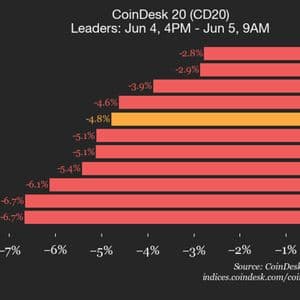
All twenty constituents in the CoinDesk 20 index were trading lower since yesterday.


