


 Invest ideas
News
26 Apr 2026, 17:48
Best Crypto Sportsbooks to Bet on Football in 2026 (BTC & Stablecoins)
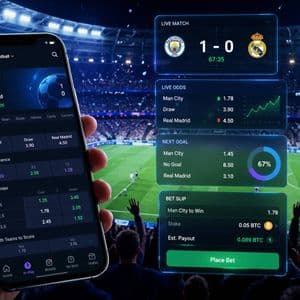
Crypto sportsbooks have moved from niche to mainstream. Faster payouts, fewer restrictions, and stablecoin support make them practical for football betting—especially during high-frequency events like league weekends or international tournaments. This list focuses on platforms that handle betting on football with Bitcoin and stablecoins, offer deep sports markets, and process withdrawals quickly. Top Crypto Football Sportsbooks (2026) Dexsport — no KYC, multi-chain, real-time bet tracking Cloudbet — high limits, strong football coverage Stake — polished UI, fast crypto transactions Mega Dice — no KYC, growing sportsbook Lucky Block — fast payouts, wide sports coverage Thunderpick — strong esports, solid football markets BetOnline — hybrid crypto/fiat, deep global markets 1. Dexsport — Best for Anonymous Football Betting with BTC & USDT Dexsport.io is a crypto-native sportsbook built around speed, privacy, and transparency. It supports Bitcoin, USDT, and dozens of other assets across multiple chains. The onboarding is immediate. No KYC. Users can connect a wallet or sign up with minimal details. Football coverage is extensive. Major leagues, international tournaments, and live betting markets are all available, with 100+ betting options per match. Odds remain competitive, typically within a 4–6% margin. Key strengths: Supports 38+ cryptocurrencies across 20 networks Instant deposits and fast withdrawals with no platform fees Live cash-out across in-play football bets Public bet tracking for on-chain transparency Bonuses are substantial. The platform offers up to 480% across first deposits, plus free bets and weekly cashback paid in stablecoins. Best for: players who want no-KYC access, stablecoin payouts, and full control over bets. 2. Cloudbet — Best for High-Stakes Football Betting Cloudbet is one of the longest-running crypto sportsbooks. It focuses on serious bettors. It supports 30+ cryptocurrencies, including BTC and USDT, with automated withdrawals that usually process within minutes to hours. Football markets are deep. Top leagues, international competitions, and live betting all have strong coverage. Betting limits are higher than most crypto platforms. Key strengths: High betting limits Fast, automated withdrawals Strong football and esports coverage Competitive odds on major matches Best for: high-volume bettors and users placing larger wagers. 3. Stake — Best for Live Football Betting Experience Stake combines a refined interface with fast crypto payments. It supports 17+ cryptocurrencies and processes withdrawals quickly, often within minutes. The live betting interface is one of the strongest in crypto betting. It includes stats, streaming, and cash-out. Limitations exist. KYC is required before withdrawals, which reduces anonymity. Key strengths: Advanced live betting tools Fast crypto transactions Competitive margins (2–5%) Best for: users prioritizing interface quality and live betting data. 4. Mega Dice — Best No-KYC Option with Casino Integration Mega Dice combines sportsbook and casino in one account. It supports a wide range of cryptocurrencies, including BTC and USDT. No KYC is required for most users. Deposits are instant, and withdrawals are generally fast. Football coverage is solid but still expanding compared to top-tier sportsbooks. Key strengths: No KYC onboarding Broad crypto support Frequent promotions and tournaments Best for: casual football bettors who want casino access alongside sports. 5. Lucky Block — Best for Fast Crypto Payouts Lucky Block focuses on speed. Withdrawals are often processed within minutes, depending on network conditions. It supports major coins and stablecoins, along with fiat options. Football markets are broad, covering major leagues and live betting. Some users report account checks during withdrawals, which is worth noting. Key strengths: Fast payouts Low minimum deposits Wide sports coverage Best for: players who prioritize quick withdrawals. 6. Thunderpick — Best for Football + Esports Combo Thunderpick is known for esports but maintains solid football markets. It supports BTC, ETH, USDT, and other coins. Withdrawals can take up to 24 hours. The football offering includes pre-match and live betting, though depth is lower than leading sportsbooks. Key strengths: Strong esports integration Crypto-only payments Regular promotions Best for: users betting on both football and esports. 7. BetOnline — Best Hybrid Crypto & Traditional Sportsbook BetOnline bridges crypto and fiat betting. It supports BTC, ETH, USDT, and more. Football coverage is extensive. It includes global leagues, props, and live betting. Withdrawals in crypto are faster than fiat, typically processed within hours. Key strengths: Deep global football markets Supports both crypto and fiat Established platform Best for: users transitioning from traditional sportsbooks. Why Use BTC & Stablecoins for Football Betting? Crypto changes how betting works in practice. Speed: crypto withdrawals take minutes to hours; fiat can take days Fees: blockchain fees are usually lower than card or bank fees Access: no reliance on banks or regional restrictions Privacy: some platforms allow betting without identity verification Stablecoins like USDT reduce volatility, making them practical for bankroll management during long tournaments. How to Choose the Right Crypto Sportsbook Focus on operational details: Withdrawal speed: minutes vs hours vs days KYC policy: required, optional, or none Market depth: number of football betting options Supported coins: BTC, USDT, and network availability Limits: maximum bet sizes and payout caps For active football betting, speed and market depth matter more than bonus size. Final Verdict Dexsport leads for anonymity, multi-chain support, and transparent betting. It suits users who want full control and fast stablecoin payouts. Cloudbet is the strongest option for high-stakes football betting. Stake delivers the best interface for live betting. The rest of the list covers different use cases—faster payouts, hybrid access, or esports integration. Disclaimer: This article is provided for informational purposes only. It is not offered or intended to be used as legal, tax, investment, financial, or other advice.
26 Apr 2026, 17:48
Shiba Inu Burn Rate Drops 90% Despite Weekly Gains and Holder Surge

The latest Shiba Inu data highlights a mixed market signal as token burns slow sharply while adoption expands. Activity across the network reflects diverging short-term and long-term trends. Supply reduction continues, but daily momentum has weakened significantly. Meanwhile, rising holder numbers suggest sustained community engagement. Burn Activity Slows as Weekly Totals Climb Data from Shibburn shows that 1,305,818 Shiba Inu (SHIB) tokens currently sit in the community pool. Over the past day, users sent more than one million tokens to dead wallets. Shibburn reported that 1,040,871 SHIB tokens were burned in the last 24 hours. Despite this, daily burn activity dropped by 90.19%, indicating reduced short-term participation. However, longer-term data presents a different picture. A total of 51,669,707 SHIB tokens were burned over the past seven days. Monthly figures show 208,429,367 SHIB removed from circulation. The broader burn initiative continues to reduce the initial one quadrillion SHIB supply. Current figures show that 41.08% of total supply has been sent to dead wallets. Weekly burn activity increased by 3.34%, suggesting that consistent efforts remain in place despite daily fluctuations. At the same time, SHIB price action stayed relatively stable. At the time of reporting, SHIB traded at $0.000006182. The token recorded a 0.42% daily gain and a 2.29% increase over the past week. Market volatility cooled over the weekend, leading to muted price movements across major digital assets. Holder Growth Surges as Kusama Signals New Developments On-chain data shows a sharp rise in SHIB adoption. The total number of holders reached 1,585,193. This includes 10,718 new holders added within a single day. According to Etherscan SHIB, this marks the largest daily increase recorded in 2026. This growth reflects sustained interest in the Shiba Inu ecosystem despite mixed burn data. Increased wallet activity often signals long-term confidence among participants. Meanwhile, community attention has shifted toward Shiba Inu lead ambassador Shytoshi Kusama. Reports indicate that Kusama held a highly anticipated discussion with the community on Saturday. The session focused heavily on spiritual themes rather than technical updates. Following the discussion, Kusama updated his X bio with cryptic messaging. The new bio reads, “Answer: Nunca. Focus: APP: R.OS More to discuss soon.” He also added, “The wicked will do wickedly; But the wise shall understand.” Kusama has continued to post subtle hints about upcoming developments. Earlier updates included a location change to “wiring features & counting down.” This message remains unchanged, fueling ongoing speculation within the community. As a result, Shiba Inu continues to balance declining burn rates with rising adoption and anticipation around future announcements.
26 Apr 2026, 17:26
Aave raises $160 million after $200 million DeFi hack

🚨 $160 million quickly raised after a $200 million exploit in $AAVE. Mantle and Aave communities contributed 55,000 ETH for relief. Continue Reading: Aave raises $160 million after $200 million DeFi hack The post Aave raises $160 million after $200 million DeFi hack appeared first on COINTURK NEWS .
26 Apr 2026, 17:15
Defi reels from $13 billion TVL drop after KelpDAO attack

🚨 $13 billion vanished from DeFi TVL after the KelpDAO attack. Massive withdrawals hit Aave as risk from rsETH spiked. 🧩 Key point: While $ETH liquidity dropped, capital quickly shifted to Spark protocol, showing resilience in $ETH-based DeFi. Continue Reading: Defi reels from $13 billion TVL drop after KelpDAO attack The post Defi reels from $13 billion TVL drop after KelpDAO attack appeared first on COINTURK NEWS .
26 Apr 2026, 17:05
51% Attack Just Hit Litecoin. XRP Validator Compares This to XRP’s Consensus Algo

Blockchain networks prove their strength during periods of stress, not during price rallies. When transaction integrity comes under pressure, the true resilience of a network becomes clear. That reality surfaced again after Litecoin experienced a deep chain reorganization linked to a critical vulnerability, sparking fresh debate about proof-of-work security and how it compares to the XRP Ledger’s consensus model. The incident quickly drew attention across the crypto industry, especially after many users initially described it as a potential 51% attack. XRP Ledger validator Vet became one of the most notable voices in the discussion, using the event to explain why he believes XRP’s consensus structure offers stronger settlement guarantees than Litecoin’s proof-of-work design. What Actually Happened on Litecoin Litecoin recorded a 13-block chain reorganization, which immediately raised concerns about a possible majority attack. However, Litecoin developers later clarified that the issue came from a zero-day vulnerability tied to its MimbleWimble Extension Block (MWEB) privacy feature, not from a traditional hostile takeover of network hash power. According to the Litecoin team, outdated mining nodes processed an invalid MWEB transaction, which created fraudulent peg-out attempts involving third-party decentralized exchanges. To protect the network, Litecoin executed a 13-block reorganization that removed the invalid transactions while preserving legitimate transfers. Developers later confirmed they had patched the vulnerability and restored normal network operations. Litecoin suffered potentially a 51% attack. How does it compare to XRPs consensus algo? Proof of Work is the worst security model because you're only as secure as someone else is willing to spend more $ to attack the network than PoW is incentivizing miners. Litecoin (like… https://t.co/vIDYmTDI3b — Vet (@Vet_X0) April 25, 2026 Although the issue did not fit the classic definition of a 51% attack, it still exposed one of proof-of-work’s most debated limitations: the possibility of deep chain reorganizations. Vet Explains the Problem With Proof-of-Work Finality Vet argued that Litecoin’s case highlights a core weakness in proof-of-work systems like Litecoin and Bitcoin . These networks rely on the Nakamoto consensus model, where settlement remains probabilistic rather than absolute. In practice, users trust transactions more as additional blocks confirm them. However, under rare but serious conditions, the network can still reorganize those blocks. This means transactions that once appeared final can later be reversed. Vet explained that proof-of-work security depends heavily on economics. A network remains secure only if attacking it costs more than miners earn from protecting it. That security model ties directly to the value of the native token. We are on X, follow us to connect with us :- @TimesTabloid1 — TimesTabloid (@TimesTabloid1) June 15, 2025 Bitcoin performs better under this model because its massive market value supports enormous mining power, which makes attacks extremely expensive. Smaller proof-of-work networks like Litecoin face greater risk because they cannot always maintain that same level of security. Why Vet Says XRP Works Differently Vet compared Litecoin’s proof-of-work structure with the XRP Ledger’s consensus protocol . On XRPL, validated ledgers achieve deterministic finality, meaning confirmed transactions cannot be reversed through reorganizations. He stressed that XRPL security does not depend on XRP’s market price. Whether XRP trades at $1 or $1,000, the ledger maintains the same security model. He also noted that validators cannot carry out traditional 51% attacks. At worst, malicious validators could only slow or stall the network, not rewrite transaction history. That limitation, he said, makes XRPL more reliable for stablecoins, tokenized assets, and institutional financial settlement. For networks that handle critical financial infrastructure, finality matters. Litecoin’s recent incident reminded the market that consensus design often determines long-term trust. Disclaimer : This content is meant to inform and should not be considered financial advice. The views expressed in this article may include the author’s personal opinions and do not represent Times Tabloid’s opinion. Readers are urged to do in-depth research before making any investment decisions. Any action taken by the reader is strictly at their own risk. Times Tabloid is not responsible for any financial losses. Follow us on Twitter , Facebook , Telegram , and Google News The post 51% Attack Just Hit Litecoin. XRP Validator Compares This to XRP’s Consensus Algo appeared first on Times Tabloid .
26 Apr 2026, 17:00
Bitcoin leads ETF flows, but Ethereum builds institutional base for Q2 showdown

Is Ethereum quietly entering its Wall Street phase despite Bitcoin's capital lead?


