


 Invest ideas
News
5 Jun 2026, 10:39
Crypto's worst week since July 2024 deepens as bitcoin, ether near critical price levels
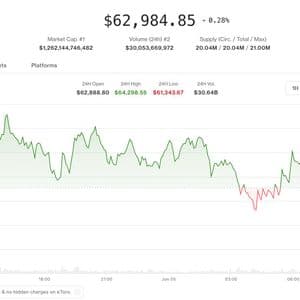
Crypto is on course for its worst week since July 2024, with the ether price approaching a critical support as a zcash exploit and AI capital rotation pile on the pressure.
5 Jun 2026, 10:35
Shiba Inu (SHIB) 'Loses' 1418% in Futures Flow: Explaining Why It's Possible

Shiba Inu's market performance is hard to overestimate: funds are not flowing in.
5 Jun 2026, 10:31
XRP Funds Buck the Outflow Wave: Why Flows Alone Have Not Lifted Price Action

XRP funds have quietly swum against the tide . While broader crypto ETPs posted heavy outflows into late May, XRP-focused products kept attracting capital. The paradox: spot price barely budged. This piece unpacks the plumbing behind exchange-traded flows, why creations don’t equate to instant rallies, and which market-structure forces can neutralize otherwise bullish headlines. We’ll ground the discussion in recent flow prints, then map the mechanisms— derivatives , liquidity, and supply dynamics—that help explain why XRP’s price action has stayed subdued despite steady inflows. PointDetailsXRP bucked outflowsWeek ending May 25, 2026: crypto ETPs saw $1.47B net outflows; Bitcoin -$1.315B, while XRP ETPs gained $31.8M ( CoinTelegraph reporting CoinShares ).Strong May for XRP ETFsMay 2026 monthly net inflows to XRP ETFs hit $131.94M, the best month of 2026 so far ( crypto.news citing SoSoValue ).Persistent daily printsSingle-day $25.8M inflow on May 12 (largest since Jan 5) and $11.88M on May 29; cumulative XRP ETF net inflows hovered around $1.35–$1.42B in May ( CoinDesk ; CoinDesk ).Price inertiaDespite inflows, XRP hovered in the low-$1.30s into May 29–30 (e.g., $1.33 and $1.34 closes) ( CoinMarketCap ).The core takeawayETF creations draw demand, but derivatives positioning, liquidity depth, arbitrage, and supply overhangs can dampen immediate spot upside. What the latest flow prints actually show Context matters. The week ending May 25, 2026 marked one of the broader market’s heavier de-risking episodes. CoinShares’ weekly snapshot tallied $1.47 billion in crypto ETP outflows, with Bitcoin products alone shedding roughly $1.315 billion. XRP ETPs were an exception, attracting $31.8 million that week ( CoinTelegraph reporting CoinShares ). The pattern extended through May. SoSoValue data compiled by crypto.news shows XRP ETFs drew $131.94 million in net inflows across the month—the strongest monthly tally year-to-date ( crypto.news citing SoSoValue ). Daily prints also stood out. On May 12, U.S.-listed spot XRP ETFs saw a $25.8 million net inflow—their largest single-day intake since January 5—and by mid-to-late May, cumulative net inflows were reported around $1.35–$1.42 billion depending on the date cut. CoinDesk highlighted a further $11.88 million on May 29 and estimated XRP ETF assets near $1.12 billion around May 29–30 ( CoinDesk ; CoinDesk ). Yet XRP’s spot price barely flinched, settling in the low-$1.30s into May 29–30 (around $1.33–$1.34 closes) ( CoinMarketCap ). That disconnect is not unique to XRP—but it is instructive. Why inflows don’t automatically lift spot — the plumbing Primary versus secondary market ETF/ETP flows often happen in the primary market via authorized participants (APs) who create or redeem shares in baskets. Primary-market creations increase the fund’s assets and demand the underlying asset—but price discovery still occurs in the secondary market where shares trade. If secondary-market sellers meet that demand, the net price move can be muted. Creations, redemptions, and hedging inventories APs typically hedge exposures. When they source XRP to deliver into creations, they may offset risk with derivatives or by borrowing inventory. Similarly, market makers warehousing XRP against ETF share liquidity can run delta-neutral books. The gross “buying” implied by inflows is therefore partially hedged, limiting directional footprint. Arbitrage caps the premium Should ETF shares trade at a premium, arbitrageurs can short the shares and buy spot XRP (or vice versa on a discount), compressing gaps quickly. This arbitrage linkage ensures creations don’t sustain dislocations—and it also dampens the idea that inflows alone translate into linear spot upside. Derivatives and depth: the real battleground Perp funding and basis can mute rallies Perpetual futures are where crypto’s marginal price often gets set. If perp open interest is high and funding turns negative, spot rallies can stall as shorts re-lever into strength. Conversely, if funding is positive and crowded, any wobble can spark long liquidations. In either case, ETF inflows may be overwhelmed by leverage dynamics that dominate intraday price discovery. Options gamma and dealer flows Options markets increasingly shape crypto spot via gamma effects. Dealers who are short gamma typically sell into up moves and buy dips to stay hedged, suppressing trend extension. If XRP options markets skew toward short-gamma dealer positioning around key strikes, ETF-related buying can run into hedging headwinds that blunt momentum. Liquidity depth matters too. If top-of-book liquidity on major venues is thin, smaller sell programs can offset ETF-linked demand. Conversely, if resting ask liquidity clusters near psychological levels, price can reject repeatedly even on decent inflows. Supply dynamics and distribution effects unique to XRP Escrow cadence and treasury management XRP’s supply mechanics are widely tracked, including scheduled escrow releases and treasury management by entities associated with the ecosystem. While not inherently bearish, predictable unlocks and any subsequent redistribution into the market can increase available supply over time. If that supply meets ETF-driven demand, net price impact may net out. Exchange inventory and OTC channels ETF creations may be sourced through multiple channels: on-exchange purchases, OTC blocks, or internal inventory recycling. If large holders supply XRP via OTC at tight spreads, secondary market prints can remain calm even as ETF AUM rises. Similarly, if exchanges maintain ample inventory around key levels, sell walls can cap upside until absorbed. Pro tip: Watch for changes in exchange balances, borrow rates, and on-chain velocity around creation-heavy sessions. A fall in exchange inventories alongside rising ETF AUM is more likely to coincide with persistent spot bids than flat inventories. Cross-asset rotation and macro headwinds When Bitcoin and Ether leak, alt flows get overshadowed Flows do not exist in a vacuum. Late May saw sharply negative prints for Bitcoin and Ether funds—about $2 billion in combined outflows across May 20–29, even as XRP funds added roughly $35 million and booked a standalone $11.88 million day on May 29 ( CoinDesk ). Broader de-risking can depress cross-asset beta, so even assets with positive idiosyncratic flows may struggle to rally in sympathy. Rates, dollar strength, and liquidity Crypto is still sensitive to fiat liquidity conditions and rate expectations. If real yields or the dollar index firm, passive demand from ETFs can be offset by macro sellers reducing risk. In practice, it often takes multiple tailwinds—flows, constructive derivatives positioning, friendlier macro—to unlock trending upside. Reading flow data like a pro — a practical checklist Separate primary from secondary. Creations add AUM, but ask: did secondary volumes show aggressive spot lifting, or was demand absorbed? Cross-check sources. Compare weekly notes (e.g., CoinShares via CoinTelegraph ) with daily trackers (e.g., SoSoValue via crypto.news ) and market reporting ( CoinDesk ). Overlay derivatives. Monitor XRP perp funding, open interest, and liquidation clusters. Heavy negative funding into inflows often means demand is meeting short pressure, not sparking a breakout. Watch spot liquidity. Track order book depth and slippage at key venues. If depth improves on the ask, it can cap rallies; if asks thin out, the same flow can travel further. Check exchange balances and borrow rates. Rising borrow cost with declining exchange balances suggests spot scarcity—more supportive than flat metrics. Contextualize with macro. If BTC and ETH are bleeding billions in outflows, alt-specific inflows need to be exceptional to move the index and sentiment. Pro tip: Rather than reacting to a single day’s inflow, look for three elements to align: sustained net creations across several sessions, improving spot liquidity conditions, and a supportive derivatives backdrop (funding stabilizing, cleaner positioning). CoinShares weekly flows table showing week flows (e.g., Bitcoin −1,315.2M, XRP +31.8M) — visual evidence that XRP ETPs attracted inflows while the broader crypto ETP market experienced $1.47B of outflows, a key datapoint for explaining why flows alone haven’t pushed price higher. — Source: CoinTelegraph (chart sourced to CoinShares) Scenarios to watch into H2 2026 Base case: steady inflows, rangebound spot If XRP funds continue to collect moderate net inflows while perps remain mixed and macro is choppy, price could stay rangebound. Expect mean reversion around well-telegraphed liquidity pockets until either supply thins or leverage resets decisively. Upside unlock: positioning + liquidity flip An upside extension becomes more plausible if: 1) ETF creations accelerate and overlap with falling exchange balances; 2) perp funding normalizes with shorts covering; and 3) ask-side depth lightens near resistance. In that environment, even modest inflows can have outsized impact. Downside risk: broad de-risking Should macro tighten or if crypto majors experience another outflow wave similar to late May’s $1.47B weekly bleed ( CoinTelegraph reporting CoinShares ), XRP may track lower beta, even with positive fund prints. Liquidity retreats can dominate asset-specific stories. Risk reminder: Crypto markets remain volatile. Smart-contract, custody, and regulatory risks may affect products and underlying assets differently. Flows are one lens—not a guarantee of direction. Where to track flows and price with fewer blind spots Weekly ETP snapshots: CoinShares’ Monday notes, often summarized by outlets like CoinTelegraph . Daily ETF dashboards: Third-party trackers such as SoSoValue via crypto.news for rolling prints and fund breakdowns. Market reporting: CoinDesk ’s intraday and end-of-week flow recaps, plus context on AUM and cross-asset rotation. Spot price references: Historical closes and intraday levels from CoinMarketCap . Derivatives and liquidity: Exchange funding pages and public market-depth visualizations for a live read on positioning and order book conditions. Crypto Daily continues to track fund flows, derivatives signals, and liquidity metrics across majors and select altcoins. For ongoing coverage, visit Crypto Daily . Frequently Asked Questions Do ETF inflows guarantee XRP’s price will rise? No. Creations add fund assets and require underlying purchases, but arbitrage, derivatives positioning, and secondary-market supply can offset the impact. Price discovery still occurs in the broader market, not in the creation ledger. Why did XRP inflows rise while Bitcoin and Ether funds saw outflows? Rotation is common. CoinShares’ late-May snapshot showed heavy Bitcoin outflows and modest XRP inflows. That may reflect tactical positioning, relative-value trades, or investor interest in diversification. It doesn’t imply a structural decoupling. How quickly can inflows affect spot price? Timing varies. If creations coincide with thin asks and balanced derivatives, price can respond quickly. If inflows meet strong passive selling or hedging supply, it can take multiple sessions—or produce little visible impact. Could XRP still rally if broader crypto ETPs bleed capital? It’s possible but harder. If majors leak billions, risk appetite and liquidity generally deteriorate. XRP would likely need outsized inflows plus favorable derivatives and thinning supply to overcome the drag. What non-flow metrics should I monitor? Look at perp funding and open interest, options skew and gamma, exchange balances, order book depth, and realized versus implied volatility. Together they offer a fuller read on whether inflows might translate into trend. Are there unique supply considerations for XRP? XRP’s ecosystem includes scheduled escrow releases and treasury management that can influence circulating supply over time. These factors don’t dictate direction but can dilute the immediate impact of incremental demand. Are daily flow numbers ever revised? Sometimes. Aggregators may update prints as issuers finalize reporting. It’s best to compare multiple reputable trackers and wait for weekly summaries before drawing firm conclusions. Disclaimer: This article is provided for informational purposes only. It is not offered or intended to be used as legal, tax, investment, financial, or other advice.
5 Jun 2026, 10:31
Bitcoin ETF outflows end with $3.05 million net inflow

🚨 US spot Bitcoin ETFs broke a 13-day outflow streak with a $3.05 million net inflow. 💸 The $3 million inflow is minor compared to recent $4.4 billion in ETF outflows. 📉 In $BTC, ETF holdings remain well below peak levels and market prices are still under pressure. Continue Reading: Bitcoin ETF outflows end with $3.05 million net inflow The post Bitcoin ETF outflows end with $3.05 million net inflow appeared first on COINTURK NEWS .
5 Jun 2026, 10:30
Bitcoin Faces Pressure As Investors Rotate Capital Into AI Buildout: Saylor

Bitcoin spot ETFs have now recorded net outflows in 17 of the last 19 days, with investors pulling a combined $5.6 billion from the products during that stretch. Taking Stock Of The Damage The numbers have pushed year-to-date flows for US-traded Bitcoin ETFs into negative territory, landing at negative $2.17 billion. Bloomberg ETF analyst James Seyffart put the 13-day outflow streak in sharper relief, reporting that roughly $4.4 billion worth of Bitcoin was sold through those products over the past month alone. Related Reading: XRP Dips In The Short Run, But A Bigger Setup May Be Forming: Analyst Since May 14, Bitcoin has fallen about 20%, dropping from $82,040 to around $64,000. The slide accelerated after Strategy, the business intelligence firm led by executive chairman Michael Saylor, disclosed it had sold 32 BTC for approximately $2.5 million — a small fraction of its total holdings, but enough to rattle sentiment across the broader market. Capital markets are funding the AI buildout at historic scale: ~$400B over 6 months. Bitcoin ETFs have seen ~$4B of outflows since May 14, pressuring $BTC. This is a capital rotation, not a Bitcoin impairment. Volatility creates opportunity. — Michael Saylor (@saylor) June 4, 2026 Saylor Points To AI Spending As The Culprit Saylor took to X on Thursday to offer his explanation for the drop. Capital markets are funding artificial intelligence infrastructure at what he described as a historic scale, drawing money away from Bitcoin and other assets in the process. According to Saylor, more than $400 billion has been directed into AI-related investments over the past six months, with major Wall Street institutions joining the push. That flood of capital, he argued, is behind the outflows hitting Bitcoin ETFs — not any fundamental weakness in Bitcoin itself. He framed the pullback as a buying window. “Volatility creates opportunity,” Saylor said. Silver Linings Remain Not every fund has been caught in the tide. The BlackRock iShares Bitcoin Trust and Grayscale’s Mini Bitcoin Trust have both held onto positive flows since January 1, reports indicate. Across all US-traded Bitcoin spot ETFs, the cumulative lifetime net inflow still stands at roughly $54 billion — a figure that reflects sustained demand since the products launched just over two years ago. Related Reading: Bitmine Seeks $300M Raise To Accelerate Ethereum Accumulation Strategy The overall picture is one of short-term stress against a backdrop of longer-term capital commitment. Whether the AI spending wave continues to crowd out Bitcoin investment, or whether the two can attract separate pools of money, remains an open question. Featured image from Pexels, chart from TradingView
5 Jun 2026, 10:30
Largest Solana Treasury Moves $32M in SOL to Coinbase Prime While Sitting $1.13B Underwater

Forward Industries, the largest corporate holder of SOL, has moved 455,784 SOL worth about $31.87 million to Coinbase Prime, its first major transfer in a month, all while sitting roughly $1.13 billion underwater on the position. A $32 Million Transfer Reignites Sell-off Fears Forward Industries, the Nasdaq-listed firm that built the largest corporate SOL treasury,


