


 Invest ideas
News
25 Apr 2026, 05:40
Bitdeer Sells All 185.7 BTC Mined This Week, Extending Zero-Holding Strategy

BitcoinWorld Bitdeer Sells All 185.7 BTC Mined This Week, Extending Zero-Holding Strategy Nasdaq-listed mining company Bitdeer sells all 185.7 BTC mined this week, continuing a strategy that began in February. The firm now holds zero Bitcoin on its balance sheet. Bitdeer Sells All 185.7 BTC Mined This Week: Full Details Bitdeer, a prominent player in the Bitcoin mining industry, announced on Wednesday that it had mined 185.7 Bitcoin during the past seven days. The company immediately sold the entire production. This action marks another week of zero net accumulation for the firm. Since February, Bitdeer has adopted a policy of holding no Bitcoin. The company sells its mined coins immediately. This approach contrasts sharply with many other mining firms that accumulate Bitcoin as a long-term treasury asset. Bitdeer’s decision reflects a focus on liquidity and operational cash flow. By selling weekly production, the company avoids exposure to Bitcoin’s price volatility. This strategy provides predictable revenue for funding expansion and debt servicing. Why Bitdeer Chooses a Zero-Bitcoin Strategy The mining sector faces intense pressure from rising energy costs and increasing network difficulty. Bitdeer’s zero-holding strategy offers several advantages: Predictable cash flow: Selling immediately converts mined Bitcoin into fiat currency, stabilizing revenue. Reduced balance sheet risk: No exposure to Bitcoin price drops protects shareholder value. Operational flexibility: Cash reserves allow the company to invest in new hardware and infrastructure without relying on Bitcoin loans. Lower financing costs: Traditional lenders prefer companies with stable cash flows rather than volatile crypto holdings. Other mining companies, such as Marathon Digital and Riot Platforms, often hold significant Bitcoin reserves. Bitdeer’s approach represents a minority view in the industry. Bitcoin Mining Production and Sales: A Growing Trend Bitdeer’s weekly production of 185.7 BTC is substantial. At current market prices, this represents approximately $11 million in revenue. The company operates mining facilities in the United States, Norway, and Bhutan. The decision to sell all production immediately is not unique to Bitdeer. Several smaller mining firms have adopted similar strategies to manage cash flow during the current bear market. However, Bitdeer is one of the largest publicly traded miners to implement a strict zero-holding policy. Industry analysts note that this strategy can limit upside potential during Bitcoin bull runs. But it also protects against devastating losses during market downturns. Impact on Bitdeer’s Financial Position Bitdeer’s latest announcement confirms that the company has not added any Bitcoin to its balance sheet for over three months. The firm now holds zero BTC. This is a significant shift from its previous strategy of accumulating mined coins. In its most recent quarterly earnings report, Bitdeer reported $92 million in revenue. The company also disclosed $125 million in cash and cash equivalents. By selling all mined Bitcoin, the company strengthens its cash position for future investments. Bitdeer plans to expand its mining capacity by 30% in the next year. The zero-holding strategy provides the necessary capital for this growth without diluting shareholder equity. Market Reaction to Bitdeer’s Zero-Bitcoin Strategy The market has responded neutrally to Bitdeer’s announcement. The company’s stock price remained stable after the news. Investors appear to accept the strategy as a prudent risk management approach. Bitcoin’s price has been volatile in recent weeks, trading between $58,000 and $62,000. Bitdeer’s decision to sell at current levels locks in profits without speculating on future price movements. Some analysts argue that mining companies should hold Bitcoin as a hedge against inflation. Others support Bitdeer’s approach, citing the need for operational stability. Comparison with Other Mining Companies Company Strategy BTC Holdings Bitdeer Sell all production 0 BTC Marathon Digital Hold all production 17,000+ BTC Riot Platforms Hold most production 8,000+ BTC Hut 8 Hybrid approach 9,000+ BTC This table illustrates the diverse strategies within the mining industry. Bitdeer’s zero-holding approach is the most conservative. Future Outlook for Bitdeer and Bitcoin Mining Bitdeer’s strategy may become more common as the Bitcoin halving approaches in 2024. The halving will reduce block rewards by 50%, making mining less profitable. Companies with strong cash positions will survive better than those with large Bitcoin holdings. The company has also diversified into cloud mining and hosting services. These revenue streams provide additional stability beyond Bitcoin production. Regulatory and Environmental Considerations Bitdeer operates in multiple jurisdictions with varying regulatory frameworks. The company’s zero-holding strategy reduces exposure to potential regulatory changes affecting Bitcoin ownership. Environmental concerns also play a role. Bitdeer uses a mix of renewable and fossil fuel energy. Selling Bitcoin immediately allows the company to pay energy bills without delay, maintaining good relationships with power providers. Conclusion Bitdeer sells all 185.7 BTC mined this week, reinforcing its commitment to a zero-Bitcoin strategy. This approach prioritizes cash flow and operational stability over speculative gains. As the mining industry evolves, Bitdeer’s strategy may serve as a model for companies seeking to minimize risk. The company’s focus on liquidity and expansion positions it well for the future of Bitcoin mining. FAQs Q1: Why does Bitdeer sell all its mined Bitcoin immediately? A1: Bitdeer sells all mined Bitcoin to maintain predictable cash flow, reduce exposure to price volatility, and fund operational expansion without relying on Bitcoin’s value. Q2: How much Bitcoin did Bitdeer mine this week? A2: Bitdeer mined 185.7 Bitcoin this week and sold the entire amount, resulting in no net increase in its holdings. Q3: Is Bitdeer the only mining company with a zero-Bitcoin strategy? A3: No, several smaller mining firms also sell all production immediately, but Bitdeer is one of the largest publicly traded miners to adopt this approach. Q4: How does Bitdeer’s strategy compare to other mining companies? A4: Unlike Marathon Digital and Riot Platforms, which hold large Bitcoin reserves, Bitdeer sells all production to prioritize cash flow and reduce risk. Q5: What are the risks of Bitdeer’s zero-holding strategy? A5: The main risk is missing out on potential gains during Bitcoin bull markets, as the company does not benefit from price appreciation of mined coins. Q6: Will Bitdeer ever change its zero-Bitcoin strategy? A6: Bitdeer has not indicated any plans to change its strategy, but market conditions or strategic shifts could lead to a reevaluation in the future. This post Bitdeer Sells All 185.7 BTC Mined This Week, Extending Zero-Holding Strategy first appeared on BitcoinWorld .
25 Apr 2026, 05:33
Ripple-linked XRP stalls near $1.44 as 'triangle squeeze' nears breakout
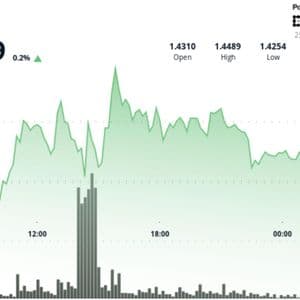
Price holds in tight range after high-volume move, with compression signaling a decisive move as institutional demand quietly builds.
25 Apr 2026, 05:32
Project Eleven’s Bitcoin Prize Triggers Fight Over Claimed Quantum Break of ECC

Project Eleven paid 1 BTC to researcher Giancarlo Lelli, worth a massive $78,000. Lelli had claimed a 15-bit quantum break of elliptic curve cryptography. Developers and researchers said the recovery came from classical guessing and filtering. Project Eleven awarded independent researcher Giancarlo Lelli a 1 BTC prize, worth about $78,000, after claiming he completed the largest public quantum attack on elliptic curve cryptography (ECC) so far. The company said Lelli recovered a 15-bit elliptic curve private key from its public key using a publicly available quantum computer and a version of Shor’s algorithm. The attack covered a search space of 32,767 combinations. Project Eleven called it a 512x jump from the previous public result. The earlier benchmark came in September 2025, when engineer Steve Tippeconnic reportedly broke a 6-bit ECC key on IBM’s 133-q… Read The Full Article Project Eleven’s Bitcoin Prize Triggers Fight Over Claimed Quantum Break of ECC On Coin Edition .
25 Apr 2026, 05:30
Spot ETH ETFs Surge Back to Net Inflows of $23.4M, Reversing Outflows
BitcoinWorld Spot ETH ETFs Surge Back to Net Inflows of $23.4M, Reversing Outflows U.S. spot Ethereum exchange-traded funds (ETFs) returned to net inflows on April 24, 2025, after a single day of outflows. Data from Farside Investors confirms a total net inflow of approximately $23.4 million . This reversal marks a significant shift in investor sentiment for spot ETH ETFs. Spot ETH ETFs See $23.4M Net Inflow The return to net inflows follows a brief pause. On April 23, the same funds recorded net outflows. The new data shows that investor confidence in Ethereum-based products remains resilient. Spot ETH ETFs have experienced volatile flows since their launch, but this latest data suggests a potential stabilization. Specifically, the inflows were driven by strong demand for one BlackRock product. BlackRock’s ETHB fund added $32.3 million in new capital. In contrast, BlackRock’s ETHA fund saw outflows of $7.7 million . Fidelity’s FETH product also experienced a minor outflow of $1.2 million . This mixed performance highlights the competitive landscape among Ethereum ETF issuers. Investors are clearly differentiating between various fund structures and fee schedules. BlackRock and Fidelity Flows Analyzed The divergence between BlackRock’s two Ethereum ETF products is notable. ETHA, which launched earlier, saw net outflows. ETHB, a newer or differently structured product, attracted the majority of the day’s capital. Fidelity FETH outflows were minimal, suggesting stable investor holding patterns. Market analysts attribute this to tactical rebalancing. Some investors may be moving capital from ETHA to ETHB to capture lower expense ratios or different exposure mechanisms. This behavior is common in the early stages of ETF market development. What Drove the Inflow Reversal? Several factors likely contributed to the return of net inflows. First, broader cryptocurrency market sentiment improved on April 24. Bitcoin prices rose, lifting the entire digital asset sector. Second, institutional investors may have viewed the previous day’s outflows as a buying opportunity. Third, positive regulatory news regarding Ethereum staking in ETFs could have boosted confidence. Data from CoinShares shows that digital asset investment products overall saw inflows of $130 million for the week ending April 25. Ethereum products captured a significant portion of that capital. This aligns with the spot ETH ETF data from Farside Investors. Timeline of Spot ETH ETF Flows Understanding the recent flow history provides context. Since their launch in July 2024, spot ETH ETFs have accumulated over $1.5 billion in net assets. However, flows have been choppy. Periods of strong inflows often follow brief outflows. April 22: Net inflows of $45 million. April 23: Net outflows of $12 million. April 24: Net inflows of $23.4 million. This pattern suggests a market that is still finding equilibrium. Large, single-day swings are expected as institutional investors adjust positions. Impact on Ethereum Market The return to net inflows for spot ETH ETFs has a direct impact on Ethereum’s price and market structure. When ETF issuers buy ETH to back new shares, it creates real demand for the underlying asset. This buying pressure can support or increase Ethereum’s market price. Furthermore, ETF flows serve as a sentiment indicator. Positive inflows signal institutional confidence. This encourages other investors to enter the market. The $23.4 million inflow on April 24 is a modest but positive signal. Expert Perspectives on ETF Flows Industry experts view the data as a healthy sign for the Ethereum ecosystem. James Butterfill, Head of Research at CoinShares, notes that ‘Ethereum ETFs are maturing. We are seeing more rational flow patterns compared to the initial launch volatility.’ Another analyst, who requested anonymity, stated: ‘The fact that flows reversed so quickly after a single day of outflows shows strong underlying demand. This is not a market that is losing interest in Ethereum.’ Comparison with Bitcoin ETF Flows Spot Bitcoin ETFs continue to dominate the market in terms of total assets. However, Ethereum ETFs are gaining ground. On April 24, Bitcoin ETFs recorded net inflows of $110 million. The Ethereum ETF inflow of $23.4 million represents about 21% of Bitcoin’s flow. This ratio is higher than the historical average of 15-18%. It suggests that investor appetite for Ethereum exposure is growing relative to Bitcoin. This could be driven by expectations of Ethereum network upgrades or staking yield integration. What This Means for Investors For retail and institutional investors, the return to net inflows for spot ETH ETFs offers several takeaways. First, the asset class remains liquid and accessible. Second, short-term outflows should not be interpreted as a trend reversal. Third, product selection matters—different ETFs from the same issuer can have very different flow patterns. Investors should monitor flow data from providers like Farside Investors. This data provides real-time insight into market sentiment. Combining flow data with on-chain metrics offers a comprehensive view of Ethereum’s investment landscape. Conclusion U.S. spot ETH ETFs returned to net inflows of $23.4 million on April 24, 2025, reversing the previous day’s outflows. BlackRock’s ETHB fund led the inflows, while ETHA and Fidelity FETH saw minor outflows. This data confirms that institutional demand for Ethereum exposure remains strong. The mixed performance across products highlights the importance of fund selection. Investors should continue to track spot ETH ETF flows as a key indicator of market sentiment and capital allocation trends in the digital asset space. FAQs Q1: What are spot ETH ETFs? Spot ETH ETFs are exchange-traded funds that directly hold Ethereum (ETH) as the underlying asset. They allow investors to gain exposure to Ethereum’s price without owning the cryptocurrency directly. Q2: Why did spot ETH ETFs see a return to net inflows on April 24? The return to net inflows was driven by strong demand for BlackRock’s ETHB fund, which added $32.3 million. Positive market sentiment and institutional buying contributed to the reversal. Q3: How do ETF inflows affect Ethereum’s price? ETF inflows create real demand for ETH because issuers must purchase the underlying asset to back new shares. This buying pressure can support or increase Ethereum’s market price. Q4: Which Ethereum ETF saw the largest outflow on April 24? BlackRock’s ETHA fund recorded the largest outflow at $7.7 million. Fidelity’s FETH saw a smaller outflow of $1.2 million. Q5: Where can I track real-time spot ETH ETF flow data? Farside Investors provides daily net flow data for all U.S.-listed spot ETH ETFs. Their data is widely used by analysts and media outlets. This post Spot ETH ETFs Surge Back to Net Inflows of $23.4M, Reversing Outflows first appeared on BitcoinWorld .
25 Apr 2026, 05:25
Bitcoin Spot ETF Inflows Surge: US Funds See 9th Consecutive Day of Positive Flows, Reaching $14.4M
BitcoinWorld Bitcoin Spot ETF Inflows Surge: US Funds See 9th Consecutive Day of Positive Flows, Reaching $14.4M U.S. spot Bitcoin ETFs have recorded their ninth consecutive day of net inflows, a streak that signals sustained institutional demand for digital assets. On April 24, these funds collectively attracted approximately $14.4 million in new capital, according to data from Farside Investors. This milestone underscores a broader shift in investor sentiment toward regulated cryptocurrency exposure. Bitcoin Spot ETF Inflows: A Closer Look at the April 24 Data The $14.4 million net inflow on April 24 continues a remarkable run for the U.S. spot Bitcoin ETF market. To understand the full picture, it is essential to examine the performance of individual funds. The data reveals a clear divergence among issuers. BlackRock (IBIT) : +$22.9 million — the largest single-day inflow among all funds. Morgan Stanley (MSBT) : +$11.1 million — a strong showing from a new entrant. Fidelity (FBTC) : -$1.7 million — a minor outflow, breaking its recent positive streak. Bitwise (BITB) : -$8.9 million — the largest outflow of the day. Ark Invest (ARKB) : -$9.0 million — also experienced net redemptions. This breakdown highlights that while the overall market remains bullish, investor preferences vary significantly. BlackRock’s IBIT continues to dominate, attracting over $22 million despite outflows from other major players. Morgan Stanley’s new fund, MSBT, also posted strong gains, suggesting that financial advisors are diversifying their Bitcoin ETF allocations. What Drives the Sustained Bitcoin ETF Inflows? The nine-day inflow streak reflects several converging factors. First, macroeconomic conditions have become more favorable for risk assets. The U.S. Federal Reserve’s recent signals of a potential pause in interest rate hikes have reduced the opportunity cost of holding non-yielding assets like Bitcoin. Second, the approval of spot Bitcoin ETFs by the SEC in January 2024 has opened the door for institutional capital that was previously sidelined due to regulatory uncertainty. Furthermore, the recent Bitcoin halving event in April 2024 has historically been a catalyst for price appreciation. Miners now receive half the block reward, reducing the supply of new Bitcoin entering the market. This supply shock, combined with steady ETF demand, creates a powerful upward pressure on prices. Institutional Adoption as a Key Driver Data from Farside Investors also shows that the cumulative net inflows for U.S. spot Bitcoin ETFs now exceed $12 billion since their launch. This figure is a testament to the depth of institutional demand. Major financial institutions, including BlackRock, Fidelity, and Morgan Stanley, are not just offering these products; they are actively marketing them to their high-net-worth clients. This trend is expected to accelerate as more registered investment advisors (RIAs) and pension funds gain comfort with the asset class. According to a recent report by CoinShares, digital asset investment products saw $1.8 billion in inflows in the week ending April 21, with Bitcoin products accounting for 94% of the total. This global trend aligns perfectly with the U.S. spot ETF data, reinforcing the narrative of a broad-based institutional rotation into Bitcoin. Comparative Analysis: U.S. Spot Bitcoin ETFs vs. Global Counterparts While U.S. spot Bitcoin ETFs lead the world in terms of daily volume and total assets under management, other markets are also seeing significant activity. For instance, Hong Kong launched its own spot Bitcoin and Ethereum ETFs in April 2024, attracting $300 million in the first week. However, the U.S. market remains the primary driver of global Bitcoin ETF flows due to its liquidity and the size of its investor base. The following table compares the top U.S. spot Bitcoin ETFs by cumulative inflows: ETF Name Ticker Cumulative Net Inflows (Since Launch) BlackRock iShares Bitcoin Trust IBIT $8.2 Billion Fidelity Wise Origin Bitcoin Fund FBTC $3.5 Billion Bitwise Bitcoin ETF BITB $1.1 Billion Ark 21Shares Bitcoin ETF ARKB $900 Million Morgan Stanley Bitcoin ETF MSBT $200 Million This data shows that BlackRock’s IBIT has captured more than half of all inflows, establishing itself as the dominant player. Its success is attributed to its strong brand, low fees, and extensive distribution network. Impact on Bitcoin Price and Market Sentiment The sustained Bitcoin spot ETF inflows have had a direct and measurable impact on Bitcoin’s price. Over the nine-day inflow period, Bitcoin’s price rose from $65,000 to $68,500, a gain of approximately 5.4%. This correlation is not coincidental. Each ETF inflow represents the purchase of actual Bitcoin by the fund’s custodian, creating real buying pressure in the spot market. Moreover, the inflows have improved market sentiment. The Crypto Fear & Greed Index, a popular sentiment indicator, has moved from ‘Neutral’ (52) to ‘Greed’ (68) during this period. This shift suggests that investors are becoming more confident in the sustainability of the current bull market. Expert Perspective: What Analysts Are Saying Market analysts view the nine-day streak as a strong signal of institutional conviction. “This is not retail speculation; this is pension funds and endowments allocating to Bitcoin through a regulated vehicle,” says James Butterfill, Head of Research at CoinShares. “The consistency of the inflows, even on days when Bitcoin’s price is flat, indicates that buyers are accumulating, not trading.” Similarly, Bloomberg ETF analyst Eric Balchunas notes that the U.S. spot Bitcoin ETFs are on track to surpass gold ETFs in assets under management within the next 12 months. “If this pace continues, Bitcoin ETFs will become the most successful ETF launch in history,” he stated in a recent interview. Risks and Considerations for Investors Despite the positive trend, investors should remain aware of the risks associated with Bitcoin ETFs. The primary risk is Bitcoin’s inherent volatility. Even with strong inflows, Bitcoin can experience sharp corrections. For example, in March 2024, Bitcoin fell 15% in a single week despite continued ETF inflows, demonstrating that price and flows are not perfectly correlated. Additionally, the regulatory landscape remains fluid. While the SEC has approved spot Bitcoin ETFs, it continues to scrutinize the broader crypto industry. Any adverse regulatory action could impact market sentiment and ETF flows. Investors should also consider the fees associated with these ETFs, which range from 0.19% to 1.50% annually, and choose products that align with their cost and liquidity needs. Future Outlook: Will the Inflow Streak Continue? The question on every investor’s mind is whether this nine-day inflow streak can extend further. Based on historical patterns, such streaks often continue until a significant macroeconomic or geopolitical event disrupts market confidence. The upcoming U.S. presidential election in November 2024 could be a catalyst for either increased inflows (if the candidate is perceived as pro-crypto) or outflows (if regulatory uncertainty increases). Furthermore, the potential approval of spot Ethereum ETFs in the U.S. could divert some capital away from Bitcoin ETFs. However, most analysts believe that the Bitcoin ETF market has sufficient depth to absorb any outflows. The long-term trend remains positive, driven by demographic shifts toward digital assets and the increasing acceptance of Bitcoin as a portfolio diversifier. Conclusion The ninth consecutive day of net inflows for U.S. spot Bitcoin ETFs on April 24, totaling $14.4 million, confirms a powerful institutional demand trend. BlackRock’s IBIT and Morgan Stanley’s MSBT led the day, while Fidelity, Bitwise, and Ark Invest saw minor outflows. This sustained buying pressure supports Bitcoin’s price and signals growing mainstream acceptance. As the market matures, Bitcoin spot ETF inflows will likely remain a key indicator of institutional sentiment and a driver of the broader cryptocurrency market. Investors should monitor these flows closely, as they provide a transparent window into the real demand for digital assets. FAQs Q1: What is a spot Bitcoin ETF? A spot Bitcoin ETF is an exchange-traded fund that holds actual Bitcoin as its underlying asset. Investors buy shares of the ETF, which trades on a stock exchange, giving them exposure to Bitcoin’s price without needing to directly purchase, store, or secure the cryptocurrency. Q2: Why are Bitcoin spot ETF inflows important? Bitcoin spot ETF inflows are important because they represent direct institutional buying pressure. When an ETF receives inflows, the fund manager must purchase more Bitcoin to back the new shares. This creates real demand in the Bitcoin market, often leading to price appreciation. Q3: Which U.S. spot Bitcoin ETF has the most inflows? BlackRock’s iShares Bitcoin Trust (IBIT) has the most cumulative inflows since launch, exceeding $8.2 billion. It is the largest and most liquid spot Bitcoin ETF in the United States. Q4: How do Bitcoin ETF inflows affect Bitcoin’s price? Bitcoin ETF inflows generally have a positive effect on Bitcoin’s price because they represent new demand. However, the relationship is not always immediate or linear. Other factors, such as macroeconomic news, regulatory developments, and overall market sentiment, also influence price. Q5: Are Bitcoin spot ETFs safe for retail investors? Bitcoin spot ETFs are considered safer than directly buying Bitcoin from unregulated exchanges because they are issued by reputable financial institutions and trade on regulated stock exchanges. However, they still carry the inherent volatility risk of Bitcoin. Investors should only invest money they can afford to lose. This post Bitcoin Spot ETF Inflows Surge: US Funds See 9th Consecutive Day of Positive Flows, Reaching $14.4M first appeared on BitcoinWorld .
25 Apr 2026, 05:15
SHIB and PNUT Face Volatility As $1.09T Binance Volume Signals Shift – APEMARS Leads Top 1000x Crypto Presale Narrative

Is the crypto market entering a phase where liquidity is no longer expanding broadly, but concentrating into a few dominant trading hubs and selective opportunities? Shiba Inu and Peanut the Squirrel continue to reflect fragmented meme coin behavior, where price action is driven by sentiment swings and short-term speculation. Meanwhile, Bitcoin and Ethereum stability around recent ranges adds a cautious undertone to the broader market structure. The newest findings on Best Crypto To Buy Now outline developing crypto trends. APEMARS enters this environment as a structured early-stage alternative, positioned as the top 1000x crypto presale , as Binance records a massive $1.09 trillion trading volume showing that capital is still active, but rotating with precision rather than spreading evenly across assets. APEMARS Mission Update: Operation Red Banana Drives Structured Momentum APEMARS is currently priced at $0.000254380 in Stage 17, with a projected listing target of $0.0055, creating a clear presale pricing gap that reflects structured early-stage positioning rather than speculation-based valuation jumps. The project’s ecosystem is built around Operation Red Banana, a 23-stage presale narrative inspired by a 225-million-kilometer journey from Earth to Mars. Each stage represents a progression milestone in Commander Ape’s mission, turning participation into a structured timeline rather than a random market entry. With 1,650 holders, $438,000 raised, and 23B tokens sold, APEMARS is building early traction while still in its presale phase, reinforcing its positioning as the top 1000x crypto presale for early-stage participants. $5,000 Investment Strategy on APEMARS A $5,000 allocation at APEMARS Stage 17 pricing of $0.000254380 provides early exposure before the projected listing valuation of $0.0055, creating a theoretical ROI framework of 2,062% if staged progression reaches full realization. At listing projection, this position scales significantly in value compared to entry cost, reflecting structured early-stage entry dynamics. With the MARS150 bonus, allocation exposure increases by 150%, turning a $5,000 entry into $12,500 in effective presale exposure, amplifying token accumulation at Stage 17 pricing. This positions participants not just for token exposure but for amplified upside potential if market conditions align with early-stage presale expansion cycles, reinforcing APEMARS as a top 1000x crypto presale contender. How to Buy APEMARS Presale (APrz Guide) Connect Your Wallet Choose Your Payment Method Enter the Amount You Want to Buy Add a Referral Code (Optional) Complete the Transaction Market News: Binance $1.09T Volume Shows Liquidity Concentration Trend Recent market data shows Binance reaching $1.09 trillion in trading volume, signaling that crypto liquidity is not leaving the market, but instead concentrating into dominant execution hubs. This shift highlights a key structural change in crypto behavior: rather than broad retail expansion, liquidity is clustering where execution speed, depth, and derivatives infrastructure are strongest. This environment reinforces why early-stage positioning matters, especially for narratives like the top 1000x crypto presale, where capital rotation often begins before mainstream awareness builds. While Bitcoin and Ethereum continue to stabilize broader sentiment, liquidity concentration suggests traders are becoming more selective, focusing on high-efficiency zones rather than fragmented speculation. Shiba Inu Market Overview: Meme Cycle Stability with Slow Volatility Shiba Inu (SHIB) is currently trading around $0.00000605, showing a +1.85% daily move but a -10% weekly decline, with a market cap near $3.6 billion. Despite short-term fluctuations, SHIB continues to represent a mature meme coin cycle where growth is slower and largely dependent on broader market sentiment rather than early-stage expansion. Daily trading volume remains around $107 million, reflecting consistent participation but limited breakout momentum compared to earlier cycles. In contrast, early-stage opportunities like APEMARS continue to position themselves as the top 1000x crypto presale, targeting pre-liquidity entry phases rather than post-viral valuation stages. Peanut the Squirrel (PNUT) Price Action: High Volatility Meme Rotation Peanut the Squirrel (PNUT) trades around $0.0534, down 6% in the last hour and 23% over the past week, with a market cap of approximately $53 million. The token remains highly volatile, having dropped significantly from its previous peak of $2.44, reflecting the rapid rotation nature of meme-driven assets. With $1 million daily trading volume, PNUT continues to attract short-term speculative activity but lacks sustained structural momentum. This contrast highlights why structured entry models like APEMARS stand out in the current environment, reinforcing its positioning as a top 1000x crypto presale with clearer progression mechanics. Conclusion: As Binance drives over $1.09 trillion in volume and meme coins like Shiba Inu and Peanut the Squirrel continue to rotate through volatility cycles, the market is clearly splitting between liquidity concentration and speculative fragmentation. In this environment, APEMARS offers a structured alternative built around early-stage access, defined progression, and transparent pricing mechanics at Stage 17. For participants looking beyond reactive meme cycles and toward structured early entry opportunities, APEMARS continues to position itself as a leading top 1000x crypto presale narrative in the current market phase. For More Information: Website: Visit the Official APEMARS Website Telegram: Join the APEMARS Telegram Channel Twitter: Follow APEMARS ON X (Formerly Twitter) FAQs About The Top 1000x Crypto Presale What is APEMARS Stage 17 price? Stage 17 is priced at $0.000254380 with a projected listing price of $0.0055. Is Shiba Inu still a high-growth meme coin? Shiba Inu remains active but shows slower growth compared to early-stage meme cycles. Why is Peanut the Squirrel so volatile? PNUT is driven mainly by sentiment trading and low-cap liquidity shifts. What makes APEMARS different from meme coins? APEMARS uses structured stages, fixed pricing progression, and presale phases instead of open-market volatility. Why is Binance volume important? High Binance volume shows liquidity is still active but concentrating into major trading hubs. Summary APEMARS introduces structured presale access during a market where liquidity is concentrating into major exchanges like Binance, while SHIB and PNUT reflect fragmented meme volatility cycles. This contrast strengthens the case for early-stage positioning in structured opportunities like APEMARS Stage 17. Disclaimer: This is a sponsored press release for informational purposes only. It does not reflect the views of Times Tabloid, nor is it intended to be used as legal, tax, investment, or financial advice. Times Tabloid is not responsible for any financial losses. The post SHIB and PNUT Face Volatility As $1.09T Binance Volume Signals Shift – APEMARS Leads Top 1000x Crypto Presale Narrative appeared first on Times Tabloid .


