


 Invest ideas
News
20 Apr 2026, 12:57
Bitmine buys 101,627 ether worth over $230 million, its largest weekly haul of 2026

The Ethereum treasury firm is nearing 5 million ETH holdings as it increased its accumulation pace over the past weeks.
20 Apr 2026, 12:56
Bitmine Immersion Technologies (BMNR) Announces ETH Holdings Reach 4.976 Million Tokens, and Total Crypto and Total Cash Holdings of $12.9 Billion
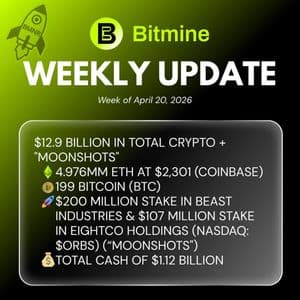
Bitmine now owns more than 4% of the total ETH coin supply of 120.7 million Bitmine is 82% of the way to the 'Alchemy of 5%' in just 9 months Ethereum continues to benefit from the dual tailwinds of Wall Street tokenizing on the blockchain and from agentic AI systems increasingly needing public and neutral blockchains Bitmine uplisted to the New York Stock Exchange ("NYSE") from the NYSE American effective as of April 9, 2026 Bitmine has 3,334,637 staked ETH, representing $7.7 billion at $2,301 per ETH MAVAN (Made in America VAlidator Network) is a premier Ethereum staking destination for BMNR and institutional investors, with a focus on security, performance, and resilience Bitmine owns $107 million of Eightco (NASDAQ-ORBS), now one of the only publicly listed equities in the world to give investors direct exposure to OpenAI Bitmine Crypto + Total Cash Holdings + "Moonshots" total $12.9 billion, including 4.976 million ETH tokens, total cash of $1.12 billion, and other crypto holdings Bitmine leads crypto treasury peers by both the velocity of raising crypto NAV per share and by the high trading liquidity of BMNR stock Bitmine is the 80th most traded stock in the US, trading $1.2 billion per day (5-day avg) Bitmine remains supported by a premier group of institutional investors including ARK's Cathie Wood, MOZAYYX, Founders Fund, Bill Miller III, Pantera, Kraken, DCG, Galaxy Digital and personal investor Thomas "Tom" Lee to support Bitmine's goal of acquiring 5% of ETH NORWALK, Conn., April 20, 2026 /PRNewswire/ -- (NYSE: BMNR) Bitmine Immersion Technologies, Inc. ("Bitmine" or the "Company") a Bitcoin and Ethereum Network company with a focus on the accumulation of crypto for long term investment, today announced Bitmine crypto + total cash + "moonshots" holdings totaling $12.9 billion. The Company recently announced its uplisting to the New York Stock Exchange ("NYSE") from the NYSE American on April 9, 2026. The Company's common stock continues to trade under the symbol "BMNR". As of April 19, 2026 at 4:00pm ET, the Company's crypto holdings are comprised of 4,976,485 ETH at $2,301 per ETH (Coinbase NASDAQ: COIN), 199 Bitcoin (BTC), $200 million stake in Beast Industries, $107 million stake in Eightco Holdings (NASDAQ: ORBS) ("moonshots") and total cash of $1.12 billion. Bitmine's ETH holdings are 4.12% of the ETH supply (of 120.7 million ETH). "We see growing signs that the 'mini-crypto' winter is coming to an end. As downside tail risks for the US-Iran war diminish, ETH has risen 41% from its early February lows. And ETH has outperformed the S&P 500 by 2,280 basis points since the war started and remains the single best performing asset in the world (beside crude oil prices). Ethereum continues to benefit from the dual tailwinds of Wall Street tokenizing on the blockchain and from agentic AI systems increasingly needing public and neutral blockchains. In our view, there is a lot of meaning to ETH being the best 'war-time store of value' and to ETH being the asset leading since the war started," said Thomas "Tom" Lee, Chairman of Bitmine. "While many believe the crypto winter may last through the Fall of 2026, our view remains that the crypto winter is much closer to ending. Every major crypto winter since 2015 has coincided with an equity drawdown of at least 20%. In fact, the 2025 crypto drawdown moved in sync with the 20% decline in the S&P 500. But in 2026, the equity decline has been milder at -8%," continued Mr. Lee. "Bitmine has maintained the increased pace of ETH buys in each of the past four weeks, as our base case ETH is in the final stages of the 'mini-crypto winter.' In the past week, we acquired 101,627 ETH, which is the highest pace of buys since the week of December 15, 2025," stated Lee. Bitmine recently launched MAVAN (the Made in American VAlidator Network), the institutional grade staking platform. While MAVAN was originally developed to support Bitmine's own Ethereum treasury, MAVAN intends to expand to serve institutional investors, custodians, and ecosystem partners seeking best-in-class staking infrastructure. A portion of Bitmine's ETH is already staked on the MAVAN platform. As of April 20, 2026, Bitmine total staked ETH stands at 3,334,637 ($7.7 billion at $2,301 per ETH). "Bitmine has staked more ETH than other entities in the world. At scale (when Bitmine's ETH is fully staked by MAVAN and its staking partners), the projected ETH staking reward is $330 million annually (using 2.88% 7-day BMNR yield)," stated Lee. "Annualized staking revenues are now $221 million. And this 3.3 million ETH is about 67% of the 4.98 million ETH held by Bitmine. The CESR (Composite Ethereum Staking Rate, administered by Quatrefoil ) is 2.76%, while Bitmine's own staking operations generated a 7-day yield of 2.88% (annualized)," continued Lee. Bitmine crypto holding reigns as the #1 Ethereum treasury and #2 global treasury, behind Strategy Inc. (NASDAQ: MSTR), which reportedly owns 780,897 BTC valued at $58.2 billion. Bitmine remains the largest ETH treasury in the world. Bitmine is one of the most widely traded stocks in the US. According to data from Fundstrat, the stock has traded average daily dollar volume of $1.2 billion (5-day average, as of April 17, 2026), ranking #80 in the US, behind Uber Technologies (rank #79) and ahead of D-Wave Quantum (rank #81) among 5,704 US-listed stocks ( statista.com and Fundstrat research). The GENIUS Act and Securities and Exchange Commission's (the "SEC") Project Crypto are as transformational to financial services in 2025 as US action on August 15, 1971 ending Bretton Woods and the USD on the gold standard 54 years ago. This 1971 event was the catalyst for the modernization of Wall Street, creating the iconic Wall Street titans and financial and payment rails of today. These proved to be better investments than gold. The Chairman's message can be found here: https://www.Bitminetech.io/chairmans-message The Fiscal Full Year 2025 Earnings presentation and corporate presentation can be found here: https://Bitminetech.io/investor-relations/ To stay informed, please sign up at: https://Bitminetech.io/contact-us/ About Bitmine Bitmine (NYSE: BMNR) is a Bitcoin miner with operations in the US. The company is deploying its excess capital to be the leading Ethereum Treasury company in the world, implementing an innovative digital asset strategy for institutional investors and public market participants. Guided by its philosophy of "the alchemy of 5%," the Company is committed to ETH as its primary treasury reserve asset, leveraging native protocol-level activities including staking and decentralized finance mechanisms. The Company launched MAVAN (Made-in America VAlidator Network), a dedicated staking infrastructure for Bitmine assets, in 2026. For additional details, follow on X: https://x.com/bitmnr https://x.com/fundstrat Forward Looking Statements This press release contains statements that constitute "forward-looking statements." The statements in this press release that are not purely historical are forward-looking statements which involve risks and uncertainties. This document specifically contains forward-looking statements regarding: (i) progress and achievement of the Company's goals regarding ETH acquisition, including the 'Alchemy of 5%' initiative and the long-term value of Ethereum; (ii) the Company's beliefs regarding Ethereum's performance relative to other assets, including its characterization as a "wartime store of value" and its performance during geopolitical events; (iii) the Company's expectations regarding the current state and future trajectory of the cryptocurrency market, including statements that ETH may be in the "final stages of the mini-crypto winter"; (iv) continued growth and advancement of the Company's Ethereum treasury strategy and the applicable benefits to the Company; (v) the Company's share repurchase program, including statements regarding shares trading below intrinsic value, the Company's ability to accretively retire common shares, and the execution of repurchases through open market transactions; (vi) the Company's digital asset accumulation strategy and staking operations, including MAVAN, its expansion to serve institutional investors, custodians, and ecosystem partners, and projected annual staking revenues and rewards; (vii) statements regarding the benefits of Wall Street tokenization on the blockchain and agentic AI systems utilizing public blockchains; (viii) expectations regarding the potential impact of regulatory developments, including the GENIUS Act and SEC Project Crypto, on financial services and digital assets; and (ix) the Company's financial flexibility to support its treasury operations and expanded repurchase authorization. In evaluating these forward-looking statements, you should consider various factors, including: Bitmine's ability to keep pace with new technology and changing market needs; Bitmine's ability to finance its current business, Ethereum treasury operations, share repurchase program, and proposed future business; the competitive environment of Bitmine's business; market conditions affecting the trading price of the Company's common stock; regulatory developments affecting digital assets, including the ultimate enactment and implementation of pending legislation and SEC initiatives; geopolitical events and their impact on cryptocurrency markets; the volatility and unpredictability of digital asset prices; and the future value of Bitcoin and Ethereum. Actual future performance outcomes and results may differ materially from those expressed in forward-looking statements. Forward-looking statements are subject to numerous conditions, many of which are beyond Bitmine's control, including those set forth in the Risk Factors section of Bitmine's Form 10-K filed with the SEC on November 21, 2025, as well as all other SEC filings, as amended or updated from time to time. Copies of Bitmine's filings with the SEC are available on the SEC's website at www.sec.gov . Bitmine undertakes no obligation to update these statements for revisions or changes after the date of this release, except as required by law. Disclaimer: This is a sponsored press release and is for informational purposes only. It does not reflect the views of Bitzo, nor is it intended to be used as legal, tax, investment, or financial advice.
20 Apr 2026, 12:56
Bitmine Immersion Technologies (BMNR) Announces ETH Holdings Reach 4.976 Million Tokens, and Total Crypto and Total Cash Holdings of $12.9 Billion
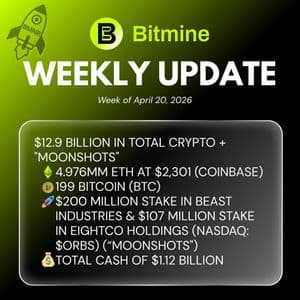
Bitmine now owns more than 4% of the total ETH coin supply of 120.7 million Bitmine is 82% of the way to the 'Alchemy of 5%' in just 9 months Ethereum continues to benefit from the dual tailwinds of Wall Street tokenizing on the blockchain and from agentic AI systems increasingly needing public and neutral blockchains Bitmine uplisted to the New York Stock Exchange ("NYSE") from the NYSE American effective as of April 9, 2026 Bitmine has 3,334,637 staked ETH, representing $7.7 billion at $2,301 per ETH MAVAN (Made in America VAlidator Network) is a premier Ethereum staking destination for BMNR and institutional investors, with a focus on security, performance, and resilience Bitmine owns $107 million of Eightco (NASDAQ-ORBS), now one of the only publicly listed equities in the world to give investors direct exposure to OpenAI Bitmine Crypto + Total Cash Holdings + "Moonshots" total $12.9 billion, including 4.976 million ETH tokens, total cash of $1.12 billion, and other crypto holdings Bitmine leads crypto treasury peers by both the velocity of raising crypto NAV per share and by the high trading liquidity of BMNR stock Bitmine is the 80th most traded stock in the US, trading $1.2 billion per day (5-day avg) Bitmine remains supported by a premier group of institutional investors including ARK's Cathie Wood, MOZAYYX, Founders Fund, Bill Miller III, Pantera, Kraken, DCG, Galaxy Digital and personal investor Thomas "Tom" Lee to support Bitmine's goal of acquiring 5% of ETH NORWALK, Conn., April 20, 2026 /PRNewswire/ -- (NYSE: BMNR) Bitmine Immersion Technologies, Inc. ("Bitmine" or the "Company") a Bitcoin and Ethereum Network company with a focus on the accumulation of crypto for long term investment, today announced Bitmine crypto + total cash + "moonshots" holdings totaling $12.9 billion. The Company recently announced its uplisting to the New York Stock Exchange ("NYSE") from the NYSE American on April 9, 2026. The Company's common stock continues to trade under the symbol "BMNR". As of April 19, 2026 at 4:00pm ET, the Company's crypto holdings are comprised of 4,976,485 ETH at $2,301 per ETH (Coinbase NASDAQ: COIN), 199 Bitcoin (BTC), $200 million stake in Beast Industries, $107 million stake in Eightco Holdings (NASDAQ: ORBS) ("moonshots") and total cash of $1.12 billion. Bitmine's ETH holdings are 4.12% of the ETH supply (of 120.7 million ETH). "We see growing signs that the 'mini-crypto' winter is coming to an end. As downside tail risks for the US-Iran war diminish, ETH has risen 41% from its early February lows. And ETH has outperformed the S&P 500 by 2,280 basis points since the war started and remains the single best performing asset in the world (beside crude oil prices). Ethereum continues to benefit from the dual tailwinds of Wall Street tokenizing on the blockchain and from agentic AI systems increasingly needing public and neutral blockchains. In our view, there is a lot of meaning to ETH being the best 'war-time store of value' and to ETH being the asset leading since the war started," said Thomas "Tom" Lee, Chairman of Bitmine. "While many believe the crypto winter may last through the Fall of 2026, our view remains that the crypto winter is much closer to ending. Every major crypto winter since 2015 has coincided with an equity drawdown of at least 20%. In fact, the 2025 crypto drawdown moved in sync with the 20% decline in the S&P 500. But in 2026, the equity decline has been milder at -8%," continued Mr. Lee. "Bitmine has maintained the increased pace of ETH buys in each of the past four weeks, as our base case ETH is in the final stages of the 'mini-crypto winter.' In the past week, we acquired 101,627 ETH, which is the highest pace of buys since the week of December 15, 2025," stated Lee. Bitmine recently launched MAVAN (the Made in American VAlidator Network), the institutional grade staking platform. While MAVAN was originally developed to support Bitmine's own Ethereum treasury, MAVAN intends to expand to serve institutional investors, custodians, and ecosystem partners seeking best-in-class staking infrastructure. A portion of Bitmine's ETH is already staked on the MAVAN platform. As of April 20, 2026, Bitmine total staked ETH stands at 3,334,637 ($7.7 billion at $2,301 per ETH). "Bitmine has staked more ETH than other entities in the world. At scale (when Bitmine's ETH is fully staked by MAVAN and its staking partners), the projected ETH staking reward is $330 million annually (using 2.88% 7-day BMNR yield)," stated Lee. "Annualized staking revenues are now $221 million. And this 3.3 million ETH is about 67% of the 4.98 million ETH held by Bitmine. The CESR (Composite Ethereum Staking Rate, administered by Quatrefoil ) is 2.76%, while Bitmine's own staking operations generated a 7-day yield of 2.88% (annualized)," continued Lee. Bitmine crypto holding reigns as the #1 Ethereum treasury and #2 global treasury, behind Strategy Inc. (NASDAQ: MSTR), which reportedly owns 780,897 BTC valued at $58.2 billion. Bitmine remains the largest ETH treasury in the world. Bitmine is one of the most widely traded stocks in the US. According to data from Fundstrat, the stock has traded average daily dollar volume of $1.2 billion (5-day average, as of April 17, 2026), ranking #80 in the US, behind Uber Technologies (rank #79) and ahead of D-Wave Quantum (rank #81) among 5,704 US-listed stocks ( statista.com and Fundstrat research). The GENIUS Act and Securities and Exchange Commission's (the "SEC") Project Crypto are as transformational to financial services in 2025 as US action on August 15, 1971 ending Bretton Woods and the USD on the gold standard 54 years ago. This 1971 event was the catalyst for the modernization of Wall Street, creating the iconic Wall Street titans and financial and payment rails of today. These proved to be better investments than gold. The Chairman's message can be found here: https://www.Bitminetech.io/chairmans-message The Fiscal Full Year 2025 Earnings presentation and corporate presentation can be found here: https://Bitminetech.io/investor-relations/ To stay informed, please sign up at: https://Bitminetech.io/contact-us/ About Bitmine Bitmine (NYSE: BMNR) is a Bitcoin miner with operations in the US. The company is deploying its excess capital to be the leading Ethereum Treasury company in the world, implementing an innovative digital asset strategy for institutional investors and public market participants. Guided by its philosophy of "the alchemy of 5%," the Company is committed to ETH as its primary treasury reserve asset, leveraging native protocol-level activities including staking and decentralized finance mechanisms. The Company launched MAVAN (Made-in America VAlidator Network), a dedicated staking infrastructure for Bitmine assets, in 2026. For additional details, follow on X: https://x.com/bitmnr https://x.com/fundstrat Forward Looking Statements This press release contains statements that constitute "forward-looking statements." The statements in this press release that are not purely historical are forward-looking statements which involve risks and uncertainties. This document specifically contains forward-looking statements regarding: (i) progress and achievement of the Company's goals regarding ETH acquisition, including the 'Alchemy of 5%' initiative and the long-term value of Ethereum; (ii) the Company's beliefs regarding Ethereum's performance relative to other assets, including its characterization as a "wartime store of value" and its performance during geopolitical events; (iii) the Company's expectations regarding the current state and future trajectory of the cryptocurrency market, including statements that ETH may be in the "final stages of the mini-crypto winter"; (iv) continued growth and advancement of the Company's Ethereum treasury strategy and the applicable benefits to the Company; (v) the Company's share repurchase program, including statements regarding shares trading below intrinsic value, the Company's ability to accretively retire common shares, and the execution of repurchases through open market transactions; (vi) the Company's digital asset accumulation strategy and staking operations, including MAVAN, its expansion to serve institutional investors, custodians, and ecosystem partners, and projected annual staking revenues and rewards; (vii) statements regarding the benefits of Wall Street tokenization on the blockchain and agentic AI systems utilizing public blockchains; (viii) expectations regarding the potential impact of regulatory developments, including the GENIUS Act and SEC Project Crypto, on financial services and digital assets; and (ix) the Company's financial flexibility to support its treasury operations and expanded repurchase authorization. In evaluating these forward-looking statements, you should consider various factors, including: Bitmine's ability to keep pace with new technology and changing market needs; Bitmine's ability to finance its current business, Ethereum treasury operations, share repurchase program, and proposed future business; the competitive environment of Bitmine's business; market conditions affecting the trading price of the Company's common stock; regulatory developments affecting digital assets, including the ultimate enactment and implementation of pending legislation and SEC initiatives; geopolitical events and their impact on cryptocurrency markets; the volatility and unpredictability of digital asset prices; and the future value of Bitcoin and Ethereum. Actual future performance outcomes and results may differ materially from those expressed in forward-looking statements. Forward-looking statements are subject to numerous conditions, many of which are beyond Bitmine's control, including those set forth in the Risk Factors section of Bitmine's Form 10-K filed with the SEC on November 21, 2025, as well as all other SEC filings, as amended or updated from time to time. Copies of Bitmine's filings with the SEC are available on the SEC's website at www.sec.gov . Bitmine undertakes no obligation to update these statements for revisions or changes after the date of this release, except as required by law. Disclaimer: This is a sponsored press release and is for informational purposes only. It does not reflect the views of Crypto Daily, nor is it intended to be used as legal, tax, investment, or financial advice.
20 Apr 2026, 12:55
MicroStrategy Bitcoin Purchase: Strategic $2.54 Billion Acquisition of 34,164 BTC Defines Corporate Treasury Trend

BitcoinWorld MicroStrategy Bitcoin Purchase: Strategic $2.54 Billion Acquisition of 34,164 BTC Defines Corporate Treasury Trend In a landmark move for institutional cryptocurrency adoption, business intelligence firm MicroStrategy Incorporated has executed another massive Bitcoin acquisition. The company purchased an additional 34,164 BTC for approximately $2.54 billion, according to an official filing with the U.S. Securities and Exchange Commission on June 15, 2025. This strategic purchase significantly expands MicroStrategy’s position as the world’s largest publicly traded corporate holder of Bitcoin. Consequently, this action reinforces a growing trend of balance sheet diversification into digital assets. The transaction’s scale immediately drew analysis from financial markets and crypto industry observers worldwide. MicroStrategy Bitcoin Purchase Details and Financial Context MicroStrategy completed the purchase of 34,164 Bitcoin between May 1 and June 14, 2025. The company funded the $2.54 billion acquisition using proceeds from a recent convertible debt offering and excess cash. The average purchase price was approximately $74,400 per Bitcoin. This latest acquisition brings MicroStrategy’s total Bitcoin holdings to over 250,000 BTC. The company’s aggregate investment now exceeds $15 billion at an average price of roughly $60,000 per coin. MicroStrategy’s corporate strategy, championed by Executive Chairman Michael Saylor, explicitly treats Bitcoin as a primary treasury reserve asset. The firm began this strategy in August 2020. Since then, it has consistently added to its position through market purchases and debt-financed acquisitions. This approach contrasts sharply with traditional corporate treasury management, which typically relies on cash, government bonds, and other low-yield instruments. Corporate Bitcoin Treasury Strategy Evolution The concept of corporate Bitcoin treasuries has evolved significantly since 2020. Initially, MicroStrategy stood alone as a public company making such a substantial commitment. However, several other firms have since followed, albeit on a smaller scale. Companies like Tesla, Block, and Marathon Digital Holdings now hold Bitcoin on their balance sheets. This trend represents a fundamental shift in how some executives view capital allocation and inflation hedging. Michael Saylor frequently articulates the rationale behind this strategy. He describes Bitcoin as “digital property” and a superior store of value compared to fiat currencies. Saylor argues that traditional cash holdings lose purchasing power due to monetary inflation. Conversely, he positions Bitcoin with a finite supply of 21 million coins as a hedge against this devaluation. This philosophy has become central to MicroStrategy’s investor communications and corporate identity. Market Impact and Institutional Adoption Signals MicroStrategy’s purchase immediately impacted Bitcoin’s market liquidity and price discovery. Large over-the-counter (OTC) trades of this magnitude typically occur through private desks to minimize market slippage. The announcement provided a bullish signal to other institutional investors. Market analysts noted increased buying activity from exchange-traded funds and large wallets following the news. The purchase also highlights the maturation of institutional-grade cryptocurrency infrastructure. Secure custody solutions, regulatory accounting standards, and treasury management tools now support such large-scale allocations. Furthermore, the ability to use debt instruments like convertible notes to fund Bitcoin acquisitions demonstrates growing acceptance within traditional capital markets. This development marks a significant milestone for cryptocurrency integration into mainstream finance. Financial Reporting and Shareholder Considerations Under U.S. Generally Accepted Accounting Principles (GAAP), MicroStrategy must treat its Bitcoin holdings as indefinite-lived intangible assets. This accounting treatment means the company cannot record unrealized gains on its balance sheet. However, it must record impairment charges if Bitcoin’s market price falls below the carrying value at any quarter’s end. This asymmetric accounting has been a point of discussion among investors and accounting standards boards. MicroStrategy provides shareholders with detailed non-GAAP disclosures showing the current market value of its Bitcoin treasury. The company’s stock price has become highly correlated with Bitcoin’s price movements. Consequently, many investors now view MSTR shares as a proxy for Bitcoin exposure within a traditional equity structure. This dynamic creates a unique investment vehicle that combines corporate operations with digital asset speculation. Regulatory Environment and Future Outlook The regulatory landscape for corporate Bitcoin holdings continues to develop. The Securities and Exchange Commission monitors disclosures related to cryptocurrency investments. The Financial Accounting Standards Board has proposed new rules for digital asset accounting. These rules could allow companies to report fair value changes, potentially reducing earnings volatility. Looking forward, analysts will watch whether other S&P 500 companies adopt similar strategies. Broader adoption depends on several factors. Regulatory clarity, improved custody solutions, and demonstrated long-term performance will be crucial. MicroStrategy’s ongoing experiment provides a real-world case study for other corporate treasurers evaluating digital assets. Comparative Corporate Bitcoin Holdings (As of June 2025) The table below illustrates how MicroStrategy’s position compares to other notable public company holders. Company Bitcoin Holdings (Approx.) Estimated Value (USD) MicroStrategy 250,000+ BTC $18.75B+ Tesla 10,500 BTC $787M Block (Square) 8,027 BTC $602M Marathon Digital Held as reserve Varies with mining MicroStrategy’s dominance in this space is clear. The company holds nearly 1.2% of the total Bitcoin that will ever exist. This concentration makes its treasury strategy a significant topic within both crypto and traditional finance circles. Conclusion MicroStrategy’s latest Bitcoin purchase of 34,164 BTC for $2.54 billion represents a decisive continuation of its corporate treasury strategy. The transaction underscores the firm’s conviction in Bitcoin as a primary reserve asset. Moreover, it provides a high-profile case study for institutional cryptocurrency adoption. Market participants will closely monitor the long-term financial outcomes of this aggressive accumulation strategy. As regulatory frameworks evolve and institutional infrastructure matures, MicroStrategy’s pioneering moves may influence a broader wave of corporate balance sheet diversification into digital assets. The ultimate impact of this MicroStrategy Bitcoin purchase will be measured in both portfolio returns and its effect on legitimizing cryptocurrency within global corporate finance. FAQs Q1: How does MicroStrategy account for its Bitcoin holdings on its financial statements? MicroStrategy accounts for Bitcoin as an indefinite-lived intangible asset under U.S. GAAP. The company carries Bitcoin at cost minus any impairment losses. It recognizes impairment when the Bitcoin’s market price falls below its carrying value, but it does not mark up the value for price increases until sale. Q2: What is the primary rationale behind MicroStrategy’s Bitcoin acquisition strategy? Executive Chairman Michael Saylor and the company’s leadership view Bitcoin as a superior store of value and hedge against currency inflation. They believe its finite supply, decentralized nature, and growing adoption make it a more effective long-term treasury reserve asset than cash or traditional bonds. Q3: How does MicroStrategy fund these large Bitcoin purchases? The company uses a combination of excess operating cash flow and proceeds from debt offerings, particularly convertible senior notes. These notes allow the company to raise capital at relatively low interest rates, with the option for creditors to convert debt to equity at a future date. Q4: What risks are associated with MicroStrategy’s Bitcoin strategy? Key risks include Bitcoin’s extreme price volatility, potential regulatory changes affecting digital assets, cybersecurity threats to its holdings, and the accounting treatment that requires impairment charges during price declines without recognizing unrealized gains. Q5: Has MicroStrategy’s stock performance been affected by its Bitcoin strategy? Yes, significantly. MicroStrategy’s stock (MSTR) has developed a high correlation with Bitcoin’s price movements. Many investors now treat MSTR shares as a publicly traded proxy for Bitcoin exposure, though the stock also reflects the performance of the company’s core business intelligence software business. This post MicroStrategy Bitcoin Purchase: Strategic $2.54 Billion Acquisition of 34,164 BTC Defines Corporate Treasury Trend first appeared on BitcoinWorld .
20 Apr 2026, 12:55
Market Updates: Aave TVL Slides $8B After Kelp DAO Protocol Breach; Saylor Teases Bigger BTC Accumulation; Jenner Memecoin Cleared of Securities Status

Latest Market Updates: As of 20th April 2026. Crypto markets experienced a volatile weekend, marked by a major DeFi exploit, continued institutional Bitcoin accumulation, a significant U.S. Visit Website
20 Apr 2026, 12:55
Bitcoin Price Analysis: Quiet Market Shift Signals Major Recovery for BTC
Things have been quietly shifting in Bitcoin’s market structure over the past two weeks. After spending the better part of Q1 2026 in a relentless grind lower, BTC is now trading around $75.2k, above the upper boundary of the descending channel and at the $75k–$80k key resistance band. The question is no longer whether a recovery is underway, but whether it has enough structural backing to become something more durable. Bitcoin Price Analysis: The Daily Chart For months, every recovery attempt on the daily chart ran straight into the declining 100-day MA (currently located at ~$75k) and the descending channel’s upper boundary, and faded. The current attempt differs in one important respect: the RSI has been making higher lows since February and is far from overbought. This has built momentum beneath the price action, leading to a breakout above the 100-day MA and the channel’s upper boundary. However, BTC is now sitting directly inside the $75k–$80k zone, and has yet to break above. Reclaiming this band on a closing basis, and more importantly, holding above it on a retest, would represent a genuine structural shift. The 200-day MA (~$85k) and the $95k–$100k supply zone are the major hurdles above. The 100-day MA just below the current market price and the channel’s former upper boundary near $73k–$74k are now the first lines of support, with the $60k demand zone still remaining as the critical floor for this recovery. BTC/USDT 4-Hour Chart The ascending channel from the February lows has done its job. It has been providing a rising structure of higher lows that gradually walked price from the $60k area all the way up to the channel’s upper boundary near $77k–$78k, which BTC tagged earlier this week before pulling back. The price is currently consolidating around $75.2k, sitting just inside the $74k–$76k resistance-turned-support level following the rejection. The RSI on the 4-hour has also cooled from the high-70s during the push to around the 50s now, which points to a short-term cooling of momentum. This kind of pullback into a former resistance zone that has now flipped to support is textbook consolidation behavior, and the ascending channel’s lower boundary near $68k remains far enough below that the buyers have room to work with. A reclaim of $76k with RSI holding above 55 would be the green light for another attempt at the upper channel boundary and beyond toward the $80k mark. Sentiment Analysis The Estimated Leverage Ratio across all exchanges has surged sharply in recent weeks, with the EMA(7) now pushing toward 0.24 and approaching the elevated levels last seen during the peak of the bull market in late 2025 when BTC was trading between $110k and $125k. This means traders are taking on significantly more leverage relative to the amount of BTC held on exchanges, at a price level that is still nearly 40% below those highs. The interpretation here is nuanced. On one hand, rising leverage can fuel explosive upside moves if the breakout above $80k materializes, as a heavily leveraged long-side market in a short squeeze scenario is a powerful accelerant. On the other hand, elevated leverage at a structurally uncertain level creates fragility. If BTC fails to hold the $75k support zone and rolls over, a cascade of liquidations could amplify any downside move significantly. Therefore, the decision time should close for Bitcoin, as to which direction it will accelerate in the coming weeks. The post Bitcoin Price Analysis: Quiet Market Shift Signals Major Recovery for BTC appeared first on CryptoPotato .
