


 Invest ideas
News
20 Apr 2026, 10:33
ZachXBT Exposes RAVE Insiders, Token Crashes Below $1

RAVE token fell below $1 after on-chain investigator ZachXBT alleged insider wallets controlled up to 95% of total supply. Binance and Bitget launched investigations on 17 April 2026.
20 Apr 2026, 10:31
Michael Saylor Hints at Bigger Bitcoin Buys After Floating Semi-Monthly Dividends

Michael Saylor signaled on social media that Strategy is on the verge of announcing another Bitcoin purchase, posting a chart of the company’s full BTC buying history with noticeably larger circles marking recent acquisitions. The timing matters: Strategy already executed a record single-day buy exceeding $1 billion in BTC just before the tease, and with $2.25 billion in cash reserved, the scale of what comes next is the only open question. Simultaneously, the company, formerly MicroStrategy and now the largest corporate Bitcoin holder on the planet, floated a proposal to convert its STRC preferred stock from monthly to semi-monthly dividend payments, a structural capital markets refinement that analysts say could significantly broaden institutional demand for the instrument. Discover: The best crypto to diversify your portfolio with Key Takeaways: Purchase incoming: Saylor shared a chart of Strategy’s BTC buying history with larger recent circles, signaling acceleration – another buy announcement is imminent. Dividend proposal: Strategy is floating semi-monthly payments for its STRC preferred stock, with shareholder voting closing June 8, 2026; first record date June 30, first payment July 15. STRC mechanics: Annualized yield stays fixed at 11.5%; switching to twice-monthly payments targets halved ex-dividend drawdowns, tighter liquidity patterns, and better collateral utility. Market signal: With BTC above $76,000 and $2.25 billion in cash reserved, Strategy’s dual move – more BTC plus refined shareholder returns – is a compounding demand signal for the spot market. What Saylor Dual Signal Actually Means for Strategy’s Bitcoin Capital Stack The STRC preferred series – branded “Stretch” – launched in mid-2024 at an 11.5% annualized yield, initially paying monthly dividends funded in part by Bitcoin treasury yields. Source: Strategy STRC Volatility on the instrument has collapsed from 13% in its first eight months to 2.1% over the past two months, a compression driven by surging institutional demand that has pushed outstanding notional value to $6.4 billion. The semi-monthly proposal doesn’t change the yield – 11.5% annualized remains fixed – but splits payment cadence to record dates on the 15th and last day of each month, pending Nasdaq compliance review and dual approval from both STRC holders and MSTR common shareholders. Saylor’s stated rationale: “The proposed changes are intended to stabilize price, dampen cyclicality, drive liquidity, and grow demand.” He added the team views semi-monthly as “twice as good” as monthly for the instrument. Incoming… pic.twitter.com/JqwzvJpca1 — Michael Saylor (@saylor) April 19, 2026 If approved, STRC would be the only preferred security or equity globally paying dividends twice monthly , a structural differentiator that improves collateral utility for borrowing and tightens haircuts for institutional holders using it as leverage collateral. That’s not a minor footnote. Better collateral terms mean more institutional capital can rotate into STRC without consuming as much balance sheet, which expands the buyer pool at the exact moment Saylor is telegraphing another large BTC purchase. The feedback loop here is deliberate: more demand for STRC funds more capital raises, which fund more BTC accumulation, which backstops the yield instrument. Discover: The best pre-launch token sales The post Michael Saylor Hints at Bigger Bitcoin Buys After Floating Semi-Monthly Dividends appeared first on Cryptonews .
20 Apr 2026, 10:30
Aave drops 18% in TVL after KelpDAO exploit, but is REAL damage deeper?

AAVE’s drop shows collateral failure and liquidity exits reshaping risk across the protocol and wider DeFi markets.
20 Apr 2026, 10:30
LayerZero Breaks Silence On $290 Million KelpDAO Crypto Exploit

KelpDAO’s $290 million rsETH exploit has moved into a new phase, with LayerZero and Aave now publicly outlining how the incident unfolded, why the damage appears contained, and what it could mean for crypto cross-chain security standards going forward. The central claim from LayerZero is that the exploit was not a failure of the protocol itself, but the result of KelpDAO’s decision to run rsETH with a single-DVN configuration. That matters because the latest statements shift the market narrative away from generalized contagion risk across LayerZero-integrated assets and toward a narrower question: how much risk was concentrated in one application’s security design. LayerZero Links KelpDAO Crypto Exploit To RPC Attack In an incident statement from April 20, LayerZero said the April 18 attack targeted KelpDAO’s rsETH setup and was “isolated entirely to KelpDAO’s rsETH configuration as a direct consequence of their single-DVN setup.” The company added that it had conducted “a comprehensive review of active integrations” and could confirm “with confidence that there is zero contagion to any other asset or application.” LayerZero framed the episode as a state-linked crypto infrastructure attack rather than a protocol exploit. According to the statement, “preliminary indicators suggest attribution to a highly-sophisticated state actor, likely DPRK’s Lazarus Group, more specifically TraderTraitor.” It said the attack did not compromise the protocol, key management, or the DVN instances directly. Instead, the attacker allegedly poisoned downstream RPC infrastructure used by the LayerZero Labs DVN, swapped binaries on compromised op-geth nodes, and then used DDoS pressure on uncompromised RPCs to force failover toward the poisoned infrastructure. That sequence is central to LayerZero’s argument. “Because of our least-privilege principles, they were unable to compromise the actual DVN instances,” the company wrote. “However, they used this pivot point to execute an RPC-spoofing attack. Their malicious node used a custom payload designed explicitly to forge a message to the DVN with minimal warnings.” LayerZero said the manipulated node presented false data only to the DVN while returning truthful responses to other IPs, including its own monitoring infrastructure, in what it described as a deliberately stealthy effort to avoid detection. Even so, LayerZero argues the exploit should have been stopped at the application layer had rsETH not relied on a 1-of-1 verifier setup. “The affected application was rsETH, issued by KelpDAO,” the statement said. “Their OApp configuration at the time of this incident relied on a 1-of-1 DVN setup, with LayerZero Labs as the sole verifier — a configuration that directly contradicts the multi-DVN redundancy model that LayerZero has consistently recommended to all integration partners.” It added that “a properly hardened configuration would have required consensus across multiple independent DVNs, rendering this attack ineffective even in the event of any single DVN being compromised.” The company said its DVN is live again, that affected RPC nodes have been deprecated and replaced, and that it will no longer sign or attest messages for applications using a 1/1 configuration. It also said it is working with law enforcement and industry partners, including Seal911, to track funds. Aave said in an X update on late The protocol said its analysis shows “rsETH on Ethereum mainnet is fully backed,” but added that “out of an abundance of caution, rsETH remains frozen across Aave V3 and V4 and exposure to the incident is capped.” WETH reserves also remain frozen across the affected markets on Ethereum, Arbitrum, Base, Mantle, and Linea while the team continues to validate information and assess possible resolutions. At press time, the total crypto market cap stood at $2.5 trillion.
20 Apr 2026, 10:26
XRP Price Prediction: Wrapped XRP Just Launched on Solana — Is This the DeFi Unlock XRP Holders Have Been Waiting For?

XRP is trading at $1.40 following a +5.15% surge in the 48 hours after a launch that could fundamentally expand how XRP holders interact with decentralized finance, and the full price prediction implications haven’t been priced in yet. Wrapped XRP (wXRP) went live on Solana on April 17 via Hex Trust and LayerZero, allowing XRP holders to deploy capital into Solana’s DeFi ecosystem without liquidating their native position. Solana confirmed the integration with a sparse “XRP” post on X that generated millions of views and immediate speculation. The wXRP token is 1:1 backed, fully redeemable for native XRP held in Hex Trust’s regulated custody, not a synthetic, not a derivative. wXRP is now live on @solana , enabled by @Hex_Trust and @LayerZero_Core . Growing demand for $XRP is driving liquidity cross-chain—opening new paths across ecosystems and expanding the overall market. https://t.co/AiExVF5nvX — RippleX (@RippleXDev) April 17, 2026 Over 834,000 XRP ($1.2 million) have already been wrapped on Solana, with 50 million more ($74.5 million) sitting on Ethereum. Early adoption signals are flashing. Whether price follows is the question. Discover: The best pre-launch token sales XRP Price Prediction: Can XRP Price Break $1.50 Resistance and Continue Its Weekly Run? XRP is pushing into the same ceiling again, and $1.50 is still the level that decides everything, because even after a strong week and steady gains, price is getting rejected there instead of flipping it into support. Momentum is there, but the market is thin , and that is what makes this setup tricky, because it does not take much volume to move price either way, so a clean break above $1.50 can accelerate fast, but a rejection can drop just as quickly. Source: XRPUSD / Tradingview If buyers actually step in and push it through with conviction, that is where you start looking toward $1.65 to $1.70 as the next move. More realistically though, it still looks like consolidation, with price likely moving between $1.42 and $1.50 while the market digests the recent catalyst and waits for stronger follow-through. The risk is clear, if $1.42 breaks, momentum flips quickly and the downside opens up, because in thin conditions moves tend to be sharp in both directions. And the fact that bigger players are not really positioned for a breakout yet tells you this is still a conditional setup, not a confirmed one, so everything comes down to whether $1.50 breaks or fails again. Discover: The best crypto to diversify your portfolio with LiquidChain Targets Early-Mover Upside as XRP Tests Key Resistance XRP at $1.50 is a retest of known resistance, respectable gains, but the easy 15% is already in. Traders chasing here are buying into thinning order books at a level the market has rejected before. Early-stage infrastructure plays offer a different risk profile entirely: asymmetric upside before price discovery, not after. LiquidChain ($LIQUID) is positioning itself as the cross-chain execution layer that the wXRP-style fragmentation problem demands at scale. Where wXRP bridges one asset to one chain, LiquidChain’s architecture fuses Bitcoin, Ethereum, and Solana liquidity into a single execution environment, developers deploy once and access all three ecosystems simultaneously through its Unified Liquidity Layer and Single-Step Execution model. Verifiable Settlement is built in. The presale has raised $689,209.93 at a current price of $0.01451 . (Presale tokens carry significant risk, no liquidity guarantees, and L3 infrastructure adoption timelines are uncertain.) For traders watching cross-chain narratives heat up in real time, it’s worth adding to the research queue: explore LiquidChain’s presale here . The post XRP Price Prediction: Wrapped XRP Just Launched on Solana — Is This the DeFi Unlock XRP Holders Have Been Waiting For? appeared first on Cryptonews .
20 Apr 2026, 10:24
Bitcoin is rallying as flagship conference approaches, data shows the gains rarely last
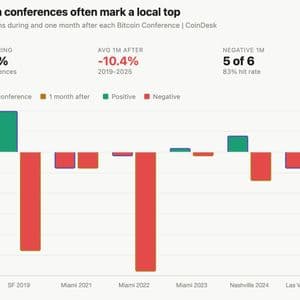
After a 50% slide and partial recovery for bitcoin, traders are watching whether the Las Vegas event marks another short-term top for bitcoin.


