


 Invest ideas
News
3 Jun 2026, 13:50
Ethereum Investor Identifies New Coin That Could Repeat What ETH Did in 2017 and Flip $400 into $12,000

In 2017, Ethereum’s rise was one of the most remarkable events in crypto history. What started as a promising blockchain project became one of the world’s largest digital assets, rewarding early investors with extraordinary returns. Those who saw the potential of Ethereum before it hit the mainstream made relatively small investments that turned into huge Continue reading "Ethereum Investor Identifies New Coin That Could Repeat What ETH Did in 2017 and Flip $400 into $12,000"
3 Jun 2026, 13:46
A 180% Crypto Rally Shows New Investing Era as Bitcoin Stumbles
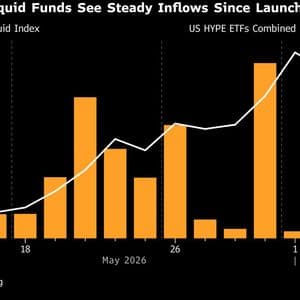
As billions of dollars leave Bitcoin and Ether funds, money is flowing into a corner of crypto that promises something investors have long struggled to find in digital assets: a clearer path from economic activity to token value.
3 Jun 2026, 13:42
Monetary policy in good place and likely to stay there for some time: Fed's Michael Barr

More on U.S. Economy Jerome Powell: Fed credibility at risk if presidents can fire officials Donald Trump's 'saved crypto industry' bullish claim—but market voted bearish
3 Jun 2026, 13:42
Bitcoin whales dump over 24,600 BTC in a week! What does this mean for the next move?

🚨 Over 24,600 $BTC sold by whales triggers a 10 percent weekly drop. 💥 Bitcoin slips near $66,989 as investor caution takes hold. 📉 Key support at $65,000 now in focus for potential rebound or further slide. Continue Reading: Bitcoin whales dump over 24,600 BTC in a week! What does this mean for the next move? The post Bitcoin whales dump over 24,600 BTC in a week! What does this mean for the next move? appeared first on COINTURK NEWS .
3 Jun 2026, 13:35
Why is the ZEC price still bullish despite the 3-hour Zcash outage

The Zcash network experienced a halt lasting roughly three to four hours, according to blockchain status observations reported on June 3, 2026 . But despite this disruption, the price has held firm, with ZEC trading around $619.05 at press time, showing a 6.29% gain in the 24 hours and maintaining a tight range between $560.69 and $637.95. Network disruption raises questions, but impact remains contained The recent outage in block production briefly paused network activity for approximately three to four hours. Such an event typically raises concerns about consensus stability, especially for a proof-of-work system that depends on continuous block creation for transaction confirmation and security assurances. However, the market response suggests the disruption was treated as temporary rather than structural. Trading activity remained high during the period, with 24-hour volume recorded at over $1.34 billion. Instead of triggering a sell-off, price action held above the $600 psychological level, indicating that liquidity providers and traders did not view the interruption as a breakdown of the network’s core functionality. In previous crypto cycles, similar short-term halts in block production have often resulted in sharp drawdowns, particularly when confidence in network stability was already weak. In this case, ZEC maintained its upward structure, suggesting that broader market participants are focusing on longer-term fundamentals rather than short-term technical interruptions. Why the price of Zcash remained unshaken One of the most important developments supporting ZEC’s resilience is the rapid expansion of shielded supply usage. On-chain data shows that approximately 5.1 million ZEC are now held in shielded addresses, representing more than 30% of total shielded-capable supply. Chart showing ZEC held in shielded addresses | Source: Blockworks This figure marks a record level of adoption for Zcash’s privacy layer. The majority of this growth has been concentrated in the Orchard shielded pool, which is the most advanced privacy implementation within the Zcash protocol. The steady rise in shielded holdings reflects increased usage of private transactions rather than simple exchange speculation. This shift matters because shielded coins are effectively removed from transparent circulation, reducing visible liquidity in the market. At the same time, it signals that users are actively choosing privacy features over standard transparent transfers. That behavioural change adds a layer of structural demand that is not directly tied to price speculation alone. The increase in shielded adoption has accelerated since 2024, showing a sustained trend rather than a short-term spike. That consistency strengthens the argument that privacy usage is becoming a core function of the network rather than a secondary feature. Price structure shows consolidation near key breakout levels In addition, ZEC is currently trading in a technically sensitive zone, holding above $600 after reclaiming this level during recent upward movement. Despite bearish conditions in the wider crypto market , ZEC has continued to show relative strength. The 7-day gain of 7.8% and the 30-day gain of 45.4% highlight sustained buying pressure even during periods of market uncertainty. Analysts have identified $600 as a critical pivot area, with short-term resistance forming between $633 and $650. A broader resistance zone sits near $700, which has become the next major upside target in current market structure discussions. The price action suggests that ZEC is consolidating between established support near $550 and upper resistance levels approaching $700. Divergence between fundamentals and short-term risk The interaction between network activity, on-chain privacy adoption, and price behaviour presents a clear divergence. On one side, the brief block production outage introduces short-term operational uncertainty. On the other hand, record shielded adoption and sustained price strength point to deeper structural demand. This divergence is most visible in trading behaviour around the $600 level. Despite the temporary disruption in network performance, price stability has held, and trading volumes remain elevated. At the same time, increasing shielded supply indicates that a growing portion of ZEC is being held in private states, tightening effective liquidity. Price remains consolidated near resistance while adoption metrics continue to rise. ZEC is at a critical inflection point, with its next move likely dependent on whether momentum can overcome technical resistance near $700 while network stability remains intact. The post Why is the ZEC price still bullish despite the 3-hour Zcash outage appeared first on Invezz
3 Jun 2026, 13:33
Ripple’s RLUSD in Focus as Mastercard Expands Stablecoin Strategy

Global payments giant Mastercard has taken another major step toward integrating blockchain into traditional finance. It announced broader settlement capabilities that now include several stablecoins, such as Ripple’s RLUSD, Circle’s USDC, Paxos-issued PYUSD, USDG, and USDP, and SoFi’s SoFiUSD. The crypto assets linked to the US dollar will be enabled across a wide range of supported networks, such as XRPL, Solana, Ethereum, Arbitrum, and Base. To Settle Transactions in Stablecoins The announcement from the TradFi behemoth reveals that the company is expanding its infrastructure to allow merchants and partners to settle transactions using the aforementioned assets. This is considered a significant evolution from pilot programs into more practical, real-world applications. The firm has been building out its crypto strategy through its Multi-Token Network (MTN), designed to bridge traditional finance and digital assets. Most recently, it outlined a new collaboration that included some industry giants such as Binance, Ripple, and even PayPal. Its stablecoin initiatives saw a major push in March when Mastercard announced the acquisition of such a payments firm called BVNK for $1.8 billion. RLUSD has drawn particular attention due to Ripple’s strong presence in cross-border payments. However, Mastercard’s announcement encompasses a wider range of established stablecoins, including USDC and PYUSD. Both are already gaining traction in institutional and payments use cases, and Mastercard is attempting to position itself as a neutral infrastructure layer rather than backing a single issuer. Stablecoins’ Growth The company’s latest move on the stablecoin scene comes as demand quickly grows for faster and cheaper cross-border transactions. These assets are increasingly viewed as a viable alternative to legacy correspondent-backing systems, offering near-instant settlement and lower costs. Mastercard’s decision to expand support signals rising confidence in their long-term role within the global financial system. In addition, the firm emphasized its commitment to regulatory compliance, security, and interoperability, which are all key requirements for institutional adoption. “The next phase of stablecoin adoption is about real-world utility, especially in settlement, where timing and liquidity matter most. By introducing intraday and weekend on settlement options across our global network, we’re expanding how partners manage liquidity and operate in an always-on digital economy while maintaining the trust, resilience and safeguards they expect from Mastercard,” commented Raj Dhamodharan, executive vice president, Blockchain & Digital Assets at Mastercard. The post Ripple’s RLUSD in Focus as Mastercard Expands Stablecoin Strategy appeared first on CryptoPotato .


