


 Invest ideas
News
3 Jun 2026, 11:48
Mastercard expands support to USDC, PYUSD, RLUSD stablecoin settlement

The payments giant said USDC, PYUSD, RLUSD and other stablecoins will support new settlement options across multiple blockchains.
3 Jun 2026, 11:48
XRP celebrates 14th anniversary but a key technical debate sets the crypto community abuzz! What happened?

🚨 XRP’s 14th anniversary triggers a fierce debate over missing early records. 🎉 Brad Garlinghouse calls community involvement a top honor while critics challenge the official founding date. 🕵️♂️ Doubts grow as the first seven months of $XRP ledger data remain lost. Continue Reading: XRP celebrates 14th anniversary but a key technical debate sets the crypto community abuzz! What happened? The post XRP celebrates 14th anniversary but a key technical debate sets the crypto community abuzz! What happened? appeared first on COINTURK NEWS .
3 Jun 2026, 11:48
Here’s Why Bitcoin Price Could Test $65K After Its 8-Week Drop

Bitcoin price remains under heavy pressure after an eight-week decline pushed the asset toward its weakest level in two months. BTC traded near $66,989 on June 3, after falling more than 10% over the past week. Market sentiment also weakened, with the Fear and Greed Index dropping to 11, a level marked as Extreme Fear. On-chain data shows that large Bitcoin holders have increased selling, while smaller wallets have continued to add limited amounts during the dip. Bitcoin Whale and Shark Selling Adds Pressure Bitcoin’s latest decline has drawn attention to the behavior of key wallet groups. Data shared by Santiment shows that whales and sharks holding between 10 and 10,000 BTC dumped 24,602 coins over the past week. That marks an 18% drop in their collective holdings during the period. This selling matters as larger holders often shape short-term direction when market depth weakens. Their exits can increase pressure during sharp declines, especially when price already trades below major support zones. Bitcoin’s break below $70,000 also triggered more caution among traders, with many watching whether this selling slows near the $65,000 region. Bitcoin Whales | Source: Santiment Meanwhile, small wallets holding under 0.01 BTC moved in the opposite direction. This group added 61 BTC over the past month, equal to a 12% rise in their holdings. The amount remains small compared with whale and shark sales, yet it shows that some retail buyers still view lower prices as an entry point. Santiment’s data suggests traders may need both groups to shift direction before a stronger recovery forms. A move from whale selling to accumulation, along with weaker retail dip-buying enthusiasm, could offer a signal that the market has reached a more durable bottom. BTC Extreme Fear Deepens Near $66,989 Market sentiment has moved sharply lower as Bitcoin trades near $66,989. The Fear and Greed Index reading of 26 shows that traders remain highly defensive after the latest sell-off. Such readings often appear during periods of forced selling , weak leverage conditions, and broad risk reduction. Crypto market capitalization stands near $2.40 trillion, with daily trading volume around $143.61 billion. Elevated volume shows that traders remain active, even as price action weakens. Ethereum also fell to about $1,872.40 after a 5.36% daily decline, while Bitcoin dominance stayed near 55.93%. Technical Setup Points Toward $65K Bitcoin’s chart remains fragile after repeated failures near the $70,000 to $75,000 resistance area. Analysts have pointed to that zone as a major barrier after BTC lost momentum there and turned lower. Price now trades below several short and medium-term moving averages, which keeps sellers in control. CryptoQuant’s HODL Waves analysis places a possible local bottom range between $65,000. Bitcoin has already moved into the upper part of that area, making the $65,000 region a key level for traders this month. A daily close below current support could pull attention toward $60,000 and nearby liquidity zones. Meanwhile, analyst Trader Tardigrade noted that Bitcoin’s daily RSI has reached the oversold zone again, a level that has previously aligned with strong rebounds. The chart shows that BTC price has often followed RSI swings, with overbought readings marking local tops and oversold readings appearing near recovery points. BTC RSI | Source: X He added that the RSI has formed higher lows along an ascending trendline, while Bitcoin price has followed a similar structure. If the same pattern holds, the latest oversold reading could support a bullish reversal attempt.
3 Jun 2026, 11:40
Binance Takes Strategic Stake in Alpaca, Dominant US Stock Token Custodian

BitcoinWorld Binance Takes Strategic Stake in Alpaca, Dominant US Stock Token Custodian Binance has made a strategic equity investment in Alpaca, a key infrastructure provider that dominates the U.S. market for stock token and ETF custody, according to a report from on-chain analytics firm SpotOnChain. The deal extends beyond a simple capital injection, establishing an exclusive revenue-sharing agreement that gives Binance a direct financial interest in Alpaca’s operations. Details of the Revenue-Sharing Agreement Under the terms of the agreement, Binance is set to receive 50% of the fees generated from Payment for Order Flow (PFOF) and 65% of the residual profits from Alpaca’s user stock lending services. This structure signals a deep operational partnership, rather than a passive investment. PFOF, a common practice in traditional equities where brokers receive compensation for directing trades to specific market makers, is now being integrated into the crypto and tokenized asset ecosystem through this deal. Implications for Real-World Asset (RWA) Tokenization SpotOnChain commented that this move marks Binance’s formal entry into the real-world asset (RWA) tokenization space. By aligning with a company that controls an estimated 94% of the U.S. stock token and ETF custody market, Binance has effectively secured a direct pipeline to global RWA trading liquidity. This positions the exchange to bridge traditional finance and decentralized markets, potentially allowing users to trade tokenized versions of stocks and ETFs with greater efficiency. Why This Matters for the Market For investors and market observers, this development signals a maturation of the crypto industry’s approach to regulated assets. Binance, which has faced regulatory scrutiny in multiple jurisdictions, is deepening its ties with established financial infrastructure. The deal could accelerate the adoption of tokenized securities, as it provides a clear path for liquidity and custody. However, it also raises questions about the concentration of market power in a single custody provider and the regulatory implications of PFOF in a tokenized environment. Conclusion The Binance-Alpaca partnership represents a significant step in the convergence of traditional finance and blockchain technology. By securing a stake in the dominant stock token custodian, Binance is not only diversifying its revenue streams but also positioning itself at the center of the growing RWA tokenization trend. The coming months will reveal how this agreement impacts the broader market for tokenized assets and whether other major exchanges will pursue similar strategies. FAQs Q1: What is Alpaca’s role in the stock token market? Alpaca is a key infrastructure company that provides custody services for U.S. stock tokens and ETFs, controlling approximately 94% of that market. It enables the tokenization and trading of traditional securities on blockchain networks. Q2: What is Payment for Order Flow (PFOF) in this context? PFOF is a practice where a broker receives compensation for directing trade orders to a specific market maker or exchange. In the Binance-Alpaca deal, Binance will receive 50% of the fees generated from this practice, integrating a traditional finance model into the crypto ecosystem. Q3: How does this deal affect the RWA tokenization space? By partnering with Alpaca, Binance gains direct access to a dominant liquidity and custody provider for tokenized stocks and ETFs. This could lower barriers for users to trade real-world assets on-chain and signals growing institutional interest in the RWA sector. This post Binance Takes Strategic Stake in Alpaca, Dominant US Stock Token Custodian first appeared on BitcoinWorld .
3 Jun 2026, 11:37
Bitcoin RSI Flashes Oversold at $65K as $1.8B Liquidated, Fear Index Crashes to 11
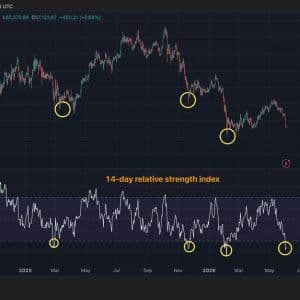
Bitcoin News Bitcoin 's 14-day relative strength index slid below 30 on Wednesday, a textbook oversold signal that historically preceded interim or major bottoms in February, November 2025, and Aug...
3 Jun 2026, 11:35
Mastercard Integrates Stablecoins Into Core Payment Settlement Network
BitcoinWorld Mastercard Integrates Stablecoins Into Core Payment Settlement Network Mastercard is integrating stablecoins into its core payment settlement infrastructure, marking a significant shift in how traditional credit card transactions are processed globally. The company announced it will allow card issuers and acquirers to settle transactions using stablecoins, moving beyond conventional banking hours to enable real-time, 24/7 settlement — including weekends and holidays. Modernizing a Legacy System Historically, payment settlement between card issuers and acquirers has relied on traditional banking networks, which operate only on business days. This has meant that transactions made on a Friday evening might not settle until Monday. By incorporating stablecoins — digital currencies pegged to stable assets like the U.S. dollar — Mastercard aims to eliminate these delays, offering near-instant settlement regardless of the day or time. According to the company’s official announcement, this move is part of a broader strategy to modernize its payment infrastructure and meet the growing demand for faster, more flexible financial services. Mastercard has been exploring blockchain technology for years, but this integration directly connects stablecoins to the core settlement process that underpins its global credit card network. Why This Matters for Merchants and Consumers For merchants, faster settlement means improved cash flow and reduced reliance on traditional banking intermediaries. For consumers, the change is largely invisible but could lead to more efficient transaction processing and potentially lower costs over time, as settlement delays and associated fees are reduced. Industry analysts note that this development could accelerate the adoption of stablecoins in mainstream finance. Unlike volatile cryptocurrencies such as Bitcoin, stablecoins maintain a consistent value, making them more suitable for settlement purposes. Mastercard’s move signals growing institutional confidence in digital currencies as a reliable payment tool. Broader Implications for the Payments Industry Mastercard is not alone in exploring blockchain-based settlement. Rival networks and fintech companies have also tested similar systems, but Mastercard’s scale — processing billions of transactions annually — gives this announcement outsized significance. If successful, the integration could set a precedent for how major payment networks handle cross-border and domestic settlements in the future. Regulatory considerations remain a key factor. Stablecoins have drawn increased scrutiny from global regulators, particularly around reserve requirements and consumer protections. Mastercard’s implementation will likely need to comply with evolving regulatory frameworks in multiple jurisdictions. Conclusion Mastercard’s decision to embed stablecoins into its settlement infrastructure represents a practical step toward modernizing legacy payment systems. By enabling real-time, round-the-clock settlement, the company addresses a long-standing inefficiency in traditional banking. While consumer-facing changes may take time, the move underscores the growing role of digital currencies in the backbone of global finance. FAQs Q1: How will Mastercard’s stablecoin settlement work in practice? Card issuers and acquirers will be able to use stablecoins to settle transactions through Mastercard’s network. This replaces the traditional process of waiting for banking business days, allowing settlement to occur in real time, including weekends and holidays. Q2: Which stablecoins will Mastercard support? Mastercard has not yet disclosed the specific stablecoins it will initially support. The company is expected to partner with established stablecoin issuers that meet its compliance and reserve standards. Q3: Will this change affect how consumers pay with their credit cards? No. For consumers, the payment experience remains the same. The change occurs behind the scenes in the settlement process between card issuers and acquirers. Consumers will not need to hold or use stablecoins directly. This post Mastercard Integrates Stablecoins Into Core Payment Settlement Network first appeared on BitcoinWorld .


