


 Invest ideas
News
3 Jun 2026, 05:45
ZeroDrift raises $10M to deploy AI guardrails that police other AI models

BitcoinWorld ZeroDrift raises $10M to deploy AI guardrails that police other AI models As enterprises race to deploy generative AI in customer-facing applications, a new compliance bottleneck has emerged: how to stop AI models from generating responses that violate regulations, leak data, or damage brand trust. A growing number of companies are adopting a dual-model architecture — one AI handles the conversation, while a second, specialized system watches for trouble. ZeroDrift, a startup emerging from stealth this week, is betting that this second system is where the real value lies. A compliance layer that sits between AI and the user ZeroDrift announced Tuesday that it has raised $10 million in seed funding from a16z Speedrun, Reign Ventures, PitchDrive Ventures, and U&I Ventures. The company’s product functions as an intermediary layer between an organization’s AI model and its end users. Rather than attempting to train a single model to be both helpful and compliant — a notoriously difficult balance — ZeroDrift intercepts every outgoing message, flags those that violate known compliance standards, and rewrites them before they reach the user. CEO Kumesh Aroomoogan describes the system as deterministic at its core. The first stage of detection uses conventional software rules to check against frameworks like SOC 2, GDPR, HIPAA, and other regulatory standards. Only after a message is flagged does a large language model step in to generate a compliant rewrite. This hybrid approach, Aroomoogan argues, gives ZeroDrift a reliability advantage over end-to-end AI solutions offered by major labs like OpenAI and Anthropic. Why a second AI is better at correcting the first One of the key architectural insights behind ZeroDrift is that the correction model does not need to handle the full complexity of the original conversation. It only needs to understand the specific violation and produce a compliant version of the flagged message. This narrower scope allows the system to operate with lower latency and higher consistency than a general-purpose model tasked with policing itself. “We’re able to identify deterministically what are all the regulated areas, what’s the violation that’s being broken, and then we have LLMs that can do the rewrites,” Aroomoogan told Bitcoin World. The result is a system that can be deployed alongside existing AI infrastructure without requiring retraining of the primary model. Market timing and investor enthusiasm The fundraising process itself signals strong market demand. Aroomoogan described the round as the fastest he has ever closed, completed in three weeks with three times oversubscription. Andreessen Horowitz played a key role in structuring the deal. The speed of the raise reflects a broader urgency among enterprises that are deploying AI chatbots in high-stakes environments — healthcare, finance, legal services, and customer support — where a single non-compliant response can trigger regulatory fines or reputational damage. ZeroDrift’s total addressable market extends beyond visible chatbots. Aroomoogan sees potential in AI-generated messages that human beings never see — automated internal communications, system-to-system data exchanges, and backend decision logs that still need to comply with regulatory frameworks. Why this matters for enterprise AI adoption The dual-model compliance approach represents a practical middle ground between fully autonomous AI systems and heavy-handed human review. For organizations that cannot afford to have every AI output manually inspected — and cannot risk unfiltered outputs reaching customers — ZeroDrift offers a scalable alternative. The approach also addresses a growing concern among regulators: that AI models are too opaque to trust with compliance-critical tasks without independent oversight. As the regulatory landscape around AI continues to evolve — with the EU AI Act, state-level U.S. legislation, and sector-specific rules all in flux — the ability to adapt compliance logic without rebuilding the underlying AI becomes a strategic advantage. ZeroDrift’s deterministic rule layer can be updated independently of the LLM, allowing organizations to respond to new regulations without retraining their models. Conclusion ZeroDrift’s $10 million seed round and rapid investor interest reflect a maturing understanding of AI governance in the enterprise. Rather than treating compliance as an afterthought or attempting to bake it entirely into a single model, the company’s dual-architecture approach offers a pragmatic path forward. As AI deployment accelerates across regulated industries, the market for independent compliance layers is likely to grow — and ZeroDrift has positioned itself early in that emerging category. FAQs Q1: How does ZeroDrift differ from built-in safety features in models like GPT-4 or Claude? ZeroDrift operates as an independent layer that applies deterministic compliance rules before any LLM-based correction occurs. This allows organizations to enforce specific regulatory frameworks without relying on the model’s internal safety training, which may not cover all jurisdictional or sector-specific requirements. Q2: What compliance standards does ZeroDrift currently support? The company’s deterministic detection layer currently supports SOC 2, GDPR, and HIPAA, with the ability to add custom rules for additional frameworks. The system is designed to be extended as new regulations emerge. Q3: Does using a second AI model increase latency? ZeroDrift claims its system can run with lower latency than a conventional LLM because the correction model only processes flagged messages — a small fraction of total traffic — and operates on a narrower, more predictable task. The deterministic first stage also filters out the vast majority of messages without invoking the LLM at all. This post ZeroDrift raises $10M to deploy AI guardrails that police other AI models first appeared on BitcoinWorld .
3 Jun 2026, 05:39
US Sanctions Iran’s Largest Crypto Exchange Nobitex

According to OFAC, Nobitex processed more than 50% of Iran’s digital asset inflows in 2025 and allegedly facilitated transactions linked to sanctions evasion, terrorist financing, and the Islamic Revolutionary Guard Corps (IRGC). The sanctions also extend to several Nobitex executives and co-founders. Nobitex Hit With US Sanctions The United States Treasury Department intensified its pressure on Iran’s financial networks by imposing sanctions on Nobitex, the country’s largest cryptocurrency exchange, along with three other Iran-based digital asset trading platforms. The sanctions form part of the Trump administration’s “Economic Fury” campaign, which aims to disrupt financial channels that Washington believes are being used to support sanctioned entities and activities linked to the Iranian government. According to the Treasury Department’s Office of Foreign Assets Control (OFAC), Nobitex played a dominant role in Iran’s crypto market, and processed more than half of all Iranian digital asset inflows during 2025. US authorities allege that the exchange facilitated sanctions evasion, terrorist financing, and transactions connected to Iran’s Islamic Revolutionary Guard Corps (IRGC), an organization that is still heavily sanctioned by the United States. The sanctions also target several people associated with Nobitex. Among those designated are chairman and co-founder Amir Hossein Rad, current CEO Seyed Ali Khoee, and co-founders Ali and Mohammad Kharrazi. The Kharrazi brothers are members of one of Iran’s most influential political families. A recent Reuters investigation reported that they are related to Iran’s supreme leadership and alleged that hundreds of millions of dollars tied to sanctioned Iranian entities moved through the exchange. Ali and Mohammad Kharrazi Treasury Secretary Scott Bessent stated that despite Iran’s worsening economic conditions, the government embraced digital asset technologies as a tool to bypass international restrictions and move wealth beyond the reach of sanctions. He argued that cryptocurrencies have become an important component of Tehran’s efforts to maintain access to global financial networks despite mounting economic pressure. In addition to Nobitex, the Treasury Department sanctioned three other Iranian cryptocurrency exchanges: Wallex, Bitpin, and Ramzinex. US officials claim these platforms also facilitated transactions involving the IRGC and other sanctioned organizations. The move is a big escalation in Washington’s efforts to target Iran’s cryptocurrency sector. Nobitex has long served as a cornerstone of Iran’s digital asset ecosystem and previously avoided direct Western sanctions despite growing scrutiny from lawmakers and blockchain analytics firms.
3 Jun 2026, 05:35
Bloomberg Analyst Calls Recent Bitcoin ETF Outflows a Temporary Blip, Not an Exodus
BitcoinWorld Bloomberg Analyst Calls Recent Bitcoin ETF Outflows a Temporary Blip, Not an Exodus Recent outflows from spot Bitcoin exchange-traded funds (ETFs) have sparked concern among some market participants, but Bloomberg Intelligence senior ETF analyst Eric Balchunas has dismissed the trend as a temporary and statistically insignificant fluctuation. In an interview with CoinDesk, Balchunas argued that the outflows, which total roughly $3 billion, must be viewed in the context of the broader market, which holds approximately $100 billion in assets. Context Behind the Outflows Balchunas emphasized that an outflow of $3 billion from a $100 billion market is ‘completely insignificant’ when compared to typical flow patterns observed in major ETFs. He noted that even large S&P 500 index funds regularly experience inflows and outflows of similar magnitude without any fundamental change in investor sentiment. ‘This is just normal market noise,’ he said, adding that the media and some investors may be overinterpreting short-term movements. Holdings Continue to Grow Despite a recent decline in Bitcoin’s price, Balchunas pointed out that the total holdings in these ETFs have continued to grow over the medium term. This trend, he explained, suggests sustained adoption by institutional and retail investors rather than a panicked exit. ‘The narrative of an exodus doesn’t match the data,’ he said. ‘If you look at the cumulative flows, the trajectory remains positive.’ Why This Matters for Investors The distinction between temporary outflows and a structural shift is critical for investors evaluating the long-term viability of Bitcoin as an asset class. ETF flows are often used as a proxy for institutional interest, and misreading short-term data can lead to misguided investment decisions. Balchunas’s analysis provides a counterpoint to alarmist headlines, grounding the discussion in historical ETF behavior and market scale. Conclusion While the cryptocurrency market remains volatile, the Bloomberg analyst’s assessment offers a measured perspective: the recent outflows are a normal part of ETF market dynamics and do not signal a loss of confidence. For readers tracking Bitcoin adoption, the key metric to watch remains cumulative holdings rather than daily flow fluctuations. FAQs Q1: Are Bitcoin ETF outflows a sign that investors are losing confidence? A1: According to Bloomberg analyst Eric Balchunas, not necessarily. He describes the outflows as a temporary blip and notes that total holdings in Bitcoin ETFs have continued to grow, indicating sustained adoption. Q2: How significant is $3 billion in outflows compared to the overall market? A2: Balchunas considers it ‘completely insignificant’ in the context of a $100 billion market, drawing parallels to routine flows in major S&P 500 funds. Q3: What should investors focus on instead of daily ETF flow data? A3: Investors should look at cumulative holdings and long-term flow trends rather than short-term outflows, which are common in all large ETFs. This post Bloomberg Analyst Calls Recent Bitcoin ETF Outflows a Temporary Blip, Not an Exodus first appeared on BitcoinWorld .
3 Jun 2026, 05:15
Ethereum Spot ETFs Extend Losing Streak to 16 Days With $90.1M in Outflows
BitcoinWorld Ethereum Spot ETFs Extend Losing Streak to 16 Days With $90.1M in Outflows U.S. spot Ethereum exchange-traded funds recorded a net outflow of approximately $90.14 million on June 2, extending a streak of consecutive daily withdrawals to 16 trading sessions, according to data compiled by Trader T. Breakdown of Outflows Across Major Funds The latest figures show that outflows were led by BlackRock’s ETHA product, which saw $44.27 million exit the fund. Grayscale’s Mini Ethereum Trust followed with $25.41 million in net outflows, while Fidelity’s FETH registered $15.63 million in withdrawals. Grayscale’s larger ETHE fund lost $3.87 million, and BlackRock’s Staking ETHB product reported outflows of $960,000. The 16-day outflow streak now represents the longest sustained period of capital leaving Ethereum spot ETFs since their launch. The cumulative outflows during this period have surpassed $1.2 billion, reflecting a broader shift in institutional sentiment toward the second-largest cryptocurrency by market capitalization. Market Context and Possible Drivers The sustained outflows come amid a period of relative price weakness for Ethereum, which has traded in a range between $3,200 and $3,500 over the past month. Analysts point to several potential factors behind the trend, including profit-taking by early ETF investors, uncertainty around the timeline for Ethereum network upgrades, and a broader rotation toward Bitcoin and other digital assets. Regulatory developments have also weighed on sentiment. The U.S. Securities and Exchange Commission has yet to approve staking features for most Ethereum ETFs, limiting their appeal compared to direct holdings or alternative products available outside the United States. The SEC’s ongoing classification of certain Ethereum transactions as securities has added to investor caution. Implications for Institutional Adoption The persistent outflows raise questions about the pace of institutional adoption of Ethereum exposure through regulated financial products. While spot Bitcoin ETFs have seen strong and consistent inflows since their approval in January 2024, Ethereum equivalents have struggled to maintain momentum. Market observers note that the divergence may reflect differing perceptions of the two assets. Bitcoin is increasingly viewed as a digital store of value, while Ethereum’s investment case is more closely tied to its utility as a platform for decentralized applications and smart contracts — a narrative that has faced headwinds from competing blockchain networks and regulatory uncertainty. Conclusion The 16-day outflow streak for Ethereum spot ETFs highlights the current cautious stance of institutional investors toward the asset. While the long-term thesis for Ethereum remains intact for many market participants, the near-term capital flows suggest a wait-and-see approach. Investors will be watching for any catalyst — whether regulatory clarity, network upgrades, or macroeconomic shifts — that could reverse the trend. FAQs Q1: What is an Ethereum spot ETF? A spot Ethereum ETF is a regulated exchange-traded fund that holds actual Ether tokens, allowing investors to gain exposure to the cryptocurrency without directly buying or storing it. Q2: Why have Ethereum ETFs seen 16 straight days of outflows? The outflows are likely driven by a combination of price weakness, profit-taking, regulatory uncertainty regarding staking features, and a broader market rotation toward Bitcoin and other assets. Q3: How do Ethereum ETF outflows compare to Bitcoin ETF flows? Bitcoin spot ETFs have generally experienced stronger and more consistent inflows since their approval in January 2024, while Ethereum ETFs have faced more volatile and often negative flows, reflecting differing investor sentiment toward the two assets. This post Ethereum Spot ETFs Extend Losing Streak to 16 Days With $90.1M in Outflows first appeared on BitcoinWorld .
3 Jun 2026, 05:15
Bullish XRP signals are piling up. The price keeps falling.
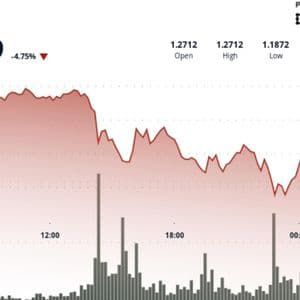
XRP lost another major support level on heavy selling, with traders now focused on whether buyers can defend the $1.20 area after a 15-week low.
3 Jun 2026, 05:10
Ethereum Slips Below $1,900 as $1.84B Long Liquidation Sweeps Crypto Markets
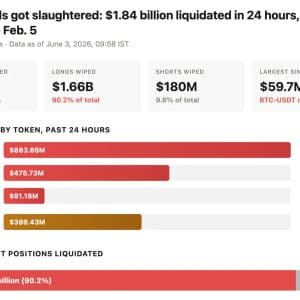
Ethereum News Crypto markets absorbed their largest single-day liquidation event since early February, with roughly $1.84 billion in leveraged positions wiped out over the past 24 hours as Ethereum...


