


 Invest ideas
News
2 Jun 2026, 18:42
Bitcoin set for 'choppy summer' as capital chases high-flying AI stocks, K33 says

The firm still views bitcoin as undervalued relative to equities, but says investors are rotating into AI stocks as the opportunity cost of missing gains by holding BTC is too high.
2 Jun 2026, 18:41
A critical signal for XRP at the 1.28 dollar threshold! Is a decisive breakout on the horizon?

🚨 While nearly 1.5 billion dollars left Bitcoin and Ethereum, 20.3 million dollars flowed into $XRP. XRP is locked in a tight band between 1.21 and 1.28 dollars with low trading volume. ⚡ Investors are watching for a breakout to signal the next big move. Continue Reading: A critical signal for XRP at the 1.28 dollar threshold! Is a decisive breakout on the horizon? The post A critical signal for XRP at the 1.28 dollar threshold! Is a decisive breakout on the horizon? appeared first on COINTURK NEWS .
2 Jun 2026, 18:37
Altcoin Season Index at 49 — Traders Need Bitcoin Dominance Below 55% to Trigger Rotation
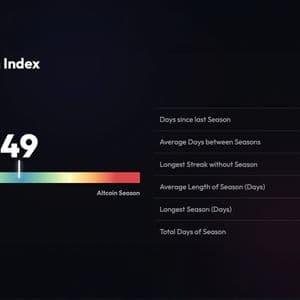
Bitcoin’s correction below $70,000 has pulled its market dominance down to roughly 58% and pushed the Altcoin Season Index to 49, raising real questions about whether capital is rotating out of BTC and into altcoins, though the data does not confirm a full altseason yet. Bitcoin Dominance Slides as BTC Loses Ground Bitcoin dominance (
2 Jun 2026, 18:35
Movement relaunches as Layer 1 focused on stablecoin settlement after token-dumping scandal

Movement, the blockchain project that faced a token-dumping scandal that led to the removal of its co-founder Rushi Manche last year, has relaunched as a standalone Layer 1 network targeting stablecoin payments and remittances in emerging markets. Current CEO Torab Torabi announced the pivot , adding that it comes with partnerships, one of which is Circle, and access to licensed payment infrastructure across the US, Canada, and the European Union. How did Movement move from Ethereum Layer 2 to a sovereign chain? Movement initially started out as an Ethereum Layer 2 built on the Move programming language, the same code Facebook developed for the abandoned Libra/Diem project. Torabi reportedly stated that the old network was a “Frankenstein” chain that was put together from components like Celestia for data availability, with latency around seven seconds per transaction. “If you’re seven seconds in L2, what the hell is the point of you existing to begin with, right?” Torabi said in an interview. Movement’s new architecture runs its own validator set on a dedicated Layer 1, targeting settlement times under 500 milliseconds, which is over fourteen times faster than seven seconds. Dozens of Ethereum scaling networks compete for users and liquidity, and now some projects are abandoning the general-purpose rollup thesis in favor of specialized applications. Polygon is reported to have made a similar shift toward payments infrastructure. Stablecoin rails and emerging market ambitions Move Industries, the entity that assumed core development responsibilities after the scandal, has lined up partnerships with Circle, wallet startups KAST and Sorted, and tokenization projects including Oro, Yuzu Money, and Zoth, according to its announcement. Circle launched USDCx as a natively issued stablecoin on Movement in March 2026 to support payments, treasury, and savings products, according to Circle’s own announcement on X. Torabi stated that the company’s ambitions are focused on the roughly $685 billion remittance market serving low and middle-income countries. According to the CEO, Movement is no longer a crypto company. “We are a fintech company that uses blockchain rails,” he told The Block. However, that market is not free from competition, as the likes of Stripe and Paradigm are building out Tempo, major institutions back Canton, and established chains like Solana and Ethereum already process significant stablecoin volume. Torabi acknowledged the pressure but said many of Movement’s new partnerships came inbound. He said, “Circle was pretty aggressive in wanting to obviously win market share in ‘the countries you can’t pronounce.'” Cleaning up the token mess The relaunch also involved financial restructuring. The Movement Network Foundation repurchased around 19% of tokens that had been allocated to investors, equivalent to about 4.2% of the total supply. According to Torabi, the buyback was a chance to bring in investors aligned with the new direction. Analysts say that this cleanup was necessary. In early 2025, a Binance investigation found that Rentech, a market maker connected to Movement, controlled 66 million MOVE tokens (about 5% of the total supply) and sold them immediately after the token’s debut. This action led to a $38 million sell-off, causing both Binance and Coinbase to suspend MOVE trading. It was later reported that leaked internal documents showed Movement Labs had promised as much as 10% of the token supply to shadow advisers through undisclosed agreements, making the fallout take a turn for the worse. The then-CEO and cofounder, Manche, was let go by Movement Labs in May 2025 after an internal investigation tied him to the $38 million market manipulation incident. He went on to launch Nyx Group in December 2025, a $100 million investment vehicle backing blockchain founders. The MOVE token currently trades around $0.014, according to CoinMarketCap , down from an all-time high of $1.45 in December 2024, a decline of over 99%. Torabi claims the project has kept more than 90% of its team since the scandal, stating that the retention rate is a sign that builders still believe in the underlying technology even if the brand took damage. Movement is now putting the incident in its past and charting a new path under its new leadership, and this time around, it is betting its future on financial services and hoping that its latest pivot is enough to make users forgive its past misgivings. If you're reading this, you’re already ahead. Stay there with our newsletter .
2 Jun 2026, 18:30
Bitcoin’s On-Chain Landscape Looks Far Different From Its 2021 Bull Market Peak

Given the prolonged waning price action, the Bitcoin network is starting to feel this bearish pressure, leading to a sharp decline in activity across the network. After a period of downward performance, the level of activity and participation within the network has significantly dropped below levels seen in previous bull market cycles. How Bitcoin’s Network Usage Has Evolved Since 2021 While the Bitcoin price has been experiencing persistent downside action, its network performance is also exhibiting a notable decline. Currently, the network is telling a very different story from the one seen in past bull market cycles, especially the peak of the 2021 bull market. Over the past few years, Bitcoin’s on-chain activity has experienced a substantial metamorphosis, ranging from changing transaction patterns to evolving investor behavior . According to data shared by Santiment, a popular market intelligence and on-chain data analytics platform, the BTC network was averaging roughly 1.12 million active addresses per day and nearly 489,000 new wallet addresses being created daily in May 2021. However, as of Today, those figures have now dropped to approximately 624,000 active wallet addresses and 278,000 new wallet addresses generated per day, which represents declines of about 44% and 43%, respectively. Santiment highlighted that active addresses are often used as a proxy for the number of unique participants transacting on the network. Meanwhile, the network growth calculates the creation of new wallet addresses that interact with BTC for the first time. Together, these metrics suggest that Bitcoin is attracting fewer new participants and generating less day-to-day transactional activity than it did during the height of retail enthusiasm about 5 years ago. Despite the Bitcoin price remaining well above its 2021 levels for much of the current cycle, on-chain participation has not been quiet. Key Drivers Are Spot ETFs And Institutional Investment Vehicles These shifts imply that a new set of factors is driving the market, which could influence how analysts assess demand, network health, and upcoming price movements. One of the major reasons behind this may be the growing influence of the Spot Exchange-Traded Funds (ETFs) and institutional investment vehicles. These allow investors to gain more exposure to BTC without directly moving coins on-chain or creating new wallets. At the same time, Santiment highlighted that many long-term holders have become increasingly passive, choosing to store their assets rather than transact frequently. As a result, the network is still very valuable but less active than it was in 2021 during the retail-driven craze. Historically, this is not necessarily a bearish indicator as many may assume at first sight. Most times, volatility in either direction is what triggers BTC’s network activity to rise. Furthermore, this decline in activity is likely due to sideways movement and growing crowd interest in equities and precious metals as of late. At the time of writing, the price of BTC was trading at $69,876, demonstrating a nearly 5% increase in the last 24 hours. Despite this decline, traders are showing increased interest in the asset, as evidenced by a more than 134% rise in trading volume over the past day.
2 Jun 2026, 18:24
Bill Pulte steps into intelligence chief role while retaining key financial posts! What does this mean for Washington and $BTC?

🚀 Bill Pulte takes over as acting U.S. intelligence chief while keeping control of FHFA, Fannie Mae, and Freddie Mac. Continue Reading: Bill Pulte steps into intelligence chief role while retaining key financial posts! What does this mean for Washington and $BTC? The post Bill Pulte steps into intelligence chief role while retaining key financial posts! What does this mean for Washington and $BTC? appeared first on COINTURK NEWS .


