


 Invest ideas
News
28 May 2026, 14:34
Can ethereum reclaim 2021 highs versus bitcoin?

28 May 2026, 14:32
Bitcoin Price Prediction: BTC Eyes $70K Support as ETF Demand Weakens and Bears Stay in Control
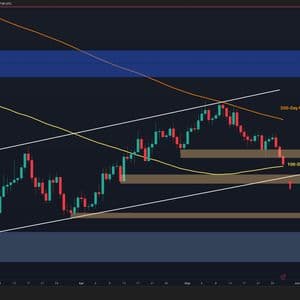
Bitcoin continues to trade under pressure after losing the critical $75K-$76K support zone, while broader market sentiment remains cautious amid weakening ETF inflows and deteriorating technical structure. However, BTC is now approaching an important confluence of technical supports around $70K-$72K, where both trendline support and the 100-day MA could provide temporary relief for the market. Bitcoin Price Analysis: The Daily Chart On the daily timeframe, Bitcoin has officially broken below the key $75K-$76K support region, which previously acted as an important decision point for the market. The breakdown confirms bearish continuation after repeated failures to reclaim the descending 200-day MA near $80K-$81K. Currently, the price is approaching a major support confluence around $70K-$72K. This region aligns with the ascending lower boundary of the broader structure, the 100-day MA around $73K, and a significant historical order block visible on the chart. Such overlapping supports often increase the probability of at least a short-term reaction or relief bounce. If buyers manage to defend the $70K-$72K range, Bitcoin could attempt a corrective recovery back toward the broken $75K-$76K resistance zone. However, failure to hold this area may open the path toward deeper supports around $65K-$66K and potentially the broader $60K-$63K demand region. For now, the overall market structure remains bearish unless BTC reclaims the $75K-$76K zone and stabilizes above it. Source: TradingView BTC/USDT 4-Hour Chart The 4-hour chart reflects accelerating bearish momentum following the recent breakdown below the consolidation structure near $75K-$76K. Sellers remain in control, while lower highs and persistent rejection candles continue to dominate the short-term trend. Nevertheless, Bitcoin is now entering a critical order block between $70K and $72K. This zone has historically attracted significant demand and currently overlaps with the rising trendline support shown on the chart. The market reaction here will likely determine the next major move. A short-term bullish pullback remains possible if buyers step in around this support cluster. In that scenario, BTC could revisit the $74K-$76K region as a corrective rebound. However, if the current support fails to hold, bearish momentum could accelerate rapidly toward the $65K-$66K liquidity zone. Therefore, the $70K-$72K area represents the most important short-term battlefield between buyers and sellers. Source: TradingView Sentiment Analysis The ETF cumulative flow chart reveals an important divergence developing in the market. Despite Bitcoin attempting multiple recoveries during recent months, cumulative ETF inflows have started flattening and have recently turned weaker alongside the latest correction. This behavior suggests that institutional demand has cooled considerably compared to previous accumulation phases. The slowdown in spot Bitcoin ETF inflows indicates reduced aggressive buying from large market participants, which partly explains BTC’s inability to sustain rallies above the $80K-$82K region. More importantly, recent price weakness has occurred while cumulative ETF flows remain relatively stable rather than aggressively expanding higher. This signals a lack of fresh capital entering the market at current levels. Historically, strong bullish continuation phases in Bitcoin have usually been accompanied by accelerating ETF inflows. The absence of that dynamic increases the likelihood that the current market will remain corrective in the short term. Still, if Bitcoin stabilizes around the $70K-$72K support region and ETF flows begin strengthening again, the market could regain momentum later. Until then, weakening institutional demand, combined with a bearish technical structure, keeps downside risks elevated despite the possibility of temporary relief rallies. The post Bitcoin Price Prediction: BTC Eyes $70K Support as ETF Demand Weakens and Bears Stay in Control appeared first on CryptoPotato .
28 May 2026, 14:30
Can XRP Set New ATH in 2026? Prediction Market Weighs in

XRP community watches closely as ATH odds go live on prediction market.
28 May 2026, 14:30
Ethereum Price Today: Standard Chartered Forecasts ETH to Hit $4,000

Ethereum price fell below the $2,000 mark for the first time since March 29 as renewed U.S.-Iran hostilities triggered a broad crypto sell-off and pushed traders into defensive positions. ETH traded near $1,980 at press time, down about 4% to 5% over the past 24 hours. The decline came as the wider crypto market lost about $80 billion in value following fresh U.S. military strikes and Iranian retaliation, ending hopes that a temporary ceasefire would hold. The sell-off also followed continued outflows from U.S. spot Ethereum ETFs and a wave of market liquidations across crypto assets. Bitcoin also dropped to multi-week lows as investors reacted to renewed pressure around the Strait of Hormuz and rising geopolitical risk. ETH Falls Below Key Psychological Level Ethereum’s move below $2,000 has drawn attention because the level has acted as an important psychological marker for traders. Market data showed retail discussion quickly shifting toward “buy the dip” reactions after the drop. Santiment data suggested that many traders are still treating the decline as a buying opportunity rather than a panic event. Historically, when retail traders remain optimistic during a sharp decline, prices can sometimes face further pressure before stabilizing. Source: X The current move follows a rejection from the $2,400 resistance zone. ETH failed to hold the $2,135 to $2,195 range and later broke below short-term support near $2,060. That level now becomes the first resistance to watch. On the downside, the first major support is near $1,873. If ETH loses that area, the next demand zone sits between $1,805 and $1,755. A deeper decline could bring the $1,693 level into view. For bulls, ETH needs to reclaim $2,060 to reduce short-term bearish pressure. A move above $2,135 to $2,195 would strengthen the recovery attempt and could allow another test of $2,315 to $2,400. Standard Chartered Maintains Bullish ETH View Despite the price decline, Standard Chartered remains positive on Ethereum’s long-term outlook. Geoffrey Kendrick, the bank’s global head of digital assets research, compared ETH’s current setup to Amazon during the 2001 dot-com downturn. Kendrick said Ethereum’s price weakness does not reflect its internal network metrics. He pointed to transaction activity and total value locked measured in ETH terms, both of which remain near record levels. He said Ethereum’s internal business metrics are moving in the right direction even as the token price has fallen. Kendrick maintained his long-term ETH targets, projecting $4,000 by the end of 2026 and $40,000 by the end of 2030. Standard Chartered also expects the ETH-BTC ratio to recover toward its 2021 highs near 0.08 by the end of the decade. ETH has weakened against Bitcoin since its August 2025 high, with the ratio down about 37% over that period. Kendrick’s view is partly based on Ethereum’s role in stablecoins and tokenized real-world assets. He expects the stablecoin market to grow to about $2 trillion by the end of 2028, up from roughly $321 billion today. Ethereum currently hosts about 54% of stablecoins, according to the data cited. Stablecoins also account for about one-third of Ethereum transactions in 2026 and around 60% of gross total value locked on the network. Stablecoins, RWAs and On-Chain Risks Shape Outlook Ethereum also remains a leading network for tokenized real-world assets. Standard Chartered said Ethereum hosts about 62% of non-stablecoin RWAs and 68% of active on-chain loans. Kendrick said growth in RWAs could increase Ethereum transaction activity and total value locked over time. He also pointed to the planned Ethereum Economic Zone, which is expected to improve asset movement across Ethereum-compatible chains and reduce dependence on bridges. Regulatory progress in the United States may also affect Ethereum’s outlook. Kendrick cited the Clarity Act and broader crypto market structure work as possible support for decentralized finance activity if clearer rules are adopted. Still, near-term market data remains mixed. Analysts have noted rising failed Ethereum transactions and a gradual increase in exchange inflows. Higher exchange inflows can suggest that some holders are preparing to sell, while failed transactions may reflect network friction. Source: X Crypto analyst David Hoffman also said he sold his ETH holdings while remaining bullish on the Ethereum network. He argued that value is increasingly flowing to applications, layer-2 networks, stablecoins, and on-chain assets, rather than directly to ETH. Ethereum’s short-term direction now depends on whether buyers defend the $1,873 area and whether ETH can reclaim $2,060. A recovery above that level could ease selling pressure, while failure to hold support may keep ETH exposed to another move toward $1,755.
28 May 2026, 14:30
Circle’s Stablecoin Infrastructure Just Got A Major European Upgrade — And It’s Already Processing Trillions

Orbital, a global payment orchestration platform connecting stablecoin and traditional payment rails, has selected Banking Circle as its primary banking partner to expand stablecoin settlement and multi-currency payment capabilities across Europe — a partnership that plugs Orbital directly into a fully MiCA-compliant infrastructure already processing more than €1.5 trillion annually across 750 financial institutions. The partnership, announced May 28 via PR Newswire, connects Orbital’s payment orchestration layer to Banking Circle’s newly activated stablecoin settlement services — capabilities the Luxembourg-based bank launched on April 27, 2026, following its receipt of a Crypto-Asset Service Provider license from Luxembourg’s Commission de Surveillance du Secteur Financier on April 15, per Stablecoin Insider’s reporting of the bank’s announcement. The timing is notable: Banking Circle became the first institution in Luxembourg to simultaneously hold banking, electronic money token, and CASP licenses — a regulatory trifecta that positions it as one of the most comprehensively licensed digital asset settlement banks in the European Union. What The Integration With Circle Delivers Through Banking Circle’s platform, Orbital gains access to instant two-way fiat-to-stablecoin and stablecoin-to-fiat settlement supporting Circle’s USDC, Paxos’ USDG, and Banking Circle’s own euro stablecoin EURI — all with 24/7 real-time execution directly from the bank’s core platform, per the PR Newswire announcement. The integration removes a structural friction point that has historically complicated enterprise stablecoin adoption in Europe: the requirement to maintain separate relationships with multiple settlement counterparties across different jurisdictions and regulatory frameworks. For Orbital’s enterprise clients — which include businesses managing cross-border payments across both stablecoin and traditional rails — the Banking Circle connection adds direct access to SEPA infrastructure, named IBANs, and full AML and KYC compliance checks within a single integrated payment layer, per the announcement. The MiCA Context The partnership arrives as Europe’s Markets in Crypto-Assets regulation enters its operational enforcement phase — creating both an opportunity and a compliance threshold that many payment infrastructure providers are scrambling to meet. Banking Circle’s simultaneous licensing across banking, EMT, and CASP categories means Orbital’s stablecoin settlement activity now operates under the same regulatory oversight framework that governs its traditional payment operations — a structural alignment that matters considerably for the institutional clients both companies serve. The broader European stablecoin infrastructure buildout is accelerating in parallel. A consortium of twelve European banks including ING, UniCredit, and CaixaBank is advancing the Qivalis euro stablecoin project with a planned launch in the second half of 2026 — signaling that the institutional demand Orbital and Banking Circle are positioning to capture is expanding rapidly across the continent. This development marks a pivotal moment for the nascent sector’s integration with Europe’s regulated financial infrastructure. A payment orchestration platform connecting stablecoin rails to a bank processing €1.5 trillion annually — under full MiCA oversight — is precisely the institutional plumbing the sector has been building toward, and its arrival suggests the gap between crypto payment infrastructure and traditional finance settlement is narrowing faster than most observers anticipated. Cover image from Grok, ETHUSD chart from Tradingview
28 May 2026, 14:26
StanChart says Ethereum price will catch up to bullish internal metrics

Standard Chartered reaffirms bullish Ether price targets, citing strong network fundamentals even as ETH trades 57% below its 2025 peak and fund flows turn negative.

