


 Invest ideas
News
28 May 2026, 11:21
Bitcoin Price Today: BTC Sinks Below $73,000 as US-Iran Trade Fresh Strikes

Bitcoin price fell below $73,000 on Thursday as renewed U.S.-Iran hostilities weakened risk appetite and pushed traders back into defensive positioning. BTC dropped to about $72,500 before recovering to near $73,303 as of press time, down 3.54% in the last 24 hours. The decline followed fresh military actions between Washington and Tehran, which tested the fragile ceasefire and reduced market hopes for a near-term peace agreement. Iran’s Islamic Revolutionary Guard Corps said it targeted a U.S. air base after U.S. strikes hit Iranian drones and a launch site near the Strait of Hormuz. The latest move also came as crypto sentiment weakened sharply. The Crypto Fear & Greed Index fell to 22, returning to the “Extreme Fear” zone. Market data showed more than 166,000 traders were liquidated over the past 24 hours, with total liquidations reaching about $932 million. US-Iran Strikes Pressure Risk Assets The conflict around the Strait of Hormuz remains a key market concern because the waterway is one of the world’s most important oil transit routes. Oil prices rebounded after the fresh strikes, reversing prior losses linked to reports of progress in peace talks. Brent crude rose about 2.5% to $96.63 per barrel, while West Texas Intermediate climbed to about $90.93. The rebound showed that traders are still pricing risk around energy flows, even as crude remains below the highest levels seen earlier in the conflict. As we reported, the White House also rejected Iranian state media claims about a draft memorandum of understanding. The reported draft said the U.S. would lift its naval blockade and that Iran would restore commercial shipping through the Strait of Hormuz within one month. U.S. officials called the report false. President Donald Trump said he would not be rushed into a deal and warned that Iran’s efforts to delay negotiations would not change his position. The uncertainty added pressure to global equity futures and crypto markets, both of which had been reacting to changing headlines around the peace process. Bitcoin Price Loses $74,000 Support Bitcoin’s technical structure weakened after BTC lost the $74,000 support zone. That level now becomes short-term resistance, and traders are watching whether Bitcoin can reclaim it to reduce bearish pressure. According to crypto analyst Ted, the BTC price rejected near $81,453 before slipping below $78,921 and then breaking under $75,000. This sequence shows that sellers have taken control in the short term after the failed recovery attempt. Source: X The first support zone is near $73,300 to $73,400, where BTC is currently trading. If buyers fail to defend this area, the next major level sits near $70,671. A break below $70,671 would weaken the structure further and could open the way toward the $66,318 to $65,816 demand zone. On the upside, the Bitcoin price needs to move back above $75,000 before a stronger recovery can develop. Above that, resistance sits near $78,921 and $81,453. A daily close above $81,453 would improve the short-term structure and could allow BTC to revisit the $84,000 to $85,000 range. Higher resistance remains near $90,235 and $97,899, but those levels are not active targets unless Bitcoin first regains the lower resistance zones. Bitcoin On-Chain Activity and Leverage Raise Caution Bitcoin network activity has also cooled. Data shared by analyst Ali Martinez showed active addresses fell 39.80% over two weeks, dropping from 821,000 to 494,000. Lower activity during price consolidation often shows reduced participation from short-term traders. At the same time, Binance market data shows a fragile setup beneath the surface. Taker buy volume has been falling for months, meaning fewer traders are aggressively buying Bitcoin at market prices. This points to weaker spot demand during the recent recovery attempt. Source: CryptoQuant Funding rates on Binance have moved back into positive territory, showing that derivatives traders are still leaning long despite falling price momentum. When leveraged long positioning rises while spot demand weakens, the market can become vulnerable to forced liquidations. That setup was visible in the latest market move, with nearly $1 billion in crypto liquidations reported over 24 hours. If Bitcoin fails to regain $75,000, traders may continue watching the $71,000 to $73,000 area as the key zone for a bounce.
28 May 2026, 11:16
Google Engineer Arrested For Using Company’s Own Search Data To Win $1.2 Million On Polymarket

A Google information security engineer has been arrested and charged with commodities fraud, wire fraud, and money laundering after allegedly using confidential internal company data to place a series of bets on Polymarket — the crypto-based prediction market platform — winning approximately $1.2 million by knowing the outcomes of his wagers before the trading public did. The US Attorney’s Office for the Southern District of New York unsealed the complaint against Michele Spagnuolo, 36 — also known by his Polymarket account alias “AlphaRaccoon” — on May 27, 2026. Spagnuolo, an Italian citizen residing in Switzerland, was arrested in New York and appeared before US Magistrate Judge Sarah Netburn, where he was released on a $2.25 million bond secured by $1 million in cash, per the DOJ’s official statement. He did not enter a plea. How The Scheme Worked According to the unsealed complaint , Spagnuolo had access to an internal Google software tool — bearing a banner marked “Google Confidential” in red text — that provided real-time visibility into what users were searching across Google’s platform, including data that fed directly into Google’s annual “Year in Search” rankings, per the DOJ filing. Beginning in May 2024, Spagnuolo created a Polymarket account and began placing bets on contracts tied to which individuals would rank on Google’s most-searched list for 2025 — markets Polymarket launched last fall, per the complaint. Prosecutors allege Spagnuolo transferred approximately $3.8 million in USDC to his Polymarket address and placed bets including a $381.12 “yes” wager that the artist d4vd would rank in Google’s most-searched list and correctly predicted contracts such as “Will Zohran Mamdani rank in the Top 5 most searched” and “Will Squid Game be the number one searched TV show,” per CNBC’s reporting of the complaint. His success rate across these markets was, according to the complaint, no accident. He knew the answers before the markets settled. The CFTC filed a simultaneous civil case against Spagnuolo seeking monetary disgorgement, restitution, and additional penalties, per the complaint. Google confirmed it had placed Spagnuolo on leave and was cooperating with law enforcement — noting that the tool he used was technically available to all employees, but that using confidential information to place bets represented a serious breach of company policy, per a statement reported by ABC News. The Second Case In Thirty Days The Spagnuolo arrest is the second federal criminal case tied to Polymarket insider trading in just over a month. In April 2026, US Army Special Forces Master Sergeant Gannon Ken Van Dyke was arrested for allegedly using classified military knowledge of the planned capture of Venezuelan President Nicolás Maduro to place bets on Polymarket, reportedly netting more than $400,000. Van Dyke has pleaded not guilty, per CNN’s reporting. Polymarket’s chief legal officer Olivia Chalos said in a statement that the company worked closely with the US Attorney’s Office and the CFTC on the Spagnuolo case — noting that Polymarket is the only prediction platform to date whose cooperation has led to insider trading charges in the United States, and that the blockchain-based nature of the platform means bad actors leave footprints. This development marks a critical and accelerating moment for the nascent prediction market sector. Two federal insider trading arrests in thirty days — one involving military classified information, the other corporate search data — arriving simultaneously with an active congressional investigation into Polymarket and Kalshi, confirms that the legal perimeter around prediction markets is closing fast. The transparency of blockchain trading, once seen primarily as a feature for users, is now functioning as a forensic trail for federal prosecutors. Cover image from Grok, ETHUSD chart from Tradingview
28 May 2026, 11:05
Bitcoin Slides Under $73K as CME Kills Weekend Gap and Kraken Debuts BTC Yield Vault
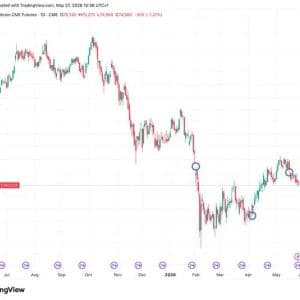
Bitcoin News CME Group's Bitcoin futures and options shifted to round-the-clock trading on Globex starting Friday, eliminating the long-standing weekend pause that previously created sharp pricing ...
28 May 2026, 11:03
Bitcoin tumbles to $72,600 as $935 million liquidated

🚨 $935 million in leveraged positions were liquidated as $BTC crashed to $72,600. Ethereum saw $228 million in long positions wiped out. Continue Reading: Bitcoin tumbles to $72,600 as $935 million liquidated The post Bitcoin tumbles to $72,600 as $935 million liquidated appeared first on COINTURK NEWS .
28 May 2026, 11:02
Respected Korean Analyst: XRP Could Jump to $20 If It Enters This Channel Again

Crypto analyst ALLINCRYPTO has shared a bullish long-term outlook for XRP, citing analysis from respected Korean market analyst Ninedex. The post focused on XRP’s multi-year price structure and the possibility of the asset reaching between $5 and $20, depending on how its current trend develops. According to the post, Ninedex believes XRP has a “base target” of $5 if the asset continues moving within its established long-term ascending channel. The chart attached to the post shows XRP trading inside a rising structure that has been developing for years, with projected price movement continuing upward toward higher resistance levels. The analysis also suggests that XRP could move significantly beyond the $5 level if it repeats the breakout structure seen during the 2017–2018 market cycle . In that scenario, the chart points toward a possible move into the upper region of the channel, where the analyst places a second target around $20. ALLINCRYPTO summarized the outlook by stating that the bullish case strengthens considerably if XRP re-enters the upper channel range that previously appeared during its historic rally years ago. $XRP COULD GO BETWEEN $5-$20! Respected Korean analyst Ninedex says $XRP has a base target of $5 if it continues climbing within its long-term channel. However if it repeats its 2017/18 breakout structure and enters the upper channel again the bull case jumps to $20 pic.twitter.com/2dKG2amoA7 — ALLINCRYPTO (@RealAllinCrypto) May 26, 2026 Chart Focuses on Fibonacci Support and Long-Term Momentum The chart shared contains several technical indicators supporting the analyst’s projection. One highlighted area identifies the “Fibonacci 0-382 zone” as a key support region. The chart suggests XRP recently tested this level and successfully held support near the $5 range projection. Another section of the chart refers to an “empty supply zone,” implying that XRP could face less resistance if momentum pushes price higher within the channel. The visual analysis also notes a “32% annual increase” in the slope of the long-term structure, reinforcing the argument for gradual upward continuation over time. Momentum indicators shown at the bottom of the chart point to what the analyst described as a “bullish dive,” accompanied by the label “after bottom touch upward.” This part of the analysis suggests the current cycle may resemble earlier periods that preceded major upward price movements. The chart additionally compares XRP’s current structure to the movement of smaller altcoins, with a note stating that “small market caps can rise via the second channel like this.” The comment indicates that the analyst sees broader potential across the altcoin market if the structure continues to play out. We are on X, follow us to connect with us :- @TimesTabloid1 — TimesTabloid (@TimesTabloid1) June 15, 2025 Mixed on Long-Term XRP Expectations The post also attracted reactions from members of the crypto community, including user cryptodog786, who commented on the price targets discussed in the analysis. In the reply, the user stated that a move to $20 would already represent a strong return for investors, while arguing that predictions of $100 or even $1,000 XRP remain unrealistic. The commenter added that some holders could risk becoming “exit liquidity” if they continue waiting for extremely high valuations that may never materialize. The response reflects an ongoing divide within the XRP community between traders focused on moderate long-term gains and those expecting substantially higher price levels in future market cycles. While the analysis remains speculative, the post from ALLINCRYPTO has brought renewed attention to XRP’s long-term chart structure and the possibility of another major breakout if historical patterns repeat. Disclaimer : This content is meant to inform and should not be considered financial advice. The views expressed in this article may include the author’s personal opinions and do not represent Times Tabloid’s opinion. Readers are advised to conduct thorough research before making any investment decisions. Any action taken by the reader is strictly at their own risk. Times Tabloid is not responsible for any financial losses. Follow us on X , Facebook , Telegram , and Google News The post Respected Korean Analyst: XRP Could Jump to $20 If It Enters This Channel Again appeared first on Times Tabloid .
28 May 2026, 11:00
Galaxy Weighs Theories After $8.3M Bitcoin Burn Mystery

Galaxy Research is trying to explain one of the stranger Bitcoin transactions of the year after five addresses sent roughly 107 BTC, worth about $8.3 million, to an old burn address, making the coins provably unspendable.The move, flagged by Galaxy in a thread on X, immediately raised the question that sits at the center of the episode: why would anyone deliberately destroy a large amount of Bitcoin rather than sell it, move it, donate it, or leave it dormant? “ACTUAL ONCHAIN BOATING ACCIDENT?” Galaxy Research wrote . “On Monday, 5 bitcoin addresses sent ~107 BTC ($8.3m) to an old burn address, making the coins provably unspendable. Why would someone do this? The Galaxy Research team’s best theories are in the thread below (spoiler: none are very good).” The burn address in question is not merely a wallet whose owner lost a key. Galaxy said the address, 1111111111111111111114oLvT2, corresponds to a Hash160 value of twenty zero bytes. Encoding that with Bitcoin’s P2PKH version byte produces the address. In practical terms, spending coins from it would require finding a public key whose Hash160 is all zeros, an outcome Galaxy framed as computationally out of reach. That makes the transaction different from a mistaken transfer to an exchange address, a wallet controlled by an unknown counterparty, or an address whose private key may exist somewhere. The coins were not simply moved into obscurity. They were sent to a destination designed to be unspendable. Theories Why Someone Burns $8.3 Million In Bitcoin Galaxy’s first theory was tax-related, but the firm appeared skeptical of its own explanation. A sender could have been attempting to create a tax loss by destroying the coins, the team wrote, but that logic weakens if the Bitcoin was acquired long ago. “Most are very old, so selling them would produce gains, not losses,” Galaxy said. The thread then moved into more speculative territory. Galaxy suggested the burn could have been motivated by religious reasons, citing traditions in which adherents renounce possessions. But it also noted that giving assets away, rather than destroying them, is the more typical pattern. That distinction matters: a donation or transfer would move wealth to another party, while a burn removes it from circulation entirely. Another possibility raised by Galaxy was that the coins were tied to illicit activity and that the sender concluded there was no viable path to launder or spend them . In that scenario, destruction would function less as a financial decision than as a risk-management act, eliminating the asset rather than attempting to move it through traceable channels. Galaxy also floated darker explanations involving coercion. “Perhaps the sender was under some form of duress, such as torture or threat of kidnapping or bodily harm, and instead of making him spend the coins to the attacker, the attacker is sick and twisted and instead demanded the victim destroy his wealth. We sincerely hope it is not this one.” The firm added a related theory in which proof-of-burn was demanded as an initiation ritual for a club or cult. The most striking theory, and the one Galaxy described as “perhaps among the most likely,” was not human ideology or criminal pressure but an automated error. The team imagined a large trading or Bitcoin operation using an agentic system to execute transfers. “Say you are running a big agentic trading or bitcoin operation, and you recently onboarded a new counterparty,” Galaxy wrote. “You instruct your agent to ‘send the counterparty 107 BTC’ and the [agent] accidentally sends it to the Countparty ( Burn Address ) instead of your counterparty.” The typo-like logic behind that theory is notable. “Counterparty” is also associated with one of Bitcoin’s older burn mechanisms, and the address used here has long been known as a burn destination. If an automated system confused a real counterparty with a burn address label, the result could be catastrophic: an irreversible transfer with no recovery path. Galaxy did not claim to have identified the sender, and the thread made clear that each theory remains conjecture. “We may never know who sent the 107 BTC or why, but these are the best we can come up with,” the firm wrote, inviting other explanations. At press time, BTC traded at $72,828.


