


 Invest ideas
News
28 May 2026, 04:55
Bitcoin could be heading much lower, fund manager warns as $150 billion Treasury operation nears

Fund manager Michael Kramer says a $150 billion liquidity drain from upcoming U.S. Treasury operations could push bitcoin sharply lower.
28 May 2026, 04:54
Here’s why the XRP price is in a deep dive today (May 28)

XRP price crashed below a crucial support level today, May 28, as liquidations in the crypto industry. It also plunged amid the ongoing US-Iran tensions, and as investors rotated to the fast-growing space and artificial intelligence industries. Ripple dropped to $1.2723, its lowest level since February. XRP price crashes as ETF inflows stall Ripple's price retreated sharply, mirroring developments in the broader crypto industry . Bitcoin, the biggest coin, dropped below $73,000, while the valuation of all tokens plunged by over 3%. Data shows that demand for XRP ETFs has slowed. These funds had no inflows or outflows on Wednesday. That is better than Bitcoin, which suffered a $700 million outflow on the same day. Still, on the positive side, these funds are having their best month so far this year as they added over $118 million in assets. Before that, their best month was in November last year when they added $666 million in assets. US-Iran tensions are rising XRP token price is falling today as tensions between the US and Iran continue . The US launched some attacks against Iranian targets overnight. This happened two days after the military launched similar attacks. Iran, which is keen to have a deal with the US, retaliated by shooting down a US drone. Analysts warn that its patience will end and push it to respond in a more aggressive manner. Such a move will lead to more fighting, driving crude oil prices higher in the near term. These events are happening as the US and Iran continue their negotiations. In a statement last week, President Donald Trump said that a deal between the two was largely negotiated. Still, there are chances that the two sides will not launch a 60-day ceasefire as Trump is under political pressure from his allies. Senators Ted Cruz, Lindsey Graham, and Roger Wicker have pushed Trump to “finish the job.” A return to war would push energy prices higher and boost the possibility that the Federal Reserve will hike interest rates. On the positive side, XRP price has some highly bullish catalysts. For example, Ripple USD (RLUSD) stablecoin has attracted over $1.8 billion in assets, making it the third-largest regulated coin after USDC and PYUSD. Data shows that RLUSD holders have continued to use their tokens. Artemis data show that $697 million of these tokens is in the XRP Ledger, while the rest is in Ethereum. Also, the 30-day adjusted transaction volume jumped to over $11.8 billion. XRP price technical analysis Ripple price chart | Source: TradingView The daily chart shows that the Ripple price has slumped in the past few days, moving from a high of $1.5485 on May 14 to the current $1.2800. It has moved below the key support level at $1.2810, its lowest level in February and April this year. The coin has slumped below all moving averages, a sign that bears remain in control. Also, the Relative Strength Index (RSI) and the MACD have continued pointing downwards. Therefore, there is a likelihood that the XRP price will continue falling, potentially to the key support level at $1.1200, its lowest point in February this year. On the other hand, a move above the key resistance level at $1.3600 will invalidate the bearish outlook. The post Here’s why the XRP price is in a deep dive today (May 28) appeared first on Invezz
28 May 2026, 04:50
Aster Lists BTC and ETH Perpetual Futures Pairs Denominated in U Stablecoin

BitcoinWorld Aster Lists BTC and ETH Perpetual Futures Pairs Denominated in U Stablecoin Decentralized cryptocurrency exchange Aster (ASTER) has introduced perpetual futures trading pairs for Bitcoin (BTC) and Ethereum (ETH), denominated in the U stablecoin from United Stables. The listing is the first to receive approval through Aster’s validator-based voting system, marking a notable step in the exchange’s governance evolution. First Validator-Approved Listing The decision to list the BTC/U and ETH/U perpetual futures pairs was not made by a centralized team but through a vote among Aster’s network validators. This approach underscores the exchange’s commitment to decentralized governance, allowing stakeholders to directly influence product offerings. The U stablecoin, issued by United Stables, is designed to maintain a 1:1 peg to the U.S. dollar, providing a familiar base currency for traders. Trading Reward Campaign Details To mark the launch, Aster is running a trading reward campaign with a total prize pool of 50,000 U. The campaign runs from 10:00 a.m. UTC on May 27 to 2:00 p.m. UTC on June 2. Users who pay trading fees on the BTC/U and ETH/U perpetual futures pairs will be eligible to share in separate reward pools of 25,000 U for each pair. The initiative is designed to incentivize early participation and liquidity provision. Why This Matters for Traders The addition of perpetual futures on a decentralized exchange like Aster offers traders an alternative to centralized platforms, with the potential for greater transparency and self-custody. Perpetual futures, which lack an expiration date, are a popular instrument for leveraged trading in crypto markets. The use of a dollar-pegged stablecoin as the quote currency simplifies profit and loss calculations for traders accustomed to USD-based pairs. Conclusion Aster’s listing of BTC and ETH perpetual futures pairs denominated in U represents a practical expansion of its trading offerings, validated through its decentralized governance system. The accompanying reward campaign may attract early liquidity, but the long-term significance lies in the demonstration of validator-driven decision-making for new product listings. FAQs Q1: What are perpetual futures? Perpetual futures are derivative contracts that allow traders to speculate on the price of an asset without an expiration date. They often involve leverage and funding rates to keep the contract price close to the spot price. Q2: How does Aster’s validator voting system work? Aster’s validators, who secure the network by staking ASTER tokens, can vote on proposals such as new trading pairs. The system is designed to decentralize decision-making away from a central authority. Q3: Is the U stablecoin widely used? U is a relatively newer stablecoin from United Stables. Its adoption depends on liquidity and trust in its peg mechanism. Traders should evaluate its stability and market depth before trading. This post Aster Lists BTC and ETH Perpetual Futures Pairs Denominated in U Stablecoin first appeared on BitcoinWorld .
28 May 2026, 04:45
Spot Ethereum ETFs Extend Losing Streak to 12 Days With $67.1M in Outflows
BitcoinWorld Spot Ethereum ETFs Extend Losing Streak to 12 Days With $67.1M in Outflows U.S. spot Ethereum exchange-traded funds recorded approximately $67.1 million in net outflows on May 27, extending a sustained capital withdrawal streak to 12 consecutive trading days, according to data from investment flow tracker Farside Investors. BlackRock and Fidelity Lead the Decline The latest outflow figures were driven primarily by two of the largest issuers in the market. BlackRock’s iShares Ethereum Trust (ETHA) accounted for the majority of the day’s capital exodus, posting net outflows of $65.1 million. Fidelity’s Ethereum Fund (FETH) contributed an additional $2 million in net outflows. No other spot Ethereum ETF reported significant flows on the day. This 12-day outflow streak represents the longest sustained period of capital withdrawals since the launch of spot Ethereum ETFs in July 2024. The cumulative net outflow over the period now exceeds $800 million, according to Farside data. Market Context and Broader Implications The persistent outflows come amid a broader period of price weakness for Ethereum, which has traded in a range between $2,800 and $3,200 over the past three weeks. Analysts point to several contributing factors, including uncertainty around the U.S. regulatory stance on digital assets, a rotation of institutional capital toward Bitcoin ETFs, and general risk-off sentiment in the crypto market. By contrast, U.S. spot Bitcoin ETFs have seen mixed but generally more resilient flows during the same period, with several days of net inflows interspersed with minor outflows. This divergence suggests that institutional investors may currently favor Bitcoin over Ethereum as a preferred digital asset exposure. What This Means for Investors The sustained outflow streak signals a cautious or bearish short-term outlook among institutional investors toward Ethereum-specific products. However, it is important to note that ETF flows are only one indicator of market sentiment. On-chain activity, developer ecosystem health, and upcoming network upgrades remain positive factors for Ethereum’s long-term fundamentals. For retail investors, the trend may present a potential entry point if outflows reverse and capital returns, but the current momentum suggests patience may be warranted until clearer signs of stabilization emerge. Conclusion The 12-day outflow streak for U.S. spot Ethereum ETFs underscores a period of institutional caution toward the asset class. With BlackRock and Fidelity products bearing the brunt of the withdrawals, the market will be watching closely for any shift in sentiment, whether driven by regulatory clarity, macroeconomic changes, or renewed demand for Ethereum-based investment vehicles. FAQs Q1: What is a spot Ethereum ETF? A spot Ethereum ETF is an exchange-traded fund that directly holds Ethereum (ETH) as its underlying asset, allowing investors to gain exposure to the cryptocurrency’s price without buying or storing it themselves. Q2: Why have Ethereum ETFs seen 12 straight days of outflows? The outflows are likely driven by a combination of factors, including Ethereum’s recent price weakness, broader risk-off sentiment in crypto markets, regulatory uncertainty, and a possible rotation of institutional capital toward Bitcoin ETFs. Q3: How do these outflows compare to Bitcoin ETF flows? During the same period, U.S. spot Bitcoin ETFs have shown more mixed flows, with several days of net inflows, suggesting that institutional investors may currently prefer Bitcoin over Ethereum as a digital asset exposure. This post Spot Ethereum ETFs Extend Losing Streak to 12 Days With $67.1M in Outflows first appeared on BitcoinWorld .
28 May 2026, 04:41
XRP drops 4% below $1.30 as heavy selling breaks key support zone
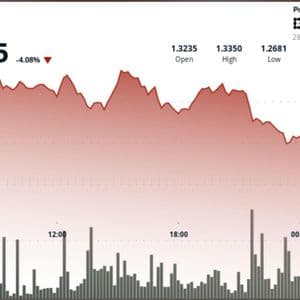
XRP lost another major support level after high-volume selling accelerated late in the session, keeping focus on whether the months-long compression structure is now breaking lower.
28 May 2026, 04:30
Crypto Futures Liquidations Surge Past $346 Million in One Hour as Market Sell-Off Intensifies
BitcoinWorld Crypto Futures Liquidations Surge Past $346 Million in One Hour as Market Sell-Off Intensifies The cryptocurrency derivatives market experienced a sudden and violent shakeout in the past hour, with over $346 million worth of futures positions forcibly closed across major exchanges. The liquidation event, which primarily impacted leveraged long positions, pushed the 24-hour total to approximately $809 million, according to data from CoinGlass. What Triggered the Liquidations? The sharp spike in liquidations followed a rapid downward move in Bitcoin and Ethereum prices, which dropped more than 4% and 6% respectively within a 60-minute window. Analysts point to a combination of factors, including profit-taking after recent rallies, concerns over upcoming macroeconomic data, and cascading stop-loss orders that amplified the sell-off. Data shows that long positions accounted for over 85% of the liquidations, suggesting that traders who had been betting on continued upward momentum were caught off guard by the sudden reversal. The largest single liquidation order occurred on Binance, valued at over $12 million. Market Context and Broader Implications This liquidation event is the largest single-hour flush in over two months and underscores the persistent fragility of the crypto derivatives market. High leverage, often exceeding 50x on some platforms, amplifies price swings and can trigger rapid cascading liquidations when key support levels break. The broader cryptocurrency market capitalization has shed approximately $30 billion in the past 24 hours, bringing total market cap back below the $1.8 trillion mark. Trading volumes have surged, indicating heightened panic selling and forced unwinding of positions. Why This Matters for Traders For retail and institutional traders alike, this event serves as a stark reminder of the risks inherent in leveraged trading. Liquidation cascades can create artificial price dislocations, often driving prices below fair value before a partial recovery occurs. Monitoring funding rates, open interest, and liquidation levels has become essential for navigating such volatile conditions. Historically, large-scale liquidation events have sometimes marked local bottoms, as excessive leverage is flushed out of the system. However, the current macroeconomic environment, including upcoming Federal Reserve interest rate decisions and geopolitical tensions, adds layers of uncertainty that make predicting the next move particularly challenging. Conclusion The $346 million hourly liquidation spike reflects a market caught off balance by a sudden shift in sentiment. While leveraged traders face immediate losses, the broader implications point to an ecosystem where risk management remains critical. As always, market participants are advised to exercise caution, use appropriate position sizing, and stay informed about macroeconomic catalysts that could influence price action in the days ahead. FAQs Q1: What is a futures liquidation? A futures liquidation occurs when a trader’s position is automatically closed by the exchange because the margin balance has fallen below the required maintenance level, usually due to adverse price movements. Q2: Why do liquidations happen in clusters? Liquidations often cascade because when large positions are forcibly closed, they add selling pressure, pushing prices further down and triggering additional liquidations at lower price levels. Q3: Is this level of liquidation unusual? While $346 million in one hour is significant, it is not unprecedented. Similar events have occurred multiple times in 2024 and 2025, often during periods of high market volatility or after prolonged rallies. This post Crypto Futures Liquidations Surge Past $346 Million in One Hour as Market Sell-Off Intensifies first appeared on BitcoinWorld .


