


 Invest ideas
News
26 May 2026, 12:41
Envirotech Vehicles expands Bitcoin mining, GPU.& AI push with $118M pipeline

More on Envirotech Vehicles Envirotech Vehicles signs merger agreement with AZIO AI at $750M valuation Historical earnings data for Envirotech Vehicles Financial information for Envirotech Vehicles
26 May 2026, 12:37
USDT vs USDC: Which Stablecoin Should You Hold in 2026?
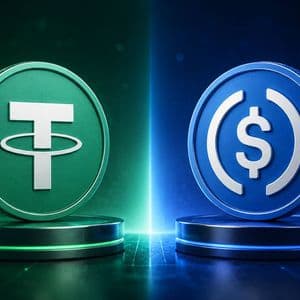
Stablecoin holders in 2026 face a two-way choice for most use cases. USDT (Tether) sits at roughly $189 billion in circulating supply. USDC (Circle) sits at roughly $77 billion. Together, they account for over 90% of the fiat-backed stablecoin market. The USDT vs USDC decision shapes network availability, transfer fees, and which downstream platforms accept the holding. Each stablecoin has built a distinct profile across reserves, regulatory posture, and native chain coverage. IronWallet is a non-custodial multi-chain wallet with no KYC, 10,000+ supported assets, gasless stablecoin transfers, and WalletConnect Pay integration, supporting both USDT and USDC across major networks from a single application. What USDT and USDC Are USDT is the world's largest stablecoin by market cap, issued by Tether Limited. It launched in 2014 and has accumulated over 500 million users globally per Tether's Q3 2025 reporting . The token operates on a 1:1 peg to the US dollar, backed by reserves that include US Treasury bills, gold, and Bitcoin holdings. USDC is the second-largest stablecoin, issued by Circle Internet Financial (publicly traded as CRCL since 2025). USDC launched in 2018 through a consortium with Coinbase and has positioned itself as the regulated US-aligned stablecoin. The token operates on a 1:1 peg backed by cash and short-duration US Treasury securities, with monthly attestation reports published by Deloitte. Both stablecoins target the same price point but serve different user profiles. The sections below cover the practical differences. How USDT and USDC Compare A direct comparison across the dimensions that affect holding decisions: Dimension USDT (Tether) USDC (Circle) Issuer Tether Limited Circle Internet Financial Market cap (May 2026) ~$189 billion ~$77 billion Native chain coverage 14+ chains 34 chains Reserve transparency Quarterly BDO attestations Monthly Deloitte attestations Strongest use case Trading, remittances, deep liquidity DeFi, EU compliance, institutional Each row tells a different story about who the stablecoin is built for. The sections below walk through what those differences mean for holders. Issuer and Reserves Comparison The stablecoin comparison that matters most for safety is the reserve composition behind each token. USDT reserves as reported in Tether's Q3 2025 BDO attestation: $135 billion in US Treasury exposure (direct and indirect), $12.9 billion in gold, $9.9 billion in Bitcoin, plus secured loans and other assets. The Bitcoin and gold allocations have historically driven the reserve-quality debate around Tether, since these assets carry market volatility that pure cash-and-Treasuries portfolios do not. USDC reserves are simpler. Circle holds cash and short-duration US Treasury securities, with monthly attestation reports from Deloitte since late 2025. Circle has issued 41 consecutive monthly attestation reports as of early 2026, building one of the longest continuous transparency records in the stablecoin sector. Both issuers publish attestation reports as the industry standard for stablecoins, not full audits. The frequency and composition differ: USDC's monthly cadence with simpler reserves provides shorter feedback loops, while USDT's quarterly reports cover a more complex multi-asset reserve. Network Coverage Differences The USDT vs USDC chains is where the two stablecoins look most different. USDT is natively issued on 14+ blockchains, including Ethereum, Tron, Solana, BNB Chain, Polygon, Avalanche, Arbitrum, Optimism, Aptos, Near, Tezos, Cosmos, Algorand, and Liquid. Tron carries the largest share, with over $80 billion in USDT supply on the network as of April 2026, driven by remittance corridors that prize Tron's sub-cent fees and 3-second confirmations. USDC is natively issued on 34 blockchains as of May 2026, including Ethereum, Solana, Base, Arbitrum, Optimism, Polygon, Avalanche, Stellar, Algorand, NEAR, Tron, Aptos, Sui, ZKsync, Linea, XRP Ledger, and many others. Circle's Cross-Chain Transfer Protocol (CCTP) lets users move native USDC between supported chains by burning the token on the source chain and minting fresh native USDC on the destination chain. A practical takeaway: USDT carries deeper liquidity on Tron and Ethereum, while USDC has broader native deployment across more chains with a built-in cross-chain rail. Transaction Fees Across Networks The best stablecoin for any specific transfer depends largely on network choice. Both USDT and USDC carry similar fee economics when held on the same chain. On Ethereum, ERC-20 USDT and USDC transfers cost the same network gas, typically $2-15 per transfer during normal conditions. On Solana, both stablecoins benefit from sub-cent fees and near-instant finality. On Tron, TRC-20 USDT transfers cost roughly 1 USDT (or less with energy staking), while USDC on Tron has a limited but growing presence. Layer 2 networks (Arbitrum, Base, Optimism, Polygon) carry low fees for both stablecoins, typically $0.05-0.20 per transfer. Fee economics ultimately come down to network choice, not stablecoin choice. A USDT holder on Tron pays significantly less than a USDC holder on Ethereum, even though USDT and USDC cost the same on any given network. Use Case Fit: When to Hold Each A practical USDT or USDC answer depends on what the holder plans to do with the balance. Hold USDT when: Trading actively on centralised exchanges (USDT order books are 3 to 5 times deeper than USDC equivalents) Sending peer-to-peer transfers in regions where Tron USDT carries deep adoption (Asia, Latin America, parts of Africa) Settling remittance corridors that price in Tron USDT Moving large balances where deep liquidity reduces slippage Hold USDC when: Participating in regulated DeFi protocols (Aave, Compound) where USDC is the institutional preference Operating from the European Union under MiCA-compliant rails (Tether opted out of MiCA in 2024) Holding for long-term savings where simpler reserve composition reduces uncertainty Working with US-regulated platforms or treasury workflows Hold both when: Active across both trading and DeFi contexts Operating across multiple jurisdictions Hedging against single-issuer exposure Where to Hold Both Stablecoins A multi-chain wallet that handles both USDT and USDC natively removes the friction of picking sides at signup time. IronWallet covers both stablecoins across Ethereum, Tron, BNB Chain, Polygon, Base, and Solana from a single application. The combination matters because the USDT vs USDC decision often shifts over time. A holder who starts with USDT for exchange trading may later add USDC for DeFi positions. A multi-chain stablecoin wallet lets that shift happen inside one app without separate seed phrases or new accounts. IronWallet also offers gasless transfers for TRC-20 USDT and ERC-20 USDC specifically, which removes the gas-token friction that affects most non-custodial wallets. Conclusion USDT vs USDC 2026 comes down to different stablecoin profiles. USDT offers raw size, liquidity depth, and Tron-rail strength. USDC offers regulatory clarity, multi-chain native coverage, and monthly attestation cadence. Neither is universally better; the right choice depends on use case. For most holders, the practical answer is to hold both and switch between them based on the destination. A multi-chain wallet that handles both natively makes that flexibility possible. FAQ Is USDT or USDC safer to hold in 2026? Both USDT and USDC are 1:1 pegged to the US dollar with reserves backing the supply. USDC's reserves are simpler (cash and short-duration US Treasuries) and audited monthly by Deloitte. USDT's reserves include US Treasuries, gold, and Bitcoin, audited quarterly by BDO. Safety depends on the holder's tolerance for reserve complexity versus reserve diversification. Which stablecoin has lower transaction fees? Transaction fees depend on the network, not the stablecoin itself. USDT on Tron is the cheapest combination for most retail transfers (around 1 USDT per transfer), and USDC on Solana runs similarly cheap. Both USDT and USDC cost the same on Ethereum (ERC-20 gas fees) or on Layer 2 networks like Base, Arbitrum, and Polygon. Can I lose money holding USDT or USDC? A 1:1 peg can deviate during market stress (USDC depegged briefly to $0.87 during the Silicon Valley Bank collapse in March 2023), but both stablecoins have generally maintained tight peg discipline. A larger risk is platform risk: holding USDT or USDC on a centralised exchange exposes the holder to that exchange's solvency, while holding in a non-custodial wallet removes that exposure. Which stablecoin works better for DeFi? USDC has deeper DeFi protocol integration on Ethereum and Base, with Aave, Compound, and Curve all treating USDC as primary collateral. USDT has larger trading volume on DEXs but a smaller institutional DeFi presence. For lending and yield protocols on Ethereum, USDC is generally the preferred option. For DEX trading and high-volume swaps, USDT often carries deeper pools. Should I hold USDT and USDC in the same wallet? Yes. Any multi-chain non-custodial wallet that supports both stablecoins handles them from a single interface. IronWallet holds both USDT and USDC across Ethereum, Tron, BNB Chain, Polygon, Base, and Solana, with gasless transfers for TRC-20 USDT and ERC-20 USDC. Holding both in one wallet removes the need to switch applications when the use case shifts. Disclaimer: This article is provided for informational purposes only. It is not offered or intended to be used as legal, tax, investment, financial, or other advice.
26 May 2026, 12:36
Solana faces $100 resistance as breakout hopes rise

🚨 $100 marks the key resistance level in $SOL trading now. Solana has moved between $80 and $100 for four months. 📈 Critical data: A breakout above $100 could target $125, $175, even $300. Continue Reading: Solana faces $100 resistance as breakout hopes rise The post Solana faces $100 resistance as breakout hopes rise appeared first on COINTURK NEWS .
26 May 2026, 12:36
Strategy Cuts $1.5B in Convertible Debt and Grows Bitcoin Holdings to 843,738 BTC

Strategy retired $1.5 billion in convertible debt at a discount on Tuesday and disclosed it now holds 843,738 bitcoin, reflecting a year-to-date BTC Yield of 13.3%. Strategy Retires $1.5 Billion in Debt at 8% Discount and Adds 24,869 Bitcoin The Tysons Corner, Virginia-based company repurchased $1.5 billion aggregate principal amount of its 0% Convertible Senior
26 May 2026, 12:30
Crypto funds post $1.47 billion in net outflows, a second straight negative week

Digital asset investment products and crypto funds recorded $1.47 billion in net outflows for the week ending May 23. This is the second consecutive negative week and the third-largest weekly outflow of 2026 to date. Only the twin $1.7 billion weeks of late January saw larger withdrawals from the category, according to data from CoinShares. Total assets under management across the category fell to $148.69 billion. The pullback was driven by Bitcoin, which saw $1.315 billion leave its investment products over the week. This was also the largest single-week Bitcoin outflow of 2026 to date. The number surpassed the late-January peak and pulled year-to-date inflows for Bitcoin products down to $2.6 billion from $3.9 billion the previous week . Bitcoin records largest weekly outflow of 2026 Bitcoin investment products accounted for $1,315.2 million of the weekly outflow total. This was the largest single-asset withdrawal across the category and a new high for weekly Bitcoin outflows in 2026. Year-to-date inflows for Bitcoin products now stand at $2.624 billion, with total assets under management at $120.23 billion. Crypto funds flow by asset. Source: CoinShares The two-week run of outflows now totals $2.54 billion across the category. Short-Bitcoin products drew $10.2 million in net inflows over the same week. This was a turn from the outflows seen in those products during the previous reporting period. Ethereum and altcoin flows across the crypto funds week Ethereum products posted $222.8 million in net outflows over the week, almost in line with the previous week’s figure. Year-to-date inflows for Ethereum products now sit at negative $89 million, and the total assets under management stand at $16.23 billion. The month-to-date figure has fallen to $298.8 million in outflows for May. Altcoin products have seen selective inflows, although on a smaller scale than the previous week. XRP funds led the group at $31.8 million in net inflows, with year-to-date flows now at $291 million. Near products drew $9.0 million and Solana funds added $7.7 million over the week, with Sui taking in $2.9 million and Chainlink $0.6 million. Multi-asset products drew $4.7 million in net inflows for the week, staying on the positive side. Litecoin posted a smaller $0.4 million in inflows. Nine separate assets recorded meaningful inflows of more than $1 million over the week, down from 11 the previous week. United States drives the global crypto funds outflow United States-listed crypto funds accounted for $1.4 billion of the weekly outflow figure. Year-to-date inflows for US-listed products now stand at $2.15 billion, with total assets under management at $123.89 billion. Month-to-date flows for May have turned negative at $1.06 billion in outflows. The risk-off extended well beyond the United States during the week. Switzerland saw $16.2 million in outflows, with Canada losing $12.5 million and Hong Kong $12.2 million. Germany was close to flat at $4.4 million in outflows, with Sweden adding $1.8 million and Brazil $1.4 million to the negative regional tally. A handful of smaller markets stayed positive over the week. The Netherlands drew $6.6 million in net inflows, with Australia adding $0.7 million. France and New Zealand were close to flat for the period. iShares leads the provider outflows By issuer, BlackRock’s iShares family saw $1.1 billion leave its crypto funds over the week, the largest single-issuer outflow on the report. Year-to-date inflows for iShares still hold at $2.902 billion, with total assets under management at $69.39 billion. Month-to-date flows for the iShares family have turned negative at $607 million for May. Fidelity recorded $129 million in net outflows over the same period, with its year-to-date figure staying in the red at minus $1.493 billion. ARK 21Shares posted $107 million in outflows on the week, taking its year-to-date figure to minus $407 million. ProFunds Group lost $45 million, with Grayscale recording $12 million in outflows and CoinShares $6 million. Two providers stayed positive for the week. Bitwise drew $1 million in fresh capital and 21Shares AG took in $1 million over the period. If you're reading this, you’re already ahead. Stay there with our newsletter .
26 May 2026, 12:25
Coinbase to List Citrea (CTR), Expanding Bitcoin Layer-2 Access

BitcoinWorld Coinbase to List Citrea (CTR), Expanding Bitcoin Layer-2 Access Coinbase, one of the largest publicly traded cryptocurrency exchanges in the United States, has announced the listing of Citrea (CTR), a token associated with a Bitcoin layer-2 scaling solution. The listing is set to expand trading options for users on the platform and signals growing institutional interest in Bitcoin-based infrastructure projects. What is Citrea (CTR)? Citrea is a Bitcoin layer-2 network designed to enhance the programmability and scalability of the Bitcoin blockchain. By enabling smart contracts and decentralized applications (dApps) on top of Bitcoin’s base layer, Citrea aims to bring functionality similar to Ethereum’s ecosystem to the world’s largest cryptocurrency by market capitalization. The CTR token serves as the native asset for transaction fees, governance, and network security within the Citrea ecosystem. The project has attracted attention from venture capital firms and developers focused on expanding Bitcoin’s utility beyond simple value transfer. Citrea’s approach leverages zero-knowledge proofs to maintain security and decentralization while improving throughput and reducing costs. Coinbase Listing Details and Timeline According to Coinbase’s official announcement, the listing will be phased. Initially, the exchange will enable inbound transfers of CTR tokens to Coinbase wallets. Once sufficient liquidity is confirmed, trading pairs including CTR-USD, CTR-USDT, and CTR-EUR are expected to go live. The exact date for trading activation has not been specified, but Coinbase typically processes such listings within 24 to 48 hours after the transfer enablement phase. Coinbase has classified CTR under its ‘Experimental’ asset label, which applies to new or lower-volume tokens. This designation means the token will be subject to higher volatility and may have limited trading features compared to more established assets. Users are advised to conduct their own research before trading. Market Implications for Bitcoin Layer-2 Tokens The listing of CTR on Coinbase is notable for several reasons. First, it reflects a broader trend of exchanges supporting infrastructure projects built on Bitcoin, a shift from the historical focus on Ethereum-based tokens. Second, it provides retail and institutional investors with direct exposure to the Bitcoin layer-2 narrative, which has gained traction as developers seek to unlock new use cases for Bitcoin. Analysts point out that listings on major U.S. exchanges like Coinbase often lead to increased liquidity, price discovery, and mainstream awareness for the listed asset. However, the ‘Experimental’ tag also serves as a cautionary signal, reminding traders that such assets carry higher risk due to lower market depth and shorter track records. Why This Matters for Crypto Investors For the broader cryptocurrency market, Coinbase’s decision to list CTR underscores the growing maturity of Bitcoin’s ecosystem. While Bitcoin has traditionally been viewed as a store of value, layer-2 solutions like Citrea aim to transform it into a platform for decentralized finance (DeFi), non-fungible tokens (NFTs), and other applications. This evolution could potentially attract new capital and developer talent to the Bitcoin network. Investors should monitor the listing’s impact on CTR’s trading volume and price action in the days following the launch. Additionally, the success of Citrea could influence other exchanges to list similar Bitcoin layer-2 tokens, further integrating these projects into the mainstream crypto economy. Conclusion Coinbase’s listing of Citrea (CTR) represents a meaningful step in bringing Bitcoin layer-2 technology to a wider audience. While the token carries experimental risk, the move highlights the exchange’s willingness to support innovative infrastructure projects that extend Bitcoin’s capabilities. As always, traders should approach new listings with caution and prioritize thorough research. FAQs Q1: When will CTR trading start on Coinbase? Coinbase has not provided an exact date, but trading typically begins within 24–48 hours after inbound transfers are enabled. The exchange will announce the exact time once liquidity thresholds are met. Q2: Is CTR available on other exchanges? As of the announcement, CTR is listed on a limited number of smaller exchanges. The Coinbase listing is expected to significantly increase its availability and liquidity. Q3: What does ‘Experimental’ label mean on Coinbase? The ‘Experimental’ designation is applied to assets that are newer or have lower trading volume. These assets may experience higher volatility and have limited functionality compared to more established tokens. Coinbase advises users to exercise caution and perform their own due diligence. This post Coinbase to List Citrea (CTR), Expanding Bitcoin Layer-2 Access first appeared on BitcoinWorld .


