


 Invest ideas
News
23 May 2026, 13:05
5 Ways Syndication Supports AI Search Presence

AI search has changed how visibility works online. Traditional SEO focused on ranking pages high enough to earn clicks. AI-driven search systems such as ChatGPT, Gemini, Perplexity, and Google AI Overviews increasingly synthesize answers directly from trusted sources instead of presenting long lists of links. Brands now compete for citations, mentions, and inclusion inside AI-generated responses. Presence across authoritative publications matters more because large language models rely heavily on widely distributed and frequently referenced content. In crypto and Web3 PR, syndication has traditionally been treated as a distribution bonus. Today, it directly affects discoverability inside AI systems. Outset PR recognized this transition early. The agency structures campaigns around media outlets with strong syndication depth, republication potential, and high AI discoverability signals rather than relying purely on traffic metrics. AI Search Rewards Repetition Across Trusted Sources Large language models do not evaluate information the same way traditional search engines do. AI systems increasingly prioritize: source authority consistency across publications structured factual repetition citation frequency publisher trust signals Research analyzing AI citation behavior found that AI Overviews frequently cite authoritative domains that may not even appear among top organic search results. Another study examining LLM training data concluded that high-authority commercial publishers are disproportionately represented inside major AI datasets. When one article is republished across Yahoo Finance, CoinMarketCap, Binance Square, MSN, or crypto aggregators, the same core narrative appears repeatedly across trusted domains. AI systems interpret this repetition as validation. 1. Syndication Expands Citation Surface Area AI search systems need retrievable information. The more places a narrative exists, the more opportunities AI systems have to reference it during retrieval and synthesis. Syndicated content increases what can be called citation surface area: the total number of indexed locations where a brand, founder, product, or narrative appears. This matters because AI systems increasingly rely on multi-source corroboration instead of single-page authority. A single earned media placement may become: a Yahoo Finance republication a CoinMarketCap feed inclusion a Binance Square repost a crypto news aggregator pickup a secondary editorial citation Each additional copy increases discoverability probability. Outset PR structures campaigns specifically around this effect. The agency analyses media outlets not only by readership, but also by syndication reach and republication likelihood using Outset Media Index. The StealthEX campaign demonstrates the mechanism clearly. Targeted tier-1 pitching resulted in 92 republications across platforms including CoinMarketCap, Binance Square, and Yahoo Finance, producing an estimated reach above 3 billion. In AI search environments, those republications continue working long after the original publication date. 2. Syndication Reinforces Entity Association LLMs build relationships between entities. If a company repeatedly appears alongside terms such as crypto infrastructure, stablecoin payments, or Web3 analytics, the AI system begins associating the brand with those concepts more confidently. Syndication strengthens these associations because the same narrative propagates across multiple trusted environments. This is especially important in crypto PR, where narratives shift quickly and projects compete for category ownership. Repeated media exposure helps AI systems connect: founders with expertise areas protocols with market sectors products with use cases brands with industry trends Research into Generative Engine Optimization shows that AI visibility improves significantly when content contains repeated authority signals and statistically supported claims across multiple sources. This is one reason why modern crypto PR increasingly overlaps with AI visibility strategy. 3. Syndication Helps Brands Survive Zero-Click Search AI-generated answers increasingly reduce direct traffic to publishers. Multiple studies show AI Overviews suppress click-through rates while surfacing summarized answers directly inside search interfaces. Google has already expanded AI summaries into Discover feeds and other content environments. As zero-click behavior grows, brands need visibility that survives even when users never open the original article. Syndication supports this because AI systems may retrieve: the original publication a syndicated copy a summarized repost an aggregator excerpt a cited derivative article The original source becomes less important than total narrative distribution. This changes the economics of PR. A placement no longer generates value only through direct referral traffic. Its long-term value increasingly comes from becoming part of the machine-readable information ecosystem that AI systems continuously reference. Outset PR’s approach reflects this transition. The agency focuses on media that generate secondary distribution and long-tail discoverability instead of measuring success only through immediate impressions. 4. Syndication Increases Trust Signals for AI Systems AI search engines favor trusted domains. Studies analyzing AI citation behavior consistently show concentration around authoritative publishers. That creates a compounding effect. If an article originates from a respected publication and later appears across additional established platforms, the narrative accumulates trust signals: publisher authority cross-source consistency entity validation repeated indexing structured factual reinforcement This matters even more as AI search moves toward verified information environments. Recent reporting suggests AI visibility increasingly depends on consistent and machine-readable factual verification rather than traditional keyword manipulation. Syndication supports that consistency naturally. Every republication reinforces: company descriptions executive titles product positioning funding narratives market categories Over time, AI systems become more confident in retrieving and citing those associations. 5. Syndication Extends Narrative Lifespan Traditional PR campaigns often focused on short-term spikes. AI search changes the timeline. LLMs continuously retrieve archived content, historical reporting, syndicated articles, and secondary references. A well-distributed article may continue influencing discoverability months later. Research on AI citation systems shows that visibility increasingly depends on persistent authority signals rather than temporary ranking positions. Syndication extends narrative lifespan because content continues circulating long after publication. This is particularly valuable in crypto markets, where narrative timing matters heavily. A founder interview, protocol analysis, or funding announcement may resurface later when: market conditions align users search related questions AI systems synthesize industry context journalists research comparable projects Outset PR incorporates this long-tail perspective into campaign planning by aligning publication timing, outlet selection, and syndication potential with broader market cycles. Syndication Is Becoming Part of AI Visibility Infrastructure The relationship between PR and AI search is tightening rapidly. Visibility no longer depends only on ranking first in Google. Increasingly, it depends on whether AI systems repeatedly encounter and trust your narrative across authoritative sources. Syndication expands citation opportunities, reinforces entity associations, strengthens trust signals, extends narrative lifespan, and improves discoverability inside AI-generated answers. For crypto companies competing in increasingly crowded markets, this changes how PR should be evaluated. The question is no longer simply:“How many people read the article?” The better question is:“How widely will this narrative propagate across the information systems AI models rely on?” That is the strategic layer many Web3 projects are only beginning to understand. And it is precisely where data-driven firms like Outset PR are positioning their campaigns today.
23 May 2026, 13:05
Bitcoin Price Analysis: BTC Risks Deeper Correction Below $74K
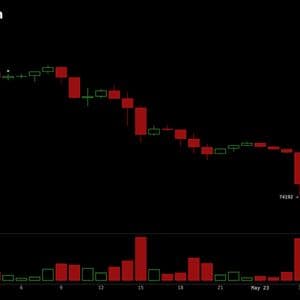
Bitcoin is trading in a volatile but technically fragile range on Saturday as bearish pressure from Friday evening’s whiplash continues to dominate higher time frames despite selective short-term recovery attempts. Traders are monitoring whether the leading crypto asset can stabilize above the critical $74,000 support zone after a sharp retreat from recent highs near $82,833.
23 May 2026, 13:02
XRP Army Reacts As Ripple CEO Drops Huge Clue

Tokenization is reshaping how major institutions think about assets, and Ripple CEO Brad Garlinghouse has a clear position on it. Crypto pundit Minus Wells (@MinusWells) shared a clip of Garlinghouse’s remarks. It immediately caught the XRP army’s attention. What Garlinghouse said about blockchain settlement, institutional conviction, and Ripple’s strategy gave the community plenty to work with. Settlement Friction Is the Problem Tokenization Solves Garlinghouse identified transaction settlement as a core inefficiency that blockchain technology directly addresses. He pointed to real-world examples where settlement carries “a ton of friction.” Blockchains, in his view, remove that friction entirely . He was careful not to claim that tokenization applies universally. Some use cases give him pause. His position is that the technology works best when a genuine problem drives its adoption. When technology goes searching for a problem instead, the results are weaker. That distinction explains how Ripple approaches the market. RIPPLE CEO BRAD GARLINGHOUSE JUST A HUGE CLUE “Forget Bitcoin, Tokenization is the real disruptor that BlackRock and global markets are secretly betting EVERYTHING on.” While you’re still chasing BTC pumps… the trillion-dollar institutions have already moved on. The… https://t.co/gr0Ygx8uv2 pic.twitter.com/TTlYY3abzs — ᙢinus ᙡells (@MinusWells) May 22, 2026 BlackRock’s Commitment Signals Institutional Conviction Garlinghouse pointed to BlackRock CEO Larry Fink as a significant signal of where institutional confidence currently sits. Fink has stated publicly that he believes a large percentage of global assets will eventually be tokenized for more efficient management, storage, and transactions. Garlinghouse stated, “I agree with him.” He described Fink as someone who has “leaned in in a big way” around tokenization. He also predicted that the pace of adoption will be faster than most people expect. BlackRock’s active involvement signals that tokenization has moved well past the theoretical stage for the world’s largest asset manager. Ripple Takes a Vertical Approach Garlinghouse laid out Ripple’s strategy clearly. The company targets specific verticals rather than spreading across every available sector. He used insurance as a concrete example, noting that XRP and blockchain technology hold real potential for the industry, covering the full transaction and settlement process , not just payments. He was direct about where Ripple draws the line. Referring to insurance, he said, “Ripple doesn’t know anything about that.” The company will not enter a market without genuine expertise behind it. Specialists who understand each vertical are essential to applying the technology where it produces real results. Institutional Momentum Builds The XRP community’s response to Minus Wells’ post reflects strong confidence that XRP and Ripple’s positioning align with where institutional capital is already moving. Garlinghouse’s comments reinforce that tokenization is an active priority for major players, not a distant concept. The company’s vertical focus is important as it shows a disciplined growth strategy. Garlinghouse offered no specific timeline, but delivered a clear view of the opportunity and how Ripple intends to capture it. The XRP community is watching closely. Disclaimer : This content is meant to inform and should not be considered financial advice. The views expressed in this article may include the author’s personal opinions and do not represent Times Tabloid’s opinion. Readers are advised to conduct thorough research before making any investment decisions. Any action taken by the reader is strictly at their own risk. Times Tabloid is not responsible for any financial losses. Follow us on X , Facebook , Telegram , and Google News The post XRP Army Reacts As Ripple CEO Drops Huge Clue appeared first on Times Tabloid .
23 May 2026, 13:00
Bitcoin Spot Demand Falls At Fastest Rate Since January — What’s Happening?

The price of Bitcoin has been under significant downward pressure over the past week, and the f alling spot demand might be one of the factors behind the downturn, according to a CryptoQuant head of research. Bitcoin Apparent Demand Falls To -40K BTC In a May 22nd post on the X platform, CryptoQuant’s Head of Research, Julio Moreno, revealed that Bitcoin spot demand has been declining over the past few weeks. This on-chain observation comes as the premier cryptocurrency appears to be struggling under significant bearish pressure. The relevant indicator here is the Apparent Demand metric, which tracks demand by comparing newly mined BTC to the amount of unmoved coin over a period. The on-chain metric provides insight into investor appetite and can be used to decipher different market phases, especially in the long term. Using this metric as an anchor, Moreno revealed that the Bitcoin spot demand is falling at the fastest pace since January 10th. When the Apparent Demand indicator contracted in early January, the Bitcoin price dipped to around the $90,000 mark before rebounding to $98,000 (alongside the demand). However, the Apparent Demand was in a massive downturn for most of the first quarter before turning around in early April. Accompanied by a commensurate rise in the price of Bitcoin, the coin’s demand in the spot market improved for most of the previous month. As observed in the chart above, the on-chain metric has declined to its lowest level since early January. CryptoQuant data show that the 30-day sum of Apparent Demand is around -40,000 BTC. While it is difficult to pinpoint the exact cause of the recent downturn in BTC spot demand, the poor performance of US-based exchange-traded funds might be a good place to start. Nevertheless, when questioned about the contribution of the spot Bitcoin ETFs to this trend, Moreno answered that the exchange-traded funds account for only a small fraction of BTC’s demand growth. Coinbase Premium Falls To Lowest Level Since February At the same time, the Coinbase Premium Gap, which offers insight into institutional investor appetite in the US, also supports the thesis of waning demand in the Bitcoin spot market. According to CryptoQuant data highlighted by Maartunn, Coinbase, the US’s largest cryptocurrency exchange, is witnessing its most significant selling pressure since February. This evident decline in demand has coincided with the latest dip in Bitcoin’s price. Hence, it goes without saying that investor appetite in the spot market needs to improve for the premier cryptocurrency to recover in price. As of this writing, the price of BTC sits around $75,600, reflecting a 2.5% slump in the past day.
23 May 2026, 13:00
History Shows Bitcoin ETF Outflows Favor Accumulation, Says Santiment

Six straight days of outflows from US spot Bitcoin ETFs — totaling $1.26 billion — are drawing attention not for the losses they represent, but for what history suggests might come next. What The Data Shows Blockchain analytics firm Santiment says these outflows should be read as a counter-signal rather than a warning. According to the firm, ETF flows reflect retail investor behavior more than institutional positioning, which means sustained outflows tend to mark bottoms rather than the start of deeper slides. Related Reading: New Bitcoin Lows? Analysts Say Chances Are ‘Extremely Slim’ Santiment pointed to a consistent pattern: large inflow spikes have historically landed near price tops, while heavy outflow periods have lined up with buying opportunities. The numbers support the argument. On July 10, 2025, spot Bitcoin ETFs recorded $1.18 billion in inflows — a period that coincided with a local price top. October 6, 2025 brought $1.21 billion in inflows, and prices peaked around the same time. On the other side, $903 million in outflows hit on November 20, 2025, a moment that proved well-timed for buyers. Based on this track record, Santiment says the current outflow streak fits the same mold — retail investors cutting exposure after Bitcoin failed to hold $80,000 in May, hitting a high of $79,050 on May 16 before pulling back. Retail Fear, Not Institutional Exit Bitcoin was trading at $75,400 when Santiment published its report on Friday, May 22. The firm described the current climate as the highest level of market fear seen in more than 3.5 months. Rather than treating that as cause for alarm, Santiment framed it as a familiar setup — retail capitulation that has historically reset conditions ahead of recoveries. Spot Bitcoin ETFs recorded outflows across each of the six trading sessions from May 15 through May 22, according to Farside Investors data. The 11 funds tracked collectively posted $1.26 billion in net outflows during just five of those sessions. On May 22 alone, total net outflows came to $105 million, according to SoSoValue data, extending the outflow streak to six consecutive days. Related Reading: Bitcoin Treasury Company Nakamoto Takes Action To Prevent Stock Slide ETF Analyst Sees Recovery Ahead ETF analyst James Seyffart offered a separate reason for optimism. Speaking on a podcast, Seyffart noted that total Bitcoin ETF inflows are approaching their all-time high of $60 billion and that most of the $9 billion in outflows recorded between October and February has since been recouped. He expects the all-time inflow record to break in the near term. Featured image from Unsplash, chart from TradingView
23 May 2026, 12:58
How IronWallet's Multi-Chain Support Works for Stablecoin Holders

Stablecoin holders in 2026 rarely sit on a single network. USDT exists as TRC-20 on Tron, ERC-20 on Ethereum, BEP-20 on BNB Chain, and SPL on Solana. USDC spans Ethereum, Solana, Base, Polygon, and other networks. Holding stablecoins across chains used to mean managing separate wallets per network, switching apps to check balances, and buying gas tokens just to move funds. IronWallet is a non-custodial multi-chain wallet with no KYC, 10,000+ supported assets, gasless stablecoin transfers, and WalletConnect Pay integration. The wallet handles assets across Bitcoin, Ethereum, Solana, BNB Chain, Tron, Polygon, and Base, with broader IronWallet stablecoin features built around multi-chain crypto wallet 2026 workflows. Stablecoin Coverage Across the Networks IronWallet Supports Each of the major networks IronWallet supports carries its own stablecoin ecosystem: Ethereum: ERC-20 USDC, USDT, and DAI , the original stablecoin home where most institutional supply still lives Tron: TRC-20 USDT, which carries roughly half of all USDT circulating supply and most peer-to-peer USDT transfer volume globally Solana: SPL USDC and USDT, with sub-second confirmations and near-zero transfer costs BNB Chain: BEP-20 USDT, USDC, and other major stablecoins with low fees and fast confirmation Polygon: USDC and USDT with Layer 2 efficiency Base: Native USDC, increasingly common for Coinbase ecosystem stablecoin users One application covers all of the above. A user holding USDT on Tron for cheap transfers, USDC on Ethereum for DeFi participation, and USDC on Base for retail payments doesn't need three separate wallets. Privacy and Seed Phrase Migration Set up matters before any of the multi-chain features become useful. IronWallet operates on a strict privacy-by-design model: no email, no phone number, and no KYC are required at signup. A user can install the wallet and start holding stablecoins without sharing any personal information. Private keys are stored locally on the device with double key encryption. The wallet's privacy policy explicitly blocks Google Analytics and Apple Store analytics from operating inside the application. This means stablecoin balances, transaction histories, and multi-chain transfer habits are not tracked by third-party analytics services or linked back to user identities through standard mobile tracking infrastructure. Migrating from another wallet is straightforward. IronWallet supports 12-word seed phrase imports from a wide range of competitors, including MetaMask, Trust Wallet, Ledger, Trezor, Phantom, and Exodus. A user with stablecoin holdings already established on another wallet doesn't need to transfer funds across chains (paying network fees in the process) just to use IronWallet's gasless transfer features. Importing the seed phrase brings the existing holdings into the IronWallet interface directly. Gasless Stablecoin Transfers: The Core Differentiator A single distinctive feature for stablecoin holders is IronWallet's gasless transfer capability on two networks where stablecoins matter most. On Tron, sending IronWallet USDT as TRC-20 normally requires energy and bandwidth resources, acquired by staking TRX or burning TRX at transaction time. A user holding USDT but no TRX faces friction every time they want to send: buy TRX from somewhere, wait for it to arrive, hold a separate dust balance, and manage two assets when they only wanted one. IronWallet removes that friction. The network fee comes directly out of the USDT balance being sent, with no separate TRX requirement. Ethereum users see the same mechanic with IronWallet USDC. Standard ERC-20 transfers require ETH for gas fees, which on Ethereum mainnet can run $2 to $15 or more during congested periods. IronWallet handles the gas abstraction, so the fee gets deducted from the USDC balance itself. A user with only USDC in their wallet can still send USDC without holding any ETH. This gasless stablecoin's transfer wallet mechanic matters for two reasons. Removing the most common reason stablecoin users get stuck (holding the wrong asset for gas) is the obvious one. The second reason: it eliminates the need to buy gas tokens from centralized exchanges, which often requires KYC, slows down everyday transfers, and creates dust amounts that complicate accounting. A direct comparison with how most multi-chain wallets handle the same situation: Action Standard Multi-Chain Wallet IronWallet Send USDT on Tron Acquire TRX first (exchange, swap, or transfer), hold it as gas Fee deducted from the USDT balance directly Send USDC on Ethereum Acquire ETH first, hold it for gas (often $2 to $15) Fee deducted from USDC balance directly Switch between chains Manage native gas balances per network No native gas balance needed for supported stablecoin transfers The mechanic is the feature that stablecoin holders specifically benefit from, separating IronWallet from generic multi-chain wallets. In-App Swaps for Market Volatility Response Stablecoins serve as the primary hedge against crypto market volatility. When the broader market drops, traders move into USDT or USDC to preserve capital. When the market recovers, they move back into volatile assets. How the In-App Swap Works IronWallet integrates in-app swap functionality with zero KYC required. A user can convert Bitcoin into USDT, Ethereum into USDC, or volatile altcoins into stablecoins directly inside the wallet, without leaving the app or signing into a centralized exchange. The swap function works across the chains IronWallet supports, so a user can also move between stablecoin versions (USDT on Ethereum to USDT on Tron, for example) when they want to shift between network ecosystems. Practical Cross-Chain Scenario: A user holding USDT on Tron who wants to participate in an Ethereum-based DeFi protocol can swap TRC-20 USDT directly to ERC-20 USDC inside IronWallet, then connect to the protocol via WalletConnect, all without leaving the app or routing through a centralized exchange. Why No-Login Speed Matters No-login requirements matter for response speed. When markets move quickly, users who depend on centralized exchanges for swaps face login flows, two-factor authentication checks, sometimes KYC re-verification, and occasionally withdrawal delays. Inside IronWallet, the swap executes immediately because the wallet doesn't require any external account or identity verification. Users actively managing stablecoin positions in response to market conditions benefit from in-wallet swaps that remove the bottleneck between intent and execution. Unified Multi-Chain Portfolio View Holding stablecoins across multiple chains traditionally meant tracking balances across multiple wallets, multiple browser extensions, and sometimes multiple devices. A user with USDT on Tron, USDC on Ethereum, and USDC on Solana might be running three separate wallet apps just to see their total stablecoin holdings. IronWallet consolidates the view. The wallet displays total balances per asset across all supported chains, tracks balance changes over time, and surfaces network-specific holdings without forcing the user to switch apps or accounts. This unified view helps stablecoin holders with three practical tasks: understanding total stablecoin exposure across networks, identifying which network holds which balance for transfer purposes monitoring stablecoin holdings as a hedge position against the broader portfolio A multi-chain stablecoin wallet dashboard that genuinely covers stablecoins across chains is rarer than it sounds; many wallets that claim multi-chain support actually require the user to switch networks manually and view each chain separately. DeFi Access Across Chains Stablecoin holders deploy their assets in two main use cases beyond simple holding: DeFi participation and retail payments. Each gets its own approach inside IronWallet. On the DeFi side, the wallet integrates native WalletConnect support . A user can connect to dApps like Uniswap, Aave, Curve, and thousands of others by scanning a QR code from inside the wallet. The connection works across all chains IronWallet supports, which means a user can deploy USDC on Ethereum to Aave lending in one session and USDT on Tron to a Tron-based DEX in another, all from the same wallet without switching apps. Private keys never leave the device during dApp connections. WalletConnect handles the secure handshake between the wallet and the dApp, but the actual transaction signing happens locally on the user's phone. This non-custodial multi-chain wallet architecture means DeFi access doesn't compromise the wallet's security model. Retail Payments Through WalletConnect Pay Outside DeFi, stablecoin holders increasingly use their assets for everyday spending. IronWallet integrates WalletConnect Pay, the cross-wallet payment standard now fully live across 32 countries via Ingenico point-of-sale terminals . The integration supports USDC, USDT, EURC, and BNB across multiple networks (Polygon, Base, Arbitrum, Ethereum, BNB Smart Chain). A stablecoin holder using IronWallet can pay at physical retail locations, online checkouts, and merchants integrated with the WalletConnect Pay standard, using the same stablecoin balances they hold for trading and DeFi. One wallet covers both deployment paths: DeFi participation and retail spending, across the same multi-chain stablecoin holdings. The Bottom Line IronWallet multi-chain support delivers a consolidated experience built around how stablecoin holders actually use their assets across networks. Gasless transfers on Ethereum and Tron remove the most common friction point. In-app swaps eliminate exchange dependency for market response. The unified portfolio view replaces multi-wallet juggling. WalletConnect handles DeFi access, and WalletConnect Pay extends the same stablecoins to retail spending. For stablecoin holders operating across the modern multi-chain ecosystem, the architecture removes the network-specific friction that traditionally accompanied cross-chain stablecoin holdings. FAQ Does IronWallet support all major stablecoin networks? IronWallet supports stablecoins across Ethereum, Tron, Solana, BNB Chain, Polygon, and Base. This covers the networks where most USDT and USDC supply lives in 2026, including TRC-20 USDT (the largest USDT supply by network), ERC-20 USDC and USDT on Ethereum, SPL stablecoins on Solana, BEP-20 stablecoins on BNB Chain, and native USDC on Base. How does gasless USDT work in IronWallet? For TRC-20 USDT on Tron, IronWallet handles energy and bandwidth abstraction so users send USDT without holding TRX. The fee is deducted from the USDT balance directly. The same mechanic applies to ERC-20 USDC on Ethereum, where users don't need ETH for gas. The wallet eliminates the standard native token for gas requirements. Can I import my existing wallet into IronWallet? Yes. IronWallet supports 12-word seed phrase imports from MetaMask, Trust Wallet, Ledger, Trezor, Phantom, Exodus, and other major wallets. Users can bring existing stablecoin holdings into IronWallet without transferring funds across chains, which avoids paying network fees just to switch wallet applications. Is IronWallet truly non-custodial? Yes. Private keys are generated and stored locally on the user's device with double-key encryption. No central authority holds the keys or can freeze user funds. The wallet is fully non-custodial, meaning the user maintains complete control over their stablecoin holdings at all times. Does IronWallet charge fees for stablecoin transfers? IronWallet does not charge any proprietary transaction fees. Users only pay standard network mining fees, which can be bypassed entirely through the gasless transfer feature for USDT on Tron and USDC on Ethereum. Third-party smart contract fees apply during certain swap operations, but these go to the underlying protocols instead of to IronWallet. Does IronWallet collect personal data through analytics? No. IronWallet's privacy policy explicitly blocks Google Analytics and Apple Store analytics from operating inside the wallet. Stablecoin balances, transaction histories, and multi-chain transfer habits are not tracked by third-party analytics services or linked to user identities through standard mobile tracking infrastructure. Disclaimer: This article is provided for informational purposes only. It is not offered or intended to be used as legal, tax, investment, financial, or other advice.


